Papua May Benefit From A
pp. 22-23 · Read in the full issue
As Beneficial As An Oil-Well
£150 Million Aluminium Plan
Developments which have followed swiftly upon the dis covery of one of the world's largest bauxite deposits (bauxite ore is the basis of aluminium) in Cape York Peninsula, Northern Australia, may have a far-reaching effect upon the Australian Territory of Papua (south-east New Guinea).
rE meaning of various moves which have been taking place in the past seven or eight years, under some veil of official secrecy, now is becoming clear.
We knew of deposits of bauxite (small in the Wessel Islands, and large in Arnhem Land), off the coast of the Northern Territory of Australia, north and north-east of Darwin. But Weipa was found only in 1956.
There is a huge and growing world demand for aluminium.
The British Aluminium Company Ltd. (BAC) has a large share in producing the world’s supply.
The first step in aluminium pro- Auction is the location of large and accessible deposits of bauxite.
Bauxite carries a high proportion of aluminium in the form of hydrated oxide. The bauxite is taken out— it lies near the surface, so opencut mining usually is practicable— and crushed, and treated with chemicals, and put through large kilns; and thus is produced alumina, which is aluminium oxide.
The next, and very important stage, is the subjection of the alumina to massive electric current —an electrolytic process by which alumina gives up its pure aluminium, the light, tough metal which is the basis of an increasing number of
m <Justries.
Therefore, the chief factor in the production of aluminium from bauxite is a massive supply of cheap electric power. It is provided, for the British Aluminium Company and its associates, by harnessing the
rivers of Northern Scotland; for the North American producers by harnessing the great rivers of North west Canada, A FTER World War 11, those jnL North Australian bauxite de posits attracted increasing at tention. Finally, in 1950, the Aus tralian Commonwealth Government (as owners of the Northern Terri tory) and the British Aluminium Company, as producers of aluminium, became equal partners in a new Company called New Guinea Re sources Prospecting Company Ltd.
Prospecting has been going on ever since.
Examination of the Arnhem and Wessel bauxite deposits was a com paratively simple technical proceed ing. It was proved that the ore was present in Arnhem Land in huge quantities—but the Wessel deposits are not big enough to justify large scale working.
The provision of the necessary electric power was another matter, That is where “New Guinea” came into the Company’s title, The Commonwealth is interested in the establishment of aluminium production works at Bell Bay, in Tasmania. At one time, it was planned to carry the bauxite from Northern Australia to Bell Bay—but the cost of Australian labour, in mining and shipping the bauxite, rather discouraged that plan. It then was considered probable that the bauxite would be brought from deposits in Indonesia, Meanwhile, quietly and without
publicity, experts began e» that great river, the Purar carries always a very largeE of water from Central New through steep ranges into t of Papua. Here, said some p is potentially enough hydra power, running to waste in a almost uninhabitable coui refine all the aluminium or: South-west Pacific.
The survey went on froi 1951. Pacific Islands Monti. referred to it at intervals sir end to the interesting idea it all; but nothing seemed of it. We know now th;. serious obstacles were encoui • Difficulties in prepare for great dams and hydrc stations under “severe tropii ditions”—no exaggeration, view of anyone who has bees Gulf of Papua region. • Physical problems rep in building dams and tui “geologically immature o The Purari River comes down through limestone which have been descri terrifying.
In a geological sense, it : and unstable country. • It is country in whit almost impossible to buil storage dams to control the water. If the Purari is; harnessed, the “harness” ; applied to the minimum flow'—which means that onl cent, of the flow will be ■ However, there is enouglu according to the experts, t; a huge supply of hydrc power from only 10 per cem river. • There is no suitable, de] port anywhere on the Papu coast, westwards of Yule; There is a gap of 200 miles the probable hydro-electrii site on the Purari River, Yule Island harbour. • Finally, was there Arnhem Land bauxite in justify enormous construct! in the Purari-Yule Island ; That appears to have b position up until a few mon THEN the powerful Zinc * tion Limited—or some satellites —discovered thi deposits in the Weipa Riv on the western side of CaE Peninsula, in Northern Aust; Immediately, the whole produce aluminium from I Australian bauxite, per me massive electric power deves the Papuan rivers (the Weii deposits are a bare 500 mill across the eastern end o:< Strait, from the mouth of tH River) assumed a new shr significance.
The Australian Commi Government announced onr that: • The Commonwealth’s in New Guinea Prospectin
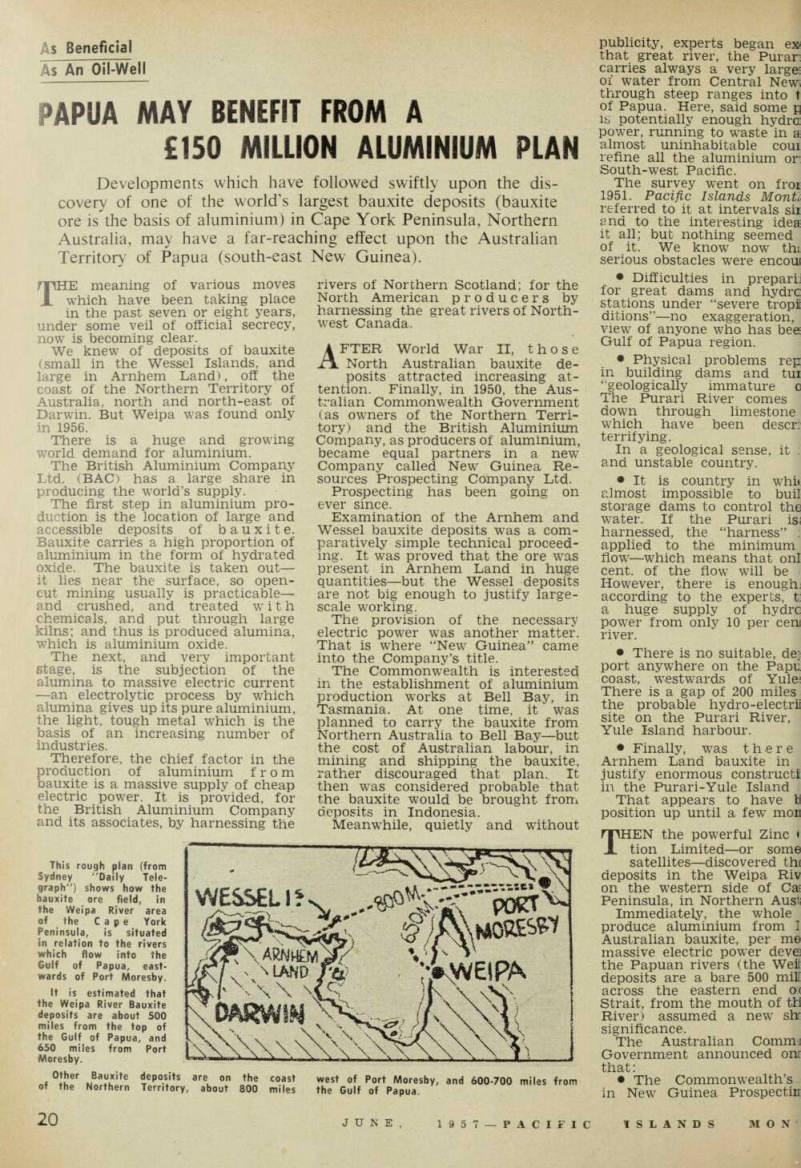
This rough plan (from Sydney "Daily Tele graph") shows how the bauxite ore field, in the Weipa River area of the Cape York Peninsula, is situated in relation to the rivers which flow into the Gulf of Papua, east wards of Port Moresby.
It is estimated that the Weipa River Bauxite deposits are about 500 miles from the top of the Gulf of Papua, and 650 miles from Port Moresby.
other Bauxite deposits are on the coast west of Port Moresby, and 600-700 miles from of the Northern Territory, about 800 miles the Gulf of Papua.
Ltd. was being sold to Con ted Zinc Pty. Ltd. onsolidated Zinc and British nium, now equal partners in guinea Prospecting Company, I continue to investigate New
a’s hydro-electric potential.”
ia 11 y, the investigation is d on the Purari River, and ler river). future surveys confirmed ex ions, those interests would d with a plan for the estab nt of a refinery for North lian bauxite, “which would over many years and would mdreds of millions of pounds.” lly, the maximum expendi nvisaged in the whole plan ot exceed £150,000,000.) lere was an assurance that ndertaking would be pressed 3 with all possible speed.” nigh the world production of ium is now 3,000,000 tons per , buyers cannot get enough Ixperts calculate that demand )duction will double every ten i be seen that, so far as the re of Papua is concerned, development may rank in mce with the oil industry— when oil is discovered, plan that now is under close ration, and which will be ed with if present indications ifirmed by closer expert in ion, consists of the following: )-electric works will be hed on the Purari River, in luitable place between the and the sea, for the produc a very large volume of elec ower will be carried by land ross about 200 miles, to a be established in the deep d water behind Yule Island, there will be constructed a ictory for the reduction of urn by the electrolytic pro port nearer the mouth of the £iver, in the Gulf of Papua, found and developed, it, of will be the site of the factory dis in turn will be 200 miles the bauxite deposits. But to date give little hope of port.) te will be mined at both Land (where there is an d 100 years’ supply) and at pa River (Cape York); re here by chemical and kiln s to alumina; and the thence shipped across Strait to the new port on f of Papua, for further re by the electrolytic process, aluminium. have been suggestions that Jtric supply required might iced in Australia by nuclear I from the uranium deposits recently in Cape leninsula), instead of in and that the hydro-electric •om Papua might be brought
undersea, across Torres Strait, to the Weipa River. But the experts de finitely wipe out both suggestions.
If hydro-electric power can be produced cheaply enough from the Purari River, and if the bauxite deposits can be worked—and both propositions at the moment appear possible and feasible—the general plan outlined above will be imple mented, and soon.
Present indications are that, with those two huge corporations (Zinc and Aluminium) in partnership and apparently eager to go on, the old Cinderella Territory of Papua is promised some startling and beneficial changes. If, on top of it, the oil industry is established, Papua’s future would appear rosy indeed.
suggestion of racial discrimination.
It is considered possible that the Government will favour a system of licensed premises, apart from the ordinary hotels, wherein liquor of specified types will be available to all classes of people. The Govern ment, in this way, would be able to maintain much closer supervision over the drinking system than is possible with ordinary hotels.
In New Guinea, Too
A somewhat similar problem has developed in Papua and New Guinea, where the more sophistica ted natives are demanding access to liquor.
The natives of New Guinea are not nearly so advanced in the social scale as the peoples of Fiji;