Resby Gaol-Breakers Keep Police,
p. 143 · Read in the full issue
[?] 't Shoot—"
Army Hopping For 20 Days
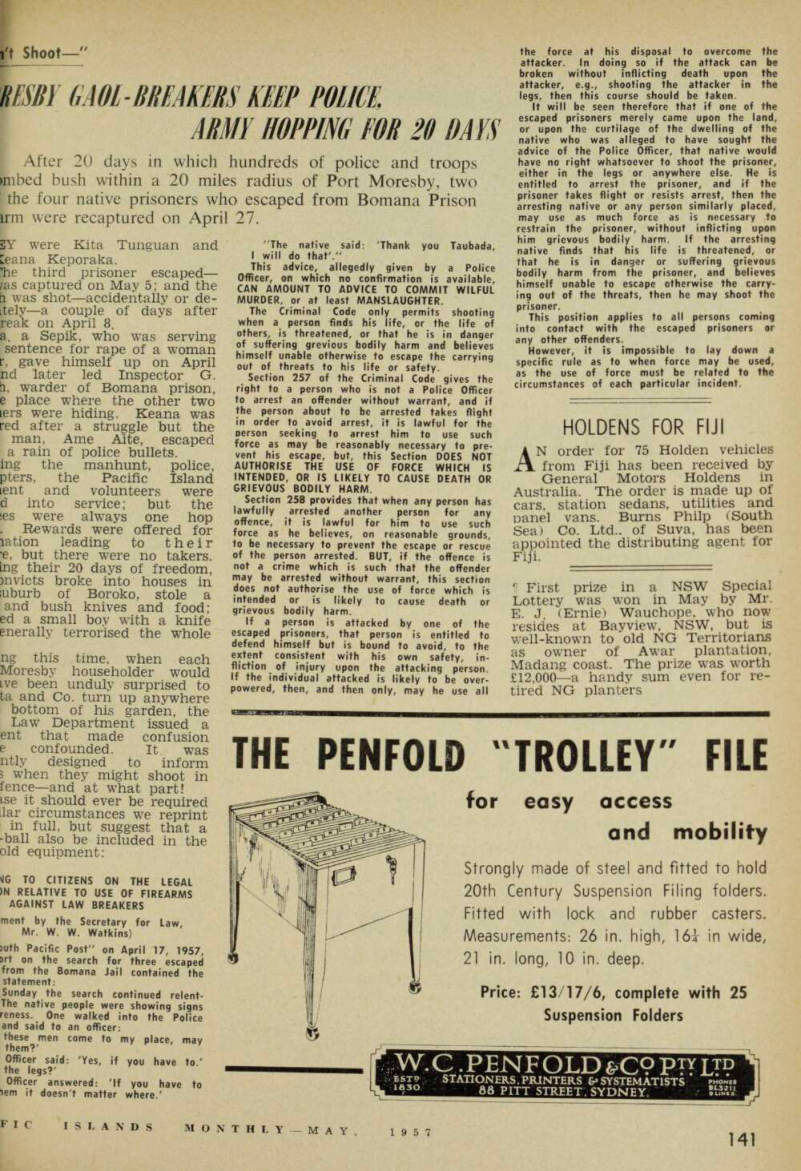
After 20 days in which hundreds of police and troops unbed bush within a 20 miles radius of Port Moresby, two the four native prisoners who escaped from Bomana Prison irm were recaptured on April 27.
SY were Kita Tunguan and [eana Keporaka. lie third prisoner escaped— fas captured on May 5; and the ti was shot —accidentally or de itely—a couple of days after reak on April 8. a. a Sepik, who was serving sentence for rape of a woman r. gave himself up on April nd later led Inspector G. ti, warder of Bomana prison, e place where the other two ters were hiding. Keana was red after a struggle but the man, Ame Aite, escaped a rain of police bullets, ing the manhunt, police, pters, the Pacific Island lent and volunteers were d into service; but the les were always one hop Rewards were offered for ration leading to their •e, but there were no takers, ing their 20 days of freedom, mvicts broke into houses in luburb of Boroko, stole a and bush knives and food; ed a small boy with a knife enerally terrorised the whole ng this time, when each Moresby householder would ive been unduly surprised to ta and Co. turn up anywhere bottom of his garden, the Law Department issued a ent that made confusion e confounded. It was ntly designed to inform 3 when they might shoot in fence —and at what part! ise it should ever be required lar circumstances we reprint in full, but suggest that a ■ball also be included in the
old equipment:
»Ig To Citizens On The Legal
In Relative To Use Of Firearms
Against Law Breakers
ment by the Secretary for Law, Mr. W. W. Watkins) )uth Pacific Post'' on April 17, 1957, ort on the search for three escaped from the Bomana Jail contained the statement: Sunday the search continued relent- The native people were showing signs reness. One walked into the Police and said to an officer: these men come to my place, may them?' Officer said: 'Yes, if you have to ' the legs?' Officer answered: 'lf you have to lem it doesn't matter where.'
"The native said: 'Thank you Taubada, I will do that'.'' This advice,, allegedly given by a Police Officer, on which no confirmation is available, CAN AMOUNT TO ADVICE TO COMMIT WILFUL MURDER, or at least MANSLAUGHTER.
The Criminal Code only permits shooting when a person finds his life, or the life of others, is threatened, or that he is in danger of suffering grevious bodily harm and believes himself unable otherwise to escape the carrying out of threats to his life or safety.
Section 257 of the Criminal Code gives the right to a person who is not a Police Officer to arrest an offender without warrant, and if the person about to be arrested takes flight in order to avoid arrest, it is lawful for the oerson seeking to arrest him to use such force as may be reasonably necessary to pre vent his escape, but, this Section DOES NOT AUTHORISE THE USE OF FORCE WHICH IS INTENDED, OR IS LIKELY TO CAUSE DEATH OR
Grievous Bodily Harm.
Section 258 provides that when any person has lawfully arrested another person for any offence, it is lawful for him to use such force as he believes, on reasonable grounds, to be necessary to prevent the escape or rescue of the person arrested. BUT, if the offence is not a crime which is such that the offender may be arrested without warrant, this section does not authorise the use of force which is intended or is likely to cause death or grievous bodily harm.
If a person is attacked by one of the escaped prisoners, that person is entitled to defend himself but is bound to avoid, to the e ?* e . n * consistent with his own safety, in fliction of injury upon the attacking person.
If the individual attacked is likely to be over powered, then, and then only, may he use all
the force at his disposal to overcome the attacker. In doing so if the attack can be broken without inflicting death upon the attacker, e.g., shooting the attacker in the legs, then this course should be taken.
It will be seen therefore that if one of the escaped prisoners merely came upon the land, or upon the curtilage of the dwelling of the native who was alleged to have sought the advice of the Police Officer, that native would have no right whatsoever to shoot the prisoner, either in the legs or anywhere else. He is entitled to arrest the prisoner, and if the prisoner takes flight or resists arrest, then the arresting native or any person similarly placed, may use as much force as is necessary to restrain the prisoner, without inflicting upon him grievous bodily harm. If the arresting native finds that his life is threatened, or that he is in danger or suffering grievous bodily harm from the prisoner, and believes himself unable to escape otherwise the carry ing out of the threats, then he may shoot the prisoner.
This position applies to all persons coming into contact with the escaped prisoners or any other offenders.
However, it is impossible to lay down a specific rule as to when force may be used, as the use of force must be related to the circumstances of each particular incident.