A Partnership In Genius
pp. 86-99 · Read in the full issue


This Month's New Reading
Conducted hy JT
fT can probably be said that, in the I military sphere, the master of tactics captures the public mind
and imagination; whfle. the Jester
of grand strategy remains obscure, almost unknown to the multitude.
So it would appear, at all events, from the history of World War 11.
The names of the great battle Generals, Alexander, Montgomery.
Eisenhower and Mark Clark, remain v?sh in the memory. The name of a man, who probably above all others, influenced and ! ha Pf course of the war, was, at best, dimly remembered.
We can use the word “was” ad visedly, in this case. Since the re cent publication of Sir Arthur Bryant’s brilliant war bi°graphy and nstorv The Turn Of the Tide, ”ield-Marshall Lord Alanbrooke is one of the best-known men of the War II generation. This book has done more for him in the publicity sense than all the very considerable honours heaped upon him at the end of the conflict.
Bryant’s book is based firstly on Brooke’s private diaries: secondly, an autobiographical notes supplied bv Brooke to the Royal Regiment of Artillery, with which he was early associated.
Bryant himself supplies the literary cement that incorporates these extracts into a free-flowing narrative that covers the period be ween the outbreak of war in 1939 and the surrender of Italy m 1943.
Soon after the outbreak of war m September, 1939, the British Ex- Tieditionary Force left for France. Its Commander-in-Chief was Lord Gort; his two Corps commanders were Sir John Dill and General Alan Brooke. Brooke therefore was in a first-class position to size up possibilities during the nine months of the Phoney War, and when in May. 1940, the Germans outflanked the Maginot Line and advanced on the Allies across Holland and Belgium, he was not unduly sur prised by either the technique of the hlitzkreig, or by the unpreparedness of Belgium, or by the low morale of the French.
The Germans reached the coast on May 21, and swiftly turned north to seize the Channel Ports. By the night of the 25th, only Dunkirk re mained in Allied hands, and a 35mile breach in the Allied lines lay wide open to the Germans to the north of the British lines on the Franco-Belgian frontier. Through this gap the Germans were poised to pour, threatening the retreat of 250,000 British Regular Army troops —and, more vital, threatening also to deny to Britain her future leaders in the field that were to turn the tide of war in North Africa, Italy, Burma and, after D-Day, in Europe.
That these men escaped German prison-camps to fight another day ; that the British army reached the coast at Dunkirk to be rescued by the Navy and the amateur seamen of England, is attributed mainly to one man, Alanbrooke.
In the four critical days between the collapse of the Belgians, and the beginning of the Dunkirk evacua tion, Brooke’s four Divisions covered the long flank left exposed by King Leopold’s surrender, while the bulk of the British army struggled back to the Dunkirk beach-head.
Within 48 hours of Brooke’s return to England from Dunkirk, he was given the task of returning to France to command the 140,000 British troops left there, and to try to bolster a fast-disintegrating Re public. To Brooke the writing was plainly on the wall in France, and at the price of some political dis pleasure, he extricated his troops before the final blow fell.
Back in the beleaguered island, he was given the task of preparing England’s defences against the in vasion believed imminent, and, at
the end of 1941 he became Chi the Imperial General Staff inj cession to Dill.
His new appointment was or eve of Pearl Harbour; the Rus were being driven back to the of Moscow; the Mediterranean closed; Malta beseiged; Ron within striking distance of C invasion of England from acroa Channel was still a possibility, "Added to that,” remarks B! in contemplating the task, was the certain trial of wa hand in hand with Winstoc handling the direction of the Small wonder then that asi as Churchill left him, after ofl him the job. he should sink t knees and ask guidance of 0 although, as he said, he waj normally an “exceptionally i ous person.”
The war now for Brooke be not a matter of battle tactics of strategy, and, with the ent America into the conflict, strategy. Disasters continued t thick and fast in 1942, but n was necessary not only to sr but also to plan for attack.
It was Brooke’s strategy North Africa should be cleared the Mediterranean reopened t Allies and that Europe shou attacked through its “soft-r belly”—ltaly.
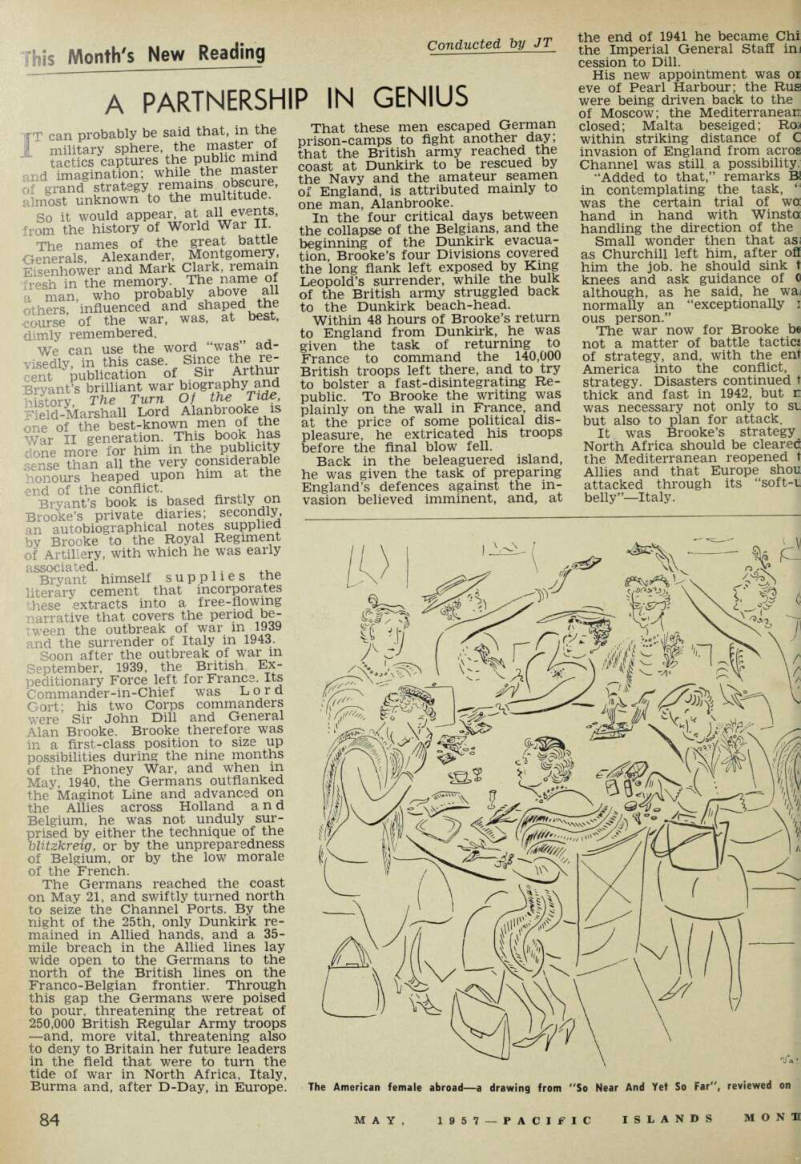
The American female abroad—a drawing from "So Near And Yet So Far", reviewed on
This strategy, as history written, paid off. But Brooke opposed in these plans, freque by his master, Churchill; and alv by the Americans who rega:j everything short of starting Second Front, merely diversion As early as 1942, when the US fo were untrained and untried, When the American war output, rudimentary, the American Cl of Staff were already arguing: benefits of settling the issue qu: by a sea-borne frontal attack German-occupied Europe.
It was also part of Bro* strategy that the conflict in Eu should be finalised before forces* equipment were diverted to Pacific. It is abundantly clear ; this book that if it had not for the Pacific-conscious Adn King, of the USA, the South Ps territories would have been lei the mercy of the Japs until such as Hitler and Mussolini were posed of, and the whole fore Allied armament was availabl roll back the Japs from as far s as Australia and New Zealand.
In Brooke’s plan of g 1 a strategy, we may have been ■ legitimately expendable, althoui. could scarcely be expected Australians rejoiced in the ide the time. This was the basis o) wave of anti-British sentiment undoubtedly attacked us here ii South Pacific in the early da: 1942.
Brooke does not say so in so r words, but one is given the: pression that he believed that tralian politicians were “squea when they insisted that AIF fc in the Middle East return ] in 1942.
AS CIGS, Brooke attended conference of World-leaj Casablanca, Washing; Moscow and Quebec. Undout the most exciting portions ol book are the passages from Bro diary that describe the meeliru these Titans, when Great N descended from their pedestals paraded all their human, it always endearing, qualities For four years, Brooke Churchill daily. His was the; of translating Winston’s intui and inspirations into hard fac; sorting out the possible from merely desirable.
Sometimes these Herculean b: lasted into the small hours a morning, and Brooke’s diary ii of resigned exasperation at master’s unfortunate habit of on all eight super-charged cyli into the a.m.
Churchill usually remained ii until mid-day. His unforti CIGS had his office routine sui as other duties, and these calk an office appearance at regui hours.
Churchill’s resilience in dis his vitality and courage wen traordinary. His health perhaps more so—best examplified pe‘ by the fact that when he, o;<
jasion, arrived in Cairo after an -night flight, he announced that had already had two whiskies 1 a cigar, and demanded a bottle white wine for his breakfast.
Jrooke describes one of his early sounters with his Chief at equers in these words; inner lasted until about 11 p.m. by the i we had finished having snuff, etc. After er the PM sent for his dressing-gown to on over his siren-suit. The dressing gown marvellous garment, rather like Joseph's robe. We then proceeded up s where he had a small cinema . . . hing Russian and German films until mid- From mid-night until 1 a.m. there was ixplanation of "Bumper exercise" which I to give ... He then proceeded to dis impending operations in North Africa and Mediterranean. Finally at 2.15 a.m. he ssted that we proceed to the hall for some wiches and I hoped that this might at mean bed. But no! He had the gramo t turned on and in the many-coloured ing-gown, with a sandwich in one hand some watercress in the other, trotted I and round the hall giving occasional skips to the tune of the gramophone, ach lap near the fireplace, he stopped to le some priceless quotation or thought. •ooke finally got to bed on that sion at 3 a.m. le CIGS frequently encountered PM’s exotic taste in dressing 's—usually when he had been moned to the morning bed-side i which Churchill conducted rs of State. On the occasion he surrender of Singapore, he been thus summoned and found
his master “propped up on the pillows in his red and gold oriental dressing gown, his few hairs ruffled on his vast domed head, a cigar sticking out of his mouth, his finished breakfast tray beside him and the bed littered with papers and despatches.”
The dragon dressing gown was, recorded Brooke, worth going miles to see.
The partnership between the far seeing, practical soldier, on the one hand, and the erupting personality and inspired leadership of the statesman on the other, was, as
Bryant has called it, a “partnership in genius” which saved Britain in her years of peril. (Published by Collins. Australian price, 37/6.)
Score Two
for Maclean
IT is much more difficult to find the words to review a book that is selling in thousands, than it is to verbally slay the mediocre or the pretentious. For the best-seller,
ie adjectives have already been ed up, inside the jacket flap, this aves the reviewer with nothing uch more to do than to state the A 1 . . . ®°- °/ Alaistair Mac Lean s The ms of Navarone, well say that it
S aoci - „
Like this writer s first book, ysses, which has sold 300,000, the ins of Navarone, leapt into the jt-seller class immediately it was ? a ,^ d , alr eady b e en m^, ny N SW by
nv?<? Z^r a ?fcoT
b f4-u Said u to 4.i? e recommendation, although this tTk r mp S hpS a^ riwln P^f liC fe. ls m S ? 5! ter u lon u of a S S o? en^ 1I l Sp i te i? fsuchaberra - IS fnnf ht! C £ y Spillane vogue.
L g ° od The' ala , human F?? 8 ,- , of Nava / one |alstothe reader s sense of exment, of imagination, and above Ko^v.Jjf lief held by mos £ of that there are some men above er men—in courage, resource, U [hp C pntp e AvS h / P ’ and wi J? i carry through ch anoears ?mno«?h]? 6 miSSlon hlS e l S f impossible. * line, not a page kj® story t J lat withmit action excitement, and one is soon in of re - admg each ence with a growing awareness urgency in keeping with the ?r° mvSff b ?f° k ‘ , .. )r myself it was a one-night
stand: dipped into late in the after noon; finished by 3 a.m The story covers four days in the lives of five men whose job it was to silence the guns of Navarone, a German-held fortress island in the Eastern Aegean. The guns guarded the approaches to Kheros, an island off the Turkish coast, where 1,200 British soldiers waited for death, or rescue. If it were to be rescue, the Navy would need to use the short route through the Navarone-Maidos channel—for time was the essence of this operation: a German landing on Kh eros was timed for six days ahead.
Aerial attempts to put Navarone’s § uns out of action had been abortive, due to the protecting rocky over hang of the island; other suicide units’ attempts had failed because the southern side of Navarone was one vast, apparently unscalable, cliff These were the five men chosen for the impossible: the leader Mallory, a New Zealander whose chief qualifications apart from thl fact that he was a magnificent sold i er ’ was that he was the world’s most accomplished rock-climber, the scaler of the unscalable. Dusty Miller, an American, “a genius with explosives, resourceful and cool, pre cise and deadly in action, regarded ... as the .finest saboteur in Southern Europe.” Lieut Andy Stevens, RNVR, navigator'of the crazy craft that was to take them
to Navarone, an alpinist of some note, fluent in Ancient and Modern Greek —but afraid of his own fears.
Petty Officer Casey Brown, first class guerilla fighter, radio operator and ex-Clydeside marine-engine mechanic. Lastly, Andre, the giant
Greek. . . “Endlessly patient, quiet
and deadly, tremendously fast in spite of his bulk, and with a feline stealth that exploded into berserker action ... the complete fighting machine . . . their insurance policy against failure.”
It was an incidental cause of some satisfaction to this reviewer' that the hero is a fellow countryman who, apart from being a super-man, was undoubtedly of considerable culture, “speaking Greek like a Greek, and German like a German,” while the only Australian character in the story, a Squadron-Leader, spoke like a refugee wharf-labourer from Wooloomooloo.
Maybe in electing a New Zea lander to the role of hero, the author intended a subtle compliment to Sir Edmund Hillary. But, in any event, on behalf of the tribe, I like wise bows.
Mac Lean’s first novel, HMS Ulysses (its first quarter million was sold within six months of publica tion) is being filmed. The Guns of Navarone is pretty certain to follow suit. (Published by Collins. Australian price 17/6.)
Was Your Journey
Necessary?
IT is a distinct contribution to human knowledge when any writer sets out to describe how a section of human-kind ticks. Emily
Kimbrough’s So Near and Ye Far comes into this cate Thanks, Emily.
The middle-aged to aged ii nationally perambulating AmeE female, solo or in packs, is or the phenomena of the modem You see them in Suva; you see
London; in Rome, Paris Johannes rg. Victoria Falls, Switzerland, hiti; anywhere, in fact, that the ury liners ply and the airlines i. >erpetually consulting itineraries thout which they do not know ;re they have been, or where they to go); figuring out the amount jhillings, lira, francs and whatnot t go to the dollar; foreheads used over the amount they should r mink stoles clutched around n, ticking off in their guide books “must” things that they have i; they move remorselessly on ig the well-worn routes, tourist ;1 to tourist hotel, back eventu to Little Rock, Arkansas or lison (Wis.), where, we presume, r sink thankfully back into ine, ritualistic pilgrimage corn ed. nily Kimbrough is one of these ititutional peringrinators, and written other books on her els. This particular story con s a visit with four college ids —now all grandmothers—to Orleans and Louisiana. As the says, so near and yet so far, Emily and friends give it the treatment. e follow them, menu by menu, . famous eating house to famous lurant; from fancy wrought work to antique shops; and out the country to stay at a famous tation house “open all year” and umerous other side excursions nmended in the Guide Books, is all-female excursion in its ae-girls-together naivete will, ourse, remain an unexplained ery to those not troubled by mass-migratory urges experi -1 by the American woman. Miss ftpugh does n(Dt attempt to ex the why of it; it is just one lose to be accepted facts of imerican way of life.
In case it has escaped you, Miss Kimbrough is the other part of the best-seller of other years, Our Hearts Were Young and Gay, in which she collaborated with Cornelia Otis Skinner. So Near and Yet So Far would have been a much better book if the partnership had been continued.
It is illustrated by line drawings by Mircea Vasiliu—a name un known in this part of the world— although the drawings themselves could be regarded as perhaps the best part of the book. (Published by William Heinemann Ltd Australian price 26/-.)
Down Among the
Frogmen
THE publication of new war books remains at the flood. Fact, fiction, stories about air war, land war, sea war—and war under the sea. Following the rule of diminishing returns to its logical conclusion, we now have one about midget submarines: Frogman, VC by lan Fraser. At the time of the exploit that won him the decoration he was Lieutenant lan Fraser, RNR Fraser has a light-hearted manner of writing that amounts to grand scale understatement. The exploits, moreover, came right at the end of the Pacific war, in July, 1945, and the dangerous task that he and his three shipmates were called upon to perform was, it transpired, unneces sary.
Fraser served the early war years m standard-sized submarines in the Mediterranean. In 1944, he volunteered for special work ’with the new midget subs and in this service found himself, in 1945, in Australia, on a Very Top Secret mission.
Air reconnaissance had shown
two large Japanese cruisers apparently floating in the sheltered waters of Johore Strait. It was be lieved that these had been turned into floating fortresses and that they would play a vital part in the de fence of Singapore should the Allies launch an assault.
It was planned therefore that two of the midgets should attempt the penetration of Jap defences of Johore Strait, attach limpet mines to the cruisers and blow them up.
The midgets, which held a crew of four in a crouched position and complete discomfort, were towed to the approaches by orthodox sub marines, and then left to their own commanders’ wits to get through the boom, and through British, Dutch and Japanese minefields, and to traverse the many miles of clear, shallow water to the cruisers Fraser’s target was the Takao, and at times the course was through water less than 15 ft deep. Through this they crept, in broad daylight, under the noses of a thousand Japs, sometimes scraping the belly of the midget on the gravel of the sea bed.
When they had at last arrived at 7 akao, it was found that both forward and aft, the cruiser was almost aground and only amidships was it possible to wedge the midget and get to work. There followed an agonising hour of tension in the confined space of the foul-aired sub white the Navy frogman Magennis left by the wet-and-dry compart ment and fixed his mines, setting them to explode six hours later When he finally rejoined hi s mates and it was time to go, it was found that Takao had settled on them in the falling tide, and it was impossible for them to either back out or go forward. They pumped water, blew water, revved engines. (Over)
no avail. They appeared stuck ti there on the bottom of Takao i the limpet mines. The mines Id not be “shut off”—any inter nee would have exploded them lediately. They thought of wait in the midget until half an hour re the explosion, when it would lark, then abandoning ship and ag to seek refuge in the neigh ing mangrove swamps. Then, q all seemed lost, with a final •t, the sub floated free. The age back to the boom-gates was e to the accompaniment of the 1 near shaves and alarms, but were able to pass through the 5 unseen before they were shut he night, and by midnight, had e contact with their mother larine. bsequently it was found that impet mines had blown a large in the side of the ship—but ;ry little avail. It was learned at the time of the attack there been only a skeleton crew on o for the very good reason that had been written off by the long before, following an earlier orpedo attack. reconnaissance pictures did [how this; nor did they show real state of affairs after r’s first excursion. It was n that some damage had red —but not enough. He was Bd to make a repeat visit, this to finish the task. While he
was preparing for this in Borneo, and sweating at the thought, peace in the Pacific was mercifully de clared.
Fraser and his shipmates were re cuperating in Sydney when it was announced that he had been awarded the Victoria Cross. One of the first messages of congratulations was a telegram signed “Henry.” Fraser could not remember any Sydney friend of that name and it was some time before it was realised that the message was from the Duke of Gloucester, then Governor- General of Australia, and to whom Fraser had demonstrated his midget sub in Sydney Harbour some time before. (Published by Angus and Robertson, Ltd.
Australian price, 21/-.)
Love
DESIGNED especially for the lend ing-library trade, Daphne, (Barbara Collard), is what is popularly called a “woman’s novel.”
There is the orthodox number of shattered lives, a beautiful soft female who loves unwisely the kind of men given to flitting.
The dissection of a lot of no hopers. But as an ever-increasing number of people come into that category, we can say with truth; That’s life! (Published by Peter Davies, Ltd. Australian price, 15/6.)
Pie in the Sky
MR. MAX CATTO, a gentleman who has more imagination than is good for anyone, has called his latest opus, Gold In the Sky.
Gold in the Sky was the name
of an American airliner which crashed in a Congo swamp on a Aight between Khartoum and Johannesburg. All very credible.
The imagination takes over from th The glutenous swamp, in the middle of Congo jungle, was such that the airplane (the hero , American) was not damaged. The passengers were got out and leit for more salubrious parts, threatening action for damages, but physically intact. „ ..
Experts come from across the Atlantic, to look at the swamp, to look at Gold in the Sky nestling in it; to look at the forest; but to shake their heads.
Gold in the Sky was pronounced unsalvable. Presumably the airline company or its underwriters wrote off the whole $700,000 of her value Enter an English professor and his geologist daughter, Stella; also Dennis, an Amerigan geologist look ing for uranium but down on his luck. , „ , , They all meet around a small bush pub, run by a Belgian and his wife who turn out, if you can believe it (and we, knowing a lot about tropical bush pubs, don’t). the most delicious French-style food.
Stella and the Professor conceive the idea of buying the airliner (it was going for a song) and by force of will and damn-all else, dragging it across country and down-river 600 miles to Entebbe, where it would again be worth $700,000.
By devious means, Dennis is in duced to join the expedition, to supply the engineering know-how and, if they deliver safely, to take one-third of the pro Ats.
Now, although the trans-Atlantic experts had proved to themselves that it was impossible to get Gold in the Sky out of the swamp, Stella
and Co., found singularly little* Acuity in doing just that, with aid of an old truck, borrowed a local Indian trader.
Nor did they experience Acuity in getting the local! habitants to cut an avenue s the length and proportion ot Champs Elysee from the swam
e river which very conveniently •wed in the direction of Entebbe Now, one might have thought that ,ving hacked down this avenue in e jungle so that it was possible tow a giant airplane a couple of les, it would not have been very ich more difficult to make an equate strip from which the air ift could be flown off.
But no—Stella and Co, do things * hard way. Gold in the Sky is ;ed with pontoons, hitched to an Jient launch and towed, although y this should be necessary, heaven jws, as the river flows in the ection they want to go. To ady the whole caboodle, huge igs of Africans are engaged to ceed along each bank, with guy es. he difficulties these natives must ;e encountered, staggering along iver bank attached to an aero be about the size of a Super istellation, encountering the kind growth that river banks in atorial Africa produce, is some ig to fire the imagination. How the reader is left to fire it, if vishes. The author does not help his department, confining most he narrative to the clash of wills personalities between Stella and nis. lis equatorial river upon which ' glide is, moreover, a most ex rdmary stream. Apart from the that 600 miles from its mouth ireds of miles from tidal influ - , its banks grow mangroves , it 5 serenely across the country jungle and savannah, without ck, a rapid or a waterfall, sally river and Gold in the 5 come to the parting of the , at a point where many miles igh-plam are still between the I and Entebbe. The veldt, we ;old, stretches huge and brown aat, punctuated by an occasional i bush, quite 60 miles to the on. t is this the spot where Gold e Skies takes again to her own mt? No. Another truck is ned and behind it the huge ilane waddles forward once , finally entering the front of the airport. Operation com perhaps not quite. Stella and is initially hated each other’s and this antipathy is the •lying theme of the story. How the old-hand is not fooled by and no doubt is without sur when we leave the pair cosily ier in bed in Entebbe.
J 0/ e . d ) by Wm ‘ Heinemann - Australian
rican Way of
-Type II
SRICAN life has more angles ian a polygon. There are no ink stoles in The Colour of ; <by Lenard Kaufman); the ' 18 on small town respect • And, although in the end
Pa gets out his gun, it is hard to reconcile the facts that the gangster dom of some of the American stories we have read recently, and the public morality of a small town m Virginia can possibly exist on the same continent.
The theme of this story is jealousy —mle jade and emerald varieties.
All belong to spoilt-boy Leon Martin who wants to marry Stella Blunden, firstly because she is beautiful; secondly because she is engaged to Harry Williams; thirdly, and most important, because he felt that it would annoy his family who had arranged for him to marry someone else.
Leon’s jealousy is not of the °°W° n ° T r . garden kind, but psycho pathic. If he were not the char acter in a book and the pivot on
which the plot turns, he would be regarded as just common crazy, first stop the reception-house.
Stella and Harry marry, and to escape the wrath of Leon, flee from Flatbush, New York, to a town in Virginia. Harry gets a job selling second-hand cars and they furnish an apartment on the time-payment system. But to no avail. Along comes Leon, hot on the trail, privily seeks out Harry’s employer and neighbouring apartment holders and tells the tale: Harry and Stella are living in sin; Stella is really Leon’s wife.
The reactions are immediate.
Harry s boss sacks him on the spot and takes the trouble to warn every other employer in town that Harry is a moral delinquent, a 100 per cent, business risk. Neighbours
ive to present Bibles, suitably jked at passages about adultery, rhe ingredients of a good story not have to be within the ,der’s own experience, but it is tty difficult for a British reader imagine a situation where a per i is hounded out of a town of 100 people, every avenue of ployment closed to him, simply ause some villain alleges that he living with a woman without efit of clergy. It becomes even •e incredible when the victim has umentary evidence to prove that •ything is on the up-and-up. pparently American citizens exist lout the protection of the laws slander. A lawyer explains to ry that even if Leon could be isted on a technical charge of arbing the peace, they would j a tough fight, especially if a had a smart lawyer on his And even if Harry won, at t half the worthy citizens of inia would believe the verdict ig, on the principle that where e is smoke there’s fire, rhaps the most startling thing he novel is the description of •y aged 32 as ageing, middle „ greying and bald-headed, en allowing for the undoubted irs of life in the United States, seems a bit severe. Remind d fill in our application forms he Old People’s Home. 18/9) by Peter Davies Ltd ‘ Austra,ian