Bui Suva’S Small Ships Saved The “Norbry[?]
pp. 80-81 · Read in the full issue
Their Size Surprised the Captain—
ON the morning of April 1, early risers in Suva saw a curious and thrilling spectacle beyond the reef—a 10,000-ton steamer, weather stained, listing badly and wallowing on the end of a long tow-line.
At the other end, the sturdy little Suva ship Ratanui, of 250 tons, slowly and patiently, at li knots, struggled along with her inert burden.
The crippled Norwegian tramp steamer Norbryn was on the last leg of her voyage to sanctuary in Suva.
In mid-February, the Norbryn left Victoria, British Columbia, with a cargo of nearly 2,000,000 board feet of timber, carried on deck, and 3,370 long tons of newsprint in her holds, for Australian ports.
The full story of the series of mishaps which befell the ship is not yet available. But from what is known, the Norbryn had been at sea about 30 days when fire broke out in the boiler-room, putting the starboard boiler out of action.
The crew fought the fire for about three hours before it was subdued.
With his ship partially crippled, Captain Karsten M. Reinertsen de cided to make for Suva, the nearest port, running the ship on only one boiler.
Then fire was discovered in the cargo, ’tween-decks. As the decks were completely stacked with lumber, holes had to be cut in the steel plates to admit the fire hoses. After that fire was put out, the crew stood watch on it for many days.
AFTER several days, the port boiler also failed, leaving the
ship drifting helplessly. She had no power at all — for essential work, cooking or refrig eration.
All the fresh meat on board went rotten and was heaved over board, to be ravaged by scavenging sharks, following the ship.
There was no light in any part of the ship and no lanterns or alternative arrangements. (One of the sea m e n had a candle.) Engineers worked solidly, en
deavouring to repair the port ba while Captain Reinertsen kept; owners advised of the situation The ship drifted helplessly onj broad Pacific for five days.
When it became clear that tl was no hope of restoring powe:; the ship, Captain Reinertsen goc touch with his agents in Suva, i ing them to arrange a tow.
THERE are no sea-going tugi; Suva. At the end of last y the Oliver Mac, a sea-going; which had been lying idle in £ Harbour for years, was sold.
The only ships available for job were the Ratanui, of 250 ti and the Yanawai, 225 tons, skippi by Captains Lumsdale and Sm:.
The position of the Norbryn given as about 40 miles nortM Round Island, in the Yasawas, al 100 miles from Suva.
So the little ships set out.
Ratanui reaching the Norbryn p.m., on Thursday, March 21, the Yanawai later.
Meanwhile, aboard the Norb a leak occurred in the oil sto< tanks, and the oil poured into port bilge.
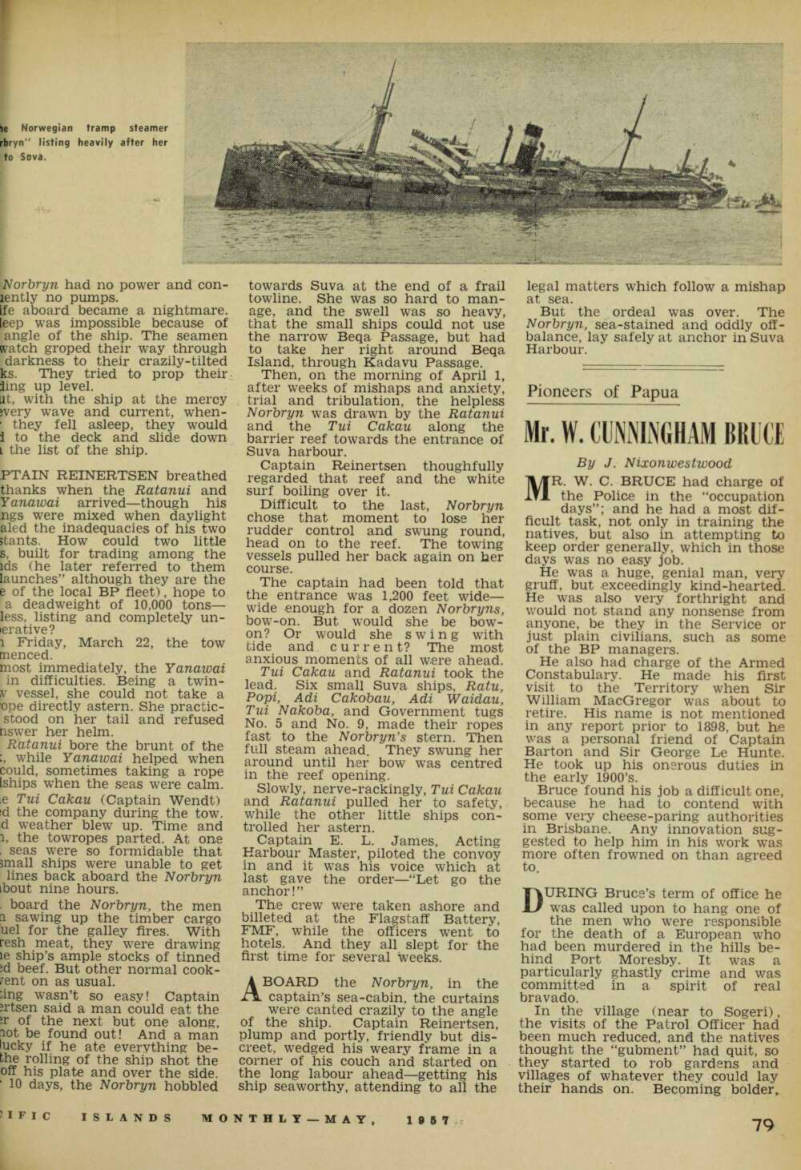
Gradually, the Norbryn begai. list to port—just a little, then ri and more. At the time the commenced, her list was estimj at 16 degrees. When she reao Suva, it was nearer 30 degrees Captain Reinertsen said that; leak was not in any way associi with the fire. It was just om those things, which would have 1 dealt with in the normal way—
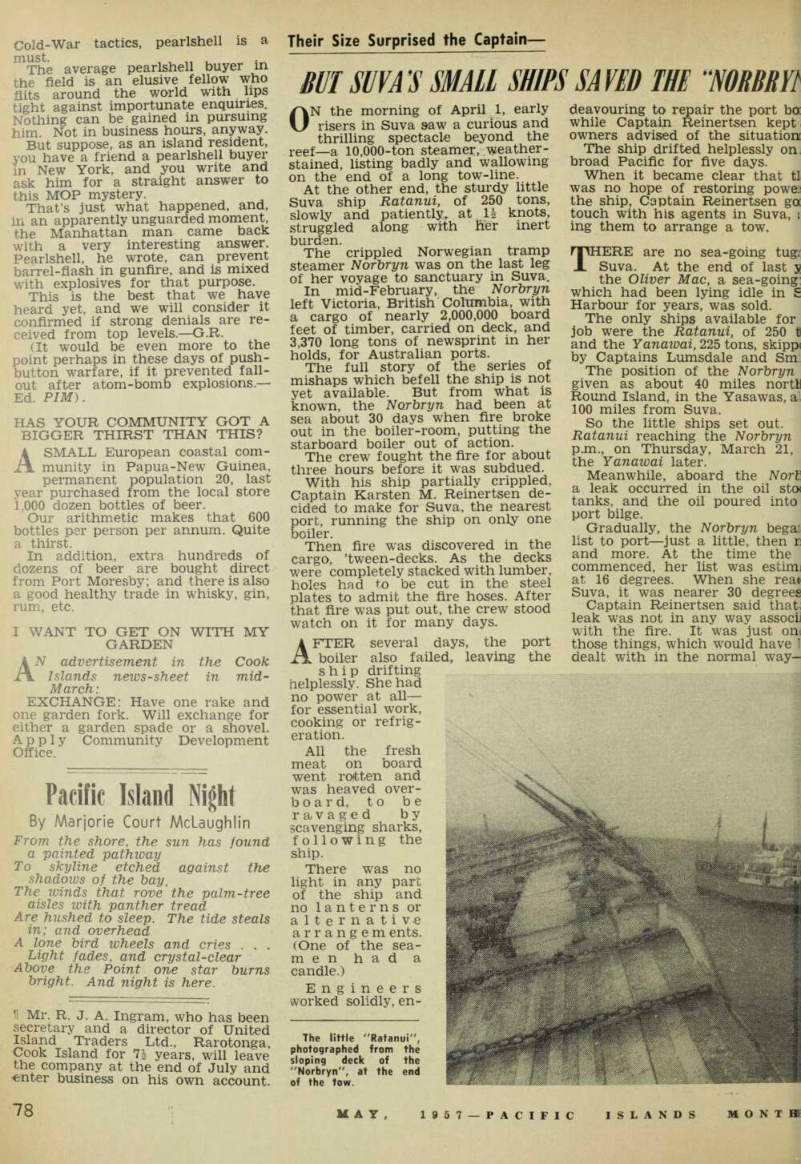
The little "Ratanui", photographed from the sloping deck of the "Norbryn", at the end of the tow.
Norbryn had no power and con lently no pumps, ife aboard became a nightmare, leep was impossible because of angle of the ship. The seamen watch groped their way through darkness to their crazily-tilted ks. They tried to prop their ling up level. at, with the ship at the mercy ‘very wave and current, when l they fell asleep, they would 1 to the deck and slide down i the list of the ship.
PTAIN REINERTSEN breathed thanks when the Ratanui and Yanawai arrived—though his ngs were mixed when daylight aled the inadequacies of his two stants. How could two little s, built for trading among the ids (he later referred to them launches” although they are the e of the local BP fleet), hope to a deadweight of 10,000 tons — less, listing and completely un erative? i Friday, March 22, the tow menced. most immediately, the Yanawai in difficulties. Being a twin v vessel, she could not take a ope directly astern. She practic stood on her tail and refused tiswer her helm.
Ratanui bore the brunt of the :, while Yanawai helped when could, sometimes taking a rope [ships when the seas were calm. ,e Tui Cakau (Captain Wendt) id the company during the tow. d weather blew up. Time and i, the towropes parted. At one , seas were so formidable that small ships were unable to get lines back aboard the Norbryn ibout nine hours. board the Norbryn, the men i sawing up the timber cargo uel for the galley fires. With resh meat, they were drawing le ship’s ample stocks of tinned ;d beef. But other normal cook fent on as usual. ;ing wasn’t so easy! Captain srtsen said a man could eat the * of the next but one along, lot be found out! And a man lucky if he ate everything be the rolling of the ship shot the off his plate and over the side. ■ 10 days, the Norbryn hobbled
towards Suva at the end of a frail towline. She was so hard to man age, and the swell was so heavy, that the small ships could not use the narrow Beqa Passage, but had to take her right around Beqa Island, through Kadavu Passage.
Then, on the morning of April 1, after weeks of mishaps and anxiety, trial and tribulation, the helpless Norbryn was drawn by the Ratanui and the Tui Cakau along the barrier reef towards the entrance of Suva harbour.
Captain Reinertsen thoughfully regarded that reef and the white surf boiling over it.
Difficult to the last, Norbryn chose that moment to lose her rudder control and swung round, head on to the reef. The towing vessels pulled her back again on her course.
The captain had been told that the entrance was 1,200 feet wide — wide enough for a dozen Norbryns, bow-on. But would she be bow on? Or would she swing with tide and current? The most anxious moments of all were ahead.
Tui Cakau and Ratanui took the lead. Six small Suva ships, Ratu, Popi, Adi Cakobau, Adi Waidau, Tui Nakoba, and Government tugs No. 5 and No. 9, made their ropes fast to the Norbryn’s stern. Then full steam ahead. They swung her around until her bow was centred in the reef opening.
Slowly, nerve-rackingly, Tui Cakau and Ratanui pulled her to safety, while the other little ships con trolled her astern.
Captain E. L. James, Acting Harbour Master, piloted the convoy in and it was his voice which at last gave the order —“Let go the anchor!”
The crew were taken ashore and billeted at the Flagstaff Battery, FMF, while the officers went to hotels. And they all slept for the first time for several weeks.
ABOARD the Norbryn, in the captain’s sea-cabin, the curtains were canted crazily to the angle of the ship. Captain Reinertsen, plump and portly, friendly but dis creet, wedged his weary frame in a corner of his couch and started on the long labour ahead—getting his ship seaworthy, attending to all the
legal matters which follow a mishap at sea.
But the ordeal was over. The Norbryn, sea-stained and oddly off balance, lay safely at anchor in Suva Harbour.
[?] e Norwegian tramp steamer [?] rbryn" listing heavily after her to Sava`.