Pacific Shipping And Cruising Yachts
pp. 59-113 · Read in the full issue
[?]is Month's News of—
Ok Islands Ship-Owners
Have Many Problems
ae name of Cook Islands ship er Dick Brown has become ast synonymous with marine sters since he went into the ship ; business with vessel number -the schooner Tahitienne —soon r the war. hitienne, Karoro, and Mahurangi \ successively ended their days !I waters—but the Brown Line seen good times, too, and each has been promptly replaced, Brown now owning the Fiji ketch Taveuni and managing smaller English-built ketch In iok Islands shipping troubles be set down in the main to ;ulty in obtaining qualified and ble engineers for service in
the seismic wave from an earth quake in the far North Pacific swept into the “harbour,” causing her to part most of her lines and swing across onto the reef on the west side of the harbour. Luckily the ketch floated off on the next surge, though leaking. She shifted to Avatiu harbour, half a mile away, to clear the jetty for Taveuni.
Taveuni arrived back and stripped down her motor. Then on March 14 came news of another North Pacific earthquake. Inspire hastily took Taveuni in tow to the leeside of Rarotonga—but no wave arrived.
Taveuni was returned to Avarua jetty. She was there with engine dismantled when, on March 16, a heavy northerly blow sprang up, bottling her in the narrow harbour.
All available lines were laid out and the vessel managed to ride it
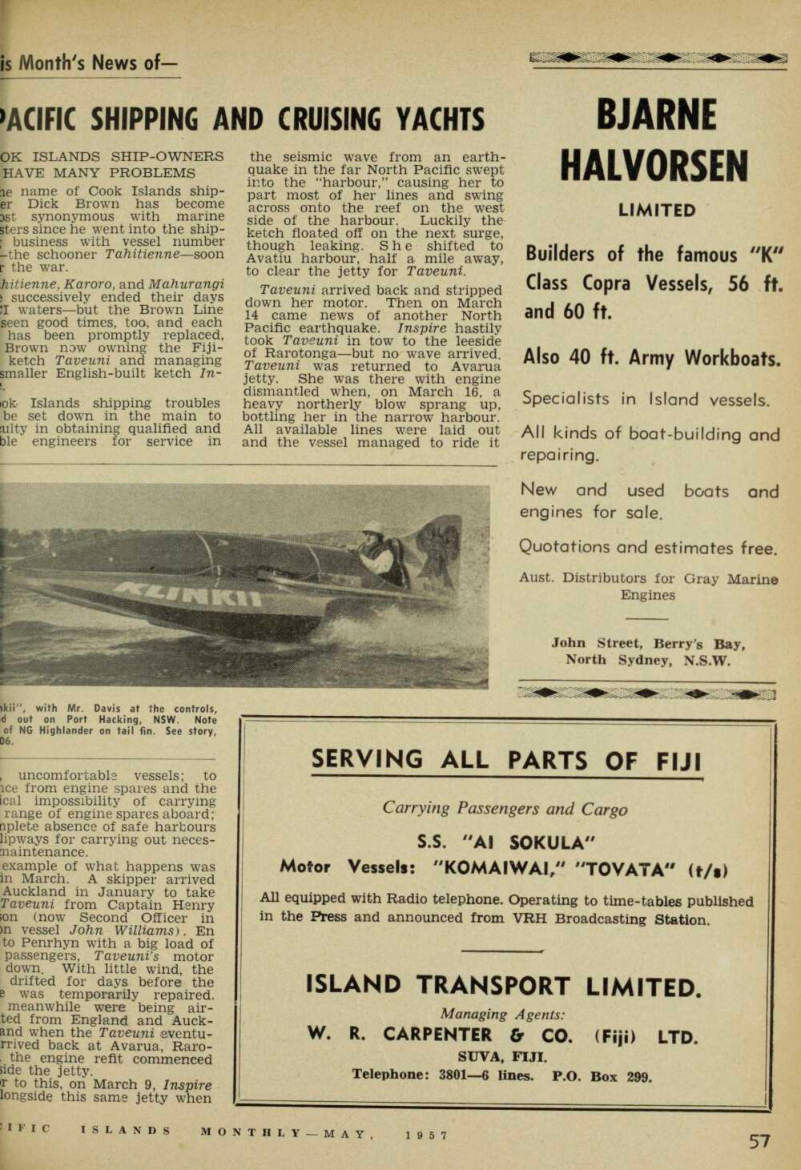
[?] kii", with Mr. Davis at the controls, [?] d out on Port Hacking, NSW. Note [?] of NG Highlander on tail fin. See story, [?] 06.
out—at the cost of many fathoms of chewed-up lines and some damage to the jetty.
The performance was repeated two days later Inspire and Mr.
John Harrington’s small ketch Manu also narrowly escaped de struction at nearby Avatiu on this da ßoth got to sea, but Inspire suf fered further damage to bulwarks by mooring lines before getting Cl After all this it was not altogether surprising that, when ordered by the Administration to take his vessel to sea, regardless of her present con dition, to clear the wharf for Maui Pomare lighterage operations, the skipper refused to do so, packed his gear, and returned to Auckland by air - Rumours to the contrary, Mr.
Brown has, in recent years, offered good money for skippers and engineers and has had some costly experiences in this direction. Life in the Cook Islands maritime service is anything but beer and skittles.
“Donkey” In Trouble
The New Hebrides Condominium ketch Don Quixote (usually irrever ently called the “Donkey Shot”, after the French manner of pro nouncing it), spent three months in dock in Noumea recently, and then sustained further damage on a rough voyage home.
The vessel left Noumea on March
28, and when 70 miles north of the island of Lifou, in the Loyalties, suf fered damage in what was locally described as a “violent tempest.”
Don Quixote turned and ran be fore the gale before finally finding refuge in Yate, on the SE coast of New Caledonia. Amongst other
damage, the ship’s radio was? molished. After minor repairs? vessel finally got away for VilJ April 3.
Merchant Navy Prograi
For seafarers who like to kee touch with shipping events ano
rpments throughout the world, BBC’s weekly Merchant Navy gramme is one source, irst broadcast on Thursdays at i GMT (Friday morning in W.
Lfic), it is repeated at 2200 GMT lays and again at 0715 GMT following Mondays, arious frequencies are used but best at present is probably one he 19-metre band on the Mon r transmission (7.15 a.m. Fiji L)
Tched In Coconut Milk
; first of the Leper Trust I yessels launched in Auckland )ril 17 by the NZ Minister for lories, Mr. MacDonald, had a of coconut milk broken over bows in lieu of the more
ional champagne,
vessel was Fauabu Twomeif, cost £N20,000, and has been ted to the Melanesian Mission prk around the Solomons and Jebrides. Two similar vessels will be completed later this ill go to the Methodist Mission le Roman Catholic Mission, launching Fauabu, Mr. Mac d is considered to have led the three ships with the ittle of coconut milk. When her two are ready for service will have no formal launch
Es About Tent Rafts
floating tent type of inflat nbber lifeboat (described and id in January PIM, pp. 99 '5), was demonstrated to Aus ship-owners and represent of maritime organisations a )nths ago and impressed most >e who saw it.
RFD Rubber-dinghy, as the stration model was called, n three sizes to accommodate or 20 people. The two smaller
types could be launched by one man; the largest required two men to throw it into the sea.
When not in use, the dinghy is packed in a valise. To launch it, a light painter is secured on deck to some convenient rail or object and the raft, still done up in its valise, is heaved into the sea.
The operating cord is pulled and gaj is discharged from a cylinder inflating the dinghy. The demonstrator informed his audience that survivors could then jump directly onto the inflated canopy and slide into the raft; or jump into the S^ er a anc * c . lim k aboard up a ladder, The floor is a double skin which is inflated manually by a bellows provided. This increases buoyancy as
well as providing insulation from the chill of the sea. Beneath the floor are rubber pockets which fill with sea water and stabilise the dinghy.
The canopy also is double skinned, thus protecting the occupants from sun and cold. Flaps at each end can be raised or lowered to regulate temperature. With all flaps lowered, it is claimed that the clothes of survivors who have been completely immersed will dry out in a very short time.
There is no means of propulsion —the whole idea of the raft being that it should remain near the area in which the vessel foundered so that survivors can more easily be picked up. (Over)
[?]old Jap wreck ("Tenyo Maru") on the [?]ear Lae, NG, which is used as a land [?]y local air pilots. Contracts have been salvage of NG mainland wrecks (see
Iiah Aids Air-Sea Rescue
new aid to air-sea rescue work jh should be of considerable e to operators of small ships ;h frequently get into trouble in nd waters, is being introduced the RAAF. imarily, the aid is designed to ne airmen who have been forced a in the sea, and the equipment esigned to fit into Mae West of lifejacket. Its total weight lbs. However, the equipment d be equally valuable on life
rafts —such as the tent-type de scribed above.
The equipment consists of a beacon with a folding aerial; and a battery with a capacity for about 20 hours of continuous operation.
The beacon contains a small speech unit with which two-way com munication can be maintained over short distances. The speech unit uses up about 20 times more battery current than the automatic trans mission from the beacon, but would need to be used only in the last
stages of rescue, anyway.
The transmission of distress signals starts immediately the sur vivor releases the whip aerial. The signals are picked up on a cathode ray tube in the search-and-rescue aircraft over a range of 66 miles for an aircraft flying at 10,000 feet. One aircraft equipped to receive these signals can cover 30,000 square miles in four hours, come haze, smoke or fog and can pinpoint a survivor’s exact position.
The equipment is called SARAH —Search and Rescue Airborne Hom ing.
Safety equipment daily becomes more versatile and more varied. But the foolhardy still continue to put to sea with no more emergency gear than the Pilgrim Fathers took with them aboard the original Mayflower.
Goya Henry In Hospital
Captain Goya Henry, of the P-NG Administration vessel Thetis , is in hospital in Lae with a shattered thigh—result of a slamming door on board his ship while in Madang.
Japanese Load Scrap in NG
About 3,500 tons of scrap metal were loaded on to the "Esutoro Maru" in P-NG recently.
New Guinea Metals, Ltd., who are export ing the metal to Japan, expect that about three more trips - lifting 10,000 tons - will about clean up their scrap. At £27/10/- for highest grade ferrous metal and up to £200 for non-ferrous metal, that makes pretty nice money in anybody's language. The "Esutoro Maru" (above) under Captain Atsuta and with an all Japanese crew, loaded 2,130 tons at Finschhafen, over 400 tons at Lae and 1,000 tons at Samarai.
He is expected to be out of cir culation for about three months.
Capt. Henry has many claims to fame: one being that, like the also famous Douglas Bader, he has a.
“tin leg” and was the victor in a war with authority over retention of a commercial pilot’s licence. He was the first qualified Australian commercial air pilot and instructor with this alleged disability.
However, in the post-war he has returned to sea-faring, in the NG coastal fleet. , . .
He began his life of adventure at the age of six when he rescued another small boy from drowning at Grafton, NSW. For this he was awarded the Royal Humane Society s Silver Medal. , Swimming is in the Henry family.
Goya won his Blue for it at Sydney Uni.; and a brother, Ernest, repre sented Australia at the Olympic Games in Paris in 1924. .
Captain Henry served in sail m his youth—at one time on the American six-master E. R. Sterling.
Unidentified Ship Calls For
Help, Disappears
On March 6, Honiara radio re ceived a distress call from an un identified vessel to the effect that it had engine trouble and would be unable to reach port in the New Hebrides.
Air-Sea Rescue was alerted and inquiries made from Sydney,
Noumea and the Hebrides for any vessel which might be in NH waters —all without result. No ship has subsequently been reported missing and nothing has been heard from the ship responsible for the message.
This kind of irresponsibility comes into the same category as the send
ing of hoax messages over the . tralian Flying-Doctor neta (There was one last year; am recent weeks Australia was a convulsed over an untrace message purporting to come fro woman dying of snake-bite).
A year or so ago a, vessel in
kl Sea had a brush with a reef sent out distress signals. Almost ediately after, it extricated itself went on its merry way—but 'eniently forgot to inform the orities of the fact.
Nordlys Revisits
Rarotonga
ie lavishly appointed topsail oner Nordlys looked in at Raro a late March from Tahiti on rrand for her American owner, ;er S. Johnson, who owns the >ail schooner Tiara Maori now ng in the Cooks. rdlys was originally in service the Scripps Oceanographic In te. Captain Johnson plans to her active and shipshape on ter work, based on Papeete.
P Factory-Ship With A
Past
e of the five Japanese whaling ry-ships now making their way to Japan from the Antarctic b Nisshin Maru. It is interest ;o recall that this vessel gave lies to the German raider et in the Antarctic late in Feb r, 1941, soon after that raider destroyed the Nauru phosphate nations, er completing that bombard in December, 1940, Captain Kruder, of Komet, received ed instructions from Germany south and destroy any allied ing ships that could be found.
Jre Komet met only the Nisshin ■ whaling fleet and received lies before heading for Kcr
guelen Island to refit in a quiet bay and take on food and ammunition from a German supply ship, before continuing on to sink more ships in the Galapagos area.
Micronesian Fleet
Addition
News comes slowly from Micronesia and only now have details of thp T 1& n q Trnnnvt Export Co.’s new Mieco Queen come to hand. Specially built in Hongkong to serve the co-operative company’s routes between the 34 islands of the Group. She is a single-screw steel vessel of 228 tons gross with machinery and accommodation aft and a Single long hold
served by single derricks at either end.
She carries a crew of 12 and was under command of the company’s Captain Leonard de Brum on her delivery voyage last year.
The company also owns the former Tasmanian schooner Milleeta, 5 F Guam, m 1955. The letter coinpciriy purchciSGcl the ne ( T r . from Tasmania about six years ago. n twtattwq -rr
Oliver Mac Makes It
The steam-tug Oliver Mac (formerly of the WRC Fiji fleet) finally arrived in Hongkong on
(Continued on Page 102)
[?] Folke Hillerstrom, managing director of [?]iaktiebolaget Helsingborg, owners of [?] alia-West Pacific Line, on board MS [?]s" at Lae. Mr. Hillerstrom, son of the [?]er of the ship-owning company, has visiting the company's agents in Aus [?], will visit Rabaul and Honiara, returning [?] weden via New York and London where xpects to arrive by the end of May. It [?] seventh visit to Australia and his second [?]e. In Helsingborg, Mr. Hillerstrom looks the Imperial War Graves Commission's [?]of 46 graves. The graves are those of [?]alians, Canadians, and South Africans, were members of the RAF. Mr. Hiller [?] visited Lae War Cemetary while he was [?]e and was greatly impressed with the [?]fully kept surroundings. (See page 105).
April 5, five months after leaving Noumea. . . .
Oliver Mac was sold last year to M. Jean Hagen, of New Caledonia, who immediately readied her for her last voyage to the East, towing the ancient Loyaute loaded with scrap. Captain R. T. Hamilton was in command and it was expected that the vessels would reach journey’s end before New Year.
However, bad weather, and short age of coal due to bad weather, de layed proceedings considerably and Oliver Mac and her tow spent a couple of months in Rabaul ( PIM, March, p. 57).
The New Caledonian crew of 30 has now arrived back in the Colony by air.
News Of Cruising Yachts
• SOLACE, 33-ft English ketch, which arrived back in New Zealand waters from the Cooks late De cember, cleared Auckland again April 1 in continuation of world cruise. With Lieutenant-Commander Victor Clark, RN (Retd.) is West Indian Stanley Mathurin, Don Whale, of NZ, and Nakau Marsters, of Palmerston Island —where thd yacht was wrecked then rebuilt several years ago. Solace heads first for the Cooks, then will turn back westward along the usual circum navigators’ route. Plans are to reach
England by August, 1958. ® TAIHOA, of Auckland, 47 days out from Bora Bora, reached Hilo, Hawaiian Is., on January 22, re mained there 8 days, then continued on to Honolulu, leaving there April 6 for US Pacific coast. Bob Fenton and Gunnars Dambe man Taihoo. • ZONDA 111, of Argentina, still
lies at Auckland with the Enr yacht Diana. Carlos Paiva, of Zl 111, has transferred to the A land yacht Imatra —earlier rep«i as sold to a Papeete owner. I May reported sold to Mr. A Rusden. • YANKEE, Irving John famous topsail schooner, vr
)tonga early April for the first in her 20-odd years of globe ing with paying guests. Present ilement is 23, hand-picked by ister mariner. Johnson’s maxi i allowance for Tahiti is 5 days, mid lotus rot. The Yankee has iputation for keeping a close iule no matter how remote her 7 colourful ports of call. She ue back in her home port, cester, Massachusetts, at 11 a.m. 7, 1958. Note the hour. She i a great picture as she de id Rarotonga in April under full is for Aitutaki, Palmerston, Tonga and Suva. Yankee is illy sold and this is likely to be ast world circuit, iter in month, Yankee arrived iva with polio case on board vas put in quarantine; see else ; this issue). jAMERHAK lI. —A late April r to PI M’s Sydney office was oseph Havkins, of Israel. Busi- To take us to task for a para t we published in September, wherein we said that the yacht flying the Egyptian flag, ugh it might have been re d as a slip in the type at the (and the rest of the paragraph Mr. Havkin’s nationality) he is that in view of recent events ild almost be regarded as a Havkins is an Israeli and re himself as a wandering am ior for the Jewish people. He ® that he landed in Australia 7/10/- and since then the local i community has taken care n and will also pay his air jack to Israel. He will leave y about mid-May and, so he hitch-hike to Darwin, flying iel from there by stages. When home he will get a job as a n for a year until he has i money to come back to Aus
tralia to continue his voyage. When asked why he simply did not stay in Australia and get a job he said he had to renew his contact with Israel.
Lamerhak II is being taken care of by the Cruising Yacht Club, at Rushcutters’ Bay, Sydney. Mr.
Havkins says that when he and his 23-footer get going again they will do some of the trip overland — Lamerhak has already been hauled overland from New York to the Pacific seaboard. One of the over land treks he is contemplating is from the Cape to the North African coast (west of Egyptian territory, we presume).
He said (a joke) that he had been thinking 9f visiting the Seychelles and rescuing Archbishop Makarios;
and (seriously) that there was much sympathy for the Cypriots in Israel as they were “now going through what we have experienced.”
Doctor Sails His Home
With Him
Dr. Charles Moody, a former resident dpctor at Bundaberg Gen eral Hospital, Queensland, is now a medical missionary at the Un evangelised Fields Mission at Wasua, on the Fly River, in a remote part of Western Papua.
Not for Dr. Moody the conven tional methods of travel. He sailed from Bundaberg in his 40-ft launch Crusader 1,220 miles up the Queensland coast, then across Torres Strait, to Daru, at the mouth of the
Fly.
(Continued on Page 105)
[?]ka", which came to grief on reef at [?]r, on the Rai coast. New Guinea, on [?] 29. Local smallships, directed by [?]ng Harbourmaster, tried but failed to [?]her off, and it is understood that she total loss (see April RIM, Page 118). [?] Plantation is shown in background of Photo: H. L. Dockery.
Vith him were his son, Peter, d 16, and a missionary, Mr. K. swn, who flew to Bundaberg from lua to help Dr. Moody navigate launch up the River to Wasua. s he expects to live on the launch >t of the time, Dr. Moody has ;d it up as a houseboat. His beat be up and down the 600 miles the river to visit the mission’s
dispensaries.
V Vessel For Bsip Mission
|75-ft vessel for the Dominican iers in the Solomon Islands is ig fitted out at Berry’s Bay by rne Halvorsen Ltd. It is expected i she will be ready for departure i Sydney at end of May. Who be in charge of delivery opera -5 is not yet known, le vessel is an ex-Navy general ise type. She is now being d with a Gardner diesel engine, le new ship’s name will be Salve fin a. Official christening is duled for about middle of May.
Ing To Solve Honiara’S
Port Problems
40-ft tow-launch for the BSIP Authority was loaded on the shank in Sydney in early May. e tug was built by C. A. M. Fisher, r instructions from Captain .Kennedy, Sydney ship-brokers.
II be used mostly for lighterage in Honiara. ur 35-ft scows for the same
destination are also under order through Captain Kennedy. It is ex pected that these will facilitate the loading and unloading of cargo from overseas ships at Honiara —which has no harbour worthy of the name, and no wharf.
Macuata On Slipway
The 80 tons Macuata, owned by Burns Philp (SS) Co., which ran on a reef and was extensively damaged in early January, and towed to Suva in partly submerged condition in mid-January, was finally put on the slip for repairs in late April.
Ironbark timber from Australia was specially imported to replace the damaged keel; the vessel’s main mast which was damaged will be replaced by one of Oregon which is on order from Canada. Damage was done also to some of the ship’s frames and planks and to cabins.
Repairs to the hull are being done on the Government slipway by the well-known Suva ship-building firm of C. Whippy. This firm built Macuata and her sister ship Tavsuni for Burns Philp (SS) Co., in 1954.
Taveuni has since been sold to Mr.
Dick Brown, of Rarotonga.
Milos. Aros In Smart
Passenger Transfer At Sea
Although the Swedish vessel Milos berthed at Lae, New Guinea, straight from Manila on April 22, she had
four passengers who had been on board only 16 hours This slight of-hand was accomplished by transfer from MV Aros at Sugar Loaf anchorage four miles from Lae. The passengers, including the Managing Director of the Ans tralia-West Pacific Line, Mr. Folke Hillerstrom, wished to go to the Solomons, and as no planes were available he boarded the Aros in Brisbane. She was then north bound to Japan direct. It was esti mated that she would be off Lae
about the same time as Milosz arrangements were made to tra£ the passengers. The Milos anchored off Sugar Loaf be«; another ship was at the wha;j Lae. Aros arrived about 2 a.m April 22, transferred her passe:; and went on her way. Milos bei; at Lae at 7.30 p.m. on the same The Milos is one of a fleet ofl ships belonging to Rederiaktiebo Helsingborg, owners of the tralia-West Pacific Line. SH beautifully fitted out. and carri passengers. At Lae she lo “Klinkii” ply-wood for Australis left Lae on April 23 bound Rabaul, BSIP, and Sydney.
Salvage Off P-Ng Maine
The Administrator of Papua!
Guinea, Brigadier D. M. Cle announced on April 18 that salvage rights for recovery ofi tain Administration-owned ui water war surplus materials: been granted to a Melbourne pany, Anglo-Pacific Trading Cc Ltd.
The selection of the succ; tenderer was made after const tion of several tenders receive* eluding some from overseas cour and after examination of capacity of each tenderer to out the major work of vessel sa which is expected to continue least two years.
The Company will work L operation with a large Jap salvage organisation, Mats- Limited, and it is likely that: anese workmen will be broug the Territory to carry out d cutting and collection operatii Because of pending Court i (dispute over ownership of c; wrecks), the Administration hi. at this stage granted salvage at Rabaul, but it is expected; recovery of the salvage maten Kavieng, and Wewak will beg an early date, and progressive Finschhafen, Samara! and Miln where sunken vessels and materials are located.
Payment of royalty of up per cent, of the value of maj recovered will be made by the tractor to the Administration..
Speed-Boat From Ng I
Mr. Colin Davis, secretary • Timber Development AssociatJ Australia and a speeo: enthusiast, hopes to break the tralasian water speed record boat, Klinkii. Mr. Davis wanr build a speed-boat, and he wanted to draw attention to Guinea timber and test it extreme conditions.
Commonwealth -New Gut Timbers co-operated with hr his project, and helped him toe suitable timber.
He had Lieutenant David one of America’s topline specie designers design his craft for'; When the design arrived in
lia. Mr. Davis had it modified to I local conditions, and com igioned Mr. B. King, of Fuller’s age, Sydney, to build it. The boat i almost finished when Mr. King I to give up work because of ill- Jth, so Mr. Davis handed the over to a Norwegian, Mr. Harold :h. to finish. he entire hull, with the exception the cowling, is of water-proof ikii pine plywood from Bulolo.
' cowling is of Bulolo cedar and i veneer 1/16 in. thick. The kness of the plywood varies from [. to i in. thick, ther timber used in the frame t is Canadian Sipka spruce and tralian mountain ash. le boat is powered with a 190-hp linder overhead valve Chevrolet )r. It is 7 ft 6 in. wide, 20 ft long, weighs 1,100 lb. The maximum d Mr. Davis has attained at pt is 70 miles an hour. He has to America for an Edelbrock ersion, which will be fitted to kii during the winter. He will iron out other faults in the during the off season, len the Edelbrock gear is fitted, Davis hopes that he will be able ;tain a maximum speed of 120 i an hour, and break the exist-
ing Australasian record of 105 miles an hour, held by New Zealander Len Southward He has only ‘ had Klinkii out in
Port Hacking Svdnev so far hut will not make hS?eco?ri i-wJ * re . c 9 r ? attempt th b of restricted space.
Yankee , with all sails set, on a former visit to the Pacific (see story, page 102).
jord attempts will be made from rby Kogarah Bay.
Ir. Davis is a member of the ircastle Branch of the Royal tor Yacht Club, and the St. irge Motor Club, Sydney.
Weral Grant Still Keeps
That Treasure
5 hand this month a letter from J. Havens, who last appeared in f in January issue (p. 62), just r he and party had left Eng l in the 70 tons Gold Seeker ook for the treasure alleged to * gone down with the General nt off the Auckland Islands, h of NZ, about 100 years ago. lis was Mr. Havens second at- Dt. His first in a vessel, Absit n, in 1954, came to an end when vessel was wrecked in the Red ace the January paragraph, the ad expedition has also come to I —on Timor, during the mad ;h weather; but apparently Mr. ms is already thinking of a I attempt. He writes us, more rrow than in anger; irstly, Absit Omen was a MFV there was no syndicate which :ibuted (as PIM stated) and a considerable sum of money, whole thing was my investment loss except that my crew mem had contributed to cover their ailing for the journey. Needless y, this kind of crew frequently interest in voyages on small,
active and uncomfortable craft and after a while you never can tell when they will pack up and leave you.
“With regard to the second at tempt which ended by Gold Seeker being blown ashore in Lore Bay, Timor, and about which you have no doubt learned by now—all monies used to purchase and equip the vessel were supplied by myself. Crew members victualled themselves on the voyage out and necessity forced me, before leaving England, to raise a small mortgage on my ship. I won’t bore you with my feelings after three years of endeavour and not a little hardship, to have had so much hard luck and so little en couragement. I’ll just say that I have a feeling about the General Grant treasure and do not propose to give up my quest.
“I am 37 and a native of Sydney and not retired. In between spells at sea, I have erected batteries, stamps, mills and other installations on mines in four different countries.”
The wreck of Gold Seeker and subsequent happenings were the usual seven-days wonder in March.
By the time the expedition had reached Singapore apparently most of the original crew had had it—a fact that, as Mr. Havens points out, is not unusual under such circum stances. Some new crew members were engaged there, including a young journalist, Verity Gill, and besides Havens there were six on
board when the vessel went aground on Timor. After a day or so, Havens decided to walk across the island to Dilli to report the wreck and get help.
After he had been gone some days, the crew got restive and con trary to native advice put to sea in a 16-ft lifeboat, intending to sail round the island to Dilli. Instead they were swept out into the Timor Sea and eight days and 300 miles later they were (luckily for them) washed up on the northern end of Bathurst Island. Another eight days followed before they were found, near to death, by a couple of Australian miners.
Mr. Gill had kept a diary and immediately improved the shining hour by having it published in several instalments in a Sydney newspaper.
As he wrote it, it was all highly dramatic. But it is old stuff to old hands. All men (and some women) dream of a life of adventure on the wide blue ocean. One day of sea sickness on a small ship is sufficient to cure most of them.
New Coastal Vessel For
Papua
A vessel, name not given, was completed late in April in Brisbane lor the British New Guinea De
velopment Co., and left soon after wards for HQ in Port Moresby.
The vessel was built by Norman R. Wright and Sons, boat-builders of Bulimba, Brisbane. It has a length of 42 ft; beam of 13 ft; apd
draft of 4 ft. It is copper fau and copper sheathed and hardwood construction. The is powered by a Gardner die 74 bhp at 900 rpm.
The wheel house is immeo;
e the engine and all naviga il instruments, engine control guages have been brought up ie steering position for conveni in handling the boat. A two- Crammond radio has also been lied in the wheel-house, self-contained unit for the cap is abaft the wheel-house— ing compartment, toilet-wash-
and a galley fitted with a kero stove, kerosene refrigerator tainless-steel sink. 5 cargo-personnel carrier has modation for four native crew ilso for carrying native deck igers. It will be used on the n coast. eacher and Vocational Train •llege is under construction at a, Honiara, BSlP—but there been the usual delays, this )f steel from England. When Jted, the College will provide aming courses—one for teach d clerks; and the other for t tradesmen, such as car s. chief of the New Caledonian t bureau has been asked by itish Government to make a of the radio-activity in the •here during the H-bomb tests istmas Island. e R. V. Kay, of the Cook i High Court, returned to nga in April after four 3 leave in New Zealand. He companied by Mrs. Kay.
t Suva’s second. Hibiscus Festival will take place this year between September 19 and 23. In addition to the Miss Hibiscus contest and soap-box derby, other novelty events are being planned by the Junior Chamber of Commerce, which organised the festival last year.
Passengers who sailed for the Solomons aboard the April "Tulagi" included Misses Roth Lotze and Gillian Kimber, who were headed for Honiara to visit Miss Lotze's parents. Mr. Lotze has been with the Govern ment Trade Scheme at Honiara for a number of years.
Mr. and Mrs. W. T. Wade (right) left for Malaita where Mr. Wade will run the mission ship "Evangel" for the South Sea Evangelical Mission. Malaita residents since 1935, the couple had retired to Melbourne four years ago.
[?] e new vessel leaving Brisbane.