Extended Term For Fiji’S
p. 24 · Read in the full issue
Sir Ronald Garvey’s Difficult Task
Popular Governor
The extension of Sir Ronald Garvey’s term of Governorship by one year—giving him six continuous years of administration, ending late in 1958 —has pleased the mixed communities of Fiji.
THE extension was the direct re sult of quiet but influential representations made in recent months to the British Colonial Office.
Sir Ronald Garvey came to the Governorship in 1952 much better equipped for his onerous task than most of his predecessors. He began his Colonial Office career in the South Pacific; spent some consider able time in Fiji; and married in Fiji, over 20 years ago, the attrac tive daughter of Dr. McGusty, the Chief Medical Officer.
Therefore, he wasted no time in getting acquainted with his job, as most Governors have to do. He already knew most of what there was to know about the complex problems of the races—the em barrassments arising daily from the facts that the Fijians own most of the land, but have not learned to trade and labour in European fashion, and that the Indians are increasing 25 per cent, more rapidly than the Fijians, and already out number the latter by nearly 30,000.
There is a land problem, an inter racial problem, an industrial problem, and a whole range of social problems—all stemming from the facts that the establishment of the rich sugar industry brought about the Indian implantation in Fiji; and that Indian fecundity threatens to overwhelm the Fijians.
The Indians were introduced in the ’Eighties. In 1890 there were only 7,000 of them; by 1944, there were 113,000 Indians and the same number of Fijians; and to-day there are 170,000 Indians and 145,000 Fijians.
The British Crown, in 1872, under took to preserve the Fijian land for the Fijian people. Now, the British Administration is seeking, almost desperately, for a formula which will meet half-way the developing Indian demand for a larger share in ad ministration, a division of land rights with the Fijians, and the gradual elimination of European properties and authority from Fiji.
SIR RONALD GARVEY started at the point where most of the other Governors had ceased— namely, he knew all about the problems, but he could see no early practicable solution.
In the few years since then, his policy and his plans have become fairly clear.
He hopes to gain the confidence and the genuine co-operation of the Indian and Fijian leaders, so that they may accept the facts as they are, and try to adjust future living conditions to them. This could mean some pretty drastic readjustments regarding land usage and voting rights (to which all races may per haps agree). But, to achieve this, the Indians must forget India and accept citizen responsibilities only in respect of Fiji; and the Fijians must prepare to abandon their ancient communal village system of life, and become individualists, with a capacity to farm and trade in dependently, and to meet economic competition.
In these things, the Governor has had a good deal of success—one carl see a pattern emerging. But it is slow and heart-breaking work.
The Indians tend to stick stub bornly to the ancient cultures and religions of India. The Fijians show a similar reluctance to abandon their village systems.
GIVEN time, Fijians and Indians eventually would collaborate faithfully with Europeans in
solving their common problen world conditions are such ths is little time to be given.
Unless Fiji can evolve a wv constitution within a very fev to take care of population ini racial differences and adminis. control, Fiji is going to mees troubles.
Sir Ronald Garvey knovi and has been striving hard to. a background against whie stitutional machinery • properly designed and shap: fore it is too late.
The few people in Fiji w see and appreciate this a;j that His Excellency has bee; another year, wherein to w the task to which he applie self five years ago.
The great majority, who lii day to day in the pleasant se and do not bother about! political problems, also are g; cause Sir Ronald and Lady conscientiously but amiably ing on the duties of Gove House, are held in high i
esteem.-
Rwr.
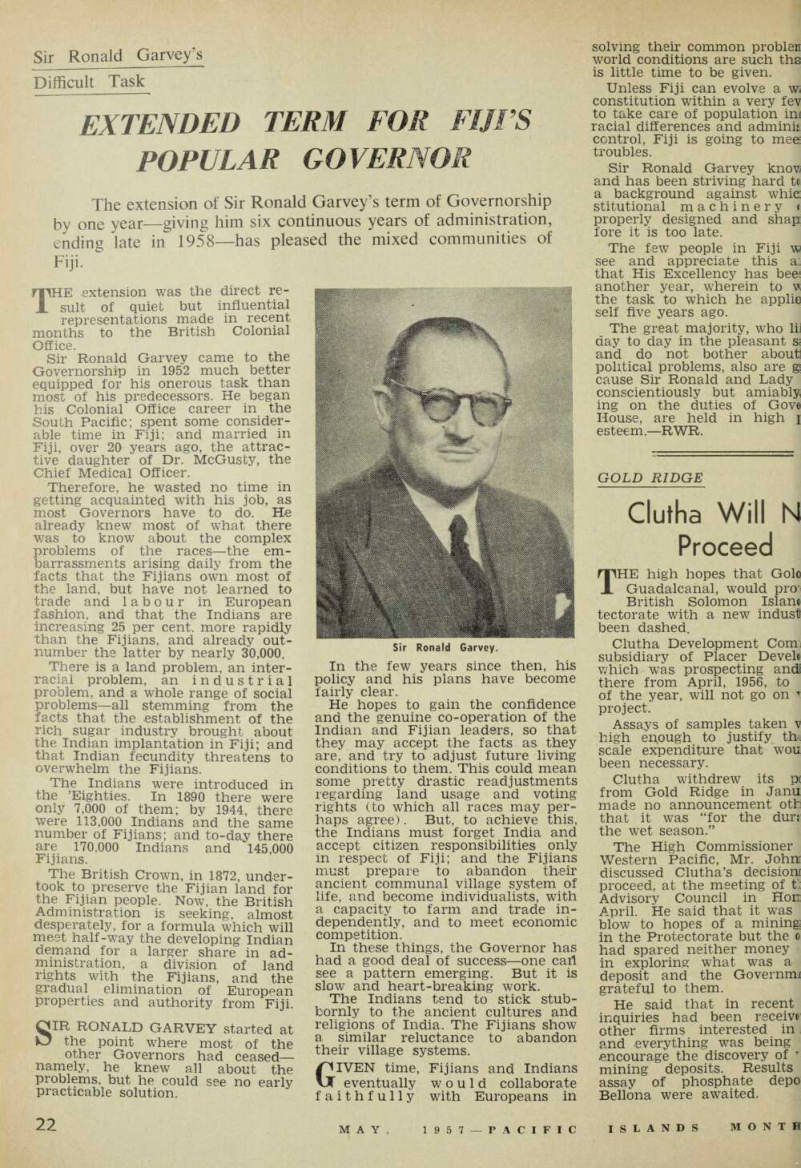
Sir Ronald Garvey.