Illegal Strike By Qabtas Pilots
pp. 22-23 · Read in the full issue
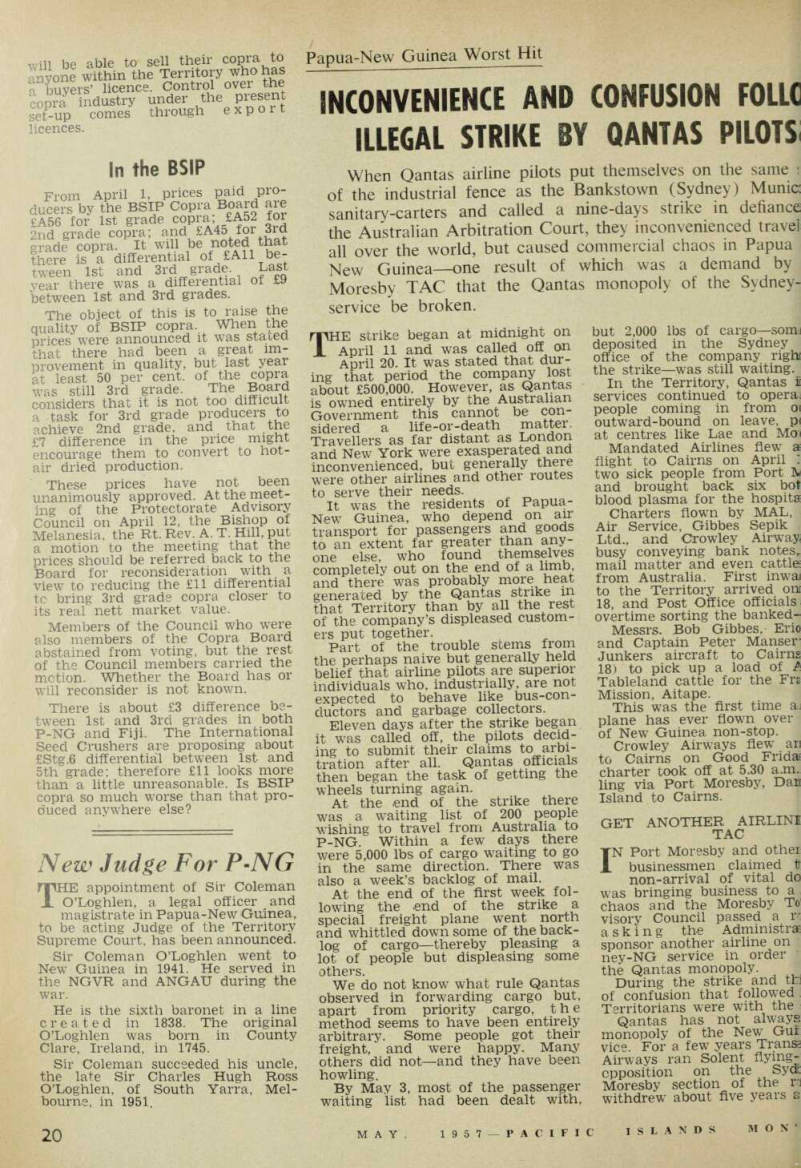
Papua-New Guinea Worst Hit
Inconvenience And Confusion Folio
When Qantas airline pilots put themselves on the same : of the industrial fence as the Bankstown (Sydney) Munkx sanitary-carters and called a nine-days strike in defiance the Australian Arbitration Court, they inconvenienced travel all over the world, but caused commercial chaos in Papua New Guinea —one result of which was a demand by Moresby TAC that the Qantas monopoly of the Sydney service be broken.
r;E strike began at midnight on April 11 and was called off on April 20. It was stated that dur ing that period the company lost about £500,000. However, as Qantas is owned entirely by the Australian Government this cannot be con sidered a life-or-death matter.
Travellers as far distant as London and New York were exasperated and inconvenienced, but generally there were other airlines and other routes to serve their needs.
It was the residents of Papua- New Guinea, who depend on air transport for passengers and goods to an extent far greater than any one else, who found themselves completely out on the end of a limb, and there was probably more heat generated by the Qantas strike in that Territory than by all the rest of the company’s displeased custom ers put together.
Part of the trouble stems from the perhaps naive but generally held belief that airline pilots are superior individuals who, industrially, are not expected to behave like bus-con ductors and garbage collectors.
Eleven days after the strike began it was called off, the pilots decid ing to submit their claims to arbi tration after all. Qantas officials then began the task of getting the wheels turning again.
At the end of the strike there was a waiting list of 200 people wishing to travel from Australia to P-NG. Within a few days there were 5,000 lbs of cargo waiting to go in the same direction. There was also a week’s backlog of mail.
At the end of the first week fol lowing the end of the strike a special freight plane went north and whittled down some of the back log of cargo—thereby pleasing a lot of people but displeasing some others.
We do not know what rule Qantas observed in forwarding cargo but, apart from priority cargo, the method seems to have been entirely arbitrary. Some people got their freight, and were happy. Many others did not—and they have been howling.
By May 3, most of the passenger waiting list had been dealt with,
but 2,000 lbs of cargo—sonu deposited in the Sydney office of the company righi the strike —was still waiting.
In the Territory, Qantas ii services continued to operaj people coming in from 0( outward-bound on leave, p< at centres like Lae and Mo:< Mandated Airlines flew r ae flight to Cairns on April I two sick people from Port IV and brought back six bot blood plasma for the hospita Charters flown by MAL, Air Service, Gibbes Sepik Ltd., and Crowley Airway busy conveying bank notes,, mail matter and even cattle; from Australia. First inwai to the Territory arrived one 18, and Post Office officials, overtime sorting the banked- Messrs. Bob Gibbes, Erio and Captain Peter Manser Junkers aircraft to Cairns 18) to pick up a load of A Tableland cattle for the Frs Mission, Aitape.
This was the first time aj plane has ever flown over of New Guinea non-stop.
Crowley Airways flew an to Cairns on Good Fridai charter took off at 5.30 a.m. ling via Port Moresby, Dan Island to Cairns.
Get Another Airlini
Tac
IN Port Moresby and other businessmen claimed tt non-arrival of vital do was bringing business to a chaos and the Moresby To visory Council passed a r asking the Administrae sponsor another airline on ney-NG service in order the Qantas monopoly.
During the strike and tW of confusion that followed .
Territorians were with the Qantas has not always monopoly of the New Gui vice. For a few years Transs Airways ran Solent flymg" opposition on the Syce Moresby section of the n withdrew about five years a
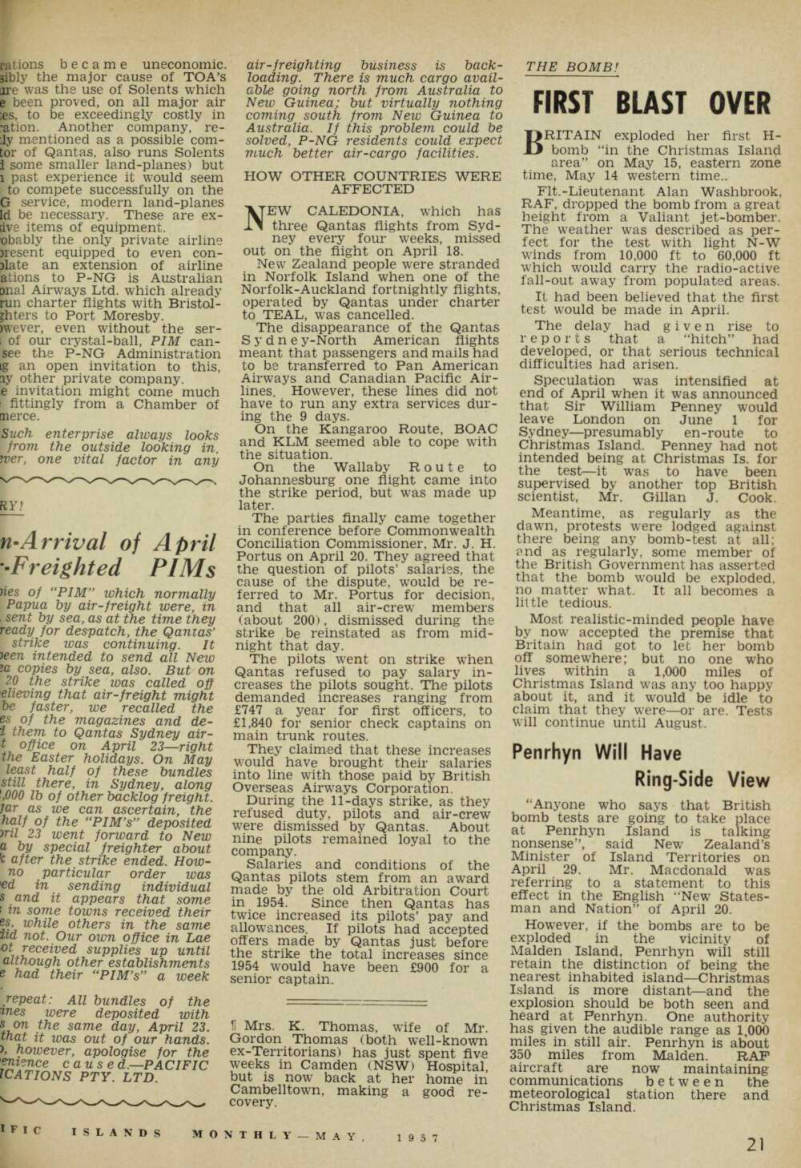
rations became uneconomic, sibly the major cause of TOA’s LU’e was the use of Solents which e been proved, on all major air ;es, to be exceedingly costly in •ation. Another company, re ;ly mentioned as a possible com tor of Qantas, also runs Solents i some smaller land-planes) but i past experience it would seem to compete successfully on the G service, modern land-planes Id be necessary. These are ex live items of equipment, obably the only private airline jresent equipped to even con nate an extension of airline ations to P-NG is Australian onal Airways Ltd. which already run charter flights with Bristol jhters to Port Moresby. »wever, even without the ser l of our crystal-ball, PIM can see the P-NG Administration ig an open invitation to this, ly other private company, e invitation might come much i fittingly from a Chamber of merce.
Such enterprise always looks from the outside looking in. roer, one vital factor in any