Editorial...
pp. 19-20 · Read in the full issue
[?]ER 1957: WHAT IS GOING ON IN THE SOUTH
Pacific Copra Industry
SRYONE with Interest in the outh Pacific Islands will note lat definite steps now are being r to create a copra marketing isation to take the place of the h Ministry of Food copra g contract, which expires on ttber 31, 1957. [ same observers may be d by the fact that the primary ■ in creating at least a British lonwealth-wide organisation is rer, the international concern I monopolistic power was so ' felt in the 1920-1939 period, whose market control was d— rightly or wrongly—for a of painfully low copra prices, ing come through eight years d prices fixed by Government , and enjoyed a standard of rt rarely experienced by them ■war days, the coconut planters >t well prepared to face the [ They have forgotten those d days of 20 years ago when product was at a starvation They feel that it just can’t i again. be they are right—maybe the >e in the world demand for it products, the result of a 1 rise in the standard of liv [ overcrowded countries, will > keep prices up. Maybe the hilever is different, in some from the 1930 Unilever, and ot or cannot control world of oil-seeds. Nonetheless, auld be wise to observe closely ves that are in progress, and ay to act according to their idgment.
IE is an old-established organ bion called the International relation of Seed Crushers as its name indicates, in millers from most of the e s where vegetable oil seeds shed. The treatment of copra nts an important section— no means the only section— industry. e-war days, Unilever domin his Association. This was —Unilever then seemed to most of the seed-crushers in mntries. It is said that this t the position now—that r. as a buyer of vegetable oil peets firm competition in the The signs indicate that >y be so Unilever is no in unchecked monopoly—but lot know this positively, ver, it is clear that Unilever fen all the initial steps to p among copra-producers ly some system of orderly
marketing, after December 31; and that this system will be based on grading. It is sought to- establish, throughout all British coconutgrowing areas in the tropics, and perhaps generally, certain standards for grading which will be upheld by the Association, so that they may become the basis of world marketing in the future, The Copra Quality Sub-Committee of the International Association of Seed Crushers has recommended that a grading system be given a six-months’ trial. It appears that the Association favours five grades of copra—the difference between Grade 1 and Grade 5 being, in value, between £5/10/- and £6 per ton. The Sub-Committee made this public statement: . x . x . , . o r a Hi„o W Vrhfm r p? d laa if u' lat,ve va L ues of grading schemes could only be assessed as a result of actual periods of operation.
"in view Of this the members decided to recommend an experiment with a suggested anaiyticai grading scheme.
"They would operate this in their mills for a period of six months in order to test its
practicability as a means of assessing the relative values of copra to the crusher.
"All members were in agreement about the advantages of Marketing Boards or similar organisations in assuring to the individual producer a fair share of any premium earned for higher quality material.
"The Sub-Committee stressed the need for encouraging the replanting of large areas in order to safeguard future supplies of copra and to ensure prosperity for the producing countries whose economy is so closely linked with the coconut palm."
SO far as the South Pacific is con cerned, the next step apparently lies in a series of more or less formal talks which will take place in London in the coming summer, between the international copra fa uye r s, and representatives of planters and traders in Papua and New Guinea, Fiji. Western Samoa, Solomons and Tonga. As indicated in April PIM, the discussions probably will begin with informal talks with Unilever men, and then they will move over to more formal meetings with the Seed Crushers Association, or its Sub-Committee.
There is much to be said in favour of the plan; but great patience will be needed in securing its accept ance by planters’ organisations, and in its implementation.
The European copra-growers in the South Seas are mostly people of independent spirit, who make good copra and who naturally are unwilling to enter into any under takings, through Planters’ Union or otherwise, which in their view may affect their freedom to sell their
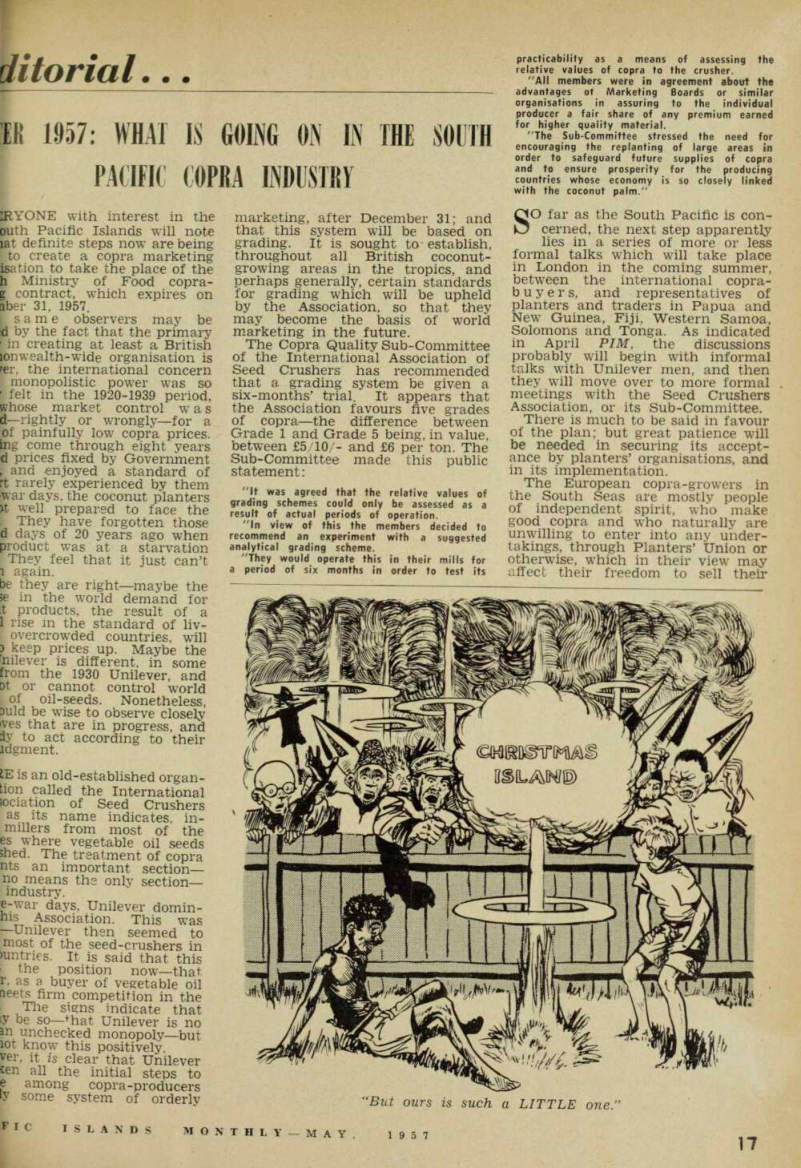
“But ours is such a LITTLE one.”
product how and when they P le^e.
There is a steadily increasing volume of native-made copra com ing in from native producers. A large proportion of this is from village oeople who know little and care less about the attainment of high grades, and who mostly sell their copra, at so much per pound, to small traders on the spot. Unless the application of the grading system is very carefully planned, it may become necessary for the Islands Administrations to ponce village copra-making—that is, if the Association’s wish for orderly market ing, for the good of the whole in dustry, is to be given effect to.
The Association, and Unilever, of course, hope to meet these con siderations by enforcing a strict system of grading through organised buying: and by establishing such a difference in price, through grading, between good and bad copra, that copra-producers will be forced by self-interest to seek the higher grades. Under the conditions which have ruled since the war, there is so little difference in the market rate, between good and bad copra, that the producer simply does not worry.
THE argument that better estab lished prices for good copra will stimulate more planting of coconut trees must not be ignored, in the over-all picture.
The vagaries of the 1920-1940 market, plus the uncertainties (both commercial and political) of the post-war period, have heavily dis couraged both new planting and re planting; and those who recognise the economic importance of the coconut palm in the South Pacific have reason for serious alarm, whenever they look into the future.
The answer lies in providing the non-mdigenous planters with re assurances about the market and about their political security; and in training the indigenous peoples to become efficient planters.
There is definite political un certainty in the two largest copra producing areas—in New Guinea, because that Territory, unfortun ately, is under the control of the unpredictable United Nations Organ isation; and in Fiji, because the ever-growing Indian population is creating a situation which, if not wisely handled, will develop a challenge to all land ownership, in digenous or non-indigenous.
The men who control Unilever (and influence the Seed Crushers Association), probably will recognise and accept the foregoing arguments.
Unilever in itself is quite powerful enough to bring about at least the creation and trial of a grading system, as a step towards more orderly marketing and the greater security of copra-planters.
If it can do this, while gaining and holding the confidence and goodwill of planters—especially those with long memories—it will be mak in g a substantial contribution
towards the economic stability of the South Pacific.
A move towards stabilisation of South Pacific copra marketing after 1957 —especially in its relation to native welfare —surely should have been considered long ago by a body like the South Pacific Commission, which represents the six nations in control of the South Pacific Terri tories and Colonies. The fact that the Commission made no such move, and that the move has come, quickly and efficiently, from private enter prise in the shave of Unilever, is a sufficient comment on the lack of initiative and the time-wasting pro cesses inherent in the average Gov ernment-controlled instrumentality.