New Hebridean Assignment For
pp. 81-82 · Read in the full issue
[?]e Reluctant Consul
New Guinea Administrator
A Glimpse of Forgotten History By Lew Friday
lIGHTEEN years before the Con- I dominium government took shape; eighteen years before » group could boast of any sort national or international entity art from the Joint Franco- Ltish Naval Commission’s shadowy ,e. the New Hebrides was the me of the most farcical appoint nt in the history of the British nsular Service. for unlike Samoa, or Tonga, Fiji before coming a British lony, there was nobody who lid be called king or reign ; chieftain to whom a Consul ild properly be accredited, ret in the year 1888, Hugh milly, CMG, who had been one Sir Arthur Gordon’s men in Fiji, I who was subsequently, to the naging of his health, Deputy nmissioner for the Pacific and t Acting-Governor of Papua (be e William MacGregor’s arrival), 5 told he had been appointed M’s Consul in the New Hebrides.
Jthough the news staggered him, appointment was made by the eign Office on the recommenda i of the Colonial Office, which I been aroused by the tioeuvres of the French and the deeds of the blackbirders. [ don’t wish to go into the isular Service, I would rather na i n in New Guinea,” was nilly’s reaction; but he wrote to his mother that though the isular Service was looked on as efuge for the destitute, he sup ed he would have to put his le into his empty pocket, and *pt rrived at Bowen, Queensland, he told by Sir A. Musgrave that commission awaited him at Gov nent House, Sydney, and there went. But it had not arrived at ney, so he set out for Fiji, to )rt to the Governor, Sir J. B. irston. A vain errand, and he to go back to Sydney to get Iter all. He was asked to pay expenses of his Fiji trip out lis own pocket. ut before the commission was in hands, he cabled the Secretary tate in London: “Am I appointed sul, New Hebrides? If so, to m am I accredited, where and am I to live, what means have visiting different parts of the rict, to whom do I report?” He already visited the group, where had found some four or five Jrable houses at Havannah bour, the calling place for ships
before Vila was developed, and a missionary or two dotted about in other parts.
“Do they expect me to camp all alone in the swamps, as they did when they sent me to New Britain?” he wondered.
These questions were pertinent, yet London had no reply to them.
“To my cable,” he ruefully remarked, “I received no answer; and as I have heard since, the reason was that they did not know how to answer it. . . The only instructions I received related to fees, which fees in my then existing state I had no legal power of levying. Nor did the Inland Revenue stamps, by which alone a Consul is allowed to collect fees, reach me till De cember 27, 1889, on which date I also received telegraphic news of the abolition of the Consulate office.
The flags, stamps and seal, which were advised on July 10, 1888, were received seventeen months after that date—on November 30, 1889.”
Romilly’s caustic comment was:
Hugh H. Romilly has left his mark on the geography of Papua—Port Romilly in the Gulf District —but few Territorians know anything of his story. In 1884 what is now known as the Territory of Papua was declared a British Protectorate (and four years later be came a British Colony). Soon after the Pro tectorate was declared. Sir Peter Scratchley was appointed its first Special Commissioner and on board the small steamship "Governor Blackall" with him when he first proceeded to his new charge in 1885, was H. H. Romilly as Deputy Commissioner.
Sir Peter was in Papua only a few months when he succumbed to "New Guinea fever"; Romilly took over from him, in an acting capacity, but after about a year the Honorable John Douglas arrived and carried on until the arrival of Sir William MacGregor, the first Administrator of the new Colony of British New Guinea.
Presumably Romilly remained in Papua under Douglas until the arrival of Sir William, as his subsequent history is taken up from 1888.
Romilly's career makes one thing clear, how ever: the South West Pacific had not then divided into small water-tight compartments and men were moving around freely from Fiji to New Guinea or the New Hebrides.
“From these facts and dates it can be seen that the natural disad vantages and difficulties in the way of establishing a Consulate in this group are not greater than the artificial official impediments with which the Consul has to contend.”
What was Romilly—a conscienti ous man with a good record of service—doing during the year and
40 days of his Consular job? As there was no house available in the New Hebrides in which he could live in accordance with the traditions of Consular life, and as he did not wish to take lodgings in, and fly the British flag over, the house of any of the traders (where it was pretty certain that illegal practices, such as the sale of arms, ammunition, and alcohol went on practices he would be quite powerless to pre vent) , he decided to live in Noumea, touring the Hebrides as occasion offered in any small inter island steamer available.
It was an un comfortable de cision; the French, anxious to grab the group for them selves, would obvi ously regard him as a spy, and in actual fact the Noumea news
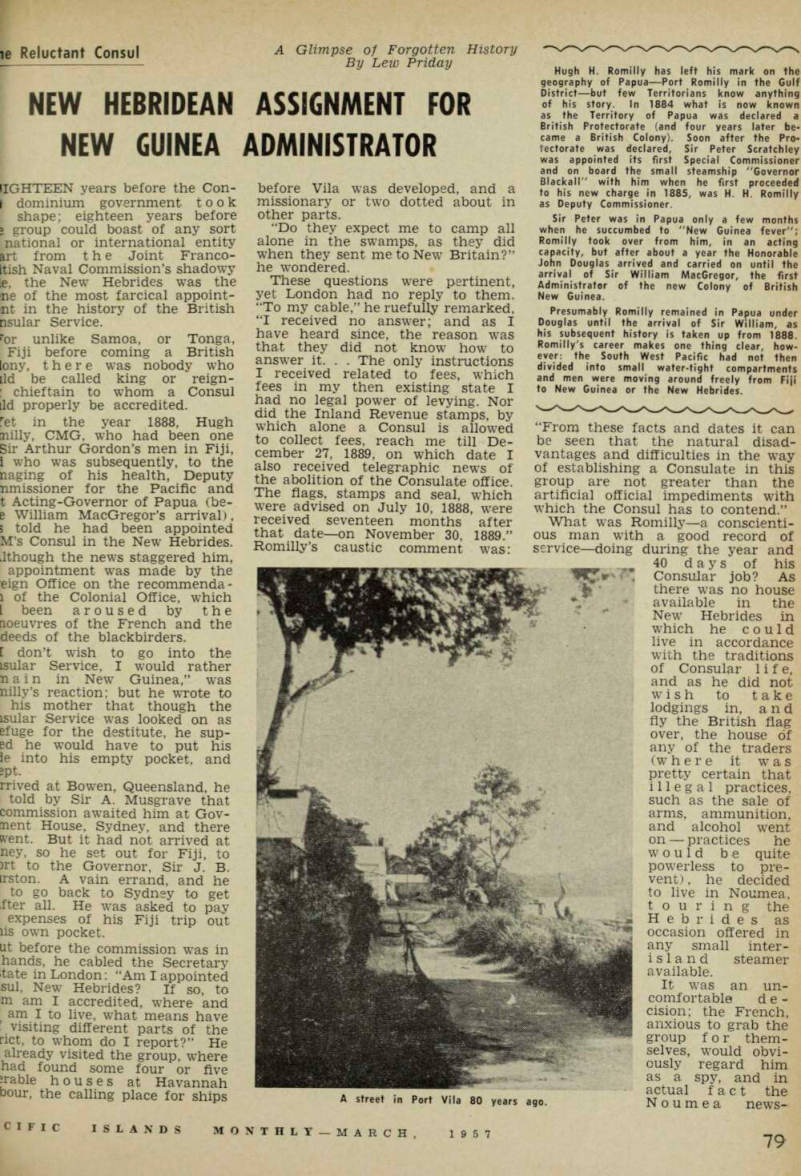
A street in Port Vila 80 years ago.
papers expressed the view that he was there under suspicious circum stances and should be turned out of the country.
The French Post Office, he found, was opening and sometimes detain ing his mail. There was, of course, a British Consul in Noumea accredited to the New Caledonian Government, the well-known E. L.
I.ayard, to whom Romilly could go for advice.
The Noumea in which he arrived, Romilly speaks of as “not a bad little place, but, of course it is only a vast prison, so the society consists chiefly of naval, military, and civil officials.” But soon he is saying; “I detest this place. There is not a decent Frenchman in it. They have invited me to their club, but as it seems to me only for the purpose of being studiously rude.
The Governor has taken no notice of my call, and, in fact, the whole situation is unpleasant.”
However, he found a sympathiser -—“my great, and indeed my only friend here is Count Lakerstein, the Italian Consul. He helps me with my work, and is a mine of informa tion on every subject. Our friend ship began on common grounds. He hates every one in the town but me, and I hate every one in the town but him.”
He was fortunate in finding a “nice little house” with an English landlady, but had no luck with servants, in fact one of them tried to kill the landlady, and then tried
to kill himself.
Things improved for a while with the arrival of the new Governor, the rich Noel Pardon (who was to entertain Robert Louis Steven son a few years later at Government House). At his first reception, Pardon treated the English with marked courtesy, almost ignoring the Ger mans and Italians, which made Romilly think, taking into account the cordial relations of the mixed Naval Com mission in the Hebrides and the punitive operations they were carrying out together, that some new friendly step was contem plated for the pro tection of the group.
By February, however, Pardon was complaining of the British Government having committed a breach of faith, and Romilly tele graphed Lord Salisbury.
The wildest dissipation available in Noumea at this time was listen ing to the convict band which played three days a week. The band was conducted by a gentleman who had been a wealthy physician in Paris, who had murdered his wife’s lover and then his wife by cutting off their heads.
One of Romilly’s visits to the New Hebrides coincided with Christmas: “a fearful and wonderful sight.
Thank God it only comes once a year! The French and English had a pitched battle—luckily they were all too drunk to shoot straight.”
Port Sandwich, on Malekula, seems to have been the site of this Christian celebration. t Mr. C. A. Stinson succeeds Mr.
W. G. Johnson as chairman of the Fiji Visitors Bureau. Mr. Johnson resigned from the Bureau at the end of last year because of pressure of other business, and because he felt it was time new “blood” was given a chance. t Samu Bale, a young Fijian fisherman, had his right arm amputated after he was attacked by a shark. Samu was wading through the water carrying a speared fish when the shark attacked. It was the first shark attack in Suva area for more than 30 years.
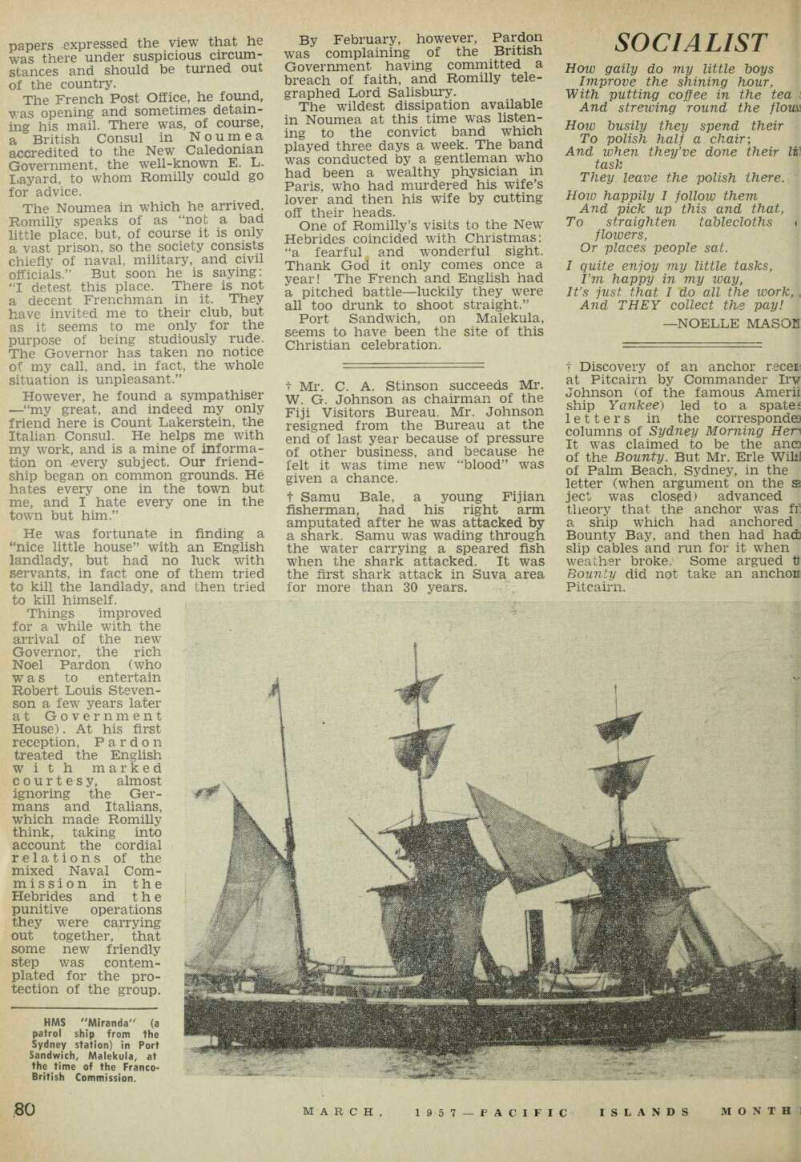
HMS "Miranda" (a patrol ship from the Sydney station) in Port Sandwich, Malekula, at the time of the Franco- British Commission.