Control and Gold-Seeking
pp. 71-76 · Read in the full issue


E Primitive Men
New Guinea
Sidelights on Problems of Population Control and Gold-Seeking
One of the Old-Timers of Papua-New Guinea, Mr. Norman bite, of Wau, has been undergoing health treatment in New Zealand tely. To fill in the weary hours, he has been writing about New uinea for the NZ newspapers. Here are some interesting extracts.
ERE is apparently little can libalism now, but up until 25 rears ago it was common lice. The reason for it? Simply, cute shortage of meat, e various tribes, speaking many d and different dialects, have ;orial boundaries, over which a ibouring tribe (unless they : the same language) venture irilous risk. Trespassers found hing for game, robbing gardens uit trees, are immediately at d; and the victims of battle — !, wounded or taken prisoner— prepared at once for cooking, neither salt nor refrigerator le is available for conservation »ses, it was a case of “eat as : as you can when you can.” ‘ absence of salt, I think, was f the greatest handicaps to the nee of these primitive neolithic
people prior to the arrival of the white man. Even now, in regions not yet under control, the same miserable condition exists.
The island of New Guinea, the largest in the world with the ex ception of Greenland, is the home of sugar-cane; and some of the numerous varieties, strange to say, produce salt when subjected to burning. This variety is “pit pit.”
The natives cut and stack great heaps of it and set it alight. The ash residue has a definitely salty flavour and all hands just eat it as is. To us it has a gritty, earthy taste and is distinctly unpalatable.
IN some localities it is possible for a strong party to make a quick trip to the coast, where they gather old coconut husks, dried fronds, old wood, etc., that has been soaked by the sea and impregnated with salt. They burn this rubbish
and carry the ashes back to the village.
Until the advent of the white men they had not advanced suf ficiently to know that a simple pro cess of dehydration by the sun would produce all the salt they needed.
The inhabitants of the coastal regions, however, had neither food nor salt problems. Adept at fish
spearing, and with plenty of coco nuts to add to the produce of the gardens, they enjoyed a more-or-less carefree existence, their only enemies being neighbouring tribes, and disease. The Anophele mos quito was a great scourge and kept the population within reasonable limits. . The man of the Highlands is probably the most interesting
human specimen in the world, and the most primitive. He lives on the hilltops because he is afraid to come down.
Along the valley floors, there is fertile soil where plenty of food could be produced with but little labour; but there is death down there because the enemy can approach unseen. He must stick to
the mountain-top where ; approaching enemy can be seenr. fought off.
The going is hard on the but there are no mosquitoes an. malaria is not the scourge it is* the coastal native. Garden are for the most part poor, and) country has to be constantly : available.
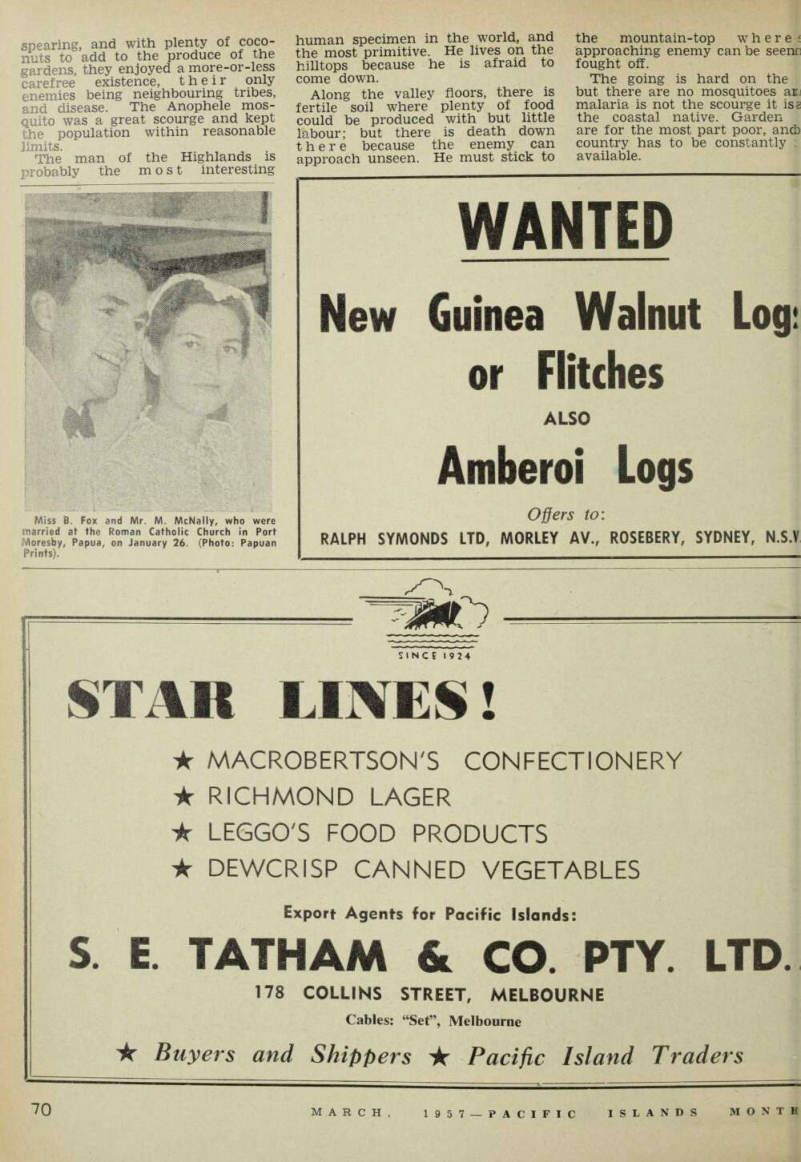
Miss B. Fox and Mr. M. McNally, who were married at the Roman Catholic Church in Port Moresby, Papua, on January 26. (Photo: Papuan Prints).
RTH control is vital to the con tinuance of village existence.
No popular method has been red to keep the sexes apart: the ilem is just as acute on the litlve hill-top as in Paris or lloomooloo. The unwanted in intrudes and, for the public , must be disposed of. dike the early Egyptians, they ot wait for natural birth. They expert abortionists and have, the centuries, evolved methods •inging about the desired event ig early pregnancy, lence came this fuzzy-headed, n-skinned, likeable chap? far as I am aware, there is uzzy hair on the east side of ■led Sea. It is the birthright le Negro type now occupying lof Africa. But the Negro is me of the accepted early in ants of that continent. They mown to have existed in the toum region sometime during Mesolithic period and that is inly a long time ago. ;y apparently interbred freely the Caucasoid people of East i and could have crossed over r estern Asia at a very early For a virile people of athletic ure, instinctively inclined to at the drop of a hat, the sy by easy stages from Cape Drin, in Southern India, to tra presents no great problem, :rom Sumatra to north-west Guinea is practically only a ig job. the variations of the human 1 they probably contacted the migration route I have >ted are faithfully represented my localities in New Guinea 7. black skin and protruding if the Negro are common ti on the upper Markham and other regions. The almost European appearance of the 1 Bukau’s, the large hook •f the Semitic types are to be with the Simban, and other and in the jet-back classical 3S of the Indian on Bougain nd adjacent islands. 7 are all there, advertising incestry; and, common to all, fuzzy hair. ►e are the Melanesians, mg most of the islands of the vest Pacific. Because of the tity of crowded Asia, their now is inextricably linked urs. )LD prospecting party tries all ming streams. ery native (“boy”) carries a ipproximately 50 lb. weight, oaded with food (“kaikai”), with camping gear, clothing ankets for the masters, and with rice, meat, tobacco, etc., : “boys”, and tools and other tals. A well-equipped party ' prospectors would run to 15 or 20 “boys.” oming to an untried stream, are downed, a hole sunk to
bed-rock if possible, the white men panning the gravels thrown from the hole as it goes down, searching for an indication of the precious metal they are seeking.
If the location where the trial hole is sunk is near the mouth of the stream, only very few particles are expected and bed-rock is dif ficult to reach on account of the depth and seepage. If the indica tion is there, up-packs and push on up-stream towards its source where the bed-rock is not so deep.
It is desirable to seek a suitable camping spot not later than 2 p.m. guards may be posted to protect camp during the hours of darkness.
Sleeping shelters are erected, beds and mosquito nets made ready for the masters, “kaikai” prepared for A clearing has to be made so that the evening meal, and a couple of “gun boys” sent out to hunt anything they may find in the way of fresh
meat.
Should you make camp within a mile of a village there is no need to contact them. They will know all about you and your arrival and will contact you, without doubt, within a couple of hours.
If the women-folk (“Mari’s”) arrive first, and unaccompanied by the men, they will have garden produce to sell and presumably all is well. The men generally arrive about half-an-hour later, in time to join in the bargaining.
Should they bring their arms (bows and arrows, spears and clubs) you have a show-down on the spot.
They must take them a fair dist ance back along the track they came by, and return unarmed.
Should they refuse to do as re quested, there is no necessity to parley. You and your party must play the game as they are playing it. Your arms are always at the
iy. and a spoken command to r personal “boy” will find you pped with rifle and revolver in mple of seconds, tie “shoot-boys” do not leave p until they get the all-clear i the leader of the party. They i appear with their shot-guns, the others with bows-and ws, in remarkably short time, village will not be a big one. If as you would not be so close to ithout knowing all about what 1 of a welcome you may expect i them.
ERE is always a leader of the native party. The leader of the white man’s party must step to this native leader and, if wing the principle I advocate, a shot over his head for propa la purposes before ordering all ( to be grounded, is unlikely the order will be garded because they know full that when the white man’s ton speaks, a man dies; and the snt moment in broad daylight ot the time for a trial of igth. the same, it was a pity you to fire that shot. It was neces and did the trick; but it carried it an insult and these men, iors all, may prove to be in mood. The chances then are trading for the native foods
brought by the “mari’s” is ou: of the question and you will be obliged to feed off your own precious rice supply.
But the women have more influ ence in council than one would ex pect and if they refuse to carry the stuff back to the village the trade will begin, with the men stand aloof while the “mari’s” shyly do the bartering. With the men being in ugly mood, neither knives nor tommy-hawks will be used in this particular trade and the “mari’s” will have to be satisfied with salt, beads, money or whatever small stuff you may have that is attrac tive to them.
You get a lot of “kaikai” for a pound of salt and, although the initial cost of it was not much, by the time you lug it over mountains week after week, it steadily in creases in cost value.
THE trading finished, the villagers gone, the routine of camp carries on apparently as usual—but only apparently.
There are other villages in the vicinity. If your camping equip ment and supplies are sufficiently attractive to induce the leaders to organise a combined attack, you are probably due for serious trouble, not at to-morrow’s dawn but the
one following.
Decision is soon made. The party has not the numerical armed strength to engage the neighbour hood and, even so, such action is forbidden by the Administration.
You are unwelcome and must re
tire.
(Continued Next Page)
There is time for a night’s sleep, to sink a hole down by the creek and retreat to friendly territory, be fore the village lads get together 'aid have a shot at collecting you : nd your very desirable equipment.
Many a man has paid for his mistake with his life by deciding to stay and fight it out.
The procedure is simple. They enrol every possible man—and they are all warriors at heart the approach to the camp is made in the dark; and, although you have sentries posted at the four corners of the square clearing, you have no possible chance of holding the assault, which is always at break of day.
One tap on the skull with a stone club is sufficient t o quieten any man, and you have no chance with out a barricade to enable you to make proper use of your superior weapons. There are many effective ways of protecting a permanent camp taut an overnight clearing in the bush is always dangerous in hostile country. , , , Should the gravels from the hole sunk down by the creek be found to contain payable gold, the prospector will assuredly return.
Next time, probably in company with an Administration Patrol. The Patrol Officer will see to it that everybody behaves themselves, in cluding the white man.
If the gold is there it will not be long before a camp springs into
existence and the ex-troublemakers will be found carrying cargo from the nearest supply centre, or work ing on one of the claims as fully fledged miners. The women-folk and children will be planting up bigger gardens and selling at higher prices.
The white man’s bush knife, axes, tommyhawks and garden tools will replace the stone-age implements of thousands of years, and new and pleasing cultural habits and ways of living will be introduced. The mystery of medicines, soap and clothing will be a boon to all and
the sunshine of civilisation will sla on this human back-wash for : first time. t An attack on the system r kerekere, which is completely 1 of place in the modern world, , made by Miss F. L. Charlton, her mistress of Adi Cakobau Sclk Fiji, at the Fijian Teachers’ O ference recently. Kerekere is ara Fijian system under which Fijian can beg from another. " makes it difficult for a Fijiaru run any sort of business.