Public-Service
pp. 68-69 · Read in the full issue
Mr. Neil Thomson
Careerist
A WELL-BUILT six-footer, with a soft and a quiet manner who has not wasted his substance on a chequered career but has been a public servant for the full 30 years of his working life —that is Mr. Neil Thomson, Papua - New Guinea’s new Public Service Commissioner.
He was born in Scotland 48 years ago but at the age of six arrived in Australia with his parents who settled at Maitland, NSW. He matriculated at the East Maitland Boys’ High School and in his last rear there was school captain, and also captain of the football and cricket teams. He has never lost the love of sport he developed at school, and now, although bowls is his favourite pastime, he still occasionally indulges in something more strenuous. He had been a member of the Maroubra (Sydney) Bowling Club for four or five years, and is a member of the Sydney Cricket Ground, The latter is one membership he will not relinquish while he is in New Guinea.
His first position in the public service was as a clerk in the court house at Cessnock, a mining town on the Newcastle coalfields. For
the next 14 years he held appoint ments as clerk of petty sessions and clerk in various parts of New South Wales, and also did relieving work.
In 1939 Mr. Thomson completed his law examinations in the course of study prescribed by the Solicitors Admission Board in NSW, and in
March, 1942, was admitted asi solicitor of the Supreme Courth New South Wales.
It was as an assistant inspets that he was transferred to Public Service Board’s staff in II (The Board is charged with ministering the Public Service <
8 State Government), Five years er he became an inspector, and 1950 was appointed the Board’s lior inspector, a position he held til his resignation to take up the MG appointment, is an inspector, it was his duty supervise the functions of the )lic service in various government
irtments. He was responsible he Public Service Board for the iency and economy of all de ments for which he was in tor. lese included staffs of the artment of the Attorney eral and Justice (departmental I office, Crown Solicitor’s office, ■erne Court, District Court and y Sessions Courts), Registrar jral’s Department, Public Trust J, Housing Commission and stry Commission. a qualified solicitor Mr. nson was required to undertake i of the Board’s legal work :e various courts and tribunals, len the Crown Employees’ sals Board Act came into opera in 1944 he was placed in charge ie Public Service Board’s pro ngs before the appellate tri 1. This tribunal deals with als by the public servants who been dismissed, reduced in • or superseded by junior irs. has also conducted proceedings the board before Conciliation mssioners and committees and industrial Commission of NSW. istructed counsel who appeared the Public Service Board in ?me Court cases, and when sel was briefed to appear before pen Public Service Board in which dealt with letting ation Department contracts i number of schools, wever, his work for the 3 went far beyond the legal Almost daily he was called »r general administration work, named out organisation and ods surveys in several govern departments. These resulted
in several improvements in the NSW Public Service.
Mr. Thomson and his wife sailed for Port Moresby in the Bulolo on
February 25.
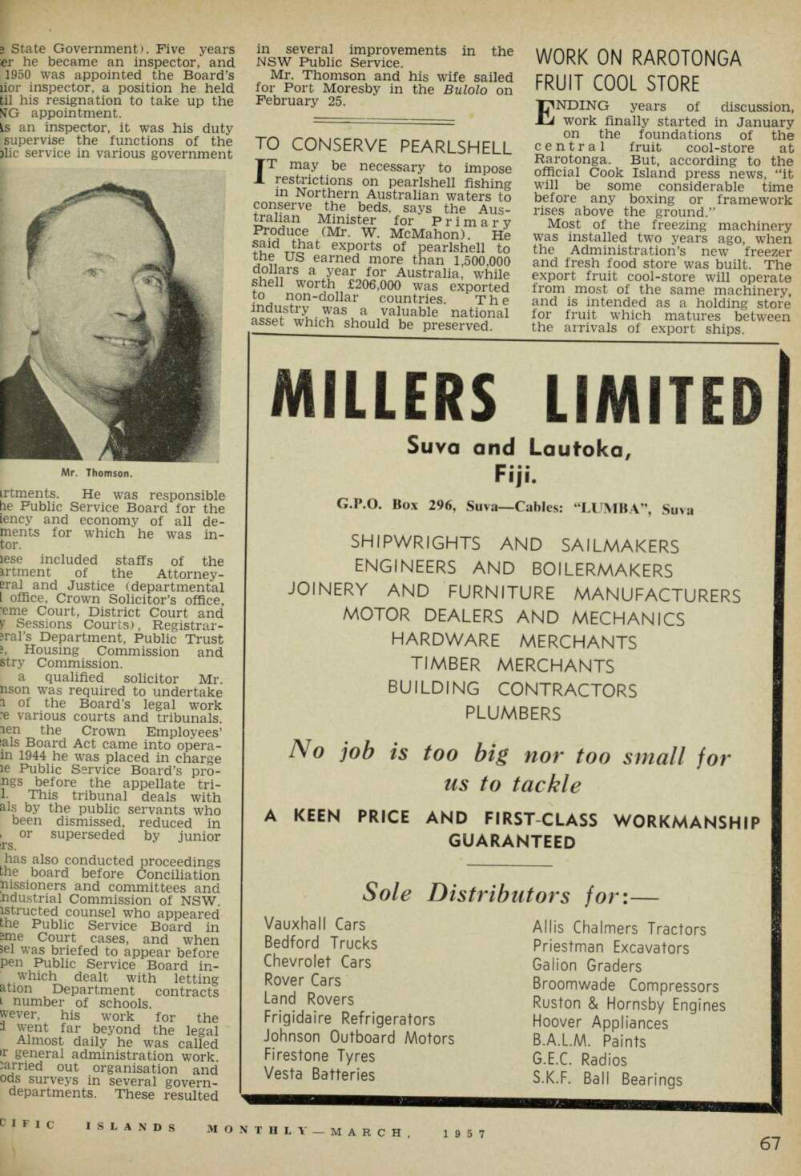
Mr. Thomson.