Pacific Shipping And Cruising Yachts
pp. 59-140 · Read in the full issue
Lara” Caused Trouble
In Papua
e Australian cyclone “Clara” ch was horn in the Gulf of Car iria early in February, crossed i York, and wove an erratic te on and off the North Queens \coast for almost two weeks e she headed south about vary 17) did a lot of incidental ige to Papua with wind, rain tides. But, surprisingly, little \ge was done to shipping. st small ships on the Papuan took shelter while “Clara” was : her preliminary manoeuvres e edge of the Coral Sea. ; the small 50-tons coaster Rui it the full gale between Daru tort Moresby. Within hours of sby, on February 9, the ship the full force of the storm; for 12 hours she was blown d in circles, as the captain to run before it. has a native captain; and one European was on board, . Turner, of Burns Philp staff, pt himself from being washed )ard by hanging on to the i railing for 12 hours. There 20 native deck passengers, all horn somehow survived the Hg seas that continually poured
he ship.
in “Clara” started to move she caused the biggest seas
seen on the NSW coast for 20 years.
She passed about 10 miles to the westward of Lord Howe Island, crossed the NSW coast near Man ning Heads, and blew herself out— the most newsworthy cyclone for years.
Suva Had A Near-Miss
Fiji, a week later, had a near hurricane of its own (officially, it came under the heading of “tropical storm”). The liner Orsova, coming south from San Francisco, berthed at Suva with difficulty at 8 a.m., February 26, and was to sail that afternoon. At 11 a.m., radio messages went out to passengers to return to the ship, as the master had decided to beat it out to sea, in case the storm worsened. However, the south-west winds had by then swung to north-east, and the big liner could not get away from the wharf. After repeated attempts, the move was abandoned and departure postponed until the following morn ing. The gale centre then moved off southwards, and Suva weather improved.
Oliver Mac Is Still Around
Oliver Mac and her tow, the old Loyaute filled with scrap iron, were still in Rabaul late February— although, when she left Noumea for Hongkong, in November, it was expected that she would be at
journey’s end before Christmas. (PIM, January, p. 103).
Heavy weather first delayed the operation, and then made Oliver Mac short of coal. She put into Rabaul, but there was no coal avail able, and she had to wait for it.
This finally arrived in bags in the Soochow from Sydney, early Feb ruary—but a few repairs were
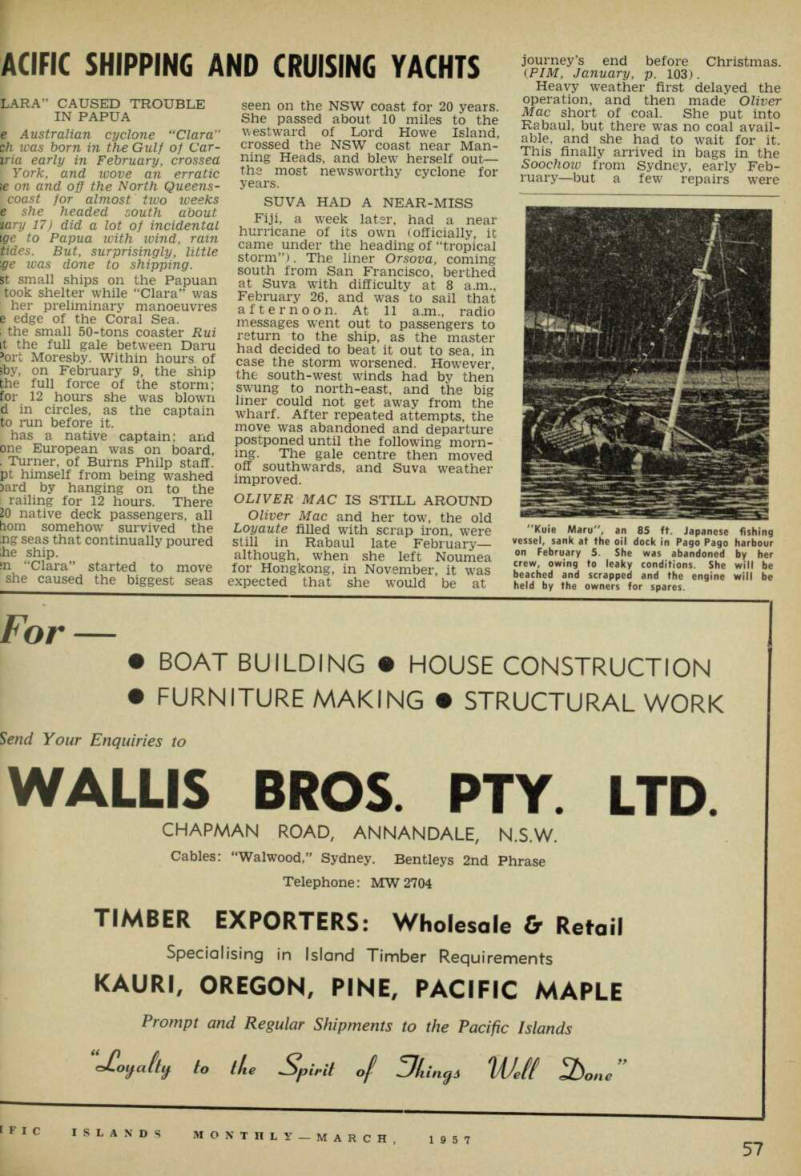
"Kuie Maru", an 85 ft. Japanese fishing vessel, sank at the oil dock in Pago Pago harbour on February 5. She was abandoned by her crew, owing to leaky conditions. She will be beached and scrapped and the engine will be held by the owners for spares.
necessary to Oliver Mac before she left for the East. Captain R. i.
Hamilton is in charge of operations.
Oliver Mac appears determined to end her Pacific career on the old note- coal troubles. W. R. Carpenter nut her onto inter-island service in Fiji in 1952; but the fact that she was a coal-burner made her un economic. She was finally retired, and tied up in Suva harbour for a couple of years until bought at the end of last year by M. Jean Hagen, of Noumea.
Oliver Mac is Japanese built and was captured in New Guinea during the war.
Joy It A Grounding—Formal
Inquiry
The Fiji Marine Board has re commended that a formal investi gation be held into the grounding of Joyita on Horseshoe Reef on January 8. The recommendation will be forwarded to the Governor (Sir Ronald Garvey).
The Joyita grounded about 4.35 am. while on a trip from Buca Bay ports to Suva. The passengers and crew abandoned her aboht 8.30 am. and took to the lifeboats. Burns Philp ship, Yanawai, went to the rescue and picked up the passengers and crew about 2.30 p.m. that day.
Joyita was towed to Nasova, near Levuka, and beached. She will be towed to Suva for repairs.
Five witnesses, including the
master, Captain David Leonard Elliott, and the mate, Sairusi Ratulailai, gave evidence.
The Joyita was running on one engine only when she grounded.
The other engine went out of action at Tabuta on January 4, and it was not possible to repair it.
The chief engineer on the Joyita,
Joseph Dickson, told the Bo* that Mr. Hurley, of Hurley’s Sic ping Agency, agents for Joyita, given instructions that the shin, taken out on one engine.
Witness said that the wear was very “dirty” when Joyita w on to the reef, and there was strong sea running.
atest reports from Fiji say that ita is now infested with rats.
Marine engineers are waiting for pring fide to refloat for the haul ►uva.
New Southern Cross
Started
ork on the Melanesian Mission’s Southern Cross has been started the Ballina Slipway and En ering Company, NSW. This pany is a subsidiary of S. G. rte Pty. Ltd., of Sydney, who red the contract for the new le old Southern Cross, purchased Jhe Bougainville Company for tal cargo work in New Guinea, Sydney in February for Rabaul.
The Reason Why
ptain M. J. McGregor, master [V Busama, has explained why )portion of the numerous coastal around Lae prefer the little ered corner at Voco Point, a from Lae’s expensive port at irdhaven (Jan. PIM, p. 101). writes that small ships prefer ittle sheltered bay because the orage holding grounds at Voco - are much better than at the f area, and the water is not as Dtain McGregor adds that, cs to the enterprise of young ! Bray, who built a jetty, own : all vessels, including the 300- ( usama, are allowed to use this when Bruce’s own trawler-type , Buka, is not working cargo, the small ships mentioned in anuary item have Lae as their port, although registered at ports.
Influenza Bearer
asked in January PIM (p. if La Curieuse took the in a epidemic to Tahiti after War I. In Papeete, Captain n took command of the 60- >ns vessel and, during the in a epidemic, was trading with :>etween Papeete and Cali tain Brisson described in the is Magazine how every mem f the crew developed the J well out at sea after a call liforma, and how, after some i, he got the ship back to :e the ’flu “spread out . . people and natives died like They recorded 3,010 deaths.”
'-a facie, it looked as though irieuse took the disease to - but a correspondent from e says that it was the Union khip Co.’s steamer, Navua was responsible. It would be JPg to learn the views of the USS Co.’s “old hands.”
Vaitiare’S Future
as been rumoured in Tahiti he Government proposes to (Continued on 6l)
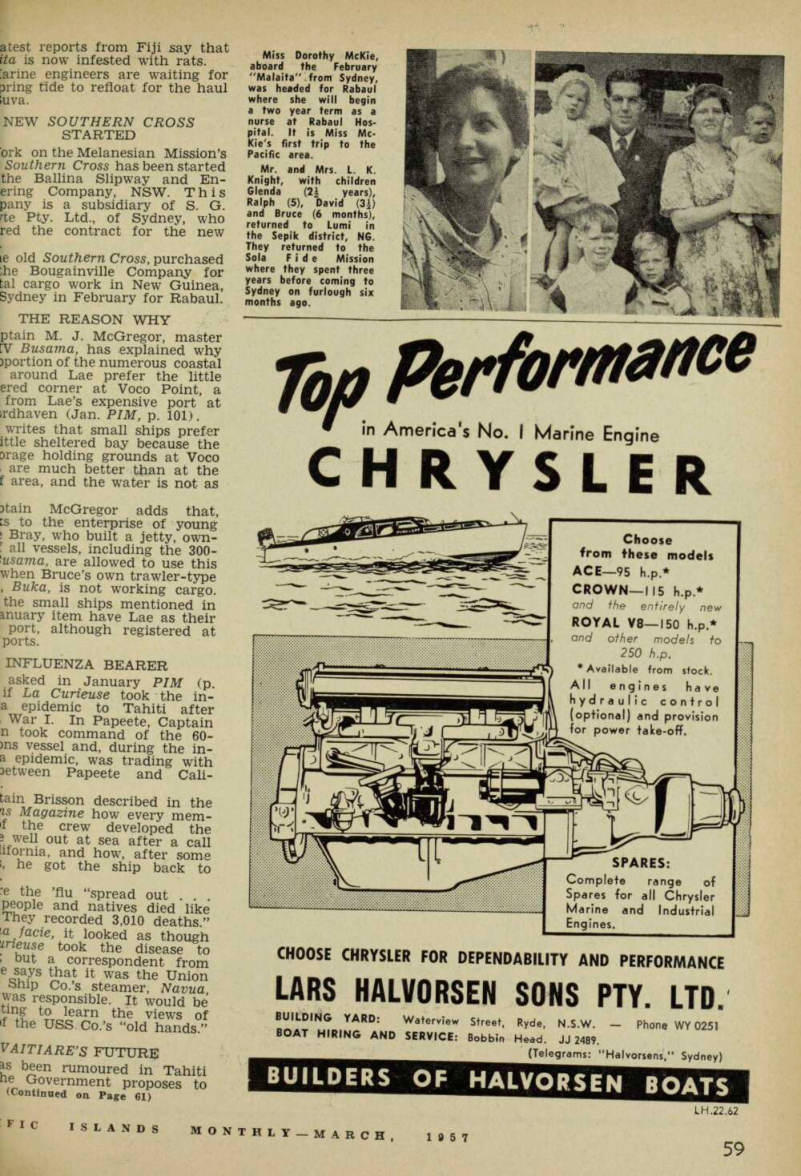
Miss Dorothy McKie, aboard the February "Malaita" from Sydney, was headed for Rabaul where she will begin a two year term as a nurse at Rabaul Hos pital. It is Miss Mc- Kie's first trip to the Pacific area.
Mr. and Mrs. L. K.
Knight, with children Glenda (2½ years),
Ralph (5), David ( 3½ )
and Bruce (6 months), returned to Lumi in the Sepik district, NG.
They returned to the Sola Fide Mission where they spent three years before coming to Sydney on furlough six months ago.
uy the NZ life-boat, formerly appy Returns, and now the Vaitiare, »r use in the Islands in conjunc on with the Bretagne.
About The Mariposa
A Wellington correspondent writes lat when the Mariposa visited the ew Zealand capital she flew a irsion of the NZ merchant ensign tiich could only have been dreamed > in Hollywood—a British Red asign with four white-bordered d stars on the fly. The corre ondent was regretful that he uld not see from wharf level aether the flag was upside down not.
Melbourne misses out on calls by e Mariposa because the ship rries so many round-trip passeng -5 who want to spend some time fewer ports. But if the demand ises, Melbourne will be restored the itinerary, says the Australian maging director of Matson, Mr.
A. Johnson.
Louis Is Recalled
Louis Carlson, pilot of the Port Papeete, who was retired at the d of last year, has been asked rejoin the Port Pilotage Service • another couple of years, this le as Inspector of the Port of peete.
Phis decision was made after the urn of the French frigate, mont D’Urville from the French eania Islands. Louis piloted the
vessel, and it is thought that the Commanding Officer noted the need for an experienced pilot and made a recommendation in Louis’ favour.
For Sydney-Singapore Run
Burns Philp’s new 3,700 dead weight motor-vessel, Montoro, was due to make her first arrival in Sydney on Tuesday, March 12 (Feb.
PIM, p. 98). She left Madang on February 28 for Rabaul, and sailed from that port on March 6 for Sydney.
BP’s shipping department has confirmed that the Montoro will go on the Sydney-Singapore run.
After More Speed
Two of the New Guinea Australia Line’s passenger and cargo liners, the Sinkiang and the Soochow, have been fitted with Costa propulsion bulbs. By the addition of this de vice it is hoped to increase the speed of the vessels by up to half a knot, and effect a saving in fuel con sumption.
The device, which is fitted to the rudder, decreases turbulence, and enables ships to move more easily through the water.
The device will also be fitted to the Shansi, which was to go into dry dock in Sydney about March 12.
The Sinkiang, which was com pletely overhauled in Hongkong, set out on her return to Sydney early this month, via the South Philippines and Port Moresby, under the com
mand of Captain J. F. Follett.
R/T Distress Watch
Further Extended
The South Pacific radio-tele phone distress watch has made a further advance, with the establish ment of a watch on the 2182 kc/s international distress channel by Rarotonga Radio as from January 1, 1957. An announcement from the Cook Islands Radio Superin tendent’s office says that loud speaker watch will be maintained on the frequency from 1700 GMT through to 1200 GMT daily.
The watch is thus continuous, except for a 5-hours break in the very early hours of the morning.
ZKR/S will reply on the same frequency to all calls. Cook Islands local vessels also use 8245 kc/s, the coast station replying on 8761 kc/s, but no regular watch is maintained on 8245 kc/s, communications here being by pre-arranged schedule.
This higher frequency is necessary
in the Cooks, due to the long dist- Sices involved, 2182 kc/s generally being too low a frequency for day light communication with vessels in the Northern Group, 600-700 miles from Rarotonga.
Rarotonga also maintains distress watch on the 500 kc/s international distress frequency used by big vessels Watch hours are 0000-0200, MOO-0600 0800-1000, and 2000-2200 GMT daily on this channel.
Lost Part Of Propellor
The Damadore del Mar, under the command of Captain Savoie, radioed after leaving Wallis Island last month with a cargo of copra for Noumea, that she had lost a propeller blade, probably after touching a coral head. The French naval sloop, Tiare, which was m New Hebrides waters, answered her call for assistance, and escorted her to Noumea, where she arrived on February 20.
Pagan Changes Hands
The English-built motor fishing vessel Pagan, which a group of Aus tralians brought out to Auckland late last year, was sold in January to an Auckland fishing company.
South-bound from Papeete to Auck land, this craft was adrift with engine trouble for three weeks.
Skipper E. R. Barker has now re turned to London.
Offer For San Antonio
Wreck
Carr Enterprises Ltd., a Sydney company, has submitted an offer of 1,500,000 francs (more than £A10,000) to Lloyds for the wrecked San Antonio and its cargo. The ship, laden with 6,000 tons of scrap iron, is on the reef opposite the
meat canning town of Ouaco, . the west coast of New Caledonisi The ship is lying on an even M with a slight list. It has 15 fti water in the forward holds, andb ft astern.
If the offer is accepted, CC Enterprises are expected to Captain Henri Helme, of Nounc
undertake salvage of the cargo, iptain Helme, who has already d considerable experience in this rt of work, in Tahiti, proposes to I the holes in the ship and pump r dry. The cargo of scrap will ;n be loaded on to the Maria del ir, which the Carr company has light, for delivery in Hongkong h a cargo of scrap.
Dnce the ship is lightened by re ival of the cargo, Captain Helme pes to be able to refloat it suf iently to bring it ashore six miles ay. There San Antonio will be ;up for scrap. The scrap will be ded on to an ocean-going vessel the nickel port of Nepoui, not far tant.
Tgnals From Tahiti Nui
Signals from the raft, Tahiti Nui, ich is drifting in the South ;ific from Tahiti to Valparaiso, being received in Broken Hill, Australia. Tahiti Nui is drifting the reverse direction from that the more famous Kon Tiki edition. he 50 ft raft is manned by se Frenchmen, a Polynesian, and Jhilean.
Broken Hill radio “ham” said t the raft probably would drift ) the Antarctic zone, if it tinued on its present course, should then be swept north ds along the Chilean coast.
Fibreglass Runabout
)hn Barraclough and Richard :th, a director of Customcraft, josed to make a trip to Brisbane n Sydney this month in a 16-ft ble-skin fibreglass runabout. The t is totally enclosed, has a hard and fuel tanks are built in ig the sides, was proposed to fit the run it with twin Holden engines (in Is it was powered by a Ford cury engine with straight drive, h propelled it at about 50 miles hour), a TR radio and other guards. ley planned to make the ney at night, with a search : permanently directed upwards, hat they could be located at time by many friends stationed r arious points along the coast, object of the trip is to prove t they claim is the astonishing igth and toughness of this new i of construction.
lews of Cruising Yachts
'PEDA, of Vancouver, a 34-ft • .is at present in Papeete after hse which started at her home on July 2, 1956, Her last port ill was Takaroa. Jopeda, built •947, m Vancouver, had two vious names— Dawn W and She is 10 ft 9 in. wide, 6 in. deep, and has a gross age of 8.4 tons. e vessel is owned by Messrs. J. asley, p. Walmsley and D. Field, the master is Mr. J. Walmsley. owners are on a pleasure cruise
which they hope will finish in Brisbane after calls at Bora Bora, Rarotonga and Suva. She expects to clear Papeete in April or May.
WHITE HART, a Canadian yacht, cruising back to Vancouver from Auckland, was at Papeete late January. On board was a crew of three young women, Misses Greta and Pauline Scott and Tino Varley who had trouble with the landing authorities because their visas were not in order. The trouble was straightened out, and they were allowed to land. They flew out of Tahiti on the TEAL Solent flyingboat. The owner-skipper, Tony Reeves, cruised from Vancouver to Auckland with his wife and 3-years- Old SOn.
MARCO POLO, Auckland ketch, westbound round the world, was at Jamaica in February, and plans to call at Island ports when home ward-bound from Panama this winter. With owner Tony Armit is Brian Loe. rr TJT „ oil .. . . „ , T .y LA *f> 31 lon £ b y 9 by 6 wlll cari T the German flag the Islands this winter. Joroslav N°vy> 37, and his wife, Bozena, cleared Hamburg last August 16, hound for Brisbane. The well fitted and well-maintained steel craft, now in the Canal Zone, will sa fi I° r Tahiti, Samoa, and New Caledonia in early April. Captain Noy y is a professional seaman.
(News of Small Ships Continued on P. 138)
MAKORA, skippered by owner H. Goodwin, a New Zealand sheep farmer, cleared Balboa on February 5 for Auckland. This 48 ft by 11 ft by 7 ft craft Eng-
land last September 1. With owner Goodwin is his daughter, Anthea, Miss Stella Copsey, and Mr. Jeremy Hewett. Another daughter was one of the crew of Arthur Rogers dur
ing an Island cruise several years ago. She may join the yacht at Tahiti. Calls are planned at the Galapagos, Marquesas, Papeete and Nukualofa IMATRA, which passed through Polynesia southbound for Auckland from England some years ago, is reported sold by Sir Ernest Davis to Mr. Tony Bambridge, of Papeete, and she will leave Auckland prob ably in April. Sir Ernest purchased the yacht soon after its arrival from England. Mr. P. Moore, of Yorkshire Insurance Co., who is well known in Papeete, has represented Mr.
Bambridge in the negotiations and may skipper Imatra on her delivery voyage.
A handsome 50-ft motor sailer, schooner-rigged, with a beam of 13 ft, is being built of heart-kauri at Kawau Island (Auckland) by Mr. R.
Lidgard, a leading boatbuilder, well known in Polynesia. Mr. Lidgard has two adopted Rarotongan sons, as well as one son of his own, who is well known in Fiji in yachting circles. The new yacht has been warmly praised by interested yachts men. Mr. Lidgard plans to take part in next year’s Auckland-Suva race, and do some Islands cruising.
KOCHAB, successor to Storte hecker 111, which Dr. John Franklen- Evans, of England, sold in Canada after cruising the Pacific several years ago, cleared Balboa for Polynesia on February 12.
With the doctor is Eric F 3 The new craft, London-reg: measures 39 ft 6 in. by 10 ft ;
6 ft. The voyage commence September 29. Plans are to s month in the Galapagos, the north to enter the 1957 Los A Honolulu (“Trans-Pacific”) continue south to Tahiti; thr New Zealand, where the i should end about early Dec:
Photo (by Max Hart) of "Makora".