Cutch Industry Has Troubles
p. 47 · Read in the full issue
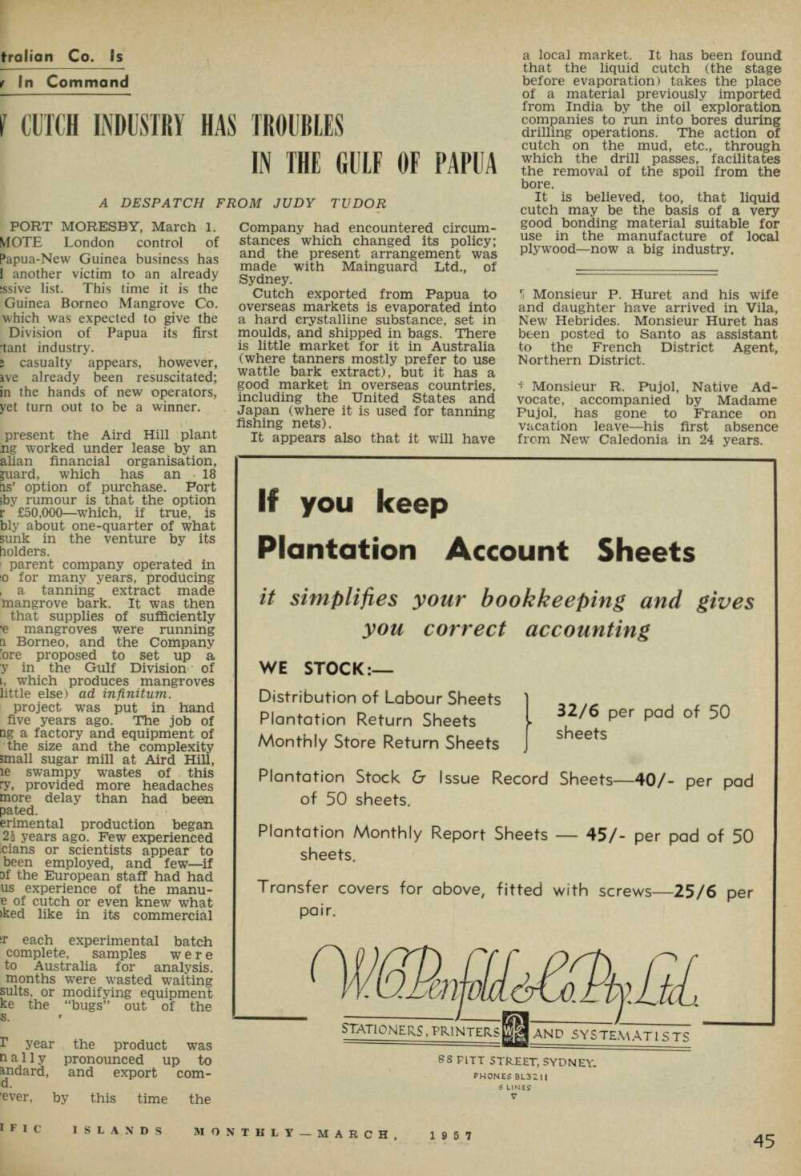
tralian Co. Is [?] In Command
In The Gulf Of Papua
A Despatch From Judy Tudor
Port Moresby, March 1.
MOTE London control of Papua-New Guinea business has I another victim to an already sssive list. This time it is the Guinea Borneo Mangrove Co. which was expected to give the Division of Papua its first •tant industry. ; casualty appears, however,
ive already been resuscitated;
in the hands of new operators, yet turn out to be a winner. present the Aird Hill plant ng worked under lease by an
alian financial organisation,
?uard, which has an 18 tis* option of purchase. Port >by rumour is that the option r £50,000 —which, if true, is bly about one-quarter of what sunk in the venture by its holders. ! parent company operated in o for many years, producing , a tanning extract made mangrove bark. It was then that supplies of sufficiently •e mangroves were running ti Borneo, and the Company tore proposed to set up a y in the Gulf Division of i, which produces mangroves little else) ad infinitum. project was put in hand five years ago. The job of ng a factory and equipment of the size and the complexity small sugar mill at Aird Hill, le swampy wastes of this ry, provided more headaches more delay than had been pated. erimental production began 2i years ago. Few experienced Icians or scientists appear to been employed, and few—if of the European staff had had us experience of the manu e of cutch or even knew what »ked like in its commercial t each experimental batch complete, samples were to Australia for analysis, months were wasted waiting suits, or modifying equipment ke the “bugs” out of the s. • r year the product was daily pronounced up to andard, and export com d. r ever, by this time the
Company had encountered circum stances which changed its policy; and the present arrangement was made with Mainguard Ltd., of Sydney.
Cutch exported from Papua to overseas markets is evaporated into a hard crystalline substance, set in moulds, and shipped in bags. There is little market for it in Australia (where tanners mostly prefer to use wattle bark extract), but it has a good market in overseas countries, including the United States and Japan (where it is used for tanning fishing nets).
It appears also that it will have
a local market. It has been found that the liquid cutch (the stage before evaporation) takes the place of a material previously imported from India by the oil exploration companies to run into bores during drilling operations. The action of cutch on the mud, etc., through which the drill passes, facilitates the removal of the spoil from the bore.
It is believed, too, that liquid cutch may be the basis of a very good bonding material suitable for use in the manufacture of local plywood—now a big industry. fi Monsieur P. Huret and his wife and daughter have arrived in Vila, New Hebrides. Monsieur Huret has been posted to Santo as assistant to the French District Agent, Northern District. + Monsieur R. Pujol, Native Ad vocate, accompanied by Madame Pujol, has gone to France on vacation leave —his first absence from New Caledonia in 24 years.