Editorial. ..
pp. 19-20 · Read in the full issue
UR VIEW OF SE ASIA AND INDONESIA GROWS
Ever More Ugly
E future of the South Pacific is bound up with developments in least Asia and Indonesia. Aus ns and Pacific Islanders naturally an interest in events there, ey may be pardoned if they find IE Asian and Indonesian events ry recent weeks hard to follow, even more difficult to get into attempt is made here to ex these things briefly, in relation ;ir own history, and in relation ch other. The picture thus ated, as it bears on our own 5, is not a pretty one. e is a list of the events which our present, and especially uture situation:
esia Near Collapse . . .
;r years of political and mic deterioration, the “Re i of Indonesia” is close to se. rabble-rouser Soekarno (estab as President by the Japanese )45) proposed, at end of ary, to abandon so-called .mentary rule, and carry on a sort of Council representing •arties, including the Com ts (who hold a quarter of the ment elected late in 1955). reactions showed that this t rule by Communists, he i ground rapidly, and now is to make an alliance with , Hatta is regarded as strongly led. nwhile, most of Indonesia is ondition of revolt—breakaway istrations, mostly of Army , rule Sumatra and all the n archipelagoes (Moluccas, is, etc.) right across to New a; and one is taking shape meo. carno’s set-up now controls lava.*
)id Not Vote . . .
iough Indonesia’s claim to rn New Guinea is only tactical mo thus has hoped to divert ational attention from his ling empire), the United is Assembly took it seriously: a move there against The rlands (inspired, of course, by est-hating Afro-Asian group) efeated by only three votes, voting was 40 for, 25 against (-thirds majority was needed), srnment collapsed on March 13 —whole thereafter under martial law.
while 13 nations (including United States) abstained from voting.
The Dutch already had made it clear that they would not accept UN dictation in this thing. But the incident shows the uselessness of the United Nations (so far as the South Pacific is concerned, at any rate), and how the South Pacific could be let down by United States at any time.
Britain and Singapore . . .
A delegation from the Singapore Legislative Assembly (which is vociferously anti-British) arrived in London in March, to demand an early date for “independence.”
Britain announced last year that Singapore was one of the important world bases which could not be sur rendered to any nationalist move ment, and the Singapore Premier Marshall thereupon resigned, and was succeeded by a Chinese.
Conferences started in London while SEATO was assembling in Australia. There are indications that Britain, under American
pressure, will make concessions to Singapore.
France is gone from Indo-China, Britain from India and Ceylon. If Britain goes from Singapore, and the Reds dominate Indonesia—as seems likely—there will be nothing left between Asia and Australia and the Islands.
As SEATO Sees It . . .
While the delegates to the South East Asia Treaty Organisation (SEATO) were assembling in Can berra (and they included Mr. Dulles, of Washington), India (which is not a member of SEATO, although Pakistan and Siam are) was making humble apologies to London be cause of a filthy Indian newspaper attack upon Queen Elizabeth.
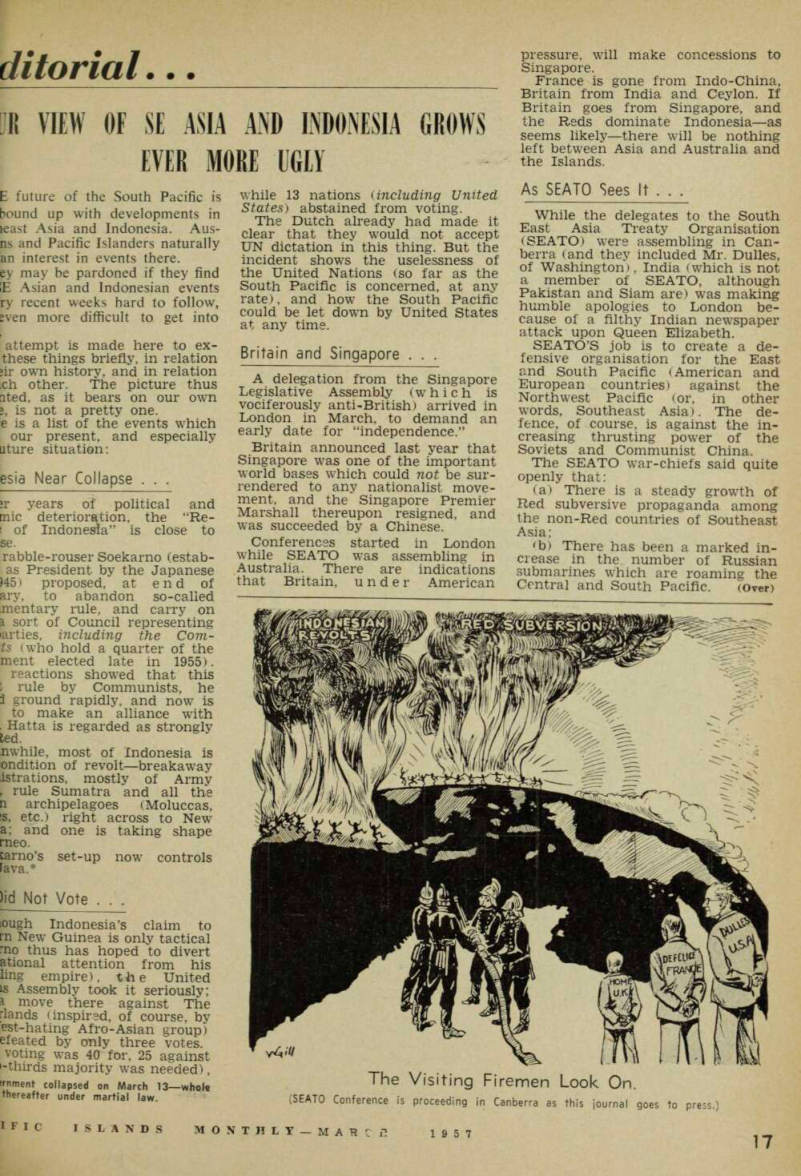
SEATO’S job is to create a de fensive organisation for the East and South Pacific (American and European countries) against the Northwest Pacific (or, in other words, Southeast Asia). The de fence, of course, is against the in creasing thrusting power of the Soviets and Communist China.
The SEATO war-chiefs said quite openly that: (a) There is a steady growth of Red subversive propaganda among the non-Red countries of Southeast Asia; <b) There has been a marked in crease in the number of Russian submarines which are roaming the Central and South Pacific. (Over)
The Visiting Firemen Look On. (SEATO Conference is proceeding in Canberra as this journal goes to press.)
"VTOW let us look back over the f\ highlights of those developments and incidents, and ask our selves as residents of the South Pacific, if there is anything there of comfort for us.
Excluding India, there are, nearly 1 >OO million people in Asia and Indonesia, compared with 12 million in the South Pacific.
And why should we exclude India’s 390,000,000 people? Every month, evidence grows that India hates the West and that Nehru, if ev .er he had to make a choice, would turn against us. . . However, leave India as a neutral, and count only the Mongoloids and Indo-Mongo ]oids‘ and there still are nearly 1 000 million Asians prepared to march south and exterminate us, if they are allowed If they are allowed! What and who eventually will stop them?
Not Britain and France. They would, if they could—but their in fluence on the South Pacific situa tion is negligible, while the factors which create the Cold War remain.
The United Nations? What can we hope for, from that mongrel combination, where the votes of Salvador and Cambodia can cancel those of France and Russia? Look
at its performance in recent months, in relation to the Middle East, Hungary and Indonesia!
The United States? The Ameri cans saved us from the Japs in the Pacific War—but not because they loved us. Their attack south-about through Australia and the SW Pacific Islands, was the simplest and easiest way of defeating Japan.
We may not forget that the United States created Indonesia (throwing out the Dutch, after they had been there for 350 years, in order to establish the Soekarno regime); and that the USA, on February 28, re fused to vote at UN when the Africo-Asian bloc tried to get the Dutch thrown out of Western New Guinea. What can we expect from USA if and when the Red Asians begin to thrust southwest upon us, through Indonesia?
IT is not a pretty picture, this that has been created for us in very recent months by the events of SE Asia and NW Pacific.
Consider those events in relation to the fact that Soviet Russia, within the same period, has turned cold and sour —in contrast with the hearty. B & K, back-slapping era which followed the Summit Con
ference at Geneva in 1955.
We are faced with stark realil We shall be asked soon to arm j selves much more heavily.
We may as well accept the that the only way in whichri Western people can retain our t dom and our culture—through the world as well as here inr South Pacific —is to build up c armaments to the point where*] can meet the Red Bloc on at 1 equal terms and put aside i United Nations and the Colol Plan and all other similar ideae conceptions for implements! perhaps at some later human evolution We do not do it for choice. H Western nation recognises war. the horror that it is and hat!, beyond expression. But the alt! ative to fighting is enslavement!] degradation.
One does not save one’s life iri jungle by laying down one’s and extending goodwill to the bd that creep upon one. Little uu trying to ensure peace and seo; by appeals to the better natuu the human beasts that murn thousands of Hungarians om few weeks ago. . .
The Southeast Asia-Indonn picture is very ugly. But reality