This Month's New Reading
pp. 90-97 · Read in the full issue

To Queenstown
For Orders
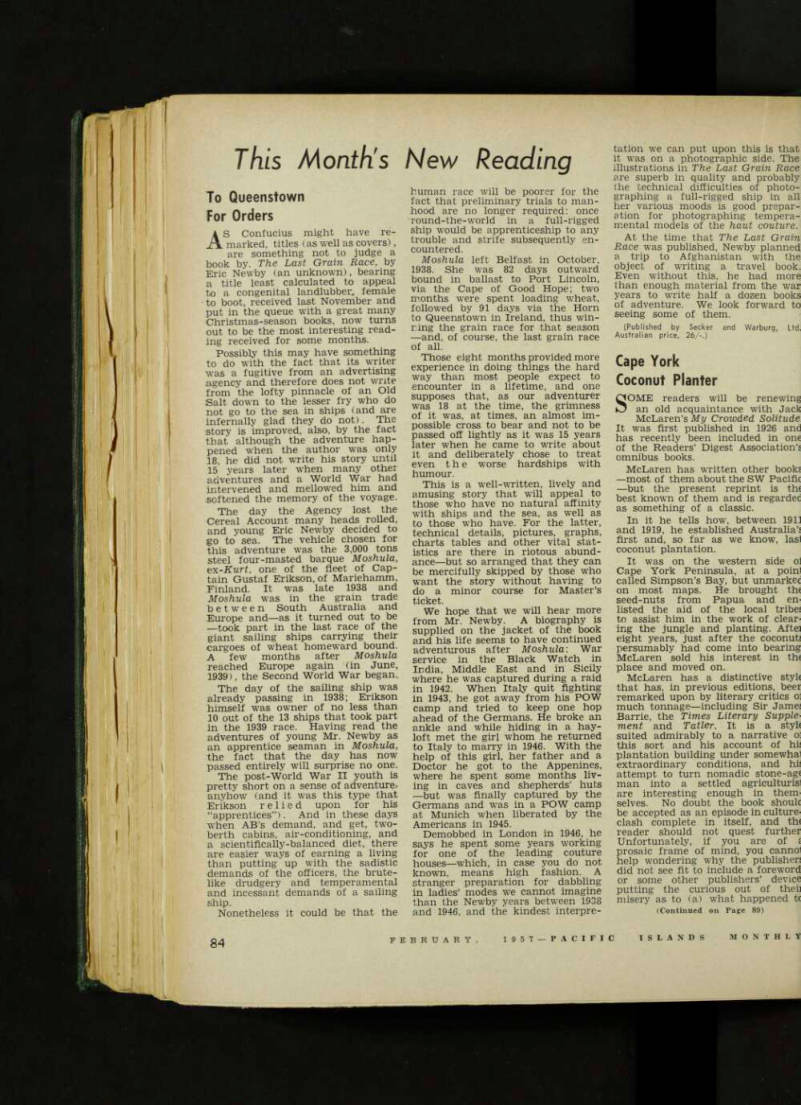
AS Confucius might have re marked, titles (as well as covers), are something not to judge a book by. The Last Grain Race , by Eric Newby (an unknown), bearing a title least calculated to appeal to a congenital landlubber, female to boot, received last November and put in the queue with a great many Christmas-season books, now turns out to be the most interesting read ing received for some months.
Possibly this may have something to do with the fact that its writer was a fugitive from an advertising agency and therefore does not write from the lofty pinnacle of an Old Salt down to the lesser fry who do not go to the sea in ships (and are infernally glad they do not). The story is improved, also, by the fact that although the adventure hap pened when the author was only 18, he did not write his story until 15 years later when many other adventures and a World War had intervened and mellowed him and softened the memory of the voyage.
The day the Agency lost the Cereal Account many heads rolled, and young Eric Newby decided to go to sea. The vehicle chosen for this adventure was the 3,000 tons steel four-masted barque Moshula, ex-Kurt, one of the fleet of Cap tain Gustaf Erikson, of Mariehamm, Finland. It was late 1938 and Moshula was in the grain trade between South Australia and Europe and —as it turned out to be —took part in the last race of the giant sailing ships carrying their cargoes of wheat homeward bound.
A few months after Moshula reached Europe again (in June, 1939), the Second World War began.
The day of the sailing ship was already passing in 1938; Erikson himself was owner of no less than 10 out of the 13 ships that took part in the 1939 race. Having read the adventures of young Mr. Newby as an apprentice seaman in Moshula, the fact that the day has now passed entirely will surprise no one.
The post-World War II youth is pretty short on a sense of adventure* anyhow (and it was this type that Erikson relied upon for his “apprentices”). And in these days when AB’s demand, and get, two berth cabins, air-conditioning, and a scientifically-balanced diet, there are easier ways of earning a living than putting up with the sadistic demands of the officers, the brute like drudgery and temperamental and incessant demands of a sailing ship.
Nonetheless it could be that the
human race will be poorer for the fact that preliminary trials to man hood are no longer required; once round-the-world in a full-rigged ship would be apprenticeship to any trouble and strife subsequently en countered.
Moshula left Belfast in October, 1938. She was 82 days outward bound in ballast to Port Lincoln, via the Cape of Good Hope; two months were spent loading wheat, followed by 91 days via the Horn to Queenstown in Ireland, thus win ning the grain race for that season —and, of course, the last grain race of all.
Those eight months provided more experience in doing things the hard way than most people expect to encounter in a lifetime, and one supposes that, as our adventurer was 18 at the time, the grimness of it was, at times, an almost im possible cross to bear and not to be passed off lightly as it was 15 years later when he came to write about it and deliberately chose to treat even the worse hardships with humour.
This is a well-written, lively and amusing story that will appeal to those who have no natural affinity with ships and the sea, as well as to those who have. For the latter, technical details, pictures, graphs, charts tables and other vital stat istics are there in riotous abund ance—but so arranged that they can be mercifully skipped by those who want the story without having to do a minor course for Master’s ticket.
We hope that we will hear more from Mr. Newby. A biography is supplied on the jacket of the book and his life seems to have continued adventurous after Moshula : War service in the Black Watch in India, Middle East and in Sicily where he was captured during a raid in 1942. When Italy quit fighting in 1943, he got away from his POW camp and tried to keep one hop ahead of the Germans. He broke an ankle and while hiding in a hay loft met the girl whom he returned to Italy to marry in 1946. With the help of this girl, her father and a Doctor he got to the Appenines, where he spent some months liv ing in caves and shepherds’ huts —but was finally captured by the Germans and was in a POW camp at Munich when liberated by the Americans in 1945.
Demobbed in London in 1946, he says he spent some years working for one of the leading couture houses —which, in case you do not known, means high fashion. A stranger preparation for dabbling in ladies’ modes we cannot imagine than the Newby years between 1938 and 1946, and the kindest interpre
tation we can put upon this is that it was on a photographic side. The illustrations in The Last Grain Race are superb in quality and probably the technical difficulties of photo graphing a full-rigged ship in all her various moods is good prepar ation for photographing tempera mental models of the haul couture.
At the time that The Last Grain Race was published, Newby planned a trip to Afghanistan with the object of writing a travel book.
Even without this, he had more than enough material from the war years to write half a dozen books of adventure. We look forward to seeing some of them. (Published by Seeker and Warburg, Ltd.
Australian price, 26/-.)
Cape York
Coconut Planter
SOME readers will be renewing an old acquaintance with Jack McLaren’sMy Crowded Solitude.
It was first published in 1926 and has recently been included in one of the Readers’ Digest Association’s omnibus books.
McLaren has written other books —most of them about the SW Pacific —but the present reprint is the best known of them and is regarded as something of a classic.
In it he tells how, between 1911 and 1919, he established Australia’s first and, so far as we know, last coconut plantation.
It was on the western side oi Cape York Peninsula, at a poinl called Simpson’s Bay, but unmarked on most maps. He brought the seed-nuts from Papua and en listed the aid of the local tribes to assist him in the work of clear ing the jungle and planting. Aftei eight years, just after the coconuts persumably had come into bearing McLaren sold his interest in the place and moved on.
McLaren has a distinctive style that has, in previous editions, beer remarked upon by literary critics oj much tonnage—including Sir James Barrie, the Times Literary Supple ment and Tatler. It is a style suited admirably to a narrative o) this sort and his account of his plantation building under somewhat extraordinary conditions, and his attempt to turn nomadic stone-age man into a settled agriculturist are interesting enough in them selves. No doubt the book should be accepted as an episode in culture clash complete in itself, and the reader should not quest further Unfortunately, if you are of £ prosaic frame of mind, you cannot help wondering why the publishers did not see fit to include a foreword or some other publishers’ device putting the curious out of theii misery as to (a) what happened tc
(Continued on Page 89)
Mr. McLaren; (b) his plantation; and (c) was copra ever made and sold from Simpson’s Bay, Cape York Peninsula? (Published by Angus and Robertson, Ltd.
Australian price, 16/-.)
Another Blonde
Bumped Off
IF one must read Erie Stanley Gardner, “the king of the mystery field in America” (and we confess to idling an hour or two away in that fashion occasionally) the flamboyant Perry Mason is much to be preferred to the other Gardner hero, respectable Doug. Selby, the District Attorney.
Present epic, The DA Takes a Chance, is exclusively Selby, as sisted by Sheriff Rex Brandon and sundry other characters of peculiarly American origin who are about as incomprehensible to the average Britisher as Men from Mars.
The role of the District Attorney in the American way of life has always been well-nigh inexplicable to this reviewer, and if there is any comparable public role in British public life we so far have managed to avoid meeting up with same. The
DA —according to Mr. Gardner, anyhow—a p p e a r s to fulfil the functions of a Crown Prosecutor, chief of the CIB, and protector of public morals. It is, moveover ah elective office and therefore open to all the worst kind of American political skulduggery. The function of a Sheriff in American life is even less clear —but certainly these two gentlemen in this case act quite in dependently of the police, who are brought in at some convenient stage merely to make the official arrest when all the sleuthing and slapping down of bad men have been suc cessfully carried through by the hard-working Selby and Brandon.
We have read better Erie Stanley Gardners than this, although even when he is at his best he is not on our list of required reading. The threads that hold the plot together are gossamer thin—if indeed they can be seen at all. There is much
running back and forth in high powered automobiles, much political string pulling, and, of course, the victim is a beautiful blonde, strictly on the make with her gentlemen friends —but very generous to her mother! (Published by William Heinemann, Ltd, Australian price, 13/3.)
He Took the
8.17 for Peru
THE 8.17 a.m. train is as much a symbol of respectable British life as the bowler hat and striped trousers. This book (A Train To Catch, by Anthony Rushworth) is about the efforts of Charles to escape the tyranny of the 8.17 and things associated therewith. Finally he up and leaves —wife, home, job, security—for Peru. But this is on page 188. If he had done so in
the beginning, of course, there would have been no reason to write the book.
Charles is one of a group of young ex-servicemen reluctant to take up the threads of civilian life in 1945. But one by one they are caught up in the pattern: a job, a wife, a house, a family—the ultimate striped pants and the 8.17 train to London. Charles is the most reluctant of the erstwhile dragons but even he succumbs at last to the charms of Use, the Swedish University student, and the rest follows in proper sequence.
As a well-educated young person with the right accent, he becomes one of the gracious young gentlemen in a West End establishment that sells rare antiques. He buys a house just far enough out of London to escape the stigma of suburbia; to gether he and Use furnish and garden, meet the right people and look after Charles’ dying mother, but Charles continues, at heart, a rebel.
When all is set for plain sailing into security, Charles makes a last minute escape to Peru, and when last beard of is writing books about the South Pacific Islands.
As a counterpoint to Charles’ story of ultimate escape, are the stories of the other young men—Graham, who could have married an Aus tralian and acquired a farm “as big as Sussex” but who married an English Jill, entered the family firm and lived at Sevenoaks; and Hubert*
who made a success of business in the north, and acquired a wife and a child and all the disciplines that go with them, when he wished to write a history of Byzantium; and Jeremy, who was a failure at selling insurance.
Mr. Rushworth has an irritating “economical” style but his characters and their setting are authentic
enough. In its way, the story is a very good advocate for migration: The 8.17 train flourishes in all societies, everywhere, but in nc society does the cult of the Bowler- Pants-Train flourish with suck vigour as it does in the Respectable Middle Classes of England. (Published by Angus and Robertson, Ltd Australian price, 16/-.)
The Long, Long Row
AUSTRALIAN writer J. K. Ewers, whose travel book, The Sun On My Back, was reviewed here a couple of years ago, has now written a fictionalised version of Captain Charles Sturt’s expedition in 1829-30 down the Murrumbidgee and Murray to Lake Alexandrina.
He calls it Who Rides On the River?
Into the plain cloth of the Sturt expedition, Ewers attempts to embroider the personal stories of the party of soldiers and convicts who accompanied him.
At that time, these great rivers of the eastern half of Australia had a big aboriginal population and how Sturt managed to take his small party through unscathed has always been something of a mystery.
Sturt went out of his way to show friendship for these people but on many occasions disaster was near.
Sturt himself attributed the happy outcome of numerous encounters to the intervention of Providence.
Ewers has another explanation for it, and in the light of knowledge we have gained of aboriginal culture since 1830, he is likely correct in his surmise. (Published by Angus and Robertson, Ltd.
Australian price 21/-.)
Reviewed Briefly . . .
SHINING HARVEST: The ninth novel in E. V. Timms’ series of pioneer Australia. This one, how ever, begins in Paris and is probably all the better for that. The scene then shifts to the pastoral area west of New England, in NSW, and the hot passions, etc., beloved of Mr.
Timms. The Gubbays are again dragged into the narrative— apparently started on their second time-round in Australia. (Published by Angus and Robertson, Ltd.
Australian price, 16/-.)
The Gates Of Bannerdale;
A Teen-age novel by Geoffrey Trease about young people anxious
to win a scholarship to Oxford, spiked with some mystery and a little decorous romance. Young readers who wonder what it would be like to go to this most famous of all Universities will find this story informative. (Published by Wm. Heinemann, Ltd. Aus tralian price, 13/3.)
The True Meaning Of
CHRISTMAS; A Christmas booklet by Bishop Fulton J. Sheen that arrived a little late for the 1956 festive season, but will still be good for 1957. The Bishop, in his own style, tells again the story of the Nativity. (Published by Peter Davies, Ltd. Australian price, 7/6.)