The Man Who Didn't
pp. 88-89 · Read in the full issue
Technicolour Dreams and Gorilla Paws —
Take His Paludrine
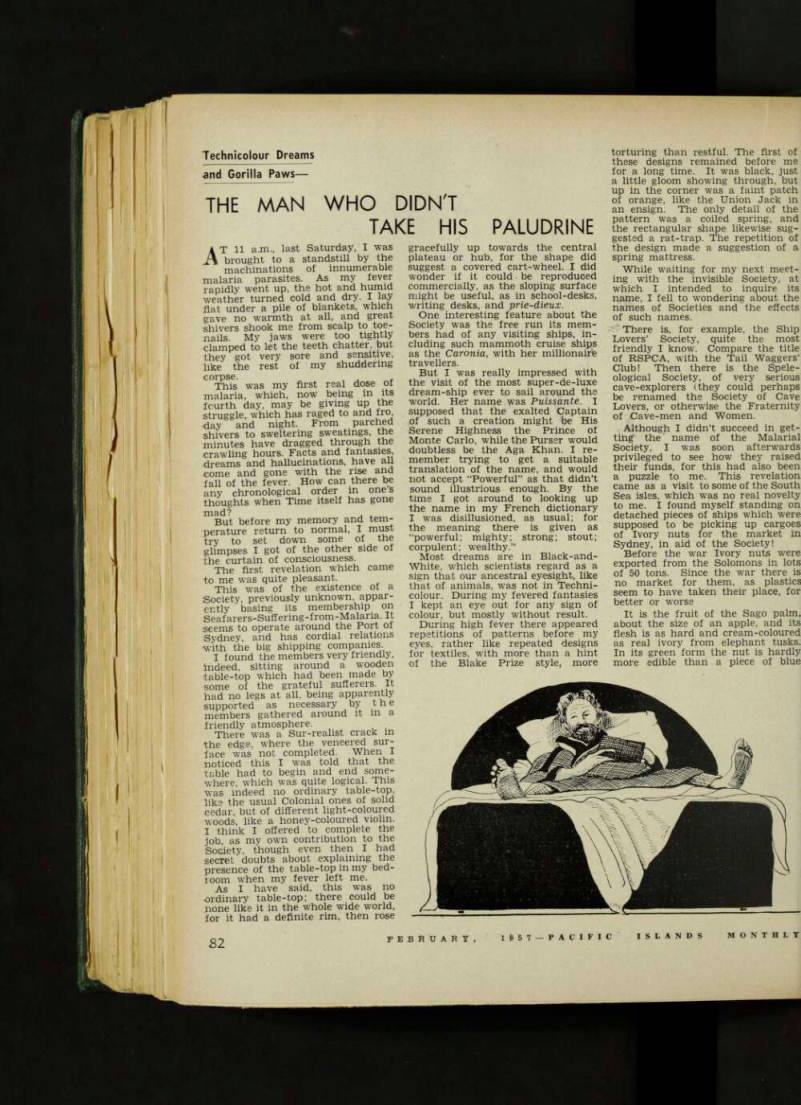
AT 11 ajn., last Saturday, I was brought to a standstill by the machinations of innumerable malaria parasites. As my fever rapidly went up, the hot and humid weather turned cold and dry. I lay flat under a pile of blankets, which gave no warmth at all, and great shivers shook me from scalp to toe nails. My jaws were too tightly clamped to let the teeth chatter, but they got very sore and sensitive, like the rest of my shuddering corpse. . f This was my first real dose of malaria, which, now being in its fourth day, may be giving up the struggle, which has raged to and fro, flay and night. From parched shivers to sweltering sweatings, the minutes have dragged through the crawling hours. Facts and fantasies, dreams and hallucinations, have all come and gone with the rise and fall of the fever. How can there be any chronological order in one s thoughts when Time itself has gone mad? , , But before my memory and tem perature return to normal, I must try to set down some of the glimpses I got of the other side of the curtain of consciousness.
The first revelation which came to me was quite pleasant.
This was of the existence of a Society, previously unknown, appar ently basing its membership on
Seafarers-Suffering-from-Malaria. It
seems to operate around the Port of Sydney, and has cordial relations -with the big shipping companies.
I found the members very friendly, indeed, sitting around a wooden table-top which had been made by some of the grateful sufferers. It Lad no legs at all, being apparently supported as necessary by the members gathered around it in a friendly atmosphere. .
There was a Sur-reahst crack in the edge, where the veneered sur face was not completed. When I noticed this I was told that the table had to begin and end some where, which was quite logical. This was indeed no ordinary table-top, like the usual Colonial ones of solid cedar, but of different light-coloured woods, like a honey-coloured violin.
I think I offered to complete the job, as my own contribution to the Society, though even then I had secret doubts about explaining the presence of the table-top in my bed room when my fever left me.
As I have said, this was no ordinary table-top; there could be none like it in the whole wide world, for it had a definite rim, then rose
gracefully up towards the central plateau or hub, for the shape did suggest a covered cart-wheel. I did wonder if it could be reproduced commercially, as the sloping surface might be useful, as in school-desks, writing desks, and prie-dieux.
One interesting feature about the Society was the free run its mem bers had of any visiting ships, in cluding such mammoth cruise ships as the Caronia, with her millionairte travellers.
But I was really impressed with the visit of the most super-de-luxe dream-ship ever to sail around the world. Her name was Puissante. I supposed that the exalted Captain of such a creation might be His Serene Highness the Prince of Monte Carlo, while the Purser would doubtless be the Aga Khan. I re member trying to get a suitable translation of the name, and would not accept “Powerful” as that didn’t sound illustrious enough. By the time I got around to looking up the name in my French dictionary I was disillusioned, as usual; for the meaning there is given as “powerful; mighty; strong; stout; corpulent; wealthy.”
Most dreams are in Black-and- White, which scientists regard as a sign that our ancestral eyesight, like that of animals, was not in Techni colour. During my fevered fantasies I kept an eye out for any sign of colour, but mostly without result.
During high fever there appeared repetitions of patterns before my eyes, rather like repeated designs for textiles, with more than a hint of the Blake Prize style, more
torturing than restful. The first of these designs remained before me for a long time. It was black, just a little gloom showing through, but up in the corner was a faint patch of orange, like the Union Jack in an ensign. The only detail of the pattern was a coiled spring, and the rectangular shape likewise sug gested a rat-trap. The repetition of the design made a suggestion of a spring mattress.
While waiting for my next meet ing with the invisible Society, at which I intended to inquire its name, I fell to wondering about the names of Societies and the effects of such names.
There is, for example, the Ship Lovers’ Society, quite the most friendly I know. Compare the title of RSPCA, with the Tail Waggers’
Club! Then there is the Spele ological Society, of very serious cave-explorers (they could perhaps be renamed the Society of Cave Lovers, or otherwise the Fraternity of Cave-men and Women.
Although I didn’t succeed in get ting the name of the Malarial Society, I was soon afterwards privileged to see how they raised their funds, for this had also been a puzzle to me. This revelation came as a visit to some of the South Sea isles, which was no real novelty to me. I found myself standing on detached pieces of ships which were supposed to be picking up cargoes of Ivory nuts for the market in Sydney, in aid of the Society!
Before the war Ivory nuts were exported from the Solomons in lots of 50 tons. Since the war there is no market for them, as plastics seem to have taken their place, for better or worse It is the fruit of the Sago palm, about the size of an apple, and its flesh is as hard and cream-coloured as real ivory from elephant tusks.
In its green form the nut is hardly more edible than a piece of blue
metal, and is covered with tight scales like a fish.
This skin peels off, the underskin rots into dark brown powder, so that the mature nut has the same dirty look as an old potato. In shape the marketed nut could easily be mis taken for a petrified apple, in which the core had rotted away. The market value of the nut used to be based on its manufacture into buttons, serviette rings and similar Items. Apart from the interesting and intriguing form of the nut it self, it has an interesting life history. For the Sago palm which bears it must first mature for 15 or 20 years, before it shoots up a special pole with branches bearing the one and only crop, consisting of about 200 nuts, after which the palm dies off. , . . .
But I digress. During the height of the fever, I found that I was over-sensitive to noise of any sort, especially any “hep music” from a blaring radio and by night, between fitful periods of sleep, the mos quitoes became my worst tormenters, despite much spraying with DDT.
They could aim accurately at my face from many yards distance in the dark, as though it were a radio beacon for their dive bombing.
With both engines over-revving they zoomed into the attack, then cut their motors as they crash landed on my cheek or temple with their rubber-sprung boots; just as they jambed on the brakes my free hand crashed down on them.
This generally meant the end of a suicide bomber, and the end of any sleep for me.
The main battlefield was the right side of my face, so it was almost a relief when the great hairy paw of a gorilla landed whallop on my left cheek. I didn’t care a hoot, but my long-suffering wife became instantly vocal, rising through about 64 octaves before I had time to suggest that it was only a cat or a ’possum.
It turned out to be a kitten which had recently adopted us, and after entering by the open window had homed on my face from the window sill, apparently using the same blind-landing navigation as the mosquitoes.
The fever has now subsided to a constant state of dampness and perspiration, but that is not unique in the present Sydney weather, which has been quite as humid, and almost as hot, as any part of the tropics.
Signed by BRETT HILDER, MSSSM ( late member of the Society of Seafarers-Suffering-from- Malaria). t The Aleisa Settlement, Western Samoa, the agricultural colony for local-born Europeans, re-elected its Mayor, Edward Westbrook, in a re cent election. Aleisa settlement is the only European communal body existing in the Territory.