tropicalities
pp. 83-84 · Read in the full issue
Magazine Section
The Human-Interest Story
That Got Away
FROM the Sydney “Daily Tele graph” of recent date, under the heading, “Suva’s Roads Are Short”: A golden, white-skirted man walked into Sydney Traffic Court to watch justice being administered to erring motorists.
The tall, well-built figure be longed to visiting Tongan Police Force Inspector Palu.
As the magistrate handed out fines to apologetic speedsters, In spector Palu said that in Suva the farthest a person could drive was 40 miles.
“Then you come to the end of the road and the beginning of the sea,” he said.
To the editorial dept, of the “Tele” we offer, at trade discount, a copy of the “Pacific Islands Year Book,” which fixes all Islands’ cap itals accurately—such as Suva be ing the capital of Fiji which has many hundreds of miles of excellent roads; and Nukualofa being the capital of Tonga.
Yin Ordinaire Drinkers Do
Not Pay For The Spuds
rnHE French are a practical lot— X —particularly when it comes to effective, if bizarre, taxes.
Our New Caledonia correspondent reports that a tax put on all alcoholic drinks, except beer and vin ordinaire, last August, has since netted a million francs —about £A7,000 —which will go into a “tourist fund” to improve country hotels and other tourist facilities.
And not content with this, another slug of 15 per cent, was put on the same type of drinks about the same time, and has collected another £7,000 —this time for the benefit of local New Caledpjnian potato pro ducers!
The fund assists growers to buy seed potatoes from Australia. Last August, of course, Australian pota toes were virtually gold-plated—be tween two and three shillings per pound. Since then there has been a slump, and £7,000 should, at current prices, be sufficient to supply New Caledonia with every spud it will need for a whole year.
Who Lost A Flag?
MEDICAL Officer I. Markheim, medical officer of the new Matson liner Mariposa, and former medical officer in the US
Marine Corps, delivered a British flag of some interest, to the United Kingdom High Commissioner at Sydney in January.
Markheim said that he had found the flag in a captured Japanese hut in the Solomons. The High Com missioner expressed the opinion that it was the former flag of the Resident Commissioner at Guadal canal. (The BSIP Resident Com missioner lived at Tulagi before the war; the High Commissioner for the Western Pacific was then also the Governor of Fiji. The two posts were separated at the end of 1952).
Markheim was seriously wounded at Rendova, invalided back to Auck
land, and spent a further four years in hospital in the United States.
He took the flag as a souvenir, but now feels that it should be returned to the
appropriate
authorities as of historical i n terest.
Day In The
Life Of An
Ado
IT is a coastal village in New Guinea.
The teacher’s wife is sick but in the cussed manner of women wants to go to the garden to plant yams just the same.
The husband says no; stay in the house and have a rest.
They argue for a while and the wife’s temper flares. The husband orders her to stay home, and keeps his temper.
In a fit of anger she chops all the yam plants to pieces.
He does not take any notice of her. So she
gets wilder and starts breaking up the happy home. Though he does not want to lose his temper, he decides that it is time to stop her.
A few bumps on the head and a black eye are the results for the wife.
More furious than ever, she re ports to the District Office that she wants to “make court” against her husband, because: (1) He did not get angry when she was, and did not stop her from chopping up the yam plants; (2) He hit her in the face and disfigured her, while he should have hit her on a more sensible part of the body.
The ADO hears the case a few days later. The wife by then has had time to cool down; she does not want her husband to go to jail, especially when she learns that while there he will have no tobacco to smoke.
The court opens and she is asked to make her complaint.
“I have nothing to say,” is all the ADO can get out of her.
“I have nothing to say,” repeats
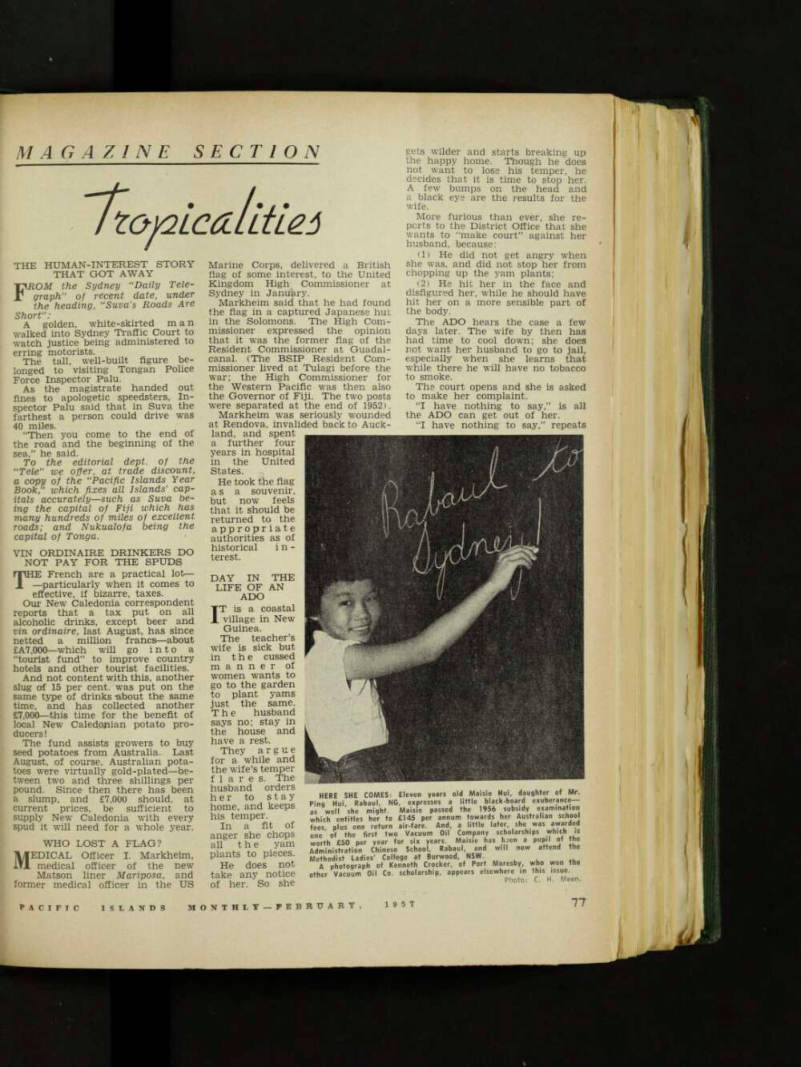
HERE SHE COMES: Eleven years old Maisie Hui, daughter of Mr.
Ping Hui Rabaul, NG, expresses a little black-board exuberance— as well she might. Maisie passed the 1956 subsidy examination which entitles her to £145 per annum towards her Australian school fees plus one return air-fare. And, a little later, she was awarded one of the first two Vacuum Oil Company scholarships which is worth £50 per year for six years. Maisie has a pupil of the Administration Chinese School, Rabaul, and will now attend the Methodist Ladies' College at Burwood, NSW.
A photograph of Kenneth Crocker, of Port Moresby, who won the other Vacuum Oil Co. scholarship, appears elsewhere in this issue.
Photo: C. H. Meen.
the husband when he is asked to say his piece.
Annoyed, but resigned, the ADO dismisses the case and sends the pair packing.
They Save Money And
Mana
ANOTHER Cook Islands’ custom shows signs of dying out with the increase of a money economy.
This is the practice of holding extravagant wedding and funeral feasts, known as umukais.
At wedding feasts the families of bride and groom strive to outdo each other in the matter of pro viding food and presents and put ting on the biggest show. The guests sometimes run into hundreds, and, in spite of wedding presents received, the young couples often begin their married lives much im poverished. Funeral feasts are also big and very expensive.
Years ago pigs and poultry were raised by Cook Islanders for the purpose of providing food for feasts, and they cost the owners only the price of their feed. Store goods were also cheap. But in Raro tonga to-day many people pay high prices for all these things.
A growing awareness of the value of money and how it should be used has caused some of the younger people to ask if something could not be done to reduce the heavy expenses incurred by umukais.
The Roman Catholic Church and the London Missionary Society have asked the people to hold less ex travagant feasts, and are receiving the support of the young people.
Some of the Co-operative Societies established in Rarotonga and Atiu have also put into practice ideas for helping their members reduce costs of wedding and funeral feasts, without losing personal prestige.
When a death occurs in the family of a Co-op. member, fellow members undertake to do any work in connection with the funeral free of charge. They have also agreed that expensive feasts are not necessary.
When a Co-op. member wishes to marry he asks his Committee for their assessment of a reasonable amount to expend on the feast. In this way extravagance is avoided and the prospective groom’s mana is saved by shifting the respon sibility from his shoulders to those of the Committee. The only people to oppose these enlightened views and new-fangled notions are the older members of the community.
But in spite of them it seems certain that the spectacular but wasteful umukais will become a thing of the
Past.—W. H. Percival.
Bring On That Old South
Seas Magic
WE presume that the gentleman in the Homburg hat saying “How” to the American Indian (above), is Mr. S. Jackson Coleman,
Hon. Principal of the Folklore Academy, Isle of Man. (The old gentleman, in the white nightie on the right, is evidently an Ancient
Druid, with a very groggy-looking Stonehenge in the background).
Mr. Coleman writes, with some exuberance, and on egg-yellow notepaper with this cute little drawing as a letterhead, that he is shortly to make a voyage on Southern Cross, calling at Papeete and Suva, as well as at Australian ports, there, we presume, to collect folk-lore. He says—amongst other things in three closely typed pages, too long, alas, to reproduce here— that: “I am looking forward very much in Fiji to getting the melody of the Isa! Isa! vulagi lasa dina; some
of the mussel-shells used by the natives as a musical instrument; and any luck-bringing charms em ployed by them; as well as to see on arrival in Tahiti the cloud topped volcanic peaks of Tahabut and the coral walls around Papeete, But, naturally, to my wife and self the kaleidoscope of colour at Tahiti will be surpassed by any memories we can get of the posturing natives as they provide for us a pageant, of history that has never been written or read.”
We don’t know exactly what you are getting at, Mr. Coleman; but we can promise you one thing; When you hit Suva and Papeete you are going to get some big, big surprises.
Mr. Coleman (who is also a barrister-at-law, and life member of the Royal Geographical Society, the Royal Anthropological Society, the Royal Empire Society, the Oyer seas League and the English- Speaking Union) feels that radio and television interviews might get him in contact with the natives.
And that newspaper articles could help, also; especially (as happened to a friend of his in Africa), if he could be made “an honorary tribal chief.”