Pacific Shipping And Cruising Yachts
pp. 63-104 · Read in the full issue
This Month's News of—
No Wake For This Argosy
WHAT happened to the “Argosy” expedition, we asked in PIM in August, 1956 —and now have received the answer from Mr. Ernst Lamberty (owner of the yacht “Anna Elizabeth”), who has been a resident of Santo, New Hebrides for the past couple of years.
In our August paragraph (“In the Wake of the Beagle—Phase Two”) we said that the Royal Societies of Australia, New Zealand, and South Africa might join forces to organise a scientific world cruise in the wake of Charles Darwin’s Beagle. We recalled too, that another such expedition, privately organised in the United States, had cleared New York in May, 1951, in a large ketch named Argosy, but the vessel had never reached the Pacific.
It seems that the Argosy expedition was financed largely by Argosy Magazine, whose publishers evidently did not realise until too late just who they were dealing with when they placed their trust
in Captain George Black “Dod”
Orsborne.
However, with Captain Orsborne in gaol in Trinidad the magazine’s issue of February, 1952, carried a story possibly more interesting than any which might have eventuated had the cruise proceeded as planned.
Captain Orsborne will be best remembered by a good many readers as connected with the famous Girl Pat incident which was front page news back in 1936.
Under his command the trawler Girl Pat sailed from Grimsby for a routine fishing voyage in the North Sea, but failed to return.
Naval vessels carried out a wide search but failed to locate her close to home, and eventually the trawler showed up at Dakar, West Africa, refuelled, and quickly departed again—and was finally arrested in British Guiana.
Orsborne later received a sentence of 18 months hard labour for the escapade. While in gaol he found time to write Master of the Girl Pat —his own version of the affair, which was substantially different from what had come out in court.
From subsequent events it is evident that Captain Orsborne is a good deal better acquainted with
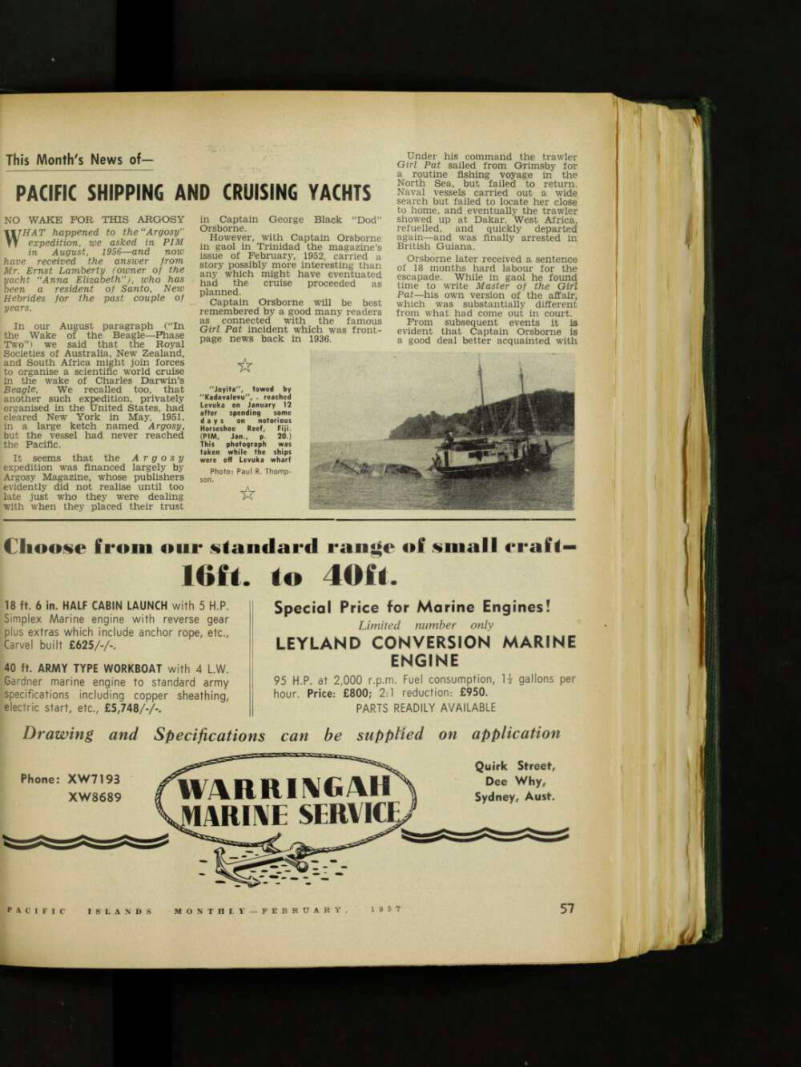
"Joyita", towed by "Kadavalevu", reached Levuka on January 12 after spending some days on notorious Horseshoe Reef, Fiji. (PIM, Jan., p 20.) This photograph was taken while the ships were off Levuka wharf Photo: Paul R. Thomp son.
fiction than with fact, especially where the subject of his own life history is concerned. For example, English newspapers investigating thrilling World War I adventures which Orsborne, during a lecture tour in the United States, alleged he had had, found from a perusal of birth records that he was just 8 years old when that war broke out.
Still, in writings and lectures, Orsborne carried right on, supplying the public with what they wanted to read and hear, and finding ready space available in the “true life” adventure type of periodical where he could give his imagination full play.
In the end it seems that he honestly believed his own ’“fantastic stories of his life.
He also seems to have been quite hopeless as an organiser and leader of an expedition, and a very poor seaman, to boot.
The Argosy expedition was one of those that never seemed to be quite ready to sail, despite money from the backers flowing like water through Captain Orsborne’s hands.
Eventually he was almost kicked out of New York and on his way.
Dissension rapidly developed aboard and the ketch was seized at Trinidad—that being the end of the affair.
Orsborne, with his fantastic uniforms which he was not qualified to wear, was last sighted in Venezuela.
Submerged Macuata Towed
Into Suva
Towed by another Burns Philip vessel, the Ratanui, the Macuata, which, on January 4, went on a reef west of Moturiki, arrived at Suva on January 14.
The Yanawai, another Burns Philip vessel, was diverted to the scene of the wreck and towed the
Macuata off the reef and then towed her to Levuka.
When she entered Suva Harbour the stern of the Macuata was well under water. WTien she arrived at Levuka her exhaust was under water, but she was lifted with drums to make the trip to Suva.
The Macuata is an auxiliary ketch of 80.16 tons net and 127.93 tons
gross. She will go on the slip when it is available.
Third Sister For Mm’S
Pacific Service
Messageries Maritimes Shipping Line is building a new ship, the Australien, for the Marseilles- Panama Canal-Tahiti-New Cale donian-Sydney service.
The firm’s Sydney’s agents have received advice that construction of the new ship was started in Sep tember at Chantiers Navals de la Ciotat shipping yards, Marseilles.
Australien will be a sister ship to Tahitien and Caledonien, which started to operate between Marseilles and the South Pacific late in 1952.
She will have a 13,000 tons dis placement, and like her sister ships, will combine passenger and cargo traffic.
It is not yet known when Aus tralien is likely to come into service.
Poor Facilities For Local
Ships At Suva
While the Suva Chamber of Com merce is hammering away at the Government for more wharf sheds for overseas cargo, little attention is paid to wharf and shed accom modation for local shipping.
Particularly at week-ends Prince’s Wharf is crowded to such an extent that cutters and the larger local vessels have to berth abreast of each other.
This holds up the discharge and loading of the vessels, and unless some relief is forthcoming these delays must result in higher freight rates.
If local vessels carrying copra are sent to the Walu Creek berth, double handling is involved in bringing the copra to the copra shed at Prince’s Wharf.
Only two small sheds are avail able at Prince’s Wharf to take copra and general cargo.
With the building of new wharves at Walu Bay, better provision for local shipping will no doubt be made, but in the meantime ex pensive congestion frequently occurs.
Exit Southern Cross Vii,
Enter Kilinailau
Southern Cross VII, which The Bougainville Co. Ltd., recently bought from the Melanesian Mission,
left Sydney at the end of January for Rabaul. ( PIM, Jan., p. 103).
Captain Bill Hallam, managing director of the company, went to Sydney after the purchase to super vise work done on the ship in a Balmain shipyard. The steering gear, bilge pipes and main engine all had to be overhauled after the ship’s long lay-up.
Captain Hallam expected to be in Rabaul about the middle of February; the ship was carrying/ cargo. It is proposed to slip her in Rabaul to modify her for trading in New Guinea waters.
Under the terms of sale the name of the ship has to be changed. The new owners have chosen Kilinailau,
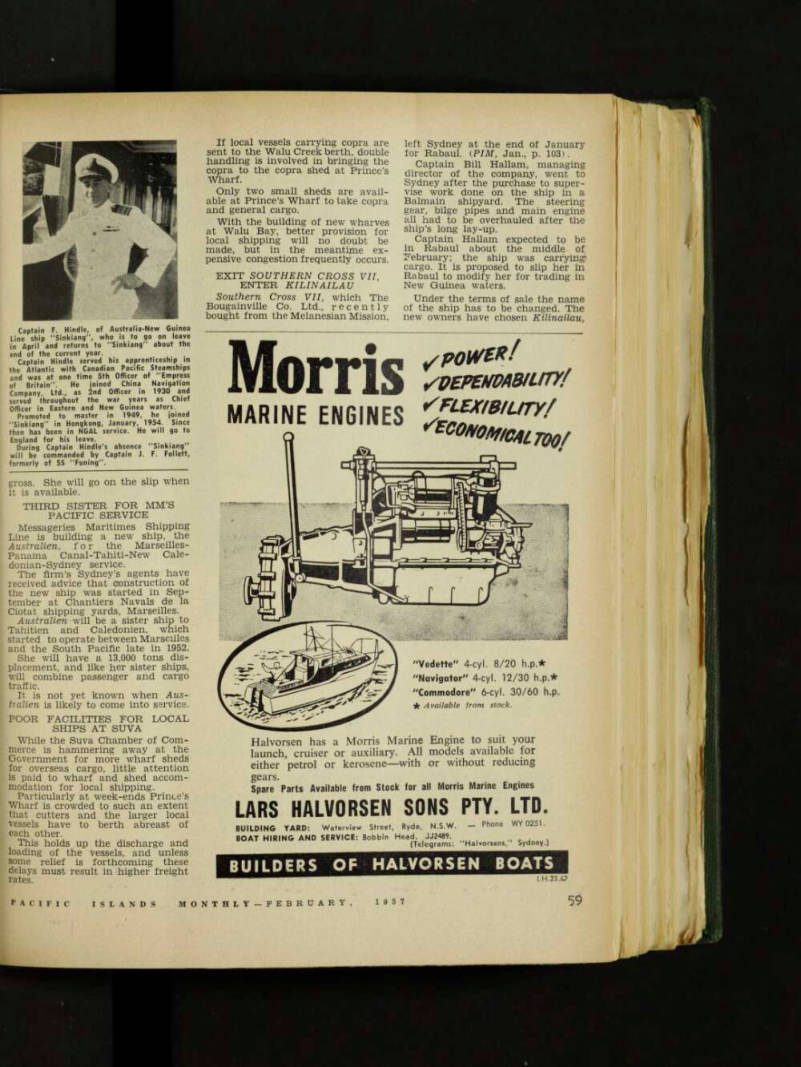
Captain F. Hindle, of Australia-New Guinea Line ship "Sinkiang", who is to go on leave in April and returns to "Sinkiang" about the end of the current year.
Captain Hindle served his apprenticeship in the Atlantic with Canadian Pacific Steamships and was at one time sth Officer of "Empress of Britain". He joined China Navigation Company, Ltd., as 2nd Officer in 1930 and served throughout the war years as Chief Officer in Eastern and New Guinea waters.
Promoted to master in 1949, he joined "Sinkiang" in Hongkong, January, 1954. Since then has been in NGAL service. He will go to England for his leave.
During Captain Hindle's absence Sinkiang will be commanded by Captain J. F. Follett,
formerly of SS "Funing".
after an island in the Carteret Group.
Purchase of the ship gives The Bougainville Co. three vessels. The other two are Nuguria and Polurrian.
The company also operates the Nusa under charter.
When the ship is modified she will have accommodation for 10 passengers, and a crew of 25—five
officers and 20 natives.
The ex-Southern Cross is of 298 gross and 142-net tonnage. She is 111 ft long.
Captain Hallam had a crew of natives with him —from Buka and Carteret. His company is the only, private company which employs Carteret Islanders.
It is expected that the renamed
"Matua", aground on Duff Reef, Fiji, lowers away a lifeboat. See story page 63). Photo: R. F. Rankin.
vessel will start trading about the end of March. She will be used for carrying copra.
Yankee Reaches Pitcairn
Arrived at Pitcairn Island early February the brigantine Yankee , with a paying crew, plus the Irving Johnsons. They left Balboa for the Galapagos on December 5. (Jan.
Pim, P. 109).
The Americans were expected to stay on Pitcairn for up to a fort night. Some Pitcairn Islanders were to travel from Pitcairn to Hender son Island in the brigantine to collect the precious mero wood they use in their most important “in dustry”—making curios for sale to tourists.
Monterey’S Master Has
Long Connection With
Pacific
A recent meeting between Captain M. C. Stone, master of the Monterey, and Dr. Stanley Bailes, now world president of the Bible Society, recalled trying circum stances, for Dr. Bailes, when they first met in August, 1930.
Captain Stone was an officer on the old Ventura when she made a dash across the South Pacific, with two other ships, to rescue the passengers and crew of the sinking liner, Tahiti. Dr. Bailes was one of the rescued passengers.
He and Captain Stone met for the first time since 1930 when, a
few weeks ago, Dr. Bailes walked on board the Monterey, before her maiden voyage from San Francisco to Sydney The steam ghlp Company has given this account of Tahiti’s slnkm 8 : “She was lost in mid-Pacific in August, 1930, as the result of an
extraordinary accident to the vessel on a voyage from Wellington to San Francisco. The vessel was about 460 miles south of Rarotonga 15 - T he ractag engine was stopped immediately, but the jagged end of the broken shaft, whipping violently, must have torn a large hole in the
shell-plating on the after-end of the ship.
“When the second engineer, Mr.
A. Thompson, went into the shaft tunnel to investigate he was con fronted with a great inrush of water.
“He raced back into the engine room and ordered the watertight doors to be closed. The damaged bulkhead was shored up but much water had found its way into the engine-room, and the after holds were flooded.
“In the meantime, Captain A. P.
Coten, master of the Tahiti, had got into wireless communication with the Tofua (not the present USS Co.
ship of the same name), the Norwegian ship Penyhryn, and the American steamer Ventura, all of which hastened to the assistance of the Tahiti, while the crew laboured to keep her afloat.
“The end was near when Penyhryn and Ventura arrived. The passeng ers of Tahiti, numbering 103, and and the crew of 149, were trans ferred in the ship’s boats.
“When Captain Coten returned to his ship for a final inspection the engine-room was flooded, and she sank soon after he returned to the Ventura”
A few years earlier, Tahiti was con cerned in a shocking mishap in Syd ney Harbour. She and the ferry Grey
cliffe, which was on the Watson’s Bay run, collided in mid-harbour.
The Tahiti was not damaged, but many passengers from the Grey cliffe, which was cut in half, were drowned.
Reef Troubles For Matua
Two well-known Islands ships, Matua and Bulolo, had brushes with Pacific reefs in January.
The Union Steamship Company owns the 4,000 tons Matua, which struck Duff Reef on a voyage be tween Apia and Suva on January 22. Duff Reef is about eight miles east of Wailangilala lighthouse in Northern Lau, and Matua was on
(Continued on Page 97)
A couple of bumps and you're down! Life boat lowered away from "Matua" aground on Duff Reef, Fiji. (Story this page).
Photo: Eric S. Adams.
her usual route around the islands from Auckland, NZ.
When Matua grounded at 2 a.m., Captain J. Broughton sent out a distress signal on the local Fiji frequency, which was relayed to the Harbour Master, Suva. Suva con tacted the Matson ship Monterey, then on her maiden voyage to Aus tralia, and Monterey altered course, but later found that four US de stroyers on their way to Suva and Brisbane from Honolulu were nearer.
The destroyers reached Matua about dawn and found —according to one of the American officers when he reached Brisbane —everything organ ised for taking off the passengers, all of whom were treating the grounding “more like a picnic” than a marine disaster.
The 126 passengers and some of the crew were transferred to the destroyers without incident, and then two of the tugs pulled Matua off the reef—apparently undamaged.
With a skeleton crew on board she proceeded with destroyer escort to Suva, arriving about the same time as her passengers.
In Suva, divers examined her hull but damage was negligible; Matua resumed her voyage—with passeng ers—a day or so later.
Matua has been on the USS Co.’s islands service for a little over 20 years, during the war and post-war years providing the only link be tween Fiji, Samoa, Tonga, etc., and New Zealand (and the outside world).
During the war she kept com munications open, running the
gauntlet from Auckland round the islands unescorted and armed with a couple of inadequate guns in charge of a small team of NZ servicemen. She came through un scathed and in her 20 years of life has had few mishaps. In Sep tember, 1936, a month after she went onto the Islands service after delivery, she ran onto a reef near Aitutaki, Cook Islands, but sustained only slight damage to her rudder.
Captain Broughton has been master of Matua for about five years. (Over)
Partly submerged "Macuata" which was towed to Suva after running aground on a Fiji reef. (See page 58). —Photo by Stinsons.
—And Bulolo
Burns Philp’s 6,000 tons “flag ship” Bulolo ran aground at the entrance to Madang harbour, New Guinea, on February 5. She was re floated on the next high tide, sus tained no damage and continued her voyage around the New Guinea group and back to Sydney, where she was due on schedule.
Captain McDermott was Bulolo’s master on this voyage; her more usual Master, Captain Bill Wilding, at present being on another of the company’s ships.
Burns Philp’s Sydney shipping department knew nothing about Bulolo —except that she had been on the mud but had got off.
Montoro Ii On Delivery
Voyage
Little information is available about the new Montoro although the ship is due in Port Moresby on her delivery voyage from Norway on February 15.
This motor-vessel of 3,700 tons dead-weight was launched from the yards of Nylands Werk last Sep tember and has come out via the Panama Canal.
Burns Philp’s shipping depart ment in Sydney—to extract infor mation from which is harder than drawing teeth —does not know to
which service Montoro II will go.
One way and another, we have gathered that no one in this canny Scots firm is prepared to acknow ledge the existence of this ship until she is actually showing her black-and-white chequered funnel from a berth in Sydney harbour.
Then, and only then, will they be prepared to admit —very reluctantly, of course—that the ship belongs to Burns Philp.
The unofficial story is, however, that Montoro Mark II will not be used in the Islands trade, but will go onto the Singapore run.