Territories Talk-Talk
pp. 33-137 · Read in the full issue
By Tolala
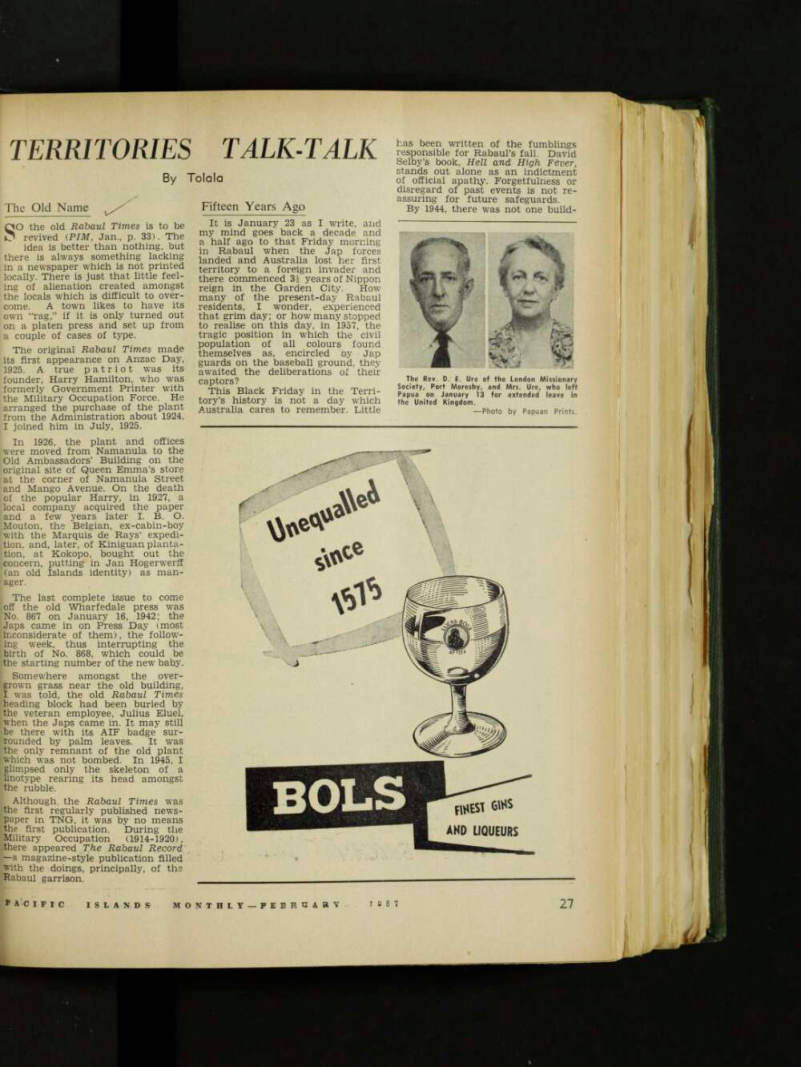
The Old Name SO the old Rabaul Times is to be revived (PIM, Jan., p. 33). The idea is better than nothing, but there is always something lacking in a newspaper which is not printed locally. There is just that little feel ing of alienation created amongst the locals which is difficult to over come. A town likes to have its own “rag,” if it is only turned out on a platen press and set up from a couple of cases of type.
The original Rabaul Times made its first appearance on Anzac Day, 1925. A true patriot was its founder, Harry Hamilton, who was formerly Government Printer with the Military Occupation Force. He arranged the purchase of the plant from the Administration about 1924.
I joined him in July, 1925.
In 1926, the plant and offices were moved from Namanula to the Old Ambassadors’ Building on the original site of Queen Emma’s store at the corner of Namanula Street and Mango Avenue. On the death of the popular Harry, in 1927, a local company acquired the paper and a few years later I. B. O.
Mouton, the Belgian, ex-cabin-boy with the Marquis de Rays’ expedi tion, and, later, of Kiniguan planta tion, at Kokopo, bought out the concern, putting in Jan Hogerwerff (an old Islands identity) as man ager.
The last complete issue to come off the old Wharfedale press was No. 867 on January 16, 1942; the Japs came in on Press Day (most inconsiderate of them), the follow ing week, thus interrupting the birth of No. 868, which could be the starting number of the new baby.
Somewhere amongst the over grown grass near the old building, I was told, the old Rabaul Times heading block had been buried by the veteran employee, Julius Eluel, when the Japs came in. It may still be there with its AIF badge sur rounded by palm leaves. It was the only remnant of the old plant which was not bombed. In 1945, I glimpsed only the skeleton of a linotype rearing its head amongst the rubble.
Although the Rabaul Times was the first regularly published news paper in TNG, it was by no means the first publication. During the
Military Occupation (1914-1920),
there appeared The Rabaul Record —a magazine-style publication filled with the doings, principally, of the Rabaul garrison.
Fifteen Years Ago It is January 23 as I write, and my mind goes back a decade and a half ago to that Friday morning in Rabaul when the Jap forces landed and Australia lost her first territory to a foreign invader and there commenced 3 h years of Nippon reign in the Garden City. How many of the present-day Rabaul residents, I wonder, experienced that grim day; or how many stopped to realise on this day, in 1957, the tragic position in which the civil population of all colours found themselves as, encircled by Jap guards on the baseball ground, they awaited the deliberations of then captors?
This Black Friday in the Terri tory’s history is not a day which Australia cares to remember. Little
has been written of the fumblings responsible for Rabaul’s fall. David Selby’s book, Hell and High Fever, stands out alone as an indictment of official apathy. Forgetfulness or disregard of past events is not re assuring for future safeguards.
By 1944, there was not one build-
The Rev. D. E. Ure of the London Missionary Society, Port Moresby, and Mrs. Ure, who left Papua on January 13 for extended leave in the United Kingdom. —Photo by Papuan Prints.
ing standing in the town; to-day Rabaul grows apace and lives again.
I am reminded of some lines I wrote as a war internee in June, 1945: The Garden City lies a blasted mass Of desolated homes and ruined stores; Of broken roadways covered o’er with grass.
While twisted ships lie out along the shores. . .
Lie gently, leaves, as you come tumbling down!
Who knows? . . . Rabaul may live again some day.
And sure enough the Frangipanni blooms again.
Near The Full Of The Moon Another double murder from Rabaul. Undoubtedly most dis tressful; but what really amazes me is that there are not more of these tragedies befalling these mixed-race romances. The first tragedy was the murder of a Malay and nis Chinese girl friend; now comes a Chinese and his Australian fiancee.
We all know that passions ride high in the South Seas. . . Bud moralising gets one nowhere.
Old-timers who have a knowledge of native ways—call it “psychology,” if you wish—realise the influence of the full moon in regard to sex acts, legal or otherwise, and have no doubt noted that the first murder was committed five days before the full moon in May; while the last crime took place four days before the January full moon.
It was a few decades ago now when I was sitting on a sand beach with a crowd of native men down Buka way; a full moon riding over head; from various points along the beach rose the eerie “W-o-W-o” cry from male moonlight strollers.
“The time now for young men to chase the girls,” said an elder, speaking in the vernacular. I asked him why now more than any other time. “Full moon time,” he replied, pointing to the sky. Further en quiries from the haus-meri brought the reply: “Fashion all-the-same.
All cranky man he like pull ’im Mary s’pose moon he big fella. Who’s that he savvy belong all?”
I don’t know whether police records bear out the fact that there are more sex crimes at or near full moon time. It would be interesting to know.
Skeletons In
Rabaul
Three skeletons of Jap soldiers have been found in Rabaul. It is surprising that more have not come to light. During ’42 and ’43, the
bodies of Japanese were cremated, the asher placed in small wooden boxes and shipped back to Nippon.
But in early ’44, when sea com
munication was practically cut off, the bodies were buried, usually in the vicinity of their dug-outs.
(Continued on Page 31)
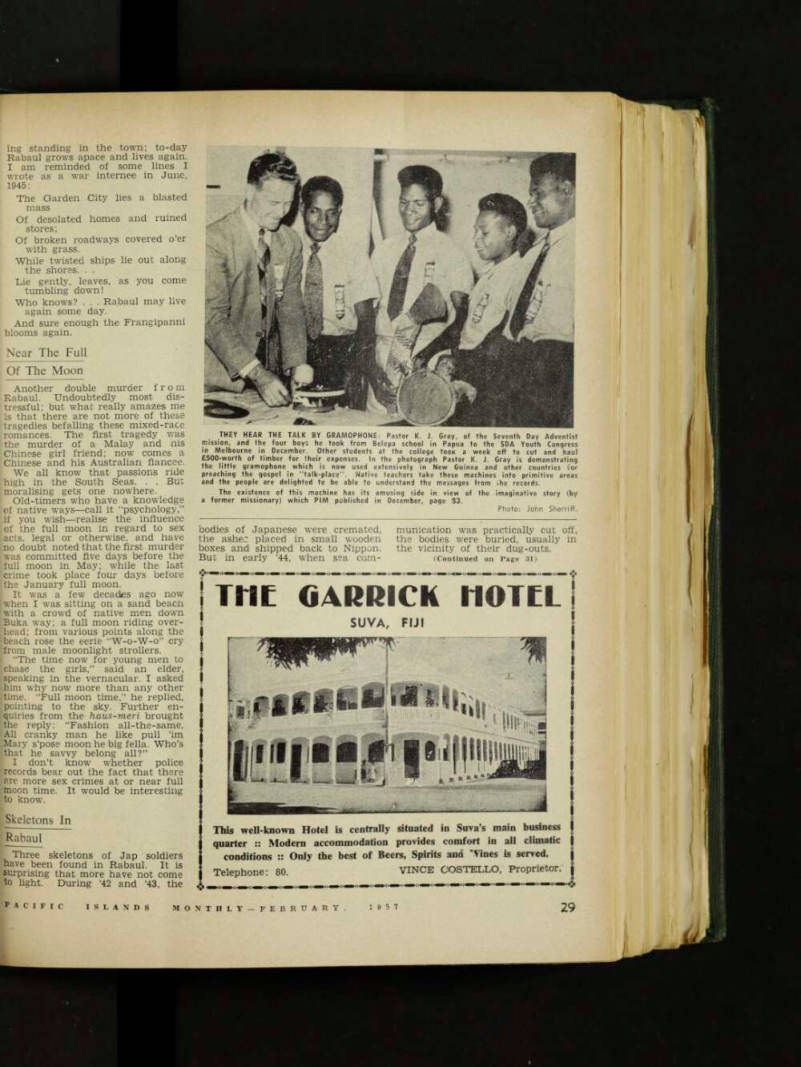
THEY HEAR THE TALK BY GRAMOPHONE: Pastor K. J. Gray, of the Seventh Day Adventist mission, and the four boys he took from Belepa school in Papua to the SDA Youth Congress in Melbourne in December. Other students at the college took a week off to cut and haul £500-worth of timber for their expenses. In the photograph Pastor K. J. Gray is demonstrating the little gramophone which is now used extensively in New Guinea and other countries for preaching the gospel in "talk-place". Native teachers take these machines into primitive areas and the people are delighted to be able to understand the messages from the records.
The existence of this machine has its amusing side in view of the imaginative story (by a former missionary) which PIM published in December, page 83.
Photo: John Sherriff.
Clothes And The Man The Planters’ Association of New Britain has been complaining be cause some Administration officials on patrol have not been upholding the dignity of the Service owing
to a laxity in dress.
No matter how appropriate this criticism may be (and I believe it hits many nails on the head) one scarcely expects the Administration to accept such a complaint with good grace. Officialdom takes a dim view of any adverse criticism.
There was a time when NG had
a dress-consciousness of its own, reaching a far higher standard than the Australian idea. (We used to shudder at the rig worn by some members of visiting Parliamentary
parties—especially Labour Senators).
But since War 11, it seems that Australian standards of dress (or rather undress) have extended to the Territory for both male and female.
Still, as both dignity and respect for the white race appear to be considered symptomatic of “colonial ism,” it doesn’t seem as if we can do anything about it. The Planters’
Association will, no doubt, be fobbed off with the admonition they are a lot out-of-date die-hards de sirous of fostering racial discrim ination.
I think myself, that if more re gard were paid to both clothing and deportment by both sexes there would be less crime in the Terri tory.
Towards Family Life
The possibility of introducing family units on plantations has been suggested again, but some planters’ representatives appear to be taking a rather dim view of the suggestion.
It was a common practice 40 or
Mr. and Mrs. J. Brown, of Rabaul, photographed after their wedding at Astonville, Northern NSW, on February 1. Mrs. Brown was formerly Miss Edith Faulkner, of the Transport Dept., lae, NG. Mr. D. Brown (extreme left), brother of the groom, was bestman; Miss Clare Faulkner (right), sister of the bride, was bridesmaid.
50 years ago in NG when labour conditions were easier and in dividual liberties greater.
I know of several old-time plant ers who, in the early ’3o’s, when the bottom fell out of the copra market, sacrificed many a personal amenity in order to support their old native pensioners still living on the estates. Certainly, it was some thing like the old feudal system but the native families enjoyed it and were loyal.
I cannot see it being revived under present conditions —whether the native families want it or not.
The idea suggests the “Deep South” functioning under the aegis of trade unionism, and like oil and water they don’t mix.
A Fused
Service
The PSA in P-NG has always something to worry about. The latest cross to bear is the sug gestion by Canberra favouring a “combined Territorial Service com prising the Department of Terri tories and the P-NG Administra tion.”
The idea of chair-borne Canberra officials walking into top jobs in P-NG over the heads of officers who have spent years in the Terri tory service is, in my opinion, the quintessence of Bureaucracy, and if Minister Hasluck is prepared tc associate himself with such a policy then he can be assured he will not get the best material for the jobs he is advertising now.
Canberra and P-NG requirements are miles apart and much of the dissatisfaction in the Service has been due to the overlord tactic from the Federal Capital. More thar half the trouble in Territorial PSA ranks has been occasioned by a dis regard by Canberra of local P-NG officials when appointments for to* brass jobs have been made.
Most glaring example has beer the former appoinments to the posi tion of Assistant Administrator am if Steve Lonergan doesn’t get i this time, the PSA should mak( an issue of it.
It would be difficult to imagim Sir Hubert Murray allowing hi men to be passed over in thii cavalier Canberra manner.
Justice
Or The Law?
On reading “A Matter of Simpl Comparison” (PIM, Jan., p. 151) there came to mind that old cliche voiced so often by Judges in thei summing-up about “Justice mus not only be done, but appear t<
(Continued on Page 129)
ic done.” As a rider I would add: rustice must appear to be im lartial.
Of the P-NG Supreme Court there an, naturally, be no question as to ts separateness from Administra ion influence. There are times, lowever, when that same certainty annot be expressed concerning the mwer courts where presiding magis rates are officers of an Adminis
ration Department.
The late “Jerry” Hogan, TNG’s re-War CLO, and a bit of a rebel [i his way, was consistently com ilaining of top-level pressure be ng attempted in matters concern ig his department. But then that :as in the bad old days and, with ge, the leopard may have changed ts spots.
Jttle Sir Echo
Two Administration vessels, fitted rith echo-sounding devices, are to et busy soon charting the P-NG oasts. The job is expected to be inished some time in 1987.
The last peace-time hydrographic fork I remember seeing in action fas a German naval vessel survey ng Buka Passage in 1912. Local oophytes are busy little blighters nd there’ll be some change in reef ormation since then. Some of the Id charts are misleading, especially long the east coast of Bougain ille.
While in this area, by-the-way, he survey ship might have a go at Dcating the old German Govern ment steamer Buka, which was unk by the local Commissioner at he start of War I.
There was a rumour at one time hat a considerable amount of pecie went to the bottom of Roro irana Bay with the vessel. The old apanese diver, Captain Komini, pent some time years ago trying o locate the treasure trove, but ailed. That was before we had modern diving gear.
Publicity
to Big Lumps
The absence of P-NG news in >ydney newspapers of recent months except, of course, murder and hooting in Rabaul), was men ioned in January.
However, P-NG public relations ;ot going at full bore at the end if January with a 30-odd page sup plement in the Sydney Daily Tele graph, containing some good plugs or the Territory, its ideals, aspira tions and accomplishments/, as de ined by Minister Hasluck’ and some »f his henchmen. (Over)
It was well supported by local dvertisers.
One sub-heading was a bit mis ;ading when it read: “The Man dated Territories of New Guinea nd Papua.”
I couldn’t agree more with Cassa” Townsend when he said PIM, Jan., p. 94) ; “What is re uired is an Information Service to ell the truth fully, competently nd, let it be added, with dignity.”
I would add: and in an interest ag manner to catch the eye of the rdinary man-in-the-street.
Fair Air Fare
Question
P-NG’s Administration policy of laying air fares for children at ending Australian schools is get ing under the skin of some out lack Queensland parents, who want o know why such preferential reatment to P-NG and not to Q?
The snap answer, I should say, rould be the P-NG PSA. No school ares; no staff.
Bits And Pieces P-NG with its twenty-odd re igious denominations shouldn’t tforry overmuch. South Africa, iccording to a top-ranking Church )fficial, has 240 various denomina :ions at work. . . Calling Henry Collins Cecil, one-time of Wewak, md other points in TNG. An Engl ish firm of solicitors in England is seeking his whereabouts. “Some thing of advantage.” Well I re nember him when he was skipper
of the old-time Nugaria for the Exproboard, always with his cap at the Beatty angle. . . Passed on to her rest: Christina Margaret Furter, on January 20, at a private hospital in Mosman. She was the widow of Gottfried Furter, well known German storekeeper in Rabaul. She was an Australian, they met in Kavieng in pre-War I days when she was a governess for a planter’s family. . . Roderick Maclean, son of the late Dentist lan Maclean, of Rabaul, and Mrs.
Enid Maclean, of Collaroy, is en gaged to Barbara Lois Cash, of Parramatta.
PRETTY PORT MORESBY DEBS; At the Masonic Ball held in Port Moresby on January 12, Mrs. Normoyle, wife of Police-Commissioner 0C. Normoyle, presented these debutantes to the wife of the Administrator, Mrs. D. M. Cleland. They are (left to right): Misses Lynne Trebilco, [?]nne Brown Beresford, June Roberts, Kay Owen Turner, Annette Stoneham and Margaret Gunther, lower-girl Christine Adams in front.
Photo: Papuan Prints.