Territories Talk-Talk
pp. 131-137 · Read in the full issue
By Tolala
2 Goodies
d The Baddies
have seen Walk Into Paradise i and most heartily I agree with ics that the scenery is Number ; could not very well have been Brwise; also the native crowds, ugh over embellished at times i “sing-sing” regalia, earn top 'ks, as do also the Police Con mlary. 0 my mind it is the non-native ; that leaves something to be red. Ostensibly it is colourful paganda for the official policy. could almost have been pro ed by the local PRO.) turdy officials are unswerving heir task of implementing UNO ts, while the unofficial members he cast (droopy, dopey “Shark ’ Kelly—and why “Shark-Eye”? id the eccentric Clayton) all Bar in any way but a favourable t, and all to the glorification he officials. this is the price paid for official stance in producing this “Walk” 1 less said about it the better, ne section shows hostile native iws falling all around the Euro is and killing poor, old “Shark ” but the order is still to fire ire the heads of the attackers. A b naive for sophisticated audi ;s, surely. tiots of Moresby and Madang exceptionally good and a radio sage signed in Keith McCarthy’s dwriting (unless I am much :aken) lends a genuine touch to whole scene. “Chips” is his usual ;que, tough self; immune to the lours of the red-headed French ’ doctor who is making a survey UNO. How she manages to re her immaculate coiffeur and 3-box appearance during the ! through the swamps, only the lucer knows. ith slight variations it could * been a top-ranker—or should iy “Raffetyer”?
Offences,
tin
Idging by the Court records ,e (and, admittedly they are but >rtion of the crimes committed) e seems to be an alarming in se in sex offences by natives nst white women and children Moresby and other settled areas
be Territory.
iis is a big question, and no )t there are faults on both sides. . that is a long argument, but down, it means that natives
often misinterpret the acts of scantily-clad European females. The present situation is reminiscent of the conditions in the Rabauh dis trict back in 1937 when a Citizens’
Assn, of NG was formed to launch a campaign for greater precau
against sex offend fntpH fu the Administration insti rooms. th 6 b °y-P r °of” sleeping tJafSff there is a corollary be tween the present upward trend of ?irf nc l e u Wlth our first Parents tast -55® V 1! frait of the Tree of "fdge I am not prepared to o £ doe ® a PPear that the mare sophisticated the native be comes, the greater the number of crimes of this nature, plus a de-
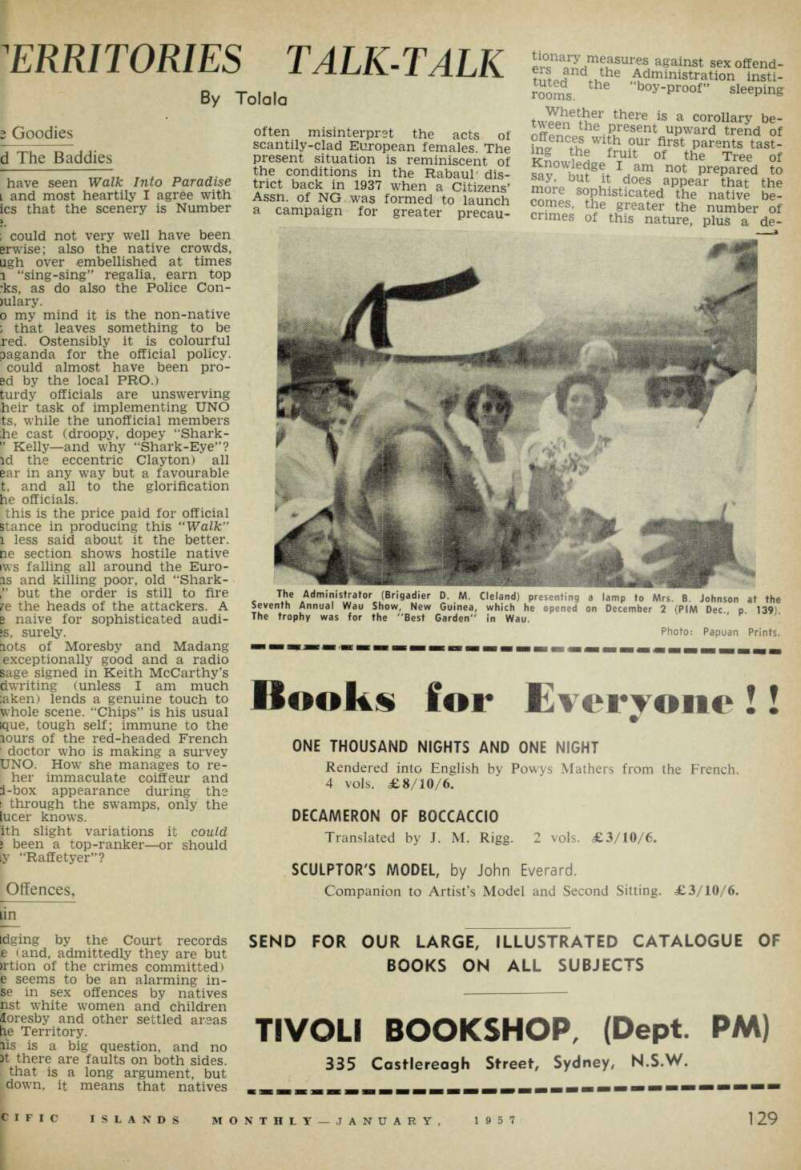
The Administrator (Brigadier D. M. Cleland) presenting a lamp to Mrs. B. Johnson at the Seventh Annual Wau Show, New Guinea, which he opened on December 2 (PIM Dec., 139).
The trophy was for the "Best Garden" in Wau.
Photo: Papuan Prints.
le in discipline, never heard an offence by lative against a ropean woman •ing the Ger n times in lex crimes are ioubtedly one the greatest tri b u t i n g tors towards creation of e discrimina i. And I leave it that.
at Sixty-four
liar Question
[ore colour scious touchi^ 5 has been wn in Moresby ecent weeks in
isory Council
les, resultant the official re to create a ;ater native ncil” in PM.
t can only lead to trouble be en the two races,” says the Post. And such a phrase must irally conjure up thoughts of “Deep South’’ and apartheid, ch should make the ADPANG ministration of Papua and New nea, to the uninitiated) stop to k before adding to the native liality policy within the Terri wonder if governments in mixed ured areas realise that if they Id only restrict themselves to equitable balanced policy—with partiality one way or the other ere would be little of the colour rimination that is gradually ming more and more pro ceed. And principally due to rnment “effort” to minimise ; segregation. ius from an old NG pioneer: iat the future of NG will be is er difficult to visualise. Person- I think it will follow similar i of other British colonies — faster. The Tolais get more ky and bitter as the years pass. i disputes become more intense open; flagrant poaching of i freehold land by them is fast ming the “order of the day.” id this from a man who has no to grind, but retains an intense rest in P-NG’s future, iw that UNO is on its way out I it undoubtedly is after the 5 fiasco) isn’t it about time tANG trimmed its sails and ited a more equitable attitude irds all? Or is one to assume Investigator Winder, who 3d into the possibilities of Local srnment for P-NG, has recom-
mended that the native people alone have this privilege?
And W hii e on th e subject: Why bring these Australian-bound offlclals t 0 de i v . s into P-NG affairs? what do they know of New Guinea who only Queensland know? It sounds all a bit screwy to me.
J
Other Days; Other Ways
Zt~. It~ R
Being Christmas time I received letters from old friends in man y voicing comparisons (which are always odious) with
piesent conditions. Each Christmas time is a nostalgic-time. was such thirty years ago. But the festwe party at the New Guinea.
Club for the kiddies of that day
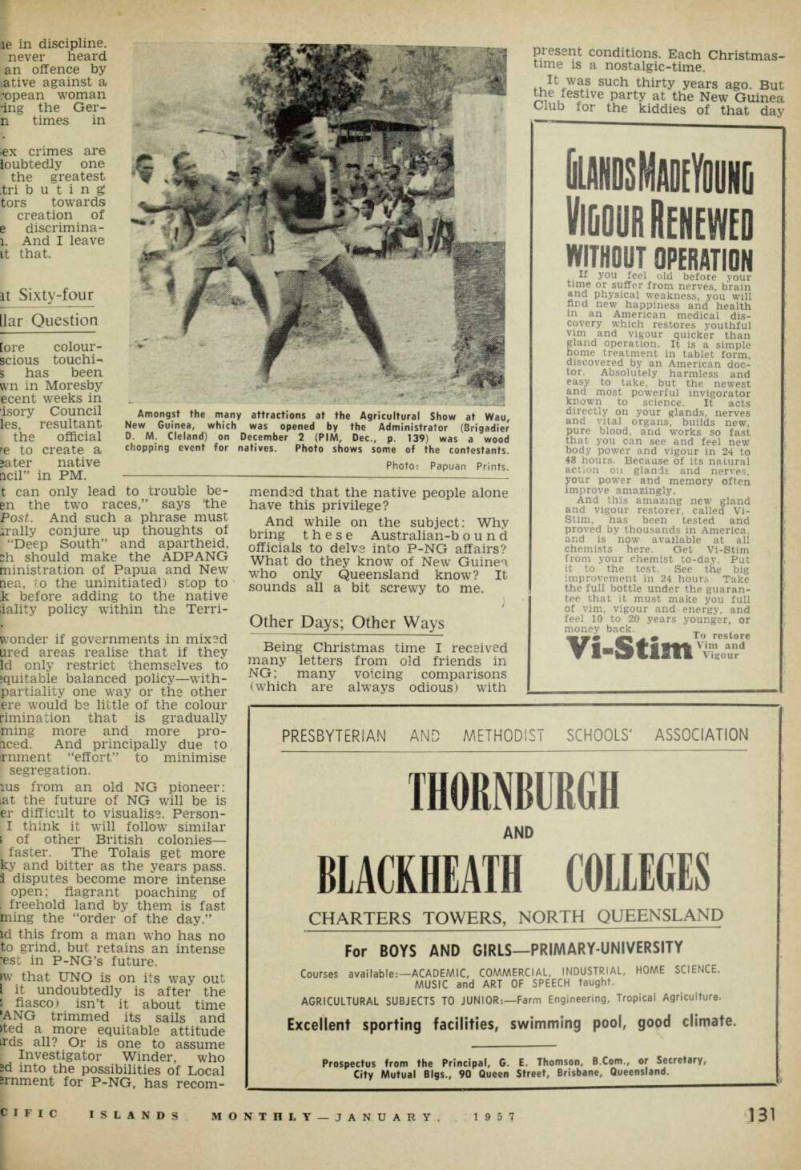
Amongst the many attractions at the Agricultural Show at Wau, New Guinea, which was opened by the Administrator (Brigadier D. M. Cleland) on December 2 (PIM, Dec., p. 139) was a wood chopping event for natives. Photo shows some of the contestants.
Photo: Papuan Prints.
remains a high-light to re iber. And the old Rabaul Club y dress ball was carried on for y years. (Old-timers still re iber the year when “Montie” lips, now Chief Judge and hted, easily won first prize as local peanut vendor!) those far-off days it was the jm for the big trading firms iuding the Chinese merchants) ;gale their customers with sub tial Yule-tide presents. A case ■doz. beer; half-a-dozen Scotch; tese silks by the dress length or ierful embroidered tea-cloths serviettes from far inland China, mder how many generous gifts ! made this year? id before that: Well do I re iber the unexpected parcel that to come in the packing cases Christmas groceries from eter’s, Anthony Hordern’s or rath’s. They did a big export B to New Guinea at one time ngst Australian settlers who did enthuse over the continental obtainable in the stores of the German companies, it all that was before the days Planning and high taxation, ho! Yes, it is certainly other ; other ways. And I hope ybody is as happy.
Consular
iresentatives
a result of Hans Mannsfeld’s ; (Editors’ Mailbag, Nov. PIM ),
I had an enquiry from an old Terr torian resident asking why H. R.
Wahlen was referred to as “Consul H. R. Wahlen.” The answer is simple! HRW was appointed Swedish Consul in Rabaul about 1911 and therefore became Herr Konsul Wahlen. Other consuls whom I remember about this time were: Fred Jolly (British), Captain Komine (Japanese) and Ah Tam (Chinese).
The Didiman Query
Herr Mannsfeld’s reference to the possible derivation of Didiman for Habaul’s Botanic Gardens I cannot agree with. Radish? No Can! His mention of the names of the Director and Master Gardener ( p IM, Nov., p. 22) is not helpful; n £r,, er is Miss Egan’s suggestion (P/M. Dec., p. 18). So far as I am aware it is not a native word. She is correct about “ra” being the in definite article in the Tolai talk, however.
Incidentally, I can’t agree that the word is “pidgin for gardener.”
Originally it was the name used by all natives for the Botanic Gardens at Rabaul and in later
CALLING ANGORAM. The people in this photograph (published in December PIM, p. 29) been identified by Mr. Jack Bannigan, who appears first on the left, back row. The [?]s are: Jerry Keogh; Mrs. S. H. Gander (SDA mission); Jim Delaney; Mrs. Jack Spence; [?]binson. And sitting, Jack Bradshaw and Jack Spence. [?]he place? Outside the Police-Post at Kainantu, in the present Eastern Highlands district [?]ew Guinea then referred to as the Upper Ramu. The time: 1935.
Four of these people are now dead —Keogh, both Spence and his wife, and Bradshaw.
Mr. Bannigan who now lives in Sydney, has a copy of the photo. (Our copy was sent [?] Mr. Peter England, of Angoram, Sepik River, who said that it had been the subject of [?]essing competition at the local hotel).
years was also applied to certain cultivated areas near government out-stations. The name was also applied to Australia’s first Curator of the Gardens during the military occupation (Major H. O. Newport) and the name stuck to him after he became head of the Agriculture De partment, but was never applied to his successors —Dr. Bryce or George Murray. The diminutive form— (Mrs. “Diddy”—was applied to his wife up to the time of her death last month.
I repeat my remarks made in May (1956) Talg-Talk and again call on Capt. Haug over in Darm stadt, or perhaps we will hear from the Club of Old-Timers in Ham burg, as mentioned by Herr Manns feld. If not it could be a problem for the newly-formed Historical Society at Kokopo to solve.
Delving Into
The Past The proposed formation of a historical society at Kokopo is good news. I congratulate the folk who realise what a wealth of old-time data, lying idle, they can operate upon. The biggest trouble is they have started about 30 years too late, but that is a common fault. I know, for I became secretary of a historical society in a Macquarie town in NSW shortly after War II finished and we have to grope about for in formation amongst people who are a generation too young. Kokopo will be doing much the same.
There are few pre-war I originals in New Britain now—save, perhaps some of the older missionaries at Vunapope. At the moment I can only think of Mrs. Lulu Miller, George Yanke and the Stehr brothers over on Duke of York. If Albert is still alive he could tell some interesting tales of the early days in Manus.
Looking further afield —beyond New Britain—d own Bougainville way there are Dr. and Mrs. Kroenig.
The former (as far as I know) is the one and only remaining ex government official of German times in the Territory. A highly-qualified medico, he was MO in the Kieta district in pre-War I days. In 1913 (or thereabouts) Frances Highley returned from her schooling in
England and the Continent —a attractive and charming ; lady, who soon became the of Bougainville. She marric doctor and after the War they up their residence at Toboroi south of Kieta.
Here’s wishing the K Historical Society every succe
No News
From The North As I mentioned before, thei been a decided lack of P-NG in Sydney newspapers of lati I was beginning to wonder wl the Fourth Estate had placed i cott on Australia’s far-flung post. But directly after the Year holidays, the news wj leased, and published, ol murder of 19 villagers by th tameable Mianminities, and N again on the map.
Incidentally, in December, Jim Taylor, with the Hagen patrol, met up with these warriors who gave the pal go and John Black is repor have remarked at the time: do not encourage visitors.”
Their manners have not inr over the years.
In the reference to lack ol I do not, of course, indue statement by Minister Haslucl this month over the ABC n
Tning the very important need ’radicating malarial fever in r, and the appointment of irial observers” in order to down the mortality rate, stralian medicos —and others 'e been studying malaria sines Perhaos if Mr. Hasluck opened lis purse-strings a bit wider the PHD, results might be p. If any department needs a ; cheque for operational ex is it is the PHD.
Did Hostess
;s ny an old-time Rabaul resident be saddened to hear of the ag on of Mrs. Jessie Somer (“Diddy”) Newport. She died private hospital in Manly on nber 16, and had been in ill ti for several months, so it was ipy release from her physical nts as “Diddy” was always a t and entertaining personality, i arrived in Rabaul during the try Occupation, shortly after I broke out, accompanying her md, Major H. O. Newport, who charge of the Botanic Gardens laid the foundation for the ng Department of Agriculture, h he and his wife were gener mown as “Didiman.” During early years she kept open and was one of Rabaul’s ;t hostesses. After the death ier husband in the early *s she remained in Rabaul for time and then retired to ;y and after War II became ithusiastic worker for the NG m’s Club. ling health during the last ears had forced her into re- Bnt and her presence at the ir meetings was missed.
)yal
ire fG circles are pleasantly ciative of the Duke of Edin [s kindly gesture in summoning Lois Niall (daughter of Dis- Commissioner and Mrs. Niall, e) to Government House, Syd -3n his return from his P-NG Lois was attending the Syd- Jniversity. Were there some -burnings? Of course, there but, nevertheless, it was a htful act and gave a lot of ire to Lois, and no doubt to nd Mrs. Niall, at whose home )uke had stayed in Lae.
Pieces:
thday Honours included the for Ron McNicoll, Temp. r-General and Engineering of Army HQ, son of TNG’s
late Administrator. . . During the International Geophyhical year (in other words 30 nations co-operating in watching natural phenomena of the world) Moresby will have a magnetic and geophysical observa tion station: Lae, cosmic ray and Rabaul radiation observations. . .
Passed on: Harry Stuart Kerr, MC, of Saratoga and formerly of Moresby, at the age of 40. . . Prof.
Ekin, in an ABC talk last month, said the natives of Wabag were not suffering from malaria, liver com plaints, or was there much evidence of polio amongst them. . . The Vacuum Oil Co. will award two scholarships annually to a P-NG girl and boy, tenable for six years and valued at £5O a year. . . One of the yachts competing in the Sydney-Hobart race this year was entered by Des Ashton, a patrol officer of P-NG. It was a 33-ft sloop, named Lahara. . . Born on December 10 to John and Pat Leeuwin-Clark, at North Shore, a daughter. Both well.