[?] Orld Experts Confer On Methods
pp. 119-123 · Read in the full issue

[?]e Brisbane Symposium
Of Tracking Tropical Hurricanes
by Captain Brett Milder
Between December 10 and 14, weather experts from all over the oorld gathered in Brisbane to conduct a symposium of tropical yclones. The author of this article was one of the delegates.
ROPICAL Cyclones or hurricanes are intense, revolving storms which deserve special study m the Meteorologists. They ur only in certain parts of the rid, and during certain seasons, ing to their constitutional rules ich are now fairly well known, [ut we still don’t know why they m in the first place; nor why re of them don’t form where the it conditions are present, lost of the work done on hurri ,es in the past has been devoted their detection and tracking, v we have reached the stage jre it may be possible to predict future track of a hurricane up two or three days in advance, s would greatly reduce the loss life along the affected sea-coast, jreat deal of the damage done a hurricane is not caused by the d force, but by the great sea r es, surges of unusually high is, and floods caused by lonic rains as the storm centre sses the coast and moves ,nd. he calculations which would ble us to predict the path of lurricane are based on a mass observations at different levels the atmosphere in which the one has formed. These reports made by aircraft, rockets, ons, ships and shore stations, lotting and analysing the )rts take up so much time that storm may arrive before the ulations are complete, unless an tronic brain is employed, t the Symposium in Brisbane, ting experts from the US, and Jr parts of the world, presented ers and took part in discussions most aspects of tropical ones, some essentially Jretical, others quite practical. two most eminent men, lessor Riehl of the US, and lessor Palmen of Finland, had f poor speaking voices, which unfortunate for most of us, ggling as we were through a e of technical words and ded by the brilliant beauty of hematical formulae, lehl discussed, amongst other gs, the steering effect of the er winds on the track of a one; while Palmen produced ulations of the energy contained i hurricane, including a budget how it was concentrated and ersed in profit and loss accounts the stages in a cyclone’s life.
m° me the most striking parts A U f Symposium were given „ OTI b l th6 de ¥ at A es °l the Ameri can Navy and Air Force, whose
weather-spotting planes have been flymg right into the centre or e^ e °* ea °h hurricane reported, and have remained there for hours to track the progress of the storm. fu The £ showe d us three films that H 1 ley, 1 ey , taken of the majestic cloud formation around the vortex ° r . ~c o^e” which surrounds the eye (for there is a fairly clear opening up through the centre of a cyclone, very like the hollow seen when water swirls down a plug-hole), , Other striking developments have been the dropping of radio-balloons down into the “eye”, and photo graphs taken of Radar screens showing the complete structure of
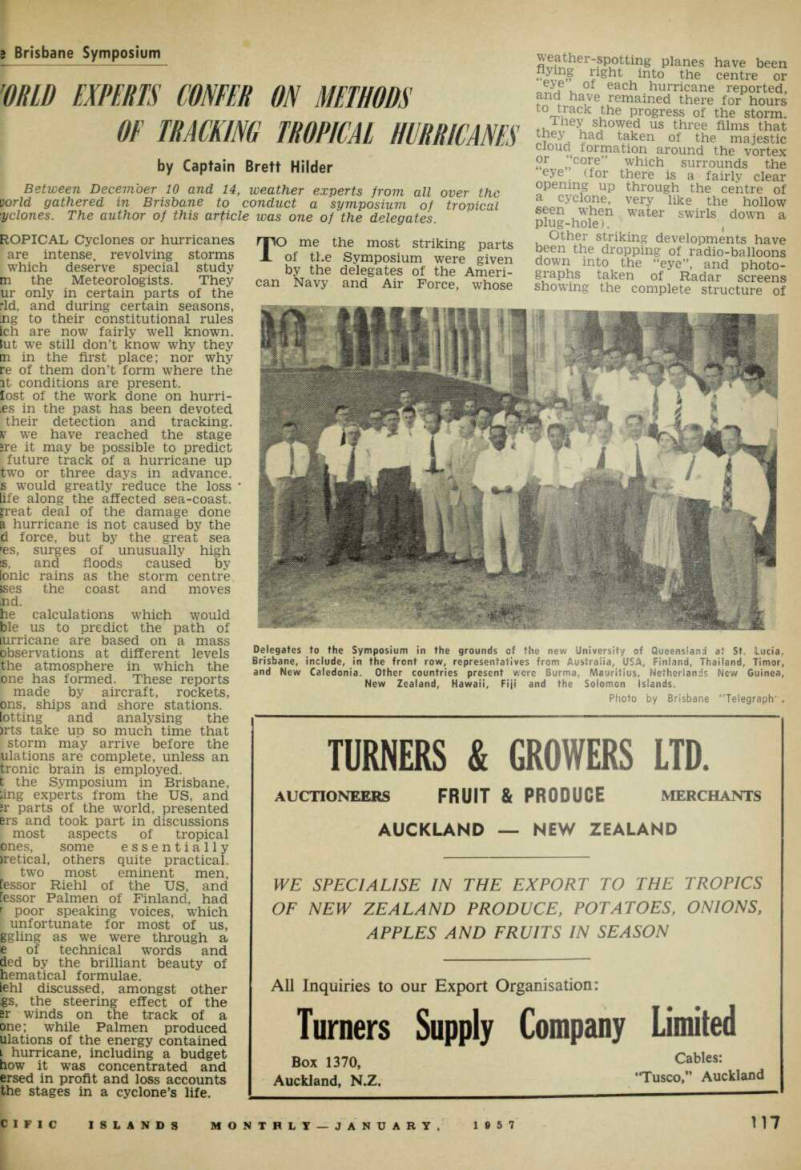
Delegates to the Symposium in the grounds of the new University of Queensland at St. Lucia, Brisbane, include, in the front row, representatives from Australia, USA, Finland, Thailand, Timor, and New Caledonia. Other countries present were Burma, Mauritius, Netherlands New Guinea, New Zealand, Hawaii, Fiji and the Solomon islands.
Photo by Brisbane "Telegraph " .
the storm. These show tl hurricanes are built up rather ] nebulae in the sky, with sp: bands of varying winds, pressu and rain clouds.
When the movements of the are accurately tracked they found to have periodic oscillati which seem to have some effect the general recurvature of storm-track. This aspect of cycl behaviour is the most importanl all, but is still proving the n difficult to analyse.
Radar as well as ordinary phi graphs are being taken from sorts of craft, including rafts ac on the ocean and space-rockets, it is also hoped to get s extensive pictures of storms : from the Earth Satellite (which US will launch during the fo coming geophysical year), whe: is in its orbit.
One form of cyclone : trac tested in the West Indies is kn as Sferics an abbreviation Radio-atmospherics. This is crackling noise heaird on ra frequencies, and is caused flashes of lightning in a st especially a thunderstorm.
By using two stati<pns at it is possible to determine the e position of the flash, even at stances of 1,000 miles. The i objection to this method is hurricanes, especially those in Pacific, do not often contain 1: Another method of locating
Photograph of a Radar screen sho[?] Typhoon in the Philippines: the cross centre shows the position of the o[?] while the "eye" and its encircling ar[?] be clearly seen to the North East, 3[?] away. The mass of Winding ram aro[?] observer is not sufficient to bli[?] penetrating rays of the Radar set.
ones is by seismic recorders. These ere developed to record earth lake shocks, and it was found that icy also show small waves in the irth caused by the vertical undu tions of the heavy cross seas in le centres of storms. These re adings are called microseisms ;cause they are so small. They ive to be magnified about 1,000 tnes to be counted and measured, it they have the great advantage ' travelling at great speeds, and in give warning of a cyclone over 500 miles away, though there is ; present no reliable method of dng the position of the cyclone j microseisms.
The United States has almost ven up research on this subject, s it has other more reliable sys ms, but it is being pursued in ueensland with some promising suits.
Most of the latest methods of r clone-tracking depend on the ea being covered with a radio ‘twork of Hyperbolic Navigation, bdch does not exist in the Aus alian region. It is therefore, not uch use for us to send our air aft into hurricanes without a eans of fixing their position ac irately in the overcast conditions ! a storm, where the standard ethods of navigation would be of ;tle use. It would be possible, >wever, for our aircraft to plot ie centre of a hurriane by flying ound it in a square, or by flying fely over the top of the distur mce.
In trying to find the most useful ethods to employ over the vast ■eas of ocean where Australian irricanes develop, the Australian ireau of Meteorology is up against eat problems. The research work ling done on cyclones throughout ie world, both theoretical and ■actical, all requires far more ob rving stations over a cyclonic area an is possible in this sparsely ►pulated part of the globe.
In the Coral Sea we could make ie of more ships for regularly re nting weatheir, and Mr. L. J. wyer, the Australian Director of eteorology, has proposed to fit itomatic radio weather-reporting ts on floating rafts or buoys, which ight be anchored on banks or set ) on reefs and islets to fill in ime of the large gaps in the Bather maps.
We must consider ourselves for mate that our tropical cyclones ) not occur as frequently as the [irricanes in the West Indies, or ie typhoons in the South China Ba, although their very inf re lency is a handicap to research id practice in tracking them.
Although Australia lacks the oney and equipment available to merican research, our meteorolo gists are doing good work in some riginal methods, and are keeping lemselves up to date with the work Jing done overseas. The Sympo um was a good opportunity to
iron out a lot of misunderstandings th?rth*a r f t C d on f C o e r Pt -i°H n urrS cane hunting” are specially streng-
SeSis
rately all the time, to give a orrect reading of the barometric pressures, and it is also quite a problem to obtain the correct ternperature and humidity of the air 111^0 iroug^:i storm at t Amongst the delegates present were representatives of the various Air Forces and Navies, but no pro-
vision had been made for either V S weather chart over lire! areas and the other was mvself up for toe MScLnrslVvfce Most the exnerte nresent'
studied cyclones P f^?m P thl
towers of universities f r L S altitudes in aircraft,’ and so were ignorant of the mountainous seas and great ocean swells generated by hurricanes; and likewise obli vious to the dangers and difficulties
:ed by ships in their efforts to Did the worst damage to their ift towards the eye of the storm, r did any of them appreciate ; Tom-Thumb size of many of i islands vessels which occasion y have to make long Pacific pages. :t is too early to judge the effects the Symposium upon the hurri le-warning services in the Pacific, that will depend upon Govern nt implementation of the con sions reached.