Tropicalities
pp. 79-80 · Read in the full issue
Magazine Section
Translator Of Parkinson
|/|R NOEL C. BARRY, who has |1 been a planter and trader in the Rabaul district of New guinea in recent years, has sold out iis interests there, and leaves labaul this month on an extended World War 11, Mr. Barry vas a member of the staff of the Jew Guinea Supreme Court, and issociated with Sir Beaumont >hillips. In the late ’Thirties, Mr. Barry nade a translation (from the Ger nan) of Thirty Years In the South teas, a famous book by the late I. H. R. Parkinson (who died in 907). He handed it over to Mrs. s hoebe Parkinson, who died in New [reland, in 1943, during the Jap inse occupation. The translation vas lost for some years, but was •ecovered. It is of considerable in vest to South Pacific scientists and listorians, but has never been pub ished.
Tale Of A Port Moresby
Dog
A HIGH P-NG official sat among friends in Sydney recently and spoke affectionately of his
ancient “houseboy.”
f “We can come away South and leave the old chap in charge, quite safely,” he said. “He writes me regularly to assure us that all is well. Got a letter from him this morning, as a matter of fact.”
“Yes, but it is very hard to under stand,” complained his wife, f “He is proud of his knowledge of English,” said the official. “He keeps adding English words to his Pidgin, but it rather complicates his mean ing.” “Why don’t you tell him to stick to Pidgin?” demanded his wife. “I cannot tell from to-day’s letter whether our dog is dead or is going to have pups!”
I “Got to encourage the use of English,” said the high official, a little sheepishly.
The official? Direction of Educa tion “Bill” Groves, who seems to be still Canberra’s favourite cock-shy whenever Canberra begins to dream up plans for making the multiple language Territory literate and self governing within the lifetime of the Trusteeship Council.
A Test For Those Of Little
Faith
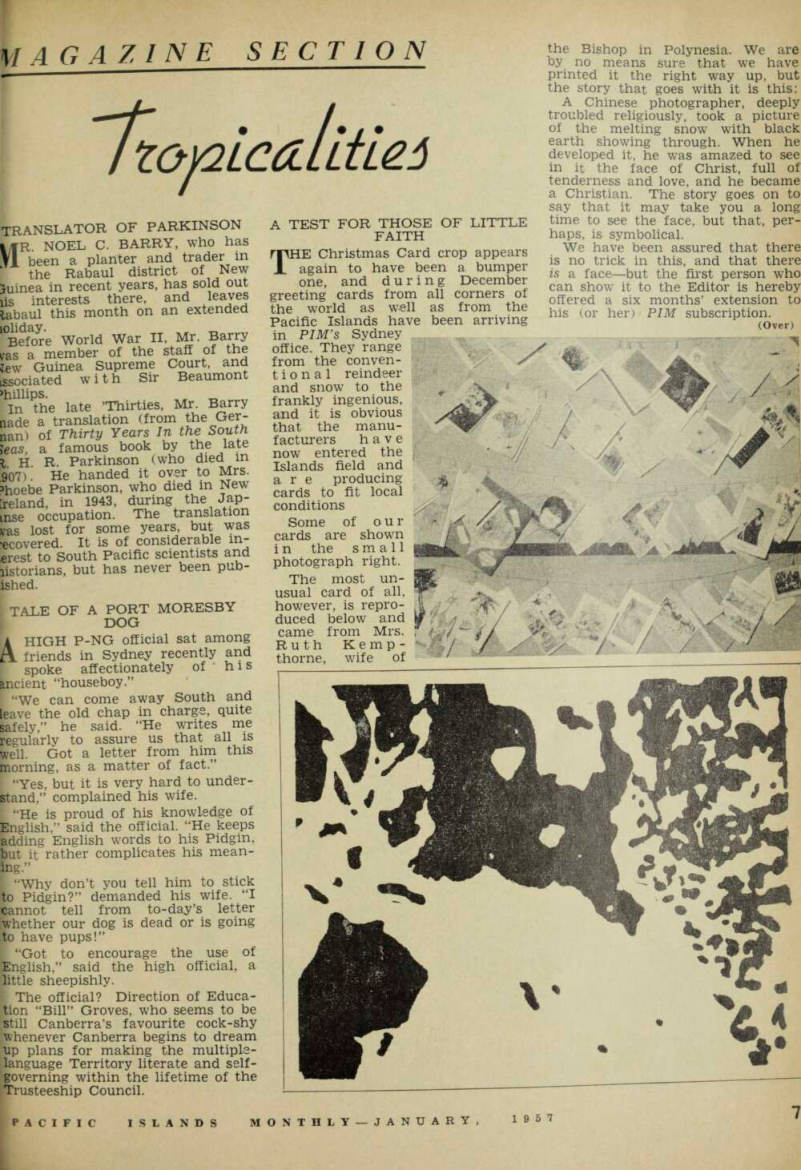
THE Christmas Card crop appears again to have been a bumper one, and during December greeting cards from all corners of the world as well as from the Pacific Islands have been arriving
in PlM’s Sydney office. They range from the conven tio n a 1 reindeer and snow to the frankly ingenious, and it is obvious that the manu facturers have now entered the Islands field and are producing cards to fit local conditions Some of our cards are shown i n the small photograph right.
The most un usual card of all, however, is repro duced below and came from Mrs.
Ruth Kemp thorne, wife of
the Bishop in Polynesia. We are by no means sure that we have printed it the right way up, but the story that goes with it is this: A Chinese photographer, deeply troubled religiously, took a picture of the melting snow with black earth showing through. When he developed it, he was amazed to see in it the face of Christ, full of tenderness and love, and he became a Christian. The story goes on to say that it may take you a long time to see the face, but that, per haps, is symbolical.
We have been assured that there is no trick in this, and that there is a face —but the first person who can show it to the Editor is hereby offered a six months’ extension to his (or her) PIM subscription. (Over)
To win the island, contestants have to supply the last line of a limerick. A million entry forms will be distributed in the United States and Canada. Thousands of good dollars are to be spent to advertise the contest through the mediums of radio, television and newspapers.
The prize island is Yawalo, which is about a half-mile off-shore near Lautoka, Viti Levu. It is, we are informed, four acres in extent; has 60 coconuts growing thereon, is partially fringed by mangroves but also has a piece of beach of white coral sand, and a piece of coral reef.
The island is freehold, but will be bought by the Fijian Affairs Board and leased by the Board to the winner at 1/- per year—reverting to the local Fijians when the winner dies or surrenders the island.
Fijians retain the fishing rights.
The island was selected by the Fiji Visitors’ Bureau.
So, doubtless in due time, some ingenious Yank or Canadian will supply the winning limerick, and, complete with light-weight baggage supplied by one of the sponsors, and supplied with a free passage to Fiji, and other accessories, by other kings of North American commerce, will proceed to Yawalo
and sit amongst his 60 coconu And then what?
Sorry, boys—but from where ’ are sitting at present (and no don soured by long years of dealing wi things Pacific) this idea of “se ing” the South Seas appears coi pletely daft.
Australia Day In Fiji
AROUND Melbourne Cup tin Fiji usually forgets that it a British Crown Colony, a Australia is allowed to predomina A large proportion of the flutti on the event are made by t Indian community; but this year t big Pustakalaya consultation, wi a first prize of £l,OOO, was w by a Fijian—a policeman, no le This fact produced a good d( of good natured banter, as t consultation was advertise extensively as being “drawn in t presence of a Police Officer.”
The Police Officer in quest] had the pleasure of seeing Constal Vono, No. 481. of Suva Pol Headquarters, gather in the 1 prize, but apart from that it v ,almost strictly an Indian affa One syndicate which drew a ho; was called “God Blessed.” G did, as it happened, but not any great extent —the horse v unplaced and only £6 was t reward.
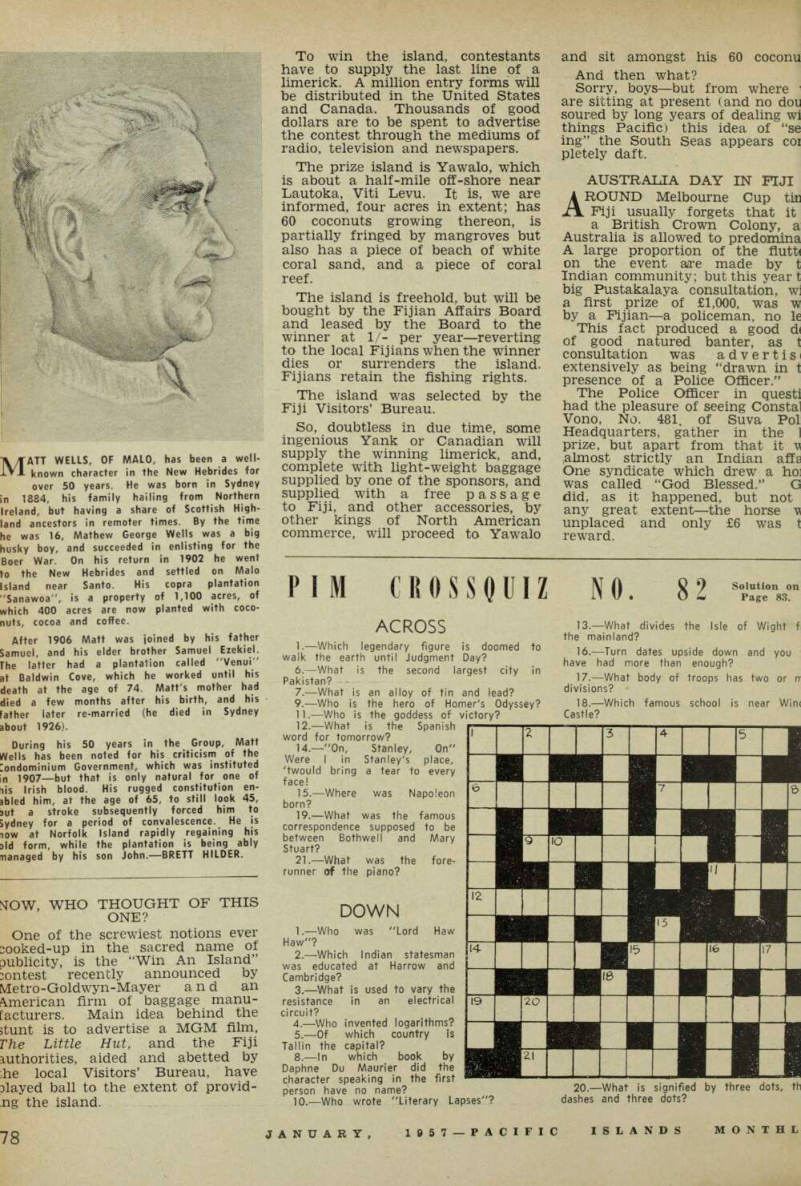
MATT WELLS, OF MALO, has been a well known character in the New Hebrides for over 50 years. He was born in Sydney in 1884, his family hailing from Northern [?]reland, but having a share of Scottish High [?]land ancestors in remoter times. By the time [?]he was 16, Mathew George Wells was a big [?]husky boy, and succeeded in enlisting for the Boer War. On his return in 1902 he went to the New Hebrides and settled on Malo Island near Santo. His copra plantation "Sanawoa", is a property of 1,100 acres, of which 400 acres are now planted with coco [?]nuts, cocoa and coffee.
After 1906 Matt was joined by his father Samuel, and his elder brother Samuel Ezekiel.
The latter had a plantation called "Venui" at Baldwin Cove, which he worked until his death at the age of 74. Matt's mother had died a few months after his birth, and his Father later re-married (he died in Sydney about 1926).
During his 50 years in the Group, Matt Wells has been noted for his criticism of the Condominium Government, which was instituted i n 1907—but that is only natural for one of [?]is Irish blood. His rugged constitution en [?]abled him, at the age of 65, to still look 45, [?]ut a stroke subsequently forced him to Sydney for a period of convalescence. He is [?]ow at Norfolk Island rapidly regaining his [?]old form, while the plantation is being ably managed by his son John.—BRETT HILDER.