[?]Pacific Shipping And Cruising Yachts
pp. 59-113 · Read in the full issue
[?]is Month's News of—
Anny Was Off Her Beat
Joyita” and “Arakarimoa,” hav promoted recent discussion on uges that went amiss, another it recently came to our notice is rth mentioning, as the incident
opened at this time of the it in 1905.
The story is recorded in the •hives of the French Consul Auckland, in the form of letter from the Resident mmissioner of the Cook j nds, dated February 24, 5. which reads as follows: }ir, I have the honour to tort that the French three sted schooner Fanny, Cap -1 n Boutmy, arrived at rotonga on the morning of ) 20th inst. from Aitutaki charge of Captain Jonassen pilot. :t appears the vessel left iney, Australia, for Noumea December 30 last. Accord ; to the statements made : the crew, immediately the p left Sydney the Captain ik to drink and remained a semi-drunken state for ;r 20 days. It was not until ! ship was over three weeks
out that land was seen, and the Captain was apparently unable to say what the land was.
Land was again sighted and was seen for a few days but each night the ship was put about. Then land
was lost and it was not until February 12 that an island was seen which the Captain then said was Huon or Surprise Island to the north of New Caledonia.
On the island being reached it was found to be Manuae, one of the Cook Group, the vessel being thus some two thousand miles out of her course. By this time the ship was almost out of provisions, there remaining only some four tins of biscuits on board. (over)
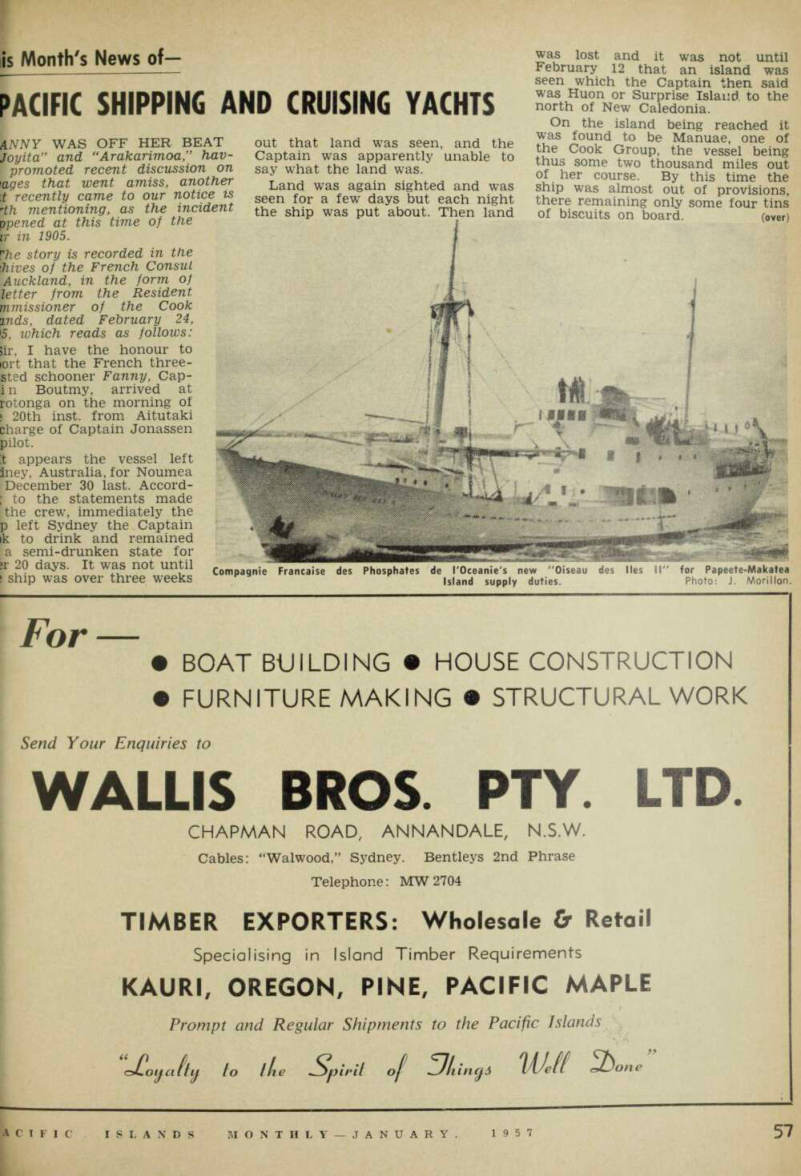
Compagnie Francaise des Phosphates de I'Oceanie's new "Oiseau des lies II" for Papeete-Makatea Island supply duties. Photo: J. Morillon.
During the trip the Captain made, or pretended to make, observations and told the crew that they might see land at any moment. At Manuae the ship procured a small amount of provisions and Mr. Gosset, who is in charge of the island, advised the Captain to proceed to Aitutaki, where a Government Officer was resident and who might deal with the complaints the crew were mak ing concerning the incapacity of the Captain.
Aitutaki was reached and the crew then refused to proceed further in the vessel unless there were another Master. It was then arranged by Mr. Cameron, the Gov ernment Agent, with the consent of the Captain, that Captain Jonassen should pilot the ship to Rarotonga, where she arrived as above stated.
Shortly after the arrival of the vessel at Rarotonga I received two letters signed by the crew, copies of which I enclose. As there were two British subjects in the crew I deemed it my duty to hold an informal enquiry into the com plaints made against the Captain, although, of course, as I pointed out, I had no jurisdiction to inter fere as between the men and the Captain, the ship being under the French flag.
At this enquiry, at which the Captain was present, the men re iterated the statements made by them in the letters, which were, of eourse, denied by the Captain,
As the men absolutely refused to proceed further unless another navigator were on board (the Mate being unable to navigate), I recom mended the Captain to engage the services of Captain Jonassen as a matter of necessity to pilot the vessel to Noumea. This Captain Boutmy has done, the fee payable to Captain Jonassen being fixed at
£5O and a passage back to B tonga.
The vessel has obtained provii here for which the Captain given drafts on the Agent in ney for the owners. Ca] Jonassen has a similar draft fo fee (£2O) for piloting the \ from Aitutaki.
I am informed that the o'v
the vessel are Messrs. Ballande 5 aine of Noumea, and that the tiney Agent is Mr. M. Seguir, Pitt reet, Sydney. As I have no reason believe that the Captain has not mmunicated with the owners or e Agent from here I also have it done so, preferring that the in rmation as to the vessel’s where outs should go officially through u.
The vessel has sailed this morn g for Noumea with a fair wind, id I hope will reach her destina m safely. I have sent in care of iptain Jonassen a report of this atter to the British Consul at )umea for the information of the ithorities there.
I have the honour to be Sir, Dur obedient servant, W. E. udgeon, Resident Commissioner, )ok Islands.
Now Feast, Now Famine
In 1955, a wealthy American in ie advertising business, who )peared in the Cook Islands in his Jll-f ou n d 72-ft schooner-yacht ordlys, noticed that the Group as short of shipping and that there )peared to be some possibilities in ie mother-of-pearl industry, and entioned that be would be back ith a vessel suitable for the inter land trade.
As others had been before him id said the same things, but had
never been seen again, no one took much notice at the time.
But in mid-December, Walter S.
Johnson, Jr., the American in question, suddenly appeared on the scene with as handsome a trading craft as is to be seen in the South Pacific to-day—a 104-ft, 121-gross tons staysail schooner named Tiare Maori, flying the British flag and registered at Nassau, Bahamas, under the ownership of a company styled South Pacific Trading Co.
Ltd- There appeared to be only one thing wrong. Since Mr. Johnson was last on the scene, the shipping situation in the Cooks has changed radically, and even prior to his
arrival with Tiare Maori cargoes were in short supply for the vessels on hand—a 300-tonner, a 240tonner, another of 125 tons, and a fourth of 70 tons. The 240-tonner and the 125-tonner are recent arrivals. Competition in the Group will be healthy and services may improve, but it seems unlikely that five vessels of this size will be able to operate profitably for long, Meanwhile Tiare Maori cleared inwards at Rarotonga from New port Beach, California, with a cargo of building materials for Penrhyn Island, where Mr. Johnson is apparently setting up base. The schooner was then listed to clear again for Papeete—possibly for dry-
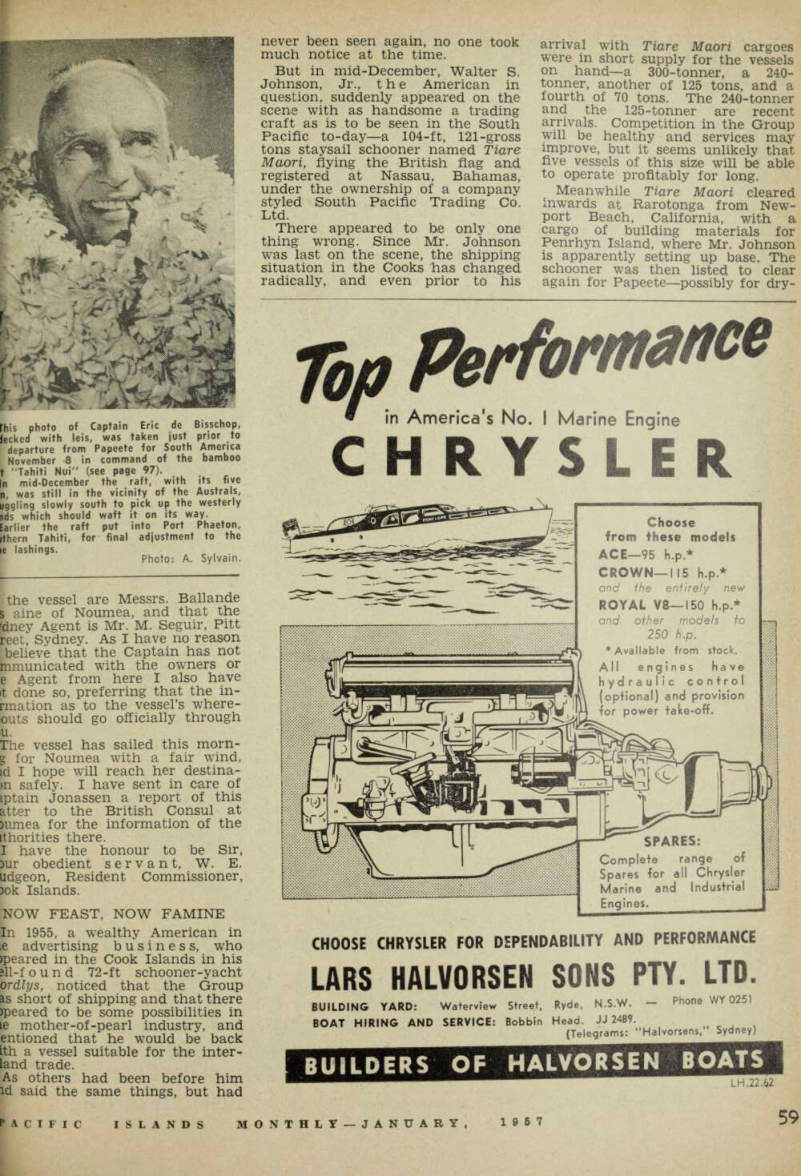
[?]his photo of Captain Eric de Bisschop, [?]ecked with leis, was taken just prior to departure from Papeete for South America November 8 in command of the bamboo [?]t "Tahiti Nui" (see page 97).
In mid-December the raft, with its five [?]n was still in the vicinity of the Australs, [?]uggling slowly south to pick up the westerly [?]ds which should waft it on its way.
Earlier the raft put into Port Phaeton, [?]thern Tahiti, for final adjustment to the [?]e lashings.
Photo: A. Sylvain.
eking—as intentions are definitely iren as “going into inter-island ansport in Cook Is.” in our de atch from Mr. Johnson.
Tiare Maori had a crew of 14 aboard when she arrived at Papeete from Newport Beach. The schooner, said to be Californian built, carries
a considerable spread of canvas, including a big square sail and square topsail on the fore, making her a sort of brigantine schooner. We have no details of her engines.
Davey Jones Held
Thanksgiving
Because of a breakdown in her refrigeration, USS Nespelen, supply ship to the US Deepfreeze Antarctic Ex pedition, had to dump all her Thanksgiving Day turkeys in mid-Pacific. The vessel made a call at Papeete to replenish her larder—but turkeys were one commodity that the island could not supply.
Loitering With Intent
There were all the makings of another Joyita incident — and a lesson, too —in events between Papeete and Auck land last November, which re ceived no headlines at all.
The London-registered, Aus tralian-owned 61ft motor fishing vessel Pagan cleared Papeete, October 27, on the last leg of her voyage from England, with seven men aboard. Nine days later the
single-diesel motor was stopped for a routine check and could not be re started. The vessel had a radio transmitter but it had never been
Walter S. Johnson, Jr.'s, 121-ton staysail schooner "Tiare Maori”, for the Cook Islands trade.
The American-built vessel is registered at Nassau, Bahamas. —Photo by courtesy of Walter S. Johnson.
used on the voyage and was un serviceable. A small spread of canvas was set and Pagan edged towards New Zealand while the engineer worked on the motor. Then came a heavy blow south-west of the Kermadecs, one of the two sails being lost. A course was laid back for the Kermadecs which had been passed far away ten days earlier.
Then came calms, with the vessel blowing back and forth across the international date line in a be wildering succession of date changes. It was estimated then that the voyage to New Zealand might take 50 days, so a daily ration of 3 ozs of rice and 2 ozs of flour was fixed —almost all other food had been eaten.
Then suddenly, when the situa tion was looking grim, the motor came to life and ran like a clock all the way in to Auckland. There, no one had been expecting the vessel, so no alarm had been given, and Pagan might well have drifted for many more weeks before relatives of the men aboard had in stituted inquiries from overseas.
Pagan, a very useful type of vessel, suitable for the Islands trade, is now for sale in Auckland. The fault with the motor was in significant but spares were lacking at sea.
The navigator for the voyage from London was Mr. Graham Gain, former war-time pilot of RAF
pathfinder aircraft. Last year he was hired as navigator of an identical craft, Richard & John, on delivery from England to New Zealand. Now he may return to take another out to California.
Pagan's owner, E. R. Barker, will probably return to London (where he founded the Down Under Club), when the vessel is sold.
Gold Is Where You Find
And it seems that at the i mention of a treasure-hunt a of gold can be found to fin an expedition. In 1954, a syndi headed by a Mr. W. J. Havens England in a small vessel na Absit Omen to claim the Ger Grant treasure in the Auck
lands south of New Zealand.
The syndicate lost a substantial m when the vessel was wrecked ’ the Red Sea a few months later, at there was plenty more money irthcoming to finance a second ex ;dition, which is now on the way i an MFB —a vessel identical to ip Pagan and Richard & John entioned above—with Mr. Havens t command.
No one in New Zealand with any lowledge of the General Grant reck the storm-swept Auckland lands, and the history of past ex jditions, is optimistic as to the suits of the present Gold Seeker :pedition. Still, they may yet have I eat their words.
Mr. Havens, variously described I the press as a retired English ining engineer and an adventurer om a Sydney suburb, is said to be inning his faith on under-water levision equipment—but he wifi ive to work fast to get the job rer before this summer ends, as )ld-finding expeditions have a ibit of withering in the winter as ie members come to loggerheads id the funds diminish.
Leis To Louis
With twenty years of accident ee service as a Papeete pilot be ind him, Captain Louis Carlson jng up his cap in December and anded over the job to Captain ouis Albert Le Caill, 34-year-old cal-born master mariner and iember of a Tahiti family long ssociated with maritime affairs, enial Louis the First will be iissed. An excellent speaker of Uglish, he is remembered by [aster mariners all over the world ho have entrusted their ships to is care.
Changing The Guard
Captain Henry Simpson, of Fiji, anded over command of Mr. Dick rown’s Cook Islands trader aveuni to Mr. Joe McNamara, of nil, England, in December. Captain impson delivered the vessel from uva last year when she was pur lased from Burns Philp (SS) Ltd.
Mr. McNamara came out to New ealand as a deck officer in the hion Co. vessel Kaitoa two years ;o and has since been in coastal essels. He travelled north to Raro >nga in the Canadian fishing sssel White Hart, which left nckland December 21.
White Hart’s owner, Englishman tony Reeves, was seeking passage orkers to Rarotonga or Papeete to Dlster the one-man crew, but lough wide publicity was given D the opportunity afforded, the nly comers were two ladies, who 'ere ruled out for technical Basons—at least that was what ’ony said to the PIM represent tive in front of Mrs. Tony, who
was remaining for the present at Auckland with young Michael.
Usually a yacht heading for the Islands from Auckland is flooded with applicants to join the crew.
Wanted—A Weather
Forecast
Though the New Zealand Meteor ological Service, with its South Pacific network of observation stations and its regional forecasting headquarters at Nadi, Fiji, provides an unbeatable service to most of its clients, there is still one im portant group for which it does not adequately cater—the South Pacific yachtsman and the smaller trading vessel which does not carry a radio operator capable of receiving the
existing marine weather broadcasts in morse.
There are, of course, regional voice weather broadcasts for Fiji Samoa, etc., but they provide in formation of value only in those coastal waters. Vessels operating inter-Group, or on trans-Pacific v °yages—and there are a good
(Continued on Page 97)
any, as a perusal of PIM from Dnth to month bears testimony, ,ve no general oceanic forecast in ice to aid them.
We believe that is situation uld be greatly iproved at no st and little tra trouble to e Nadi forecast s, by slightly ex uding the exist ig Nadi 0915 MT voice broad st on 7530 kc/s. lis transmitter rovi d e s fair verage of all aters from ench Oceania to jw Guinea.
The present oadcast is de fied for Fiji teners only, and [ believe that it is intended to
bTthe” Suva
broadcasting transmitters.
However, with a new broadcast station now operating at Lautoka it would appear that the whole of Fiji should be served adequately
through those outlets, and it is pos sible that Nadi may be contemplat ing closing the 7530 kc’s trans mission, though we hope that this is not the case—or that the trans mission will instead now become one designed to serve the oceanic areas of the South Pacific with a general forecast and statement for the whole area under NNMO admin istration.
All that is required is that the statement and general forecasts already being transmitted in morse from Himatangi Radio, NZ, for the use of large ships, should also be broadcast on voice through Nadi’s 7530 kc-'s channel, or from any other high-frequency outlet in Fiji or New Zealand, and if such a transmission could be made twice daily—as is the case with the morse transmission—so much the better.
At Your Finger-Tips
Ship masters, shipping agents,
[?]he raft "Tahiti [?]i" outside Papeete [?] about to hoist her Is on commencement her voyage, Novem [?] 8 (see page 59).
and all who lay out big money on expensive shipping registers to have at hand details of the world’s ships, are usually chagrined to find that a great many Island vessels of over 100 tons gross are not listed. This, of course, is because many such vessels are not “registered” in the official sense.
So far as we know there is only one register in existence which attempts in any satisfactory fashion to provide details of these Islands craft—and the latest edition has just appeared in Sydney. This is Marine Press Pty. Ltd.’s little pocket-sized Ships on the Australian, New Zealand, and Island Registers —an annual publication containing numerous photographs, including some of Islands vessels.
Few, if any, Islands vessels of over 100 tons gross are not included.
It is a “must” for Pacific shipping men. The price is three guineas Australian currency, and the Syd ney address is GPO Box 4611, though copies are also available through some booksellers.
Attractive Newcomer
Over the past year there has been mention of a new vessel building in France for Compagnie Francaise des Phosphates de I’Oceame of Makatea Island, French Oceania.
This handsome vessel has now arrived—but not bearing the name
which was formerly mentioned, La Pallice. She is Oiseau des lies 11, a handsome successor to the three masted steel 398-ton schooner Oiseau des lies, which now lies in Papeete awaiting sale.
The new craft, built by Chantiers Navales de La Pallice, is a straight
out motor ship of pleasing appe ance. She has a soft-nosed c siderably raked bow, a very i nounced sheer-line, and streamli upper works. Engine and acc( modation are aft.
A single hold is served by t derricks ’midships. She has a ra:
Dop deck with lifeboats aft. Other etails: 499.73 gross tons, 205.81 net; metres overall length, 42 metres aterline, with a loaded draft of 50 metres. She is powered with a i 0 hp (at 430 rpm) Ruston diesel, .ving a service speed of 12 knots— le made 13.4 knots on trials.
The vessel will be engaged in ipply duties between Papeete and [akatea Island, and for the trans it of recruited labour from various irts of the Group She was com anded on the delivery voyage by aptain Argod, lately master of the Id-up vessel, and Mr. Columbani : that vessel is chief engineer, fficers and Crew jouneyed to fance from Tahiti to take de fer y.
New Name, New Owner
The 190-ton French Oceania issel Kaumoana, brought out from ranee in early 1953, and lately laid > for a lengthy period, is now itering the Tuamotu trade under ie new name of Kariga, under the mership of Gallois & Cie, who irehased her from Society Imtex st year.
It will be recalled that en route om France this single-screw vessel ,st her propeller when away to the stward of the Marquesas. Radio ntact could not be made and ientually a boat was sailed on to e Marquesas to bring assistance.
Now that alterations have been mpleted to Karinga, work will oceed on the reconditioning of e junk Cheng Ho, which belongs the same owners, and on which )rk was suspended last May when iority was given to the Kariga b.
Happy Return Remains—
Under A New Name
Another vessel entering the ■ench Oceania trade with a new ime is a former English coastal eboat, which, under the name of ippy Return, was stranded near ipeete on December 3, 1955, while i delivery voyage to New Zealand.
The vessel was sold “as is, where f to a Tahiti business man, Ivaged and repaired. There were en some differences of opinion th the Customs Department as \ the dutiable valuation, as the ssel was classed as an import, be g of foreign manufacture.
This matter has evidently been ttled, and with the name Vaitiare e 45-ft centre-board craft has now sen put to work.
Passing Through
Outward bound from a Dutch lipyard to Auckland, the Northern fcamship Co.’s new 890-ton coaster 'iranui made surprise calls at ipeete and Rarotonga in De mber. The Papeete call was for sip-stores and recreation, but the arotonga call on December 27 was r medical attention to a crew fember.
The es l el reached Whangarei, NZ, with her cargo of phosphate from Sfax, early January. A number of Northern Steamship Co. vessels have been sold to the Islands in the past two to Fiji, NiTcau and Ratanui, in recent months.
Second Thoughts
The recent sinking of the modern Italian liner Andria Doria, and other similar marine disasters are causing the world’s maritime safety Jj? i 1 thoughts in the matter of lifeboats.
It has been demonstrated over and oyer again that it is usually impossible to launch lifeboats from one side of a ship when a quick list develops, and that in heavy weather
the boats on the other side are often also smashed against the vessel’s side if the shin of manoeuvring at the P fime of launching 0f h The self-inflatine - “flnntincr tent” type of iSMb v e pr ? 7 an ?.^f d “J Punching, takes
bSard whek no
heav? Ind costly
and requires little ma intermnre it has now limited acceptance by the authorities, and will probably receive much fuller acceptance before long. Main objec tions are that in war-time such boats would be easier sunk by shrapnel, etc., and, more important, they cannot be launched with
assengers aboard like a wooden r metal lifeboat. The small open igs at each end, designed for pro »ction from weather, make it [most impossible to board the ibber boats from a swinging ladder i a seaway, so intending passengers lust first take to the water in their fe-jackets, then climb aboard by leans of small ladders at each end. ven this disadvantage may prove le lesser in the long run, and specially in tropical waters. Con ditional lifeboats are nothing but nuisance in small Island craft, ad are very frequently unservice ale when most needed.
With such craft the rubber life aat seems to have very marked Ivantages and will probably be elcomed with open arms by ship pers where the marine author ies approve their use. Exhaustive ssts carried out by British and merican naval authorities under •ctic and tropical conditions show inclusively that the survival rate i this type of craft is much higher lan in the conventional open boat. (Photo page 105)
■Gabriel Becomes Heron
Mr. Nils Madsen, who has spent le last three years crocodile hunt g on the Sepik R., NG, recently iquired from the Wewak Catholic ission the converted 52-ft lugger ttbriel. Having reconditioned the
Madang; Mubo, of Rabaul; Busana of Port Moresby ;and (over against the Point), an LTS and Morobe, of Port Moresby.
Two Months On The Way
An unexpected month in Manila came the way of the crew of the Melanesian on the vessel’s delivery voyage from Hongkong to Honiara, BSIP. She was commanded by Capt D. Thorsen, of the BSIP Marine Department.
Difficulty was experienced with the steering after leaving Hongkong and a skeg for the rudder had to be made and shipped for Manila.
The vessel resumed her voyage on November 10 and is now in inter island service in the Solomons.
Drums From Joy It A?
In September, a number of sealed, empty oil-drums, marked “Shell Company, Apia,” drifted ashore in the vicinity of Santa Anna and Santa Catalina, two small islands in the extreme south-east of the British Solomon Islands.
It is thought that these might have some bearing on the dis appearance of those on board Joyita on her ill-fated voyage between Apia and the Tokelaus in October, 1955. ( Joyita was found, waterlogged and abandoned about six weeks later, north of Fiji. The fate of those who sailed on her has never
ill and motor of his new boat, now -named Heron, he has just com eted a successful trial trip round te coast to Wewak and back.
Heron, in December, was awaiting ie arrival of new sails and other luipment, after which Mr. Madsen tends to use her in a shelling (eject.
Crowded Pool In New
Guinea
Lae’s expensive port has been filt at Milfordhaven, just around corner out of reach of the muddy ater swirling out of the Markham Iver.
But, for reasons unknown, a pro blem of the numerous coastal aft hereabouts prefer the little leltered corner at Voco Point, a lie away, in front of the Lae Dtel.
This tiny port was crowded in irly December; and photo )ove, from the roof of the hotel, (ows. right to left, the large hooner Abel Tasman, of Rabaul; . Laurence, of Madang; Melisa, of
been solved, although Joyita was salvaged and is now on inter island work in Fiji for another owner. (See elsewhere this issue).
It took some time for the news of the discovery of the 44-gallon drums to get through to Honiara, but the appropriate New Zealand authorities have now been informed of the fact.
The Early Career Of
Le Curieuse
An interesting link with the Ger man raider See Adler, and with the South Pacific, has been brought in to us by a senior member of an associate journal: an article which he wrote about the French auxiliary ketch La Curieuse, in the Millions Magazine (organ of the NSW Millions Club) away back in July, 1920.
Le Curieuse arrived in Sydney en route from France to Antarctic exploration just as war broke out in 1914. The six Frenchmen on board immediately returned to France, leaving their small ship in the care of the New South Wales Government, in whose charge she remained for four years.
Her connection with Von Luckner’s See Adler was in this way; As is well known, See Adler was wrecked in French Oceania while her crew were careening her; Von Luckner took one of the ship’s launches and set off for Fiji, where
he was subsequently captured. Most of his c r sw remained behind on the wrecked See Adler, and soon there came into the anchorage a Tahitian ship of 120 tons, the Lutece, her captain and crew quite unsuspecting. Lieut. Von Klink had been left in charge of the German
raider’s crew, and it was sm trouble for him to capture 1 Tahitian vessel. The Tahitian cr were placed ashore and away w« the Germans, 58 in all, in Lute to be wrecked on Easter Island.
When dispossessed of his ship, i captain of Lutece had begged \
Clink for the 20,000 francs in Indo- Jhinese banknotes that were on icard, and as the German officer ould not see to what use he could •ut these notes, he permitted them o be taken. fit was these francs that the twners of Lutece used in Sydney to iuy La Curieuse. In Papeete, Japtain Brisson, described as “a ilue-syed Breton sailor,” took com mand of the 60-odd tons vessel and luring the terrible influenza pidemic that followed the First Vorld War, was trading with her letween Papeete and California.
He describes in the Millions Magazine article how they caught he disease in California and how ivery member of the ship’s com lany developed it while well at sea nd how they were hove-to for 14 lays while they fought it. The date, the engineer and one sailor lied at sea, but with four sailors flio were sufficiently recovered, japt. Brisson eventually got his ship tack to Tahiti.
There, he says, the flu “spread out . . white people and natives died ike rats. They recorded 3,010 leaths.”
Did La Curieuse then take the nfluenza epidemic to Tahiti? And vhat was her subsequent history? )ver to you, Oscar Nordman.
Oliver Mac Again In Strife
The ex-WRC steamship Oliver Mac, which left Noumea on No rember 13, towing the Loyaute oaded with scrap, did not make ler destination, Hongkong, for Christmas as expected, but was, in f act, spending the New Year no tirther away than Rabaul. • The two ships, in charge of Cap lain R. T. Hamilton, were to go tom Noumea direct to Manila, hence to Hongkong. However, leavy weather at the outset forced he vessels into Santo; and then, n early December, into Rabaul. three days later they left again, rut encountered heavy weather im nediately and returned to Rabaul.
Che skipper found that they would lave insufficient coal to complete the krnrney. No coal could be obtained n Rabaul and late in January, P liver Mac was still awaiting the arrival of 300 tons from Australia.
One way and another it seems hat it will be pretty dear scrap by he time it reaches Hongkong.
Oliver Mac was purchased from W. R. Carpenters, Fiji, a couple of nonths ago. (See PIM, Nov., p. 107).
[ Southern X Name To Be
Retained By Mission
Captain Bill Hallam of the Bougainville Company, was in Syd ney in January supervising work an Southern Cross VII which the company recently purchased from the Melanesian Mission (Dec PIM,
p. 36). Two other Europeans and a native crew had also arrived for the dehvery voyage Under the terms of sale the name Southern Cross VII will cease with the change of ownership—but a new name for the vessel has not yet been announced. There is some work to be done on the vessel before she leaves for Rabaul; she is not expected to clear Sydney until at least the end of January.
Court’S Report On Vasu
Inquiry
Full text of the report of the In quiry in Fiji into the sinking of MV VASU last June has been re ceived. Mr. J. C. Saunders was pre sident of the Court- Capt A M Karvey an d Mr A A Ragg assessors.
The findings of the Court were published last September and were that Vasu had sunk (on a voyage
etween Suva and Apia, on June ), as a result of water leaking ito the hull, flooding the engine >om, passing through a bulkhead hich was supposed to be water ght (and was not), flooding the Did and forcing off the hatch [vers. The court severely censured \e Master (Captain W. F. Darling) ir failing to take steps to discover le cause of the leak as soon as B was informed of it; and stated iat the owners, Burns Philp (SS)
Ltd. were guilty of negligence be cause they knew of the defective bulkhead and the leak in the stern and did nothing about either.
Vas u, of 298 gross tons, was built in Italy in 1947, purchased by the owners in 1954 and registered in Suva. She was used on services in the Fiji Group and on services between adjacent island groups.
The report states: She sailed from Suva on June 10, 1956, carrying a cargo of 1,300 x 44 gallon drums
of fuel, kerosene and some cases of engine parts, of which 160 drums were stored on deck. She had no certificate to carry deck cargo.
About midnight on June 12, Chief Engineer Cleary, with the assistance of the Third Engineer, started the Auxiliary Pump. The main pump worked all the time that the main engine was running. He started the auxiliary because the weather was rough and the "Vasu" always made water in rough weather. During the watch of Third Engineer Gibbons, from midnight to 0400 hours on June 13, both pumps were left running. He did not know whether the water in the bilge
rose or went down. Having seen Mr. Gibbons the Court has no faith in his evidence at all He handed over to Second Engineer Vincent Tuilakeba at 0400 hours.
The Second Engineer noticed the water was a "little bit high" and he checked all the sea cocks and pipes. He lifted the plates and shone a torch inside the bilge. He did not see anything. He saw a small leak at the after end of the engine room between the dead-wood and the keel. Water was coming in drop by drop. As the water kept rising he called Mr. Cleary.
When they returned to the engine room the water was up to the flywheel. Mr. Cleary noticed that the main engine pump was pump ing about half capacity. He went to the Master, Captain Darling, and told him he had to stop the main engine because the ship was leaking and he wanted to make some adjustments to the main pump.
The Master agreed, took a look at the weather, and estimated his position. He also asked for soundings to be taken. They showed water 6 to 8 inches above the floor of the hold, nothing abnormal to this ship.
Mr. Cleary repaired the main pump and re
[?]e lifeboat suitable for islands use. A modern type of self-inflating [?]bber "floating-tent" lifeboat which seems to be the answer for [?]pical small-ship use. This one has a rain-catching sump in the roof [?]ich is self-supporting by means of inflated arches (see page 99).
started the main engine, and for some time both pumps worked together. The water con tinued to rise. It rose so high that the engine had to be stopped. Mr. Cleary then called the Extra Chief Engineer, Mr. Ranson.
The auxiliary pump failed. This was re ported to the Master. He ordered sail to be hoisted. The first sail failed because a de fective wire stay carried away. A second sail was hoisted. This was about 0800 hours on June 13, sea rough, wind force 5. He also ordered the crew to start the deck pumps.
After a few strokes the deck pumps clogged with a pitch-like substance. The engineers did all they could to deal with the pumps but the position at this time was that the water was rising over the engine and not one pump was working properly.
The Master ordered that the drums on deck should be emptied and then either thrown over the side or put in the forepeak in order to increase the buoyancy of the ship. Some drums were taken out of the hold and dealt with like this. The boats were got ready.
The water rose in the hold, forced off some hatch covers and the ship sank. The officers and the crew got into the boats and were picked up about 22 hours later by HMNZS "Lachlan".
Such are the undisputed facts.
It is clear that the ship did not hit any thing, that the weather when the leak started was moderate, and the only cause of the sinking must have been a leak in either the hull or one of the intake pipes in the engine room.
The evidence of the Second Engineer who examined the pipes before the water had risen a great extent, coupled with the evidence given by the engineers who had surveyed the ship's machinery, satisfied the Court that the leak did not come from the machinery.
The leak must have been in the hull.
The Court finds that this ship had been leaking to a considerable extent. The Master said there was nothing abnormal in sailing her with six inches to a foot of water over the floor of the hold. The practice used to be to start the auxiliary pump and this, to gether with the main pump, would be capable of pumping out the water, or at least of
controlling the level until calmer waters wi reached.
No ship is built to sail with six inches one foot of water over the floor of the he There was evidence that "Vasu" had bi on the slip in December, 1955, and was i to be slipped a day or so after she sank.
The boat-builder and his foreman g evidence of the work carried out on I
ugh Mr. Whippy himself had no idea what I been done and his foreman, Ted Richards, his best to say nothing of any value. r he work that was carried out was ordered Mr. Simpson, BP Shipping Manager, for owners. It was sought to show that be se the ship had been passed by Captain ics of the Fiji Marine Board, she must e been seaworthy. In fact, in December, itain James only carried out a part-survey I he relied on the officers or members of crew, or the owners to tell him what was mg with the remainder of the ship, he Court is satisfied, having studied the Dices of the work done by the boat builders, t it was mainly patching up of seams iciently to allow her to sail on her next age without delay.
It each end of the hold in the "Vasu" re is a bulkhead which should have been ertight. The object of these bulkheads is prevent water entering the hold if any er parts of the ship are flooded. If the ches are secured, as they were in this e, and the cargo is buoyant, as it was, no water enters the hold thus forcing the hatch covers by internal pressure, then ship could remain afloat, although in a erlogged condition. n the "Vasu" the bulkhead at the after of the hold between the engine room and hold was not watertight. As a result of i defect the Court is satisfied that water ered the hold from the engine room, the ch covers were forced off and she sank, he Court is satisfied that this defective thead was a direct cause of the foundering the ship.
Ir Simpson knew of this defective bulk d and did nothing about it. He did not md to do anything about it. The Court liders this to be a most negligent and sponsible attitude on the part of Mr. pson and the owners, for whom he was »ping Manager. he other defect was a leak in the stern ween the deadwood and the keel. The rt is not satisfied that this was the stantial leak which started at midnight on e 12, but with this leak, as Captain James I, it was evident that every time "Vasu" hed and that section went below, water le in. It is clear that as "Vasu" settled the stern, this leak would become more stantly below water and that the increasing isure would force a greater flow of water i the ship, thus contributing greatly to the saworthiness of the vessel. Nothing was e about this leak. he Master was severely censured. The rt considers it only fair to him to explain ewhat more fully why this was done. A •den ship leaks in a sea, but on the lence of Captain James the fact that the iliary pump had to be used in addition to main pump should have warned the Master \ there was an extraordinary leak. He uld have taken steps immediately to find why two pumps were running. The normal ctice is to take soundings twice a day. the "Vasu" soundings were taken on an rage twice a watch. he Master must have known that the ship le water fast and often. He showed no •rise on being told of the rise of water on last voyage. He did not try to find out Bre the leak was. His manner of giving lence in this Court was most damning to le gave evidence that "Vasu" was a most worthy vessel yet she sank under him bout apparent cause. He said he merely his breakfast, ascertained his position, id to get rid of some cargo, then got the its ready and floated off in them as the Jsu" sank. rhe only decision the Court can arrive at n this evidence, and from evidence that usually sailed with large quantities of ler in her bottom, is that he thought that "Vasu" would sink at any time, and t when the time came, there was nothing
he nor anyone else could do about it. It is to his credit that no lives were lost because the situation as the ship sank must have been unpleasant, but his manner of telling the story is not to his credit.
The Court has already answered the questions. There is much the Court would like to comment on concerning the slipping and surveying of vessels in Fiji but that is not within its province. It would like, however, to draw attention to the fact that at the end of the Preliminary Enquiry held under the Marine Board Ordinance, occur these words, "That in view of its findings, a formal investigation under section 35 of the Marine Board Ordinance was both requisite and ex pedient". That was the decision of the Fiji Marine Board.
A close perusal of the record of the Pre liminary Enquiry shows, however, that the Fiji Marine Board did not in fact record any findings, as it should have done, before recom mending that a formal investigation should be held.
Mr. M. H. Helsen, manager of Burns Philp (SS) Co., Ltd., when asked by PIM to comment on the report, said: “We have seen the president’s findings and at this stage can say that we regret that the evidence at the inquiry of those who sailed and also knew the MV Vasu in timately, has apparently been cast aside and ignored.
“The finding is now in the hands of our legal advisers.”
Captain W. F. Darling, who was master on Vasu when she sank, and who is now master of the Zephyr, said: “In my opinion there is much in that report not in accordance with the facts, the weight of evidence,
d the elementary principles of drostatics. ‘These matters will receive my ;ention at a more suitable time. ‘Meanwhile, the suggestions that lieu of a survey the assistant rbour-master ascertained the ite of seaworthiness of the ship interrogating the crew and that crew would knowingly take an safe ship far out to sea and Imly await its foundering should to the merriment of the itive season.”
Nother Mystery Of The
Sea
fhe words Suva Gamu and Timai mar painted on the side of the ck house of a derelict wooden ssel in the Louisiade Archipelago ; a problem for language experts Port Moresby in mid-December. \.s the words are not known in i Motuan language, it can only presumed that they represent the mes of two men. rhe Master of the vessel Pacific url (ex Holmdale, on her way im NZ to the East with scrap), hted the derelict about 120 miles fE of Cape Deliverance, and ad ed the Officer-in-Charge of the hine Branch, Port Moresby, who mediately sent out a warning to iriners through the ABC, Port
kesby.
Only the deck house was above water, and the life-buoy brackets visible. The vessel would be about 15 tons.
The OIC, Marine Branch, Cap tain Hawley, in mid-December, was ascertaining when the derelict was sighted, and obtaining information as to currents in the area to check on the drift of the wreckage.
News Of Cruising Yachts
• YANKEE, Captain Irving John son’s well known world-cruising brigantine, is on the way again.
The vessel cleared Balboa for the Galapagos on December 5, with a crew-tally of 17 males and six females. Crew members have paid an average of about $5,000 each to join what will probably be the last circumnavigation, at least under the Johnson ownership. Clearing Gloucester, Mass., on November 4, the vessel has called at Bermuda, Grand Cayman, and Cristobal. After the Galapagos she will call at Pit cairn and Papeete. Other Pacific ports are not mentioned in our re port. The cruise should end—as it always does —on May 4, 1958. • VIKING, sailed round the world in 1953-54 by those popular Young Swedes, Sten and Brita Holmdahl, has ended her days on the rocky west coast of Santa Cruz Island in the Galapagos. The 33-ft ketch was purchased from the
Holmdahls by an Austrian (note NOT Australian) named Pacher negg, and renamed Sunrise. Clear ing Gothenburg on August 25, 1955, the lone-hander called at Falmouth, Vigo, Madeira, Las Palmas, the Barbadoes, and the Canal. Pacher negg arrived off Santa Cruz aparently last August. Well off shore and becalmed, he slipped be low to catch up on some sleep— only to wake with Sunrise pound ing in the surf. He barely escaped with his life, taut later managed to salvage much gear and is hoping to build or acquire another yacht to continue his cruise across the Pacific • SKAFFIE, a 20-footer from Lowestoft, England, was mentioned in PIM last March as outward bound for the Pacific. The Yacht was then at Barbados. We now learn from our Balboa corre spondent that the yacht eventually arrived at Cristobal after a rough passage, whereupon owners D. Beard and G. Auchterloine, proving that life in a 20-footer is not every man’s meat, sold Skaffie and de parted, apparent for New Zealand, by more comfortable tonnage. • OTAHA, a 32-ft, 7-ton cutter rigged motor sailer, owned by Frenchman Bertrand Jaunez, arrived at Papeete aboard the vessel
Resurgent in December, and is now engaged in some local French Oceania cruising. The craft has
a beam of 10 ft and a draft of 4 and is powered by a 30-hp diese (c
» SOLACE, Lt.-Com. Clark’s glish ketch, cleared Palmerston and for Nukualofa—and presum ly Auckland —on November 30. e yacht is expected to cruise in w Zealand waters through timer, before continuing the 3Stward circumnavigation.