[?]Nta, The Man Of The Month :: Flying-
pp. 41-49 · Read in the full issue

[?]Guinea Diary [?]NTA, THE MAN OF THE MONTH :: FLYING-
[?]Tanker Service :: Making Roads Safe
Most Papua-New Guinea folk in the last month have given lemselves over to celebrating the Christmas-New Year holi ays, and not to making news except in the social sense.
Ta’S Catholic Taste In
Transportation
eaking-up parties and Christmas parties were numerous in Port res b y before and during stmas, and although the houses \ have chimneys, snow doesn’t and reindeers are unheard of, ter Christmas still seems to find way there. i December 14, he made his ds in a gaily decorated jeep, at Koki was mobbed by dozens xcited native children, te next day, the old gentleman e a repeat appearance, this arriving by helicopter at the Club. jvering gently over the blue the helicopter made a perfect ing and Santa stepped out to (reeted by hundreds of happy Iren.
Rabaul, he arrived on a fire ne.
Bomana Gaol and rubber tations along the Range, stmas trees laden with gifts i put up for the benefit of native s and their children, eamships Trading Company n this year carried out their )m of taking Santa to the
fatal.
; arrived with a gift for ;ors, the two Matrons, Sisters patients—even for new arrivals le maternity section, le Aquatic Club wound up its 5n with a dance and presenta of trophies, and despite a heavy npour, spirits were not damp -1 at the Port Moresby Bowling i, where the President, Mr. H. re, presented winning trophies, le Blue Riband events of the ■ —the Members’ singles cham ship and the Associates’ singles npionship—were won by Mr. T. nson and Mrs. A. Raven.'
Ix Club’S Drive For Road
Safety
pedestrians don’t feel safer in ; Moresby these days it is not fault of the local Apex Club, fter recently painting red Qgles at accident spots as grim inders to motorists that “this d happen to you,” in December f went a step farther in their paign to make the roads safe, hey offered motorists a free :k service for defects which ht lead to road accidents.
Three check points were set up, one in Boroka and two in Port Moresby, where qualified mechanics checked vehicles for defective brakes, lights, windscreen wipers, horns, etc., from 8.00 a.m. to 12 noon, on December 8.
Police advised motorists to take advantage of this free service, and later a spokesman for the Apex Club said that they were very encouraged by the public’s response. Out of 302 cars checked, 201 had some fault. All mechanics gave their services free.
Former Headhuntebs Open
Bank Accounib
To open a savings bank account one normally needs money and a signature. Some Sepik natives have
fined these requisites down to just having the money—and a key word.
With individual passwords, they have already made deposits in the Commonwealth Bank of £2,600.
Now that they have this amount of progress behind them they are beginning to catch on to the idea that the pen is mightier than the bow-and-arrow.
Still More Airfields
A new air strip now under way at Woitape will bring that patrol post that much closer to head quarters. Woitape is 50 miles from Tapini, and although it is only 40 minutes flying time from Port Moresby, the people in this Goilala area are very primitive, being re lated to the Kukukukus of Morobe.
The new patrol-post will tend to open up the country.
Another new strip which will maintain a supply line to planta tions is being built at Cape Rodney on the east coast of Papua.
Another war-time strip is being reconditioned at Amau, a few miles from Abau, also on the east coast; and another new one going in in the Southern Highlands, a couple of days walk from Erave.
In this flight-conscious country, the airplane is the strongest link
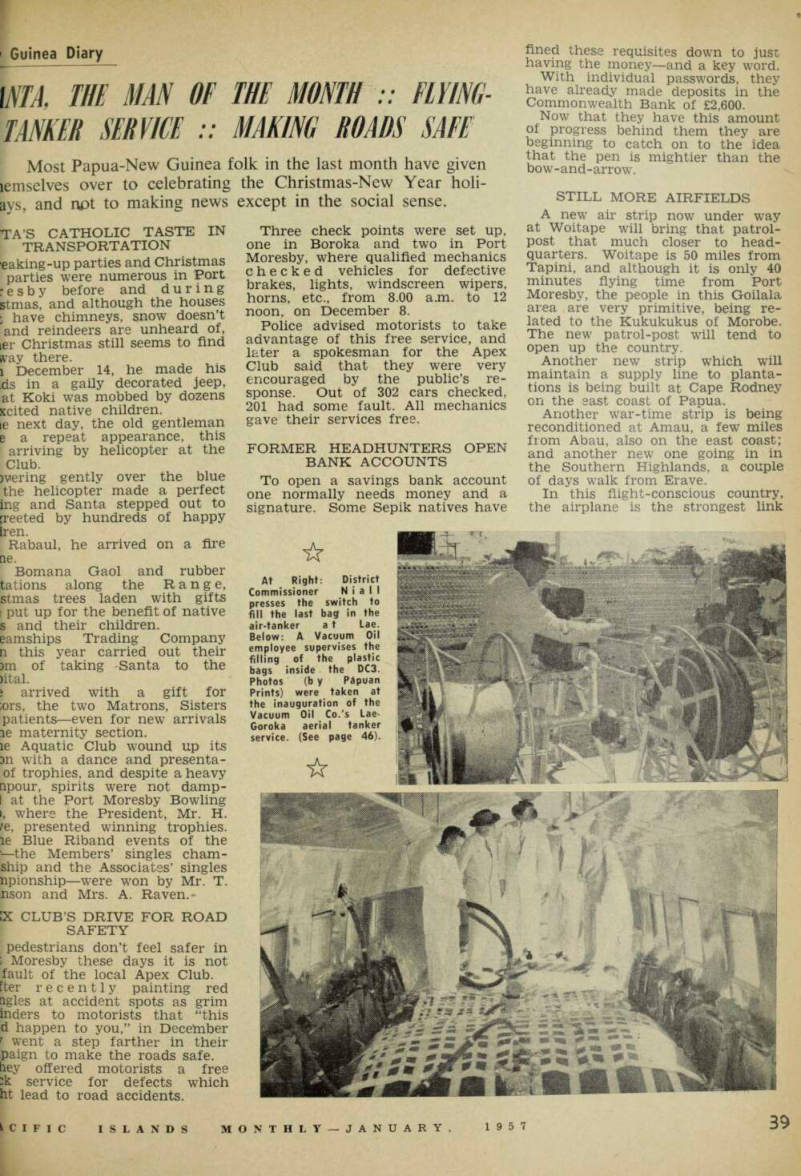
At Right: District Commissioner Niall presses the switch to fill the last bag in the air-tanker at Lae.
Below: A Vacuum Oil employee supervises the filling of the plastic bags inside the DC3.
Photos (b y Papuan Prints) were taken at the inauguration of the Vacuum Oil Co.'s Lae- Goroka aerial tanker service. (See page 46).
communication; even to the ve population, the airstrip is of t importance. le close liaison between the dnistration and the Department Jivil Aviation is enabling many strips to be recon med and new ones constructed. 1 prospective sites have to be Bcted by DCA before the Ad- Istration commences construc-
Ire Strife In The Sepik
District
report in early December, by itive from Enaru village, in the aneri River area of the Sepik, f a man, his wife and his son been killed in an attack by the io people caused a proposed by a patrol in January to be meed. le patrol, led by Patrol Officer
R. j. Daugherty, left Angoram, on the Sepik River, for the area, which has a scattered population. An in vestigation of the report will be made.
The timid and easily started Enaru people have been contacted previously by the Administration and a number of them visited Angoram some time ago. They were very friendly, stayed two weeks, and before returning home asked that village officials be appointed and a village census-book issued.
The patrol will carry out a census of the Enaru people as requested, as well as investigate the reported murder.
Early in January, a report was released of 10 other tribal murders in the Sepik area—this time from New Guinea’s biggest trouble-spot, Telefomin.
For thousands of years ritualistic
Native Built
[?]his Bridge
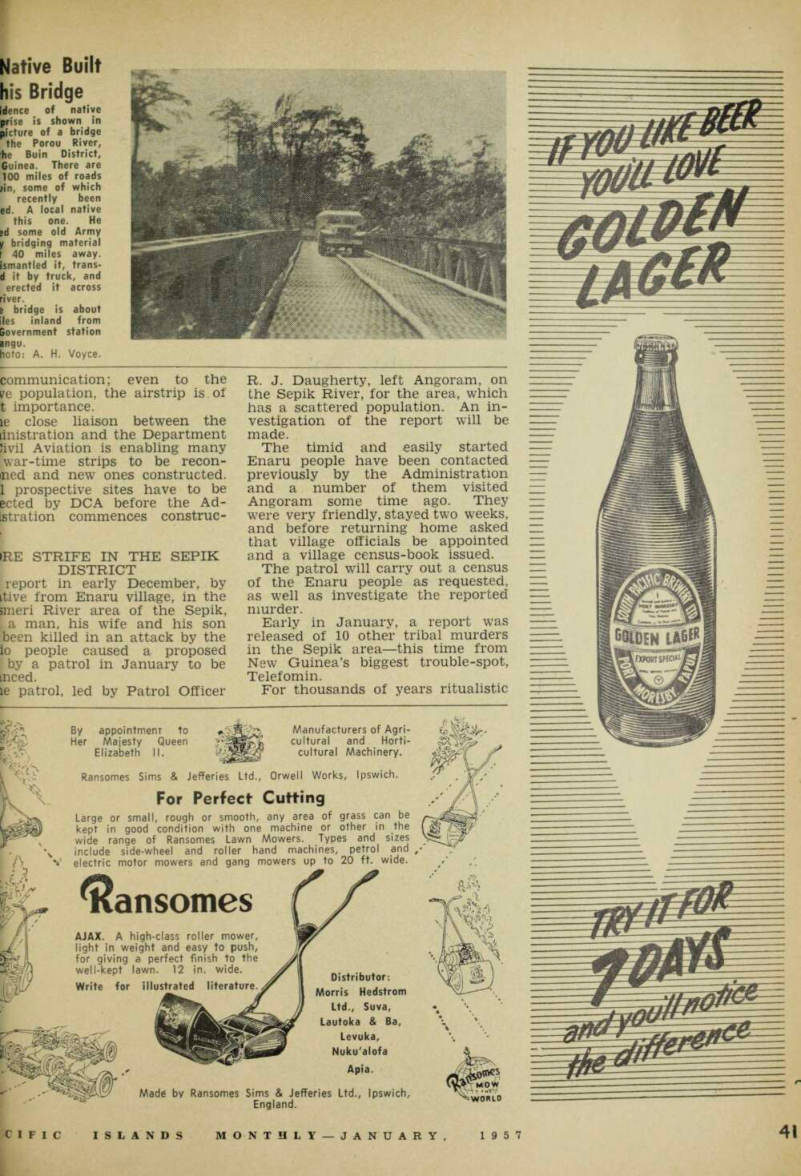
[?]dence of native prise is shown in picture of a bridge the Porou River, [?]he Buin District, Guinea. There are 100 miles of roads [?]in, some of which recently been [?]ed. A local native this one. He [?]ed some old Army [?] bridging material [?] 40 miles away, [?]ismantled it, trans [?]d it by truck, and erected it across [?]river. [?]e bridge is about [?]les inland from Government station [?]angu.
Photo: A. H. Voyce.
Photo: Papuan Prints, murder has been part of the culture of these people and they have not yet been persuaded by the sporadic Government patrols that go through their country to see the error of their ways. When a permanent patrol-post can be established they no doubt will finally be convinced that civilisation is best.
In the recent trouble, the head seekers walked for about two days over mountainous country before they arrived at the village of their selected victims. They then loosed a shower of arrows on the village, killing 19.
The Lumi Affair
The Director of Native Affairs, Mr. A. A. Roberts, in early De
cember, paid tribute to the of concerned in the patrols for men wanted in connection wit!
Yellow River massacre. (See Sept, p. 166).
About 40 suspects and ; witnesses have now been bn in.
In his statement, Mr.' Rc said: “The arrest of all sus in this case, in such a short
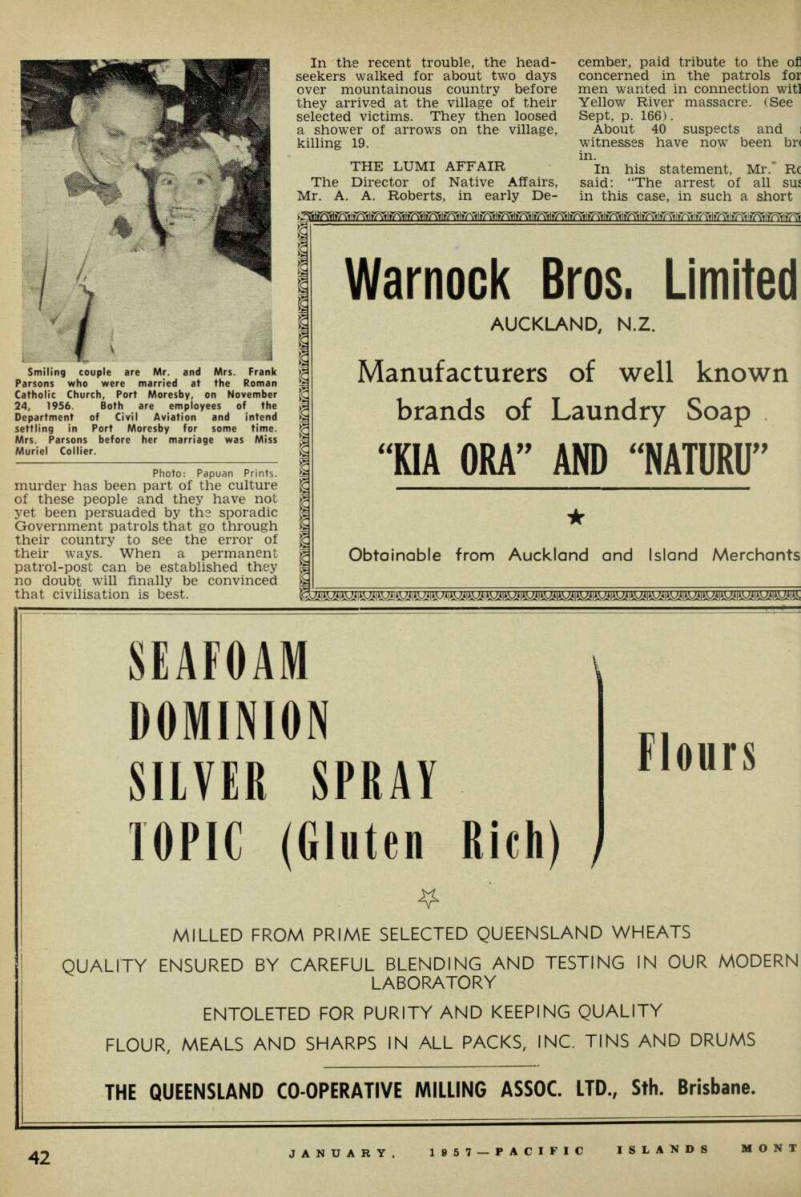
Smiling couple are Mr. and Mrs. Frank Parsons who were married at the Roman Catholic Church, Port Moresby, on November 24, 1956. Both are employees of the Department of Civil Aviation and intend settling in Port Moresby for some time.
Mrs. Parsons before her marriage was Miss Muriel Collier.
time, and considering the ex lingly difficult nature of the itry, is an outstanding example excellent field work by the •ols.” i * rhe massacre occurred last ust). . , .
Dwer Court hearings of the rges against the accused will a as soon as all investigations e been completed. Close atten . will continue to be given to the j River area.
Dre Like Sydney Every
Day
nee you were unlucky if your seboy got away with a cake of d, a stray shirt, or an odd pound ow they are getting bolder. Dur the year many natives were fenced for more serious crimes, ti as breaking into stores and aging on the wharves; on one asion one tried his hand at bag tching. atest misdemeanour is robbing ort Moresby Police in early De iber issued a warning to motorists lock their cars, especially when out all night. Goods to the le of £250 were reported stolen n cars at Moresby and Boroka ;he last weeks of 1956.
[Ant Tanker In Moresby
ort Moresby motorists need not r a petrol shortage, for a while any rate. )n December 8, one of the biggest kers seen in the harbour for le time steamed in with a load 19,000 tons of fuel aboard. She 5 the Dutch tanker Sarrah, direct tn Singapore. ifter discharging 4,000 tons of fuel Moresby I ,r the tanker will go on Gladstone, Brisbane and Suva.
The Sarrah is a sister ship to the Sarratan, recently sold by the com pany.
All ships of the line carry a white star on their blue funnels and are named after a constellation.
She is 572-ft long and has a gross tonnage of 30,000 tons.
They Were Racing—In
Rabaul, But Not Moresby
All roads led to the Vulcan Race course early December when a crowd of 1,400 people attended the in augural fixture of the Rabaul Amateur Turf Club.
The six-event programme was held in fine weather.
The District Commissioner, Mr.
Foldi, complimented the hard work and enthusiasm of club members, and congratulated the Club on its progress in bringing its first post war meeting to a successful con clusion.
The club repeated the perform ance, again successfully, on Boxing Day.
In Port Moresby, the Papua Turf Club advised in mid-December that the race meeting which was to have been held at the Boroka Recreation Reserve on December 31, had to be
[?]ular employee of A.P.C., Miss J. [?]r, made a charming bride when she married to Mr. J. Jenkins at St. John's can Church, Port Moresby, on December Photo: Papuan Prints
;poned because race track i not available.
The Wet
arrives t the end of sailing season, [ with the t” just around corner, all little VS’s and resby Class js had their s dried out, 1 were laid up gly until next »on. heir bigger ers in the hour which ictimes fish, mostly just around —have e n taken and to their
t-season wings at Ela Beach to escape norwester —and none too soon, first Guba struck Port Moresby mid-December. he “wet” came down steadily for *e nights. Dozens of cars were ,nded on Ela Beach Road and ing the day gangs of native brers were busy clearing roads
I gutters.
It was Moresby’s wettest De cember for 39 years. Other centres have also received their share of December ram. Three inches of -cin were recorded in Madang up to neeember 21; and in Lae an elec tric s t o rm produced two inches of ra in, which did something to re store the town’s usual lush green after a long period of what is re garded locally as a drought. (over)
Mr. and Mrs. N. R. East who were married recently at Rabaul by the District Commissioner, Mr. J. R. Foldi. The bride was formerly Miss A. Rundell, of the Post and Telegraphs Department.
Mr. East is in the Government Stores branch, Rabaul.
Photo: C. H. Meen.
Bags Of Oil
Natives working in the field the Australasian Petroleum C pany have always been intrii with the drilling operations, they associate oil with the drui which it comes, they have r been able to work out how drums are to be got down the c hole to be filled.
The revolutionary method of livering oil in rubber bags, put operation between Lae and Go in December, will, no doubt, be more difficult for them to ur stand.
When District Commissione: Niall pulled a switch at the auguration of the Air Ta Scheme at Lae, on December ] was the culmination of an idea ceived in 1954.
The Administrator, Brig: D. M. Cleland, in his speech al official opening, said: “It is an important event—in it is historic. It is the first in the Southern Hemisphere least, that such an air ta scheme has been inaugurated operated on a commercial seal “I congratulate the Vacuurr Company on its initiative and gressive ideas, and, with the Vac Oil Company, all those others have been so particularly conce in developing the scheme, brir it to technical perfection practical conclusion, namely D; Rubber Company, ANA, MAL, the Department of Civil Avu Each of them had their pa] play and all of them together participated in an excellent ach ment.”
Two hundred gallons of packed in rubber bags, and occ ing the entire floor space Dakota, can be transports Goroka where it is emptied ini underground reservoir. Then bags are folded away ready further use. The reduction in of transport for petroleum pro to inaccessible areas in New Gi is enormous.
Mr. and Mrs. D. G. Watkins after wedding recently in the Rabaul Chur[?] England. Mr. A. Richardson was best and Miss. J. Convary was bridesmaid
Goroka has already had a wel me reduction of 1/3 per gallon on trol.
Learning To Speak The
Native Language
The first classes for pure Motu nducted by the Public Service In tute in Port Moresby are to corn ice early in the New Year.
The Institute hopes that the ,tive language will be recognised a matriculation subject eventu [y, and then accepted as part of degree course.
The classes will be limited to Ad inistration personnel.
Police Motu, which is a sort of dgin version of the Motu language, is used by most pre-war Papua sidents. Most post-war residents f both Territories) get along with by-talk which they fondly imagine be Pidgin.
It is the policy of the Education jpartment that all natives will in ne speak straight English; there re the ability to speak pure Motu 11 likely never be more than an ;ademic distinction, except for few officials whose work takes em among Motuan-speaking itives.
Old British Gun Causes
Lae Man’S Death
For some people in the South icific, the war is not yet over. • Lae, on December 8, Ashley
Philip Blevin was using an acetylene torch to cut up an anti aircraft gun for scrap metal when the gun exploded, killing him.
Mr. Blevin, a married man with two children, was employed by Lae scrap metal merchant, Mr. Jim Pollard. He was working on the barrel of the gun when, it is believed, heat from the torch ignited a shell which had remained in the gun since last used. The charge blew back and threw him
12-ft into a pit around the base of the gun which he and four native helpers had dug. The four natives had a miraculous escape from injury.
The gun which caused Blevin’s death was a replica of one which was recently dug up and later presented to the Lae Technical Training Centre. The guns are believed to be British guns captured by the Japanese in Singapore and brought to Lae during the Pacific war.
Native students from the Lae Technical Training Centre, New Guinea, pointing out shattered gun barrel which caused the death of Ashley Philip Blevin at Lae in December.
The anti-aircraft gun which was dug up recently in Lae, New Guinea, and presented to the Technical Training Centre. Gun is replica of one which exploded and killed Blevin.