Notes By The Wayside
pp. 27-33 · Read in the full issue
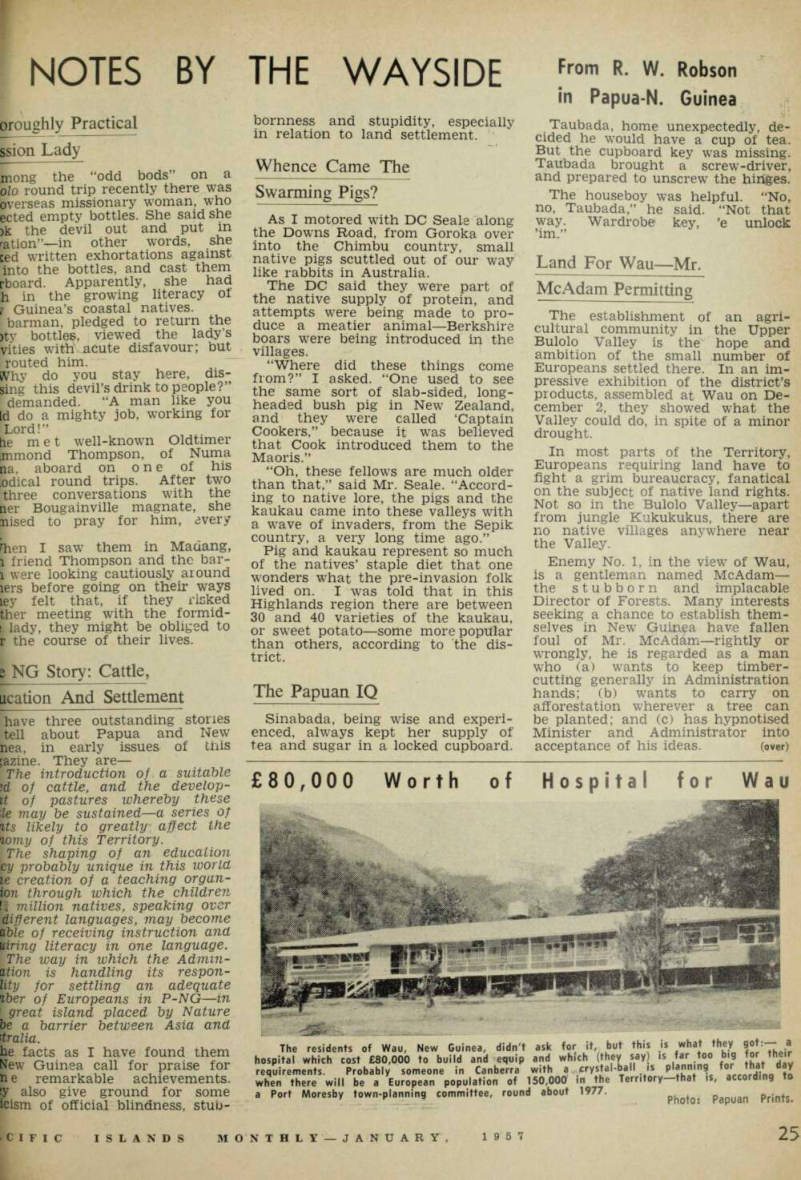
From R. W. Robson in Papua-N. Guinea
oroughly Practical
ssion Lady
mong the “odd bods” on a 010 round trip recently there was overseas missionary woman, who ected empty bottles. She said she >k the devil out and put in ration”—in other words, she ced written exhortations against into the bottles, and cast them rboard. Apparently, she had h in the growing literacy of r Guinea’s coastal natives, i barman, pledged to return the )tv bottles, viewed the lady’s vities with acute disfavour; but routed him.
Why do you stay here, dis sing this devil’s drink to people?” demanded. “A man like you Id do a mighty job, working for Lord!” tie met well-known Oldtimer immond Thompson, of Numa na. aboard on one of his edical round trips. After two three conversations with the ner Bougainville magnate, she nised to pray for him, every fhen I saw them in Madang, i friend Thompson and the bar i were looking cautiously around rers before going on their ways ley felt that, if they risked ther meeting with the formid \ lady, they might be obliged to r the course of their lives.
e NG Story: Cattle,
[ication And Settlement
have three outstanding stories tell about Papua and New nea, in early issues of this jazine. They are— The introduction of a suitable id of cattle, and the develop it of pastures whereby these ie may be sustained —a series of its likely to greatly ; affect the tomy of this Territory. [The shaping of an education cy probably unique in this world \e creation of a teaching organ ion through which the children K million natives, speaking over different languages, may become able of receiving instruction and biring literacy in one language.
The way in which the Admin ation is handling its respon- Uty for settling an adequate iher of Europeans in P-NG —in i great island placed by Nature be a barrier between Asia and iralia. he facts as I have found them New Guinea call for praise for n e remarkable achievements, “y also give ground for some Icism of official blindness, stub
bornness and stupidity, especially in relation to land settlement.
Whence Came The
Swarming Pigs?
As I motored with DC Seale along the Downs Road, from Goroka over into the Chimbu country, small native pigs scuttled out of our way like rabbits in Australia.
The DC said they were part of the native supply of protein, and attempts were being made to pro duce a meatier animal—Berkshire boars were being introduced in the villages.
“Where did these things come from?” I asked. “One used to see the same sort of slab-sided, long headed bush pig in New Zealand, and they were called ‘Captain Cookers,” because it was believed that Cook introduced them to the Maoris.”
“Oh, these fellows are much older than that,” said Mr. Seale. “Accord ing to native lore, the pigs and the kaukau came into these valleys with a wave of invaders, from the Sepik country, a very long time ago.”
Pig and kaukau represent so much of the natives’ staple diet that one wonders what the pre-invasion folk lived on. I was told that in this Highlands region there are between 30 and 40 varieties of the kaukau, or sweet potato—some more popular than others, according to the dis trict.
The Papuan IQ
Sinabada, being wise and experi enced, always kept her supply of tea and sugar in a locked cupboard.
Taubada, home unexpectedly, de cided he would have a cup of tea.
But the cupboard key was missing.
Taubada brought a screw-driver, and prepared to unscrew the hirtges.
The houseboy was helpful. “No, no, Taubada,” he said. “Not that way. Wardrobe key, ’e unlock ’im.”
Land For Wau—Mr.
McAdam Permitting
The establishment of an agri cultural community in the Upper Bulolo Valley is the hope and ambition of the small number of Europeans settled there. In an im pressive exhibition of the district’s products, assembled at Wau on De cember 2, they showed what the Valley could do, in spite of a minor drought.
In most parts of the Territory, Europeans requiring land have to fight a grim bureaucracy, fanatical on the subject of native land rights.
Not so in the Bulolo Valley—apart from jungle Kukukukus, there are no native villages anywhere near the Valley.
Enemy No. 1, in the view of Wau, is a gentleman named McAdam— the stubborn and implacable Director of Forests. Many interests seeking a chance to establish them selves in New Guinea have fallen foul of Mr. McAdam—rightly or wrongly, he is regarded as a man who (a) wants to keep timber cuttiiig generally in Administration hands; (b) wants to carry on afforestation wherever a tree can be planted; and (c) has hypnotised Minister and Administrator into acceptance of his ideas. (over)
i very large proportion of the id in the Upper Bulolo Valley, side the forests, is classed as estry reserve. If that land were de available to European settlers, agriculture purposes, Wau could lome the centre of a flourishing ming area. So far, every attempt get the afforestration reserva a removed from those desirable as around Wau (the Wau people te fairly argue that there are irmous areas elsewhere available afforestation, if needed) has n successfully resisted by the (estry Department, it the opening of the Wau Show, ministrator Cleland said he per kily was satisfied that consider e areas on the eastern side of Bulolo should be made avail e for agriculture, “and there will an announcement in a few weeks e.”
Tie Wau audience applauded— , the older hands said: “We’ve jd all that before. Wait until sees McAdam!” l few days later, I met Mr.
Adam on an airfield, and told i what the Administrator had 1. The famous McAdam jaw ck out, and he said, “Well, I am josed to that.” The incident con ned much of what I had been |ring about Mr. McAdam and his d forestry policies.
'he next move is now awaited h interest.
io Will Replace
ese Old-Timers?
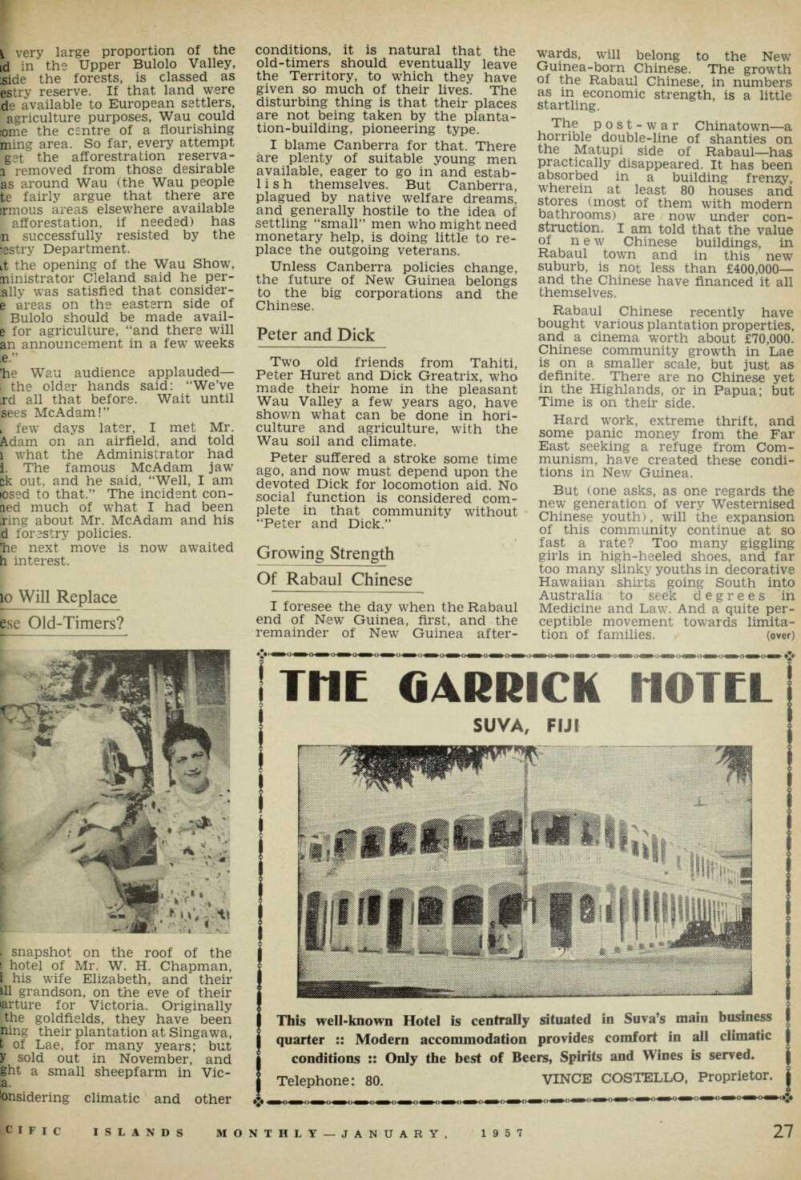
[ snapshot on the roof of the I hotel of Mr. W. H. Chapman, I his wife Elizabeth, and their ill grandson, on the eve of their larture for Victoria. Originally the goldfields, they have been Ring their plantation at Singawa, t of Lae, for many years; but y sold out in November, and ght a small sheepfarm in Vic a. bnsidering climatic and other
conditions, it is natural that the old-timers should eventually leave the Territory, to which they have given so much of their lives. The disturbing thing is that their places are not being taken by the planta tion-building, pioneering type.
I blame Canberra for that. There are plenty of suitable young men available, eager to go in and estab 1i s h themselves. But Canberra, plagued by native welfare dreams, and generally hostile to the idea of settling “small” men who might need monetary help, is doing little to re place the outgoing veterans.
Unless Canberra policies change, the future of New Guinea belongs to the big corporations and the Chinese.
Peter and Dick
Two old friends from Tahiti, Peter Huret and Dick Greatrix, who made their home in the pleasant Wau Valley a few years ago, have shown what can be done in hori culture and agriculture, with the Wau soil and climate.
Peter suffered a stroke some time ago, and now must depend upon the devoted Dick for locomotion aid. No social function is considered com plete in that community without “Peter and Dick.”
Growing Strength
Of Rabaul Chinese
I foresee the day when the Rabaul end of New Guinea, first, and the remainder of New Guinea after
wards, will belong to the New Guinea-born Chinese. The growth of the Rabaul Chinese, in numbers as in economic strength, is a little startling.
The post-war Chinatown—a horrible double-line of shanties on the Matupi side of Rabaul—has practically disappeared. It has been absorbed in a building frenzy, wherein at least 80 houses and stores (most of them with modern bathrooms) are now under con struction. I am told that the value of new Chinese buildings, in Rabaul town and in this new suburb, is not less than £400,000 and the Chinese have financed it all themselves.
Rabaul Chinese recently have bought various plantation properties, and a cinema worth about £70,000.
Chinese community growth in Lae is on a smaller scale, but just as definite. There are no Chinese yet in the Highlands, or in Papua; but Time is on their side.
Hard work, extreme thrift, and some panic money from the Far East seeking a refuge from Com munism, have created these condi tions in New Guinea.
But (one asks, as one regards the new generation of very Westernised Chinese youth), will the expansion of this community continue at so fast a rate? Too many giggling girls in high-heeled shoes, and far too many slinky youths in decorative Hawaiian shirts going South into Australia to seek degrees in Medicine and Law. And a quite per ceptible movement towards limita tion of families. (over)
Anyone Seen A
Leaping Snail?
I was having a drink in the Lae Hotel with Theo Mason, and we became confidential.
“One sees some mighty queer specimens in this country,” I re marked.
I was thinking of men (and some women) and their social habits; but Theo rolled on me an eye that was suspicious, with a hint of belliger ence. “Ho, someone’s been telling you about my snail,” he said.
“Your snail! What kind of snail?”
I asked “A leaping snail—and it has been named after me,” answered Theo; and then he told me the story.
He says he came upon the thing in the region behind Aitape, and it is a shellback snail that under con ditions of urgency, progresses in short leaps. He wouldn’t believe it at first, and went back and had a look at the label on his bottle. But he finally convinced himself that the snail was real. He captured some specimens, he says, and sent them to Mr. Cheeseman, at the Sydney Museum: and, as it was a new species, Mr. Cheeseman incorporated Mason in the name by which the creature was scientifically labelled.
I don’t doubt Theo for a moment, of course—but has anyone in the Sepik district ever seen a leaping snail?
Nominated As Assistant
Administrator
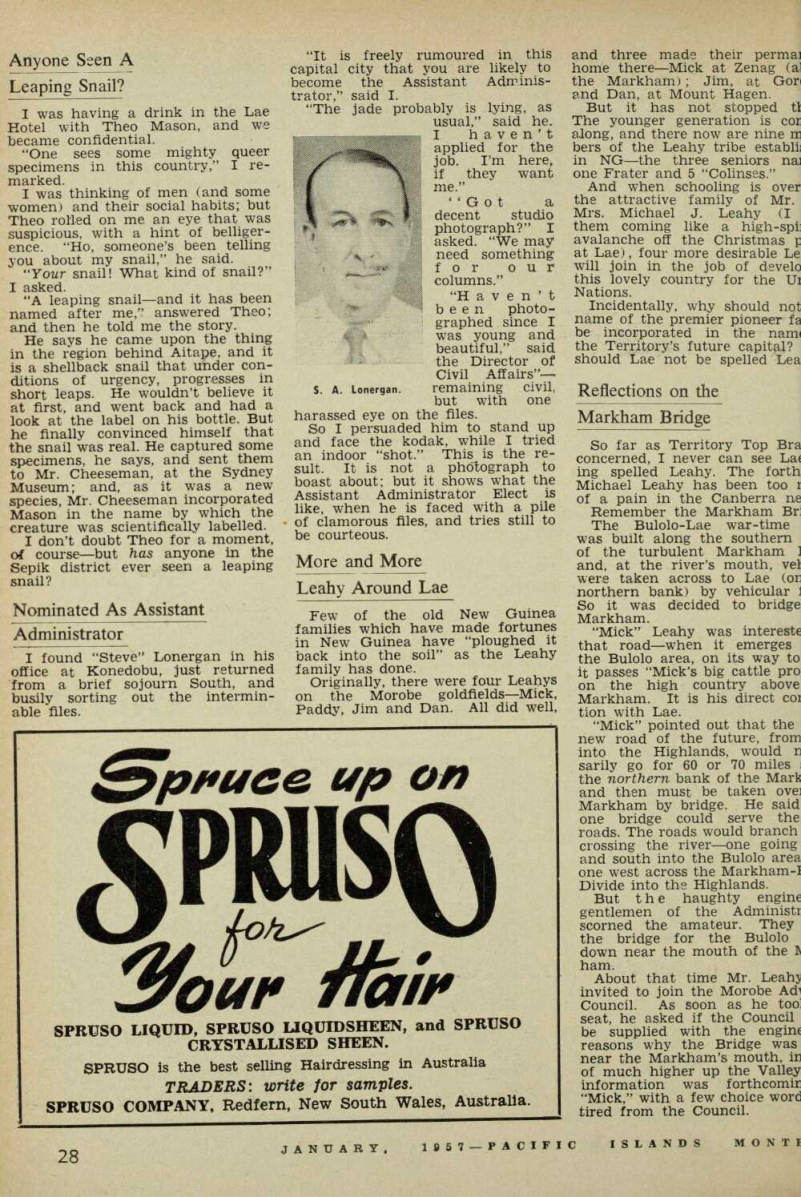
I found “Steve” Lonergan in his office at Konedobu, just returned from a brief sojourn South, and busily sorting out the intermin able files.
“It is freely rumoured in this capital city that you are likely to become the Assistant Adminis trator,” said I.
“The jade probably is lying, as
usual,” said he.
I haven’t applied for the job. I’m here, if they want me.” ‘‘Got a decent studio photograph?” I asked. “We may need something for our columns.”
“Haven’t been photo graphed since I was young and beautiful,” said the Director of Civil Affairs”— remaining civil, but with one
harassed eye on the files.
So I persuaded him to stand up and face the kodak, while I tried an indoor “shot.” This is the re sult. It is not a photograph to boast about; but it shows what the Assistant Administrator Elect is like, when he is faced with a pile of clamorous files, and tries still to be courteous.
More and More
Leahy Around Lae
Few of the old New Guinea families which have made fortunes in New Guinea have “ploughed it back into the soil” as the Leahy family has done.
Originally, there were four Leahys on the Morobe goldfields—Mick, Paddy, Jim and Dan. All did well,
and three made their permai home there—Mick at Zenag (al the Markham) ; Jim, at Gon and Dan, at Mount Hagen.
But it has not stopped tl The younger generation is cor along, and there now are nine m bers of the Leahy tribe establii in NG—the three seniors na] one Frater and 5 “Colinses.”
And when schooling is over the attractive family of Mr.
Mrs. Michael J. Leahy (I them coming like a high-spi] avalanche off the Christmas p at Lae), four more desirable Le will join in the job of develo this lovely country for the Ui Nations.
Incidentally, why should not name of the premier pioneer fa be incorporated in the nam< the Territory’s future capital? should Lae not be spelled Lea
Reflections on the
Markham Bridge
So far as Territory Top Bra concerned, I never can see Lae ing spelled Leahy. The forth Michael Leahy has been too r of a pain in the Canberra ne Remember the Markham Br; The Bulolo-Lae war-time was built along the southern of the turbulent Markham 1 and, at the river’s mouth, vel were taken across to Lae (or northern bank) by vehicular J So it was decided to bridge Markham.
“Mick” Leahy was intereste that road—when it emerges the Bulolo area, on its way to it passes “Mick’s big cattle pro on the high country above Markham. It is his direct coi tion with Lae.
“Mick” pointed out that the new road of the future, from into the Highlands, would n sarily go for 60 or 70 miles : the northern bank of the Mark and then must be taken ovei Markham by bridge. He said one bridge could serve the roads. The roads would branch crossing the river—one going and south into the Bulolo area one west across the Markham-I Divide into the Highlands.
But the haughty engine gentlemen of the Administr scorned the amateur. They the bridge for the Bulolo down near the mouth of the 1\ ham.
About that time Mr. Leahy invited to join the Morobe Ad) Council. As soon as he tool seat, he asked if the Council be supplied with the engine reasons why the Bridge was near the Markham’s mouth, in of much higher up the Valley information was forthcomir “Mick,” with a few choice word tired from the Council.
S. A. Lonergan.
ow, the Administration is press on with its Lae-Highlands road, spending much of Australia’s money in building bridges >ss the Markham’s upper utaries. “Mick” Leahy doesn’t much —beyond pointing out that he bridge had been built where suggested, it would not have i necessary to maintain two is, one on .either bank of the ■kham—one would have sufficed, a Lae up to the bridge. [eanwhile, M. J. Leahy blames Administration for the introduc i of cattle-tick to his formerly -free ranch at Zenag; and his nal, legal claim for £lO,OOO lages is to come before the courts day now. oyway, Lae will always be pro nced Leahy—Top Brass cannot rent that.
inese in the
omons ; BSI resident whom I met on Lae-Honiara plane told me that :e are now at least 400 Chinese dents in the Solomons, and be en 40 and 50 Chinese trade •es within comfortable taxi-ing ,ance of Honiara, taking a survey of the South ific Islands, to note the various in implantations, one is in ed to overlook the Solomons, ire were a few Chinese traders :e before the war; but, during war, they disappeared and, one posed, they had “gone finish.” ; that definitely is not so. They e come back and, in the (ority of cases, they have Chinese es. Some already are rich, and le are on the road to riches.
Jnder British administration (tax in of incomes and no assistance to ;lers) no European progress is be made in the Solomons. But if BSI Chinese can repeat the tics of the Rabaul Chinese —and re is evidence that they may— rich and undeveloped Solomon inds may yet become the West’s d gift to Cathay’s Four Hundred, ’he only large Territory in the ith Pacific which now has not an established Asian community Samoa. (The NZ Socialist Gov iment deported the Chinese from noa in the mid-Thirties.)
>coa Men In
le Markham
Motoring around with “Mick” ihy, I found D. M. Eden rmerly head of NZ Reparations bates in Western Samoa) over ling in Lae; and, on an in ration, we picked him up and >k him out to the new Mac bertson enterprise in the Mark in Valley—Wanaru cocoa planta n now being managed by Keith blet. (over)
r hunch was right. Keith €d the world-famous cocoa er as if he were God; and they off around the plantation, deep he science of producing the table berry, while “Mick” and md other diversions. (Pictured: on left, Noblet on right).
Ith Noblet, aided by a mighty
tanical installation from Mac rtson’s, has revolutioned that Edwards plantation. He has d out the old and unprofit trees ; lifted a large quantity of jungle off new country; and planted up no less than 300 —nearly half the area. »n was deeply interested in the md conditions leard the argument that Mark- Valley is not good cocoa try. energy and mechanisation t for anything, that Mac rtson plantation will become
one of the show places of the Mark ham Valley.
Cargo Broached In
Any Language!
Rabaul wharf-1 abourers are acquiring the blessings of Western civilisation, just like their brothers and cousins in less strenuous occuptions.
Some importers complain that it is difficult to get a case of whisky ashore, intact. It is difficult to tell, by external examination; but when the case is opened, it may be three or four bottles short. The wharf workers deny all knowledge of the theft; but in due course, if one is observant, one may see a few “coons” in a drunken condition, and the smell on their breath does not come from drinking coconuts.
It is the same here as every where —the worst of European practices, like thieving, disease, prostitution, drunkenness, are most readily acquired by those primitive people in close contact with the crews of ships.
In the Highlands, there are no -social troubles of that kind because the natives remain completely un sophisticated and no ships make contact there. There has been some methylated-spirit drinking lately, however —traced to some rather poor types brought in on building and construction jobs.
I Mr. Keith Ransom, manager of the soap factory operated in Western Samoa by Western Samoan Industries Ltd., was in Sydney late December. He told reporters that Samoans were amongst the cleanest people in the world—they used 50 tons of soap per month—a large amount for less than 100,000 of population. t New Caledonia will soon have a law forbidding the consumption of alcoholic drink in public streets. It is said that European and native wine and beer parties in the public square have “become quite a scandal.”