Roiongas Undersea
pp. 73-75 · Read in the full issue
[?]Sized but [?]table
[?]Vage Operations
By W. H. Percival
E night in December, 1916, he Union Steamship Company’s ,400-ton vessel, Maitai, lay at or off Avarua, Rarotonga, fof the crew and passengers , ashore enjoying local tality when a northerly gale g up and the Maitai dragged anchors to become a total C upon the reef. No lives were but the vessel subsequently in about 25 feet of water there she still lies on the shelf extending from the irds side of the reef.
September, 1955, two members 5 Cook Islands Administration t to spend their spare time ring the wreck with a view xall scale salvage operations, built a raft and equipped it an air compressor and motor. >assed from the compressor ?h a cooling pipe fitted under ■aft and then into an air er. [ snorkel was removed from -face diving mask, of the type by spear fisherman, and re -1 with 300 feet of plastic air Excess air escaped from the of the mask and a constant i of fresh air passed over the I face. A later refinement he fitting of a microphone he face-piece, which enabled ver to speak to the raft crew, divers found that the four lor blades of Maitai were 17 feet across and were made
uable phosphor-bronze,
blade was vertical, two were ntal and partly overgrown
with coral, and the fourth was completely bured in coral. Each blade had eleven nuts and bolts securing it to the central steel boss, and the nuts were recessed into the blades and were covered with concrete.
Many weeks were spent using hammer, cold chisel and a foot spanner. Six nuts were removed by this method (and were found to weigh 14 pounds each) then gelignite charges were used to remove the remainder.
During this time one of the divers discovered a sea snake under the steel plate on which he was standing; his companion was
thp P ff d at ? y a Mora y eel » an d times' SUpply failed a number of J' ila j year a major setback when the outboard Suin’ w s l ®? Powered the raft, the raft finished on the reef. Owing to this and a period of very bad weather it was not lift the first blade until «ri^ the vi^® cul k ies were encountered hei \ kjtojg commenced. It was found that the blades were too lieayy to be lifted from the raft, so a 400 gallon tank with a lifting power of 4,000 lbs. was pressed into k, * tank was arched to the blade, filled with air, and
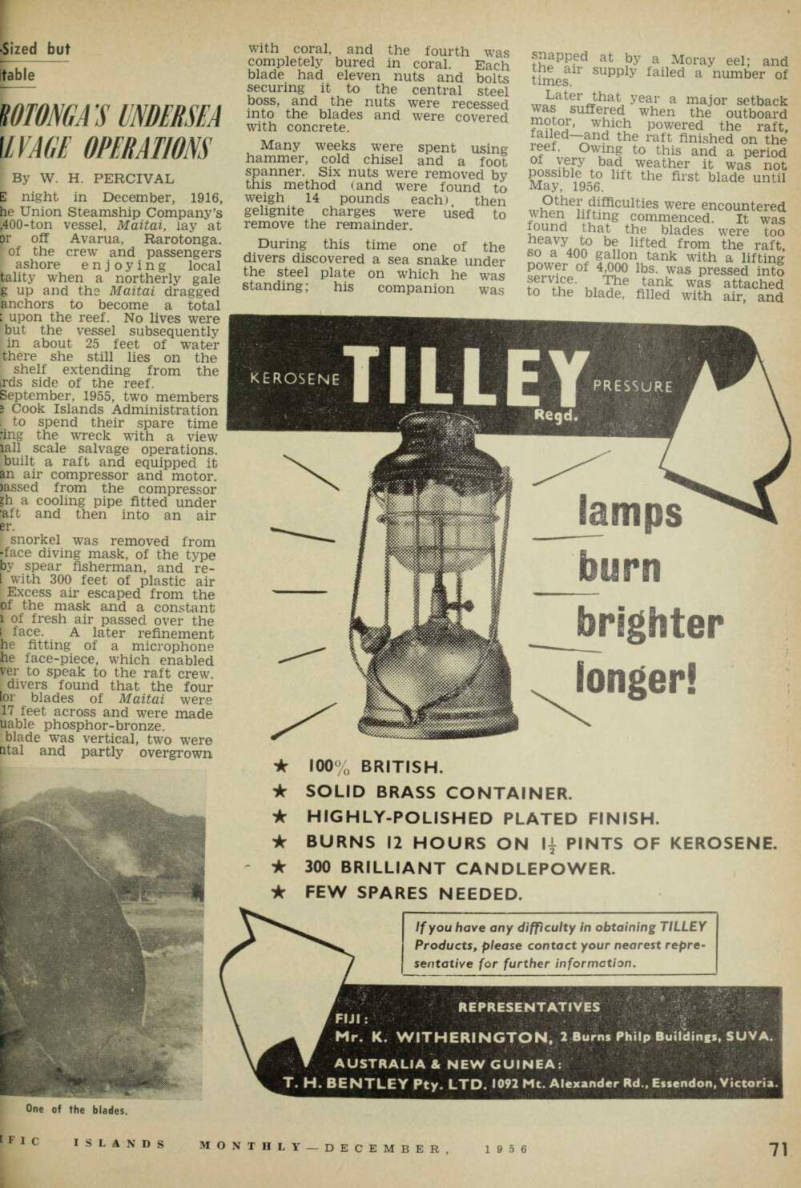
One of the blades.
[sed to just under the surface.
Ftug of the Union Steamship toipany then towed raft and blade 'the wharf, Che blade was sent to San ancisco, where it was found to ve a 92.5 per cent, copper itent. It weighed almost two is and it was sold for a hand tie figure.
Powerful charges of gelignite yed the problem of removing the it two blades. A spectacular tlosion shattered the steel boss i blew a blade ten feet away, lecond explosion moved the other de 30 feet.
'he undersea salvage operation been a success and the divers mow anticipating further profits.