[?]Agic Metals Bring Unprecedented
pp. 39-45 · Read in the full issue

[?] and [?]oom
Prosperity To New Caledonia
' LEW PRIDAY, who recently Revisited the French Colony.
tfEA is happy about the angement under which the )ken Hill Proprietary of Aus tin import iron ore from the e deposits—many miles square )n e of the
s t untapped n the world — ted on the ting Plaine js in southern aledonia. r rench Colony, played such ortant role as ed base dur ie Solomons in —when for year Noumea busier port Sydney has been a good r of Au s rhich is much for supplies f a r-a way e. The in ion at last of two-way -ships that n coal and id food sup eturning to a with iron 1 benefit both s. 5 the smelt- Newcastle of ian iron ore affect activ [ron Knob or Sound. World for steel is ig so rapidly Australia is e to find, in est and most foreign ir, a future o large and d y to her seaboard.
JP party, lief Geologist k, examined deposits before the en the Jap id begun to rial ship om the tiny Goro, where tailed ship equipment, was then Ik of BHP
taking up an option on part of the iron area, but the toar halted dis cussions.
A. second BHP party went back to prospect the plateau soon after
is h a St‘of t C hat r v”sit arrangemei?t Pronv d ?L, at a sn ? all badland .at Cool/ hnimr? nCe vlslted by Captain oook are cutting away s i de of a hill and establishing 600 ?° lnt ca P able of handling pOO tons of ore an hour The noint is notable for very deep waterM in any weathlr'and Thl Shl £ S of almost any .size, oDerate F fbo C k Co ™P ail y formed to the Nirk-P^nr, 01^6 has in assoc iation cke Company (since 1880, the power in the land), Maison S a "t <lhe big Bordeaux mar“ lime and commercial firm) and mining magnate Henri Lafleur
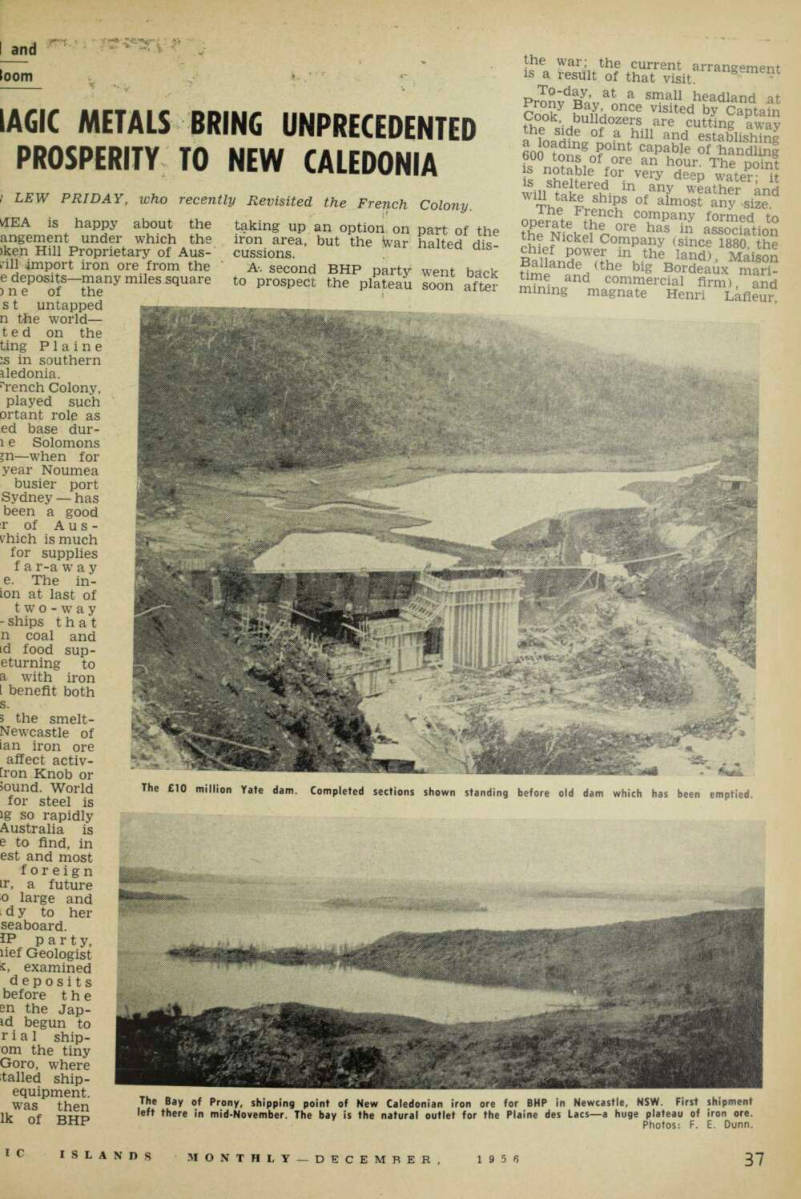
The £10 million Yate dam. Completed sections shown standing before old dam which has been emptied.
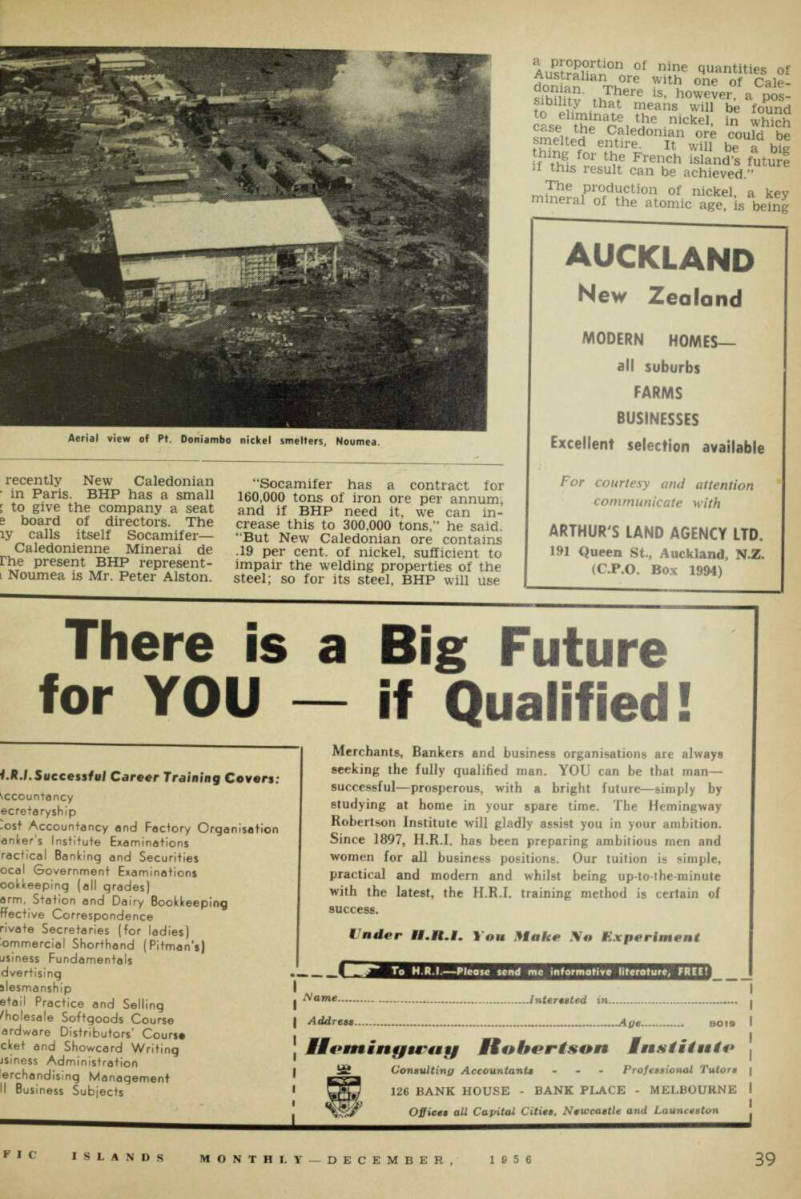
The Bay of Prony, shipping point of New Caledonian iron ore for BMP in Newcastle, NSW. First shipment left there in mid-November. The bay is the natural outlet for the Plaine des Lacs —a huge plateau of iron ore.
Photos: F. E. Dunn.
recently New Caledonian • in Paris. BHP has a small f to give the company a seat e board of directors. The ly calls itself Socamifer— Caledonienne Mineral de rhe present BHP represent i Noumea is Mr. Peter Alston.
“Socamifer has a contract for 160,000 tons of iron ore per annum, and if BHP need it, we can in crease this to 300,000 tons,” he said.
“But New Caledonian ore contains .19 per cent, of nickel, sufficient to impair the welding properties of the steel; so for its steel, BHP will use
» on of nine quantities of Australian ore with one of Cale s&mtv’ th Tl ? ere is ’ however - a pos sibility that means will be found case n he nicke1 ’ in which wfStii? 8 Caledonian ore could be smelted entire. it will be a hil if ll^ Q f ° r French island’s future if this result can be achieved.”
The production of nickel a kpv mineral Of the atomic a|“ Is being
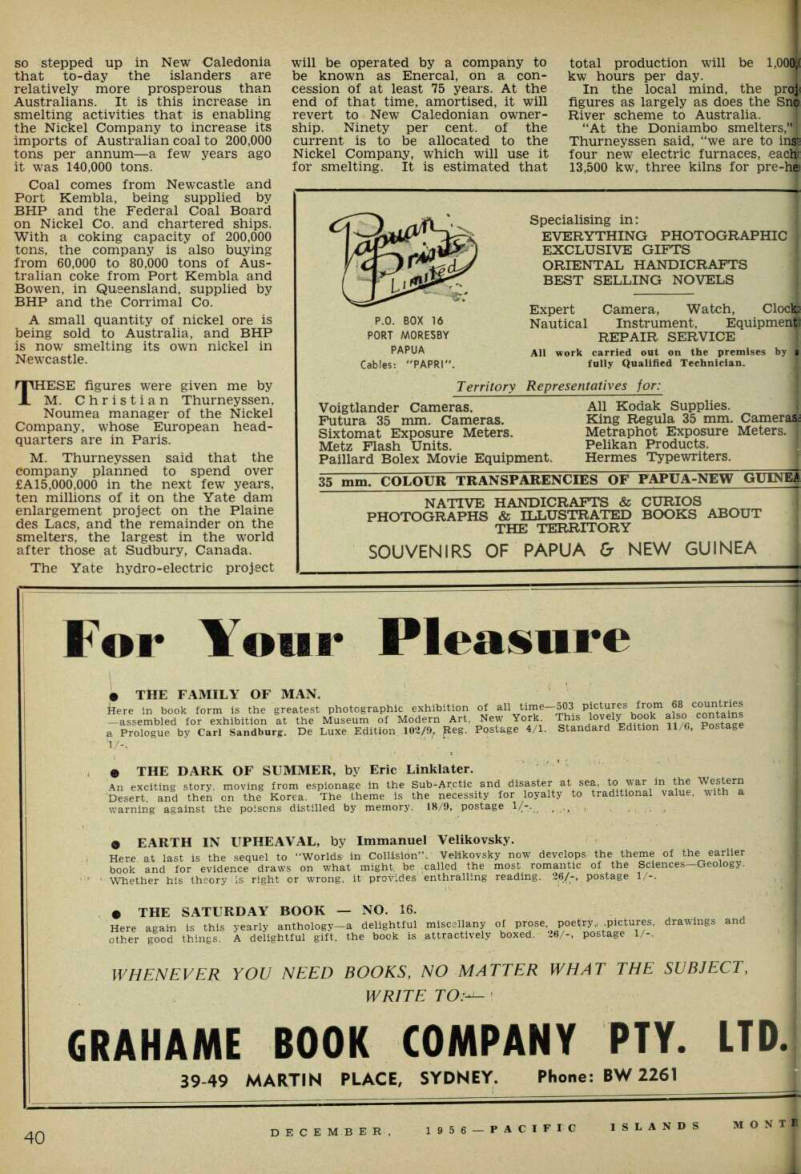
Aerial view of Pt. Doniambo nickel smelters, Noumea.
so stepped up in New Caledonia that to-day the islanders are relatively more prosperous than Australians. It is this increase in smelting activities that is enabling the Nickel Company to increase its imports of Australian coal to 200,000 tons per annum—a few years ago it was 140,000 tons.
Coal comes from Newcastle and Port Kembla, being supplied by BHP and the Federal Coal Board on Nickel Co. and chartered ships.
With a coking capacity of 200,000 tons, the company is also buying from 60,000 to 80,000 tons of Aus tralian coke from Port Kembla and Bowen, in Queensland, supplied by BHP and the Corrimal Co.
A small quantity of nickel ore is being sold to Australia, and BHP is now smelting its own nickel in Newcastle.
THESE figures were given me by M. Christian Thurneyssen, Noumea manager of the Nickel Company, whose European head quarters are in Paris.
M. Thurneyssen said that the company planned to spend over £A15,000,000 in the next few years, ten millions of it on the Yate dam enlargement project on the Plaine des Lacs, and the remainder on the smelters, the largest in the world after those at Sudbury, Canada.
The Yate hydro-electric project
will be operated by a company to be known as Enercal, on a con cession of at least 75 years. At the end of that time, amortised, it will revert to New Caledonian owner ship. Ninety per cent, of the current is to be allocated to the Nickel Company, which will use it for smelting. It is estimated that
total production will be l,oooj{ kw hours per day.
In the local mind, the prol figures as largely as does the Sno River scheme to Australia.
“At the Doniambo smelters,”f Thurneyssen said, “we are to inss four new electric furnaces, eacKr 13,500 kw, three kilns for pre-he
ore, each about 72 metres d some small 3-kw electrical and converters used for Major equipment we are tailing includes new hand ipment for nickel ore and and coke. A large hangar built and a whole system onveyers. The company has
a sta ff °f 1,400 at Donlambo, be sides those employed on the Thio mines, which have been progressively mechanised since the war, and the men who man the company’s ships ”
The great mining plateau behind the company’s p<prt of Thio, on the east coast, is a hive of activity. Pro duction by the company in the past year has so increased that the annual metal-producing capacity now is 10,000 tons, compared with about 6,000 before the war. But with the new plant in operation capacity will rise to 20,000 tons’ this on a Pacific island that was scarcely known to the outside world before 1940.
There is another important aspect of the present nickel market which
'rv.t ddmg to the islan d’s prosperity.
The amount of nickel available the world at the re cogmsed world price to day is quite insufficient for world needs. The tJmitl 8 dl f ic^ lty is Japan ’ s oppor rnd she 18 quick to seize it.
Japa ™: se ships are arriving than those of any other Japan ’ buys 01 *e from the Nickel Co., but only a small amount.
She is buying a vast quantity more —bringing her purchases of New Caledonian ore this year up to a minion tons—from independent local concerns, some small, and one or two large. This nickel, smelted in Japan, is being sold to an eager world at very much higher than accepted world prices.
(Continued on Page 43)
ly of Prony area was once a penal Some of the old ruined buildings [?]ut banyan trees have swallowed up hem below.
Photos: F. E. Dunn.
Japanese are able to make purchases in American cy, and their ships are load -3 as fast as the independent can supply them. ;hever way we look at it, ;kel market spells boom times s large, half-empty island of aledonia, where per head of tion car-ownership and pro i of mineral ore is said to highest in the world. As a Governor, M. Rene Hoffherr, ; “The smoke which rises ic Doniambo smelters to-day ises the prosperity of the population.”