Territories Talk-Talk
pp. 30-37 · Read in the full issue
By Tolala
COMES again the Yule-tide period and subconsciously our thoughts revert to the age-old Message: . . On earth Peace, Good will toward men.”
For ten years now I have sent a Christmas Greeting to readers through “Talk Talk”, with ever the hope uppermost that Peace may be our share in a world holding so many material gifts for Mankind.
And now, after a decade, the snarls and growls of nations have never been more significant, with the greatest clamour arising not far distant from where (we are told) that First Angel of Goodwill appeared.
But for all that, with all sincerity I send you the wish: “Happy Christmas and a Peaceful New Year and may a balanced prosperity prevail.”
Racing Links
With the Past
Public-spirited men of the pre war years are to be remembered by the recently resurrected Rabaul Amateur Turf Club. I refer parti cularly to the F. O. Greenwood
Stakes, the Nobby Clark Stakes and the Harry Adams Trophy. All of these old-timers (who were lost after the Fall of Rabaul in 1942) were ardent supporters of the original RATC, and it is satisfying to know that posterity will remember them.
The widows of both F.O.G. and Harry Adams are well-known in the Rabaul area to-day. Mrs.
“Nobby” Clark died in May last year in Sydney. When the Japs came into Rabaul in 1942, “Nobby” was Chief Warden and did an
excellent job of work before bi shipped away on the fa: Montevideo Maru.
Colour
Consciousness
Such phrases as “race discrinj: tion,” “segregation,” “apart® are all working overtime in ] Year of Grace 1956. The divi line between white and black; been a “Problem” and a “Quest and the world at the morner minding its P’s and Q’s.
The result, at the moment, is. colour consciousness has bet; so emphasised that the ave person (who hardly gave ] thought before) is almost compa to take sides and proclaim:
sympathies one way or anoth “Do you support ‘racial eqir or do you not?” is often a qu put forward to people (of colours) who have given.;: problem no thought at all, f( simple reason that the world accepted the fact (as a resic civilised evolution and the n trend of development) thaie Caucasian race has proven
Another "Guess Who?" This Old
graph was sent in by Mr. Peter Eng[?] Angoram, Sepik River, with this note: "Nicky Minster discovered it in an ol[?] he picked up somewhere, and it has bit subject of a sort of guessing competion the bar of the Angoram Hotel for the [?] weeks. Guesses to date —and we [?] means of checking their correctness— a,- "Standing (left to right): Jack Ba Jerry Keogh, unknown, unknown, Mrs.
Dick Bell.
"Sitting (left to right); Terry Zoppmas Spence.
"Locality: Watut (?).
"Perhaps some of the PIM staff or [?] old-timers down south might like to [?] hands at picking 'em." (The only one PIM is sure about Keogh—killed during the war in a plan[?] so it is over to the old-timers.)
mce in world affairs and is assing on the result of its ig to the under-privileged aces, in order that they may the fruits of centuries of h and learning, e are, however, standards of ig, of Efficiency, Ethics and on which must be taken into ration when comparisons of Mnent or Education arise i the two colours. These :ds are adjusted by the 0 which they aspire. lim of present-day economics everyone to attain a high •d of living with the mini expenditure of energy—in ligh wages with low working In the ultra-civilised > of the world it has become ;epted thing to make speed ed the two outstanding goals h the white race aims. The ces of the world have never to such standards—and lo not conform to our an standards of living, and • to conform with that parti andard we insist they adopt ime “speed and greed” es to which we ourselves iltimate question is: Does it appiness and peace to the oncerned? Does it eradicate tnplicate their economic in the world? we, with our super :ated training and environ truthfully answer that ?
ide
ion? realistic writer, Stuart >uched on a knotty problem in an article, appearing dney paper, on population in the Mortlocks—one of jrritory’s far-flung atoll lying east of Buka, iment officials, so the story id found the remains of babies which had been alive shortly after birth, stion arose as to whether an old tribal custom or a means of stemming over in, for there is little in the native foods grown in the and every new mouth 1 the food problem. In 1928 lation was 98, latest figures j souls, so that might be for infanticide, have never heard of these care-free people (of in strain) practising this stom. [ortlocks, like so many of e isolated groups of the , have an interesting, imewhat tragic background, y Queen Emma, she gave vedding present to one of anions, whose husband (an an) died there; the com re-married and became ier; he also died and Mrs.
herself, met a tragic death i a dynamite accident on the tiember calling there in the ;hirties on a copra-catcher skipper thought we had ;he Tasmans after days of ig, which was really not ng because the Mortlocks for
years had been incorrectly plotted on the sailing charts).
It was here I met up with Jock Goodson, who had acquired the group from the Exproboard, and whose care and personal attention of the local natives was of a high standard. For many years Mort lock Islanders were not permitted to leave the Group.
Old Time
Land Laws
Many groups and islands dotted about In teritorial waters, that were nominally the property of Queen Emma, were of little value.
In earlier days it was the practice of the skippers in trading vessels
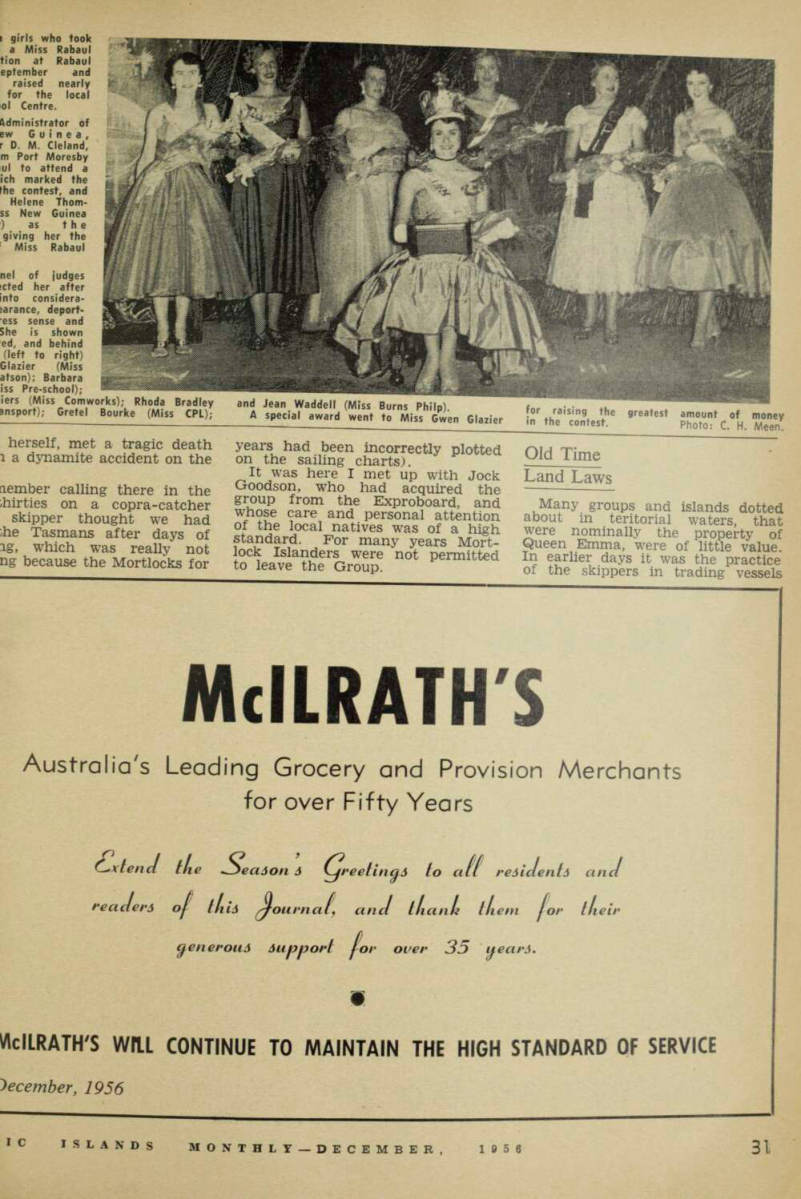
girls who took a Miss Rabaul tion at Rabaul eptember and raised nearly for the local [?]ol Centre.
Administrator of New Guinea, [?] D. M. Cleland, [?] Port Moresby [?] to attend a ich marked the the contest, and Helene Thom [?] New Guinea as the giving her the Miss Rabaul nel of judges [?]cted her after into considera earance, deport ess sense and She is shown ed, and behind (left to right) Glazier (Miss atson); Barbara iss Pre-school);
iers (Miss Comworks); Rhoda Bradley andport); Gr
and Jean Waddell (Miss Burns Philp).
A special award went to Miss Gwen Glazier
for raising the greatest amount of money in the contest. Photo: C. H. Meen.
to buy an island or group with as little ceremony as they bought a bag of copra.
A caddy of tobacco, some red calico and a few knives to the chief and the deal was closed, and later registered with the government.
But at the turn of the century, when responsible government took over from the old Neu Guinea Compagnie, it was laid down that native owners on an island should have an adequate area—l think it was three persons to a hectare — —as a reservation. On many of these islands it was found there was not sufficient arable land for such allocation, and therefore all the purchaser got was a small trading site, with fishing and trading rights.
This is what happened to Queen Emma’s purchases of the Carteret and Tasman groups and the islands of Hittau and Pororan in Carola Harbour in Buka.
But she had a win with the luxuriant Beads (Nuguria) and Nissan groups. The D. H. & P. G. with NG headquarters at Mioko, grabbed Jame and Sale islands in Buka as recruiting bases for their plantations in Samoa, and they were regular ports of call for the old wind-jammer Samoa, with Capt. Peters at the helm. As there were no natives on Jame it was able to be planted up and is now one of the model plantations in the Territory. P e t a t s and Matzungan, islands also off the Buka coast, were owned by
Hernsheim & Co., and were also considered principally as recruiting bases for the Matupi interests.
Pre-war
Planting
While wandering down this parti cular Memory Lane it is interesting, in view of my remarks in Oct.
“Talk Talk” (p. 29), to note that one of the reasons for the large area put under cultivation just before the Exproboard took over in 1921, was the fact that much of the virgin land obtained in the early days by some of the big companies had been lying idle, but that the German land laws, which came into operation about 1900, had a clause calling for a percentage of the area (I forget exactly what it was) to be cultivated within 20 years. Land held by the Neu Guinea Compagnie was exempt from this clause.
The firms realised they must get cracking on this in order to retain their titles, and so planting contracts were given out to individual planters. This applied particularly to the Buka/Bougain ville area where Queen Emma had large undeveloped land holdings.
Old Schnackenberg (he later married Mrs. Batze, of the Bainings) had the contract to plant up Kessa (Buka) and Matthias Island (Buka Passage); an Aus tralian, Les Mutton, planted up
Raua on Bougainville, and! killed in Rabaul in a motor acct: just as the Board was taking!! the place early in 1921.
Further down the coast* Mabiri, Ludwig Kramer had|J contract. All of them a Queen Emma properties. I DH&PG island of Jame was plas by Charlie Huson, an old timer! the BSI who later had hisl place at Tulaen, opposite Jamc Buka.
A point of interest about I early land grabs is that the i requirement was a suitable ant age. Rainfall, soil analysis, la availability were quite secorti considerations. There was I scientific approach to land sele in those far-off days and yet,. withstanding this slap-h system, there are few estates y have proved unsuccessful.
In fact, I can recall now! one, and that was a case whern land-seeker was most conscien and persevering. He was a' named Cogswell, a former ok in the Gilberts, and he was loi for coffee-growing land just to War I broke out. He trai up and down New Britain!
Bougainville in the schu Vella with a man named M«] who was later murdered by natives down the south coait New Britain.
Nothing would satisfy Cogij he selected a site on the NB 1 coast at Rugen Harbour, 1
it was not quite what he d, and then went behind down in Bougainville, and set up in business as the Harbour Coy, which med for some years (miles its original name spot) but ally failed. ient
orians
jondon scientist, making a for the Commonwealth ment into “environmental ns” in tropical Australia, included P-NG, says the “turnover” in P-NG is ible, principally due to itent and frustration.” , it doesn’t take a research from London to tell us nd the fact that staff—more lly Administration employees drds of passage and transient ts, en route back to Aussie, : years been well known. It seem that the greater the ies and the higher the :d of living (all well-loved l phrases) the greater also “frustration,” or straight-out ent amongst the salaried
F-Ng.
resident in the pre-frustra ►eriod, when we had no ators, no radios, no aerial nications or transport, let r there was a far greater eship and a greater capacity e it” than there appears to Lay. ne thing I do not think the control system worked quite iciently from Melbourne/ :a as it does to-day, and certainly was not the itation from Association ies as in these days, btedly there was also no y Afro-Asian bloc to le the mandate, and racial mation was a long way worthy Dr, Macpherson ends annual leave; he says i official’s efficiency is re is the annual leave period hes. What sort of sissies ; think the blokes are up r e known many old-timers ,d no leave over a period years, and were still able r on. I, personally, spent 21 p there with only two leave in Australia, and am ve (but only just) to tell 3 1
id For Annexation
month I referred to the >vement to annex P-NG and ;d that the UN was fizzling 31). At this writing (Dec. peat my remarks, has now devolved into a »f Colour. Not so much a between the East and West
tween Dark and White, with oviet allying itself with the element. id sent to me recently a few of The Rabaul Times of the 1938. From the issue of ;r 14 of that year (which was lout a year before World War an), this appeared: ’he League and the Versailles tty are both now bordering liquidation. The ideals of ity years ago have proved inefficiency to-day of tng modern conditions and irements. And yet the man system still prevails through certain areas. ... Is it to lin for ever a mandate, or is ralia prepared to cease her luious regard of the edicts dying League and press for rm of government (for New tea), whereby the country be developed along rational without the interference of •uctionists from Geneva?” annexation of P-NG will itself with the graceful are of UNO from its present status.
id Pieces
i Arthur Cress well, travelling athnaver to England: “Only us on a ship geared for The appointments are
excellent The Cape route cuts out four ports. Will visit Joburg and rejoin ship at Capetown.” He has with him his wife and dano-hiW Jeannette, who is seeking further Dramatic Art °!
Fred Archer, recovered from ‘his operation in a Brisbane hospital, nc * having travelled to Sydney and Tasmania, has now returned to the more civilised regions of Buka,