Exhibitions
pp. 88-89 · Read in the full issue
Your World of Stamps—IV
Learning From
A column for New Stamp Collecz Conducted by KN Although it is taken granted that most keen sts collectors handle their star with special care, using twees and not sticky or greasy finji to examine their specimens, alw! be wary when you “show off” y collection to admiring friends! f Make sure that they have cl: hands, otherwise some valujj stamp could easily be ruined. A what’s more they can look out fingering them.
Similarly, here’s a point wv loose stamps in a mint condili tend to become moist and sti in humid or damp weati Should your specimens be contaii in envelopes, sprinkle a little or boracic powder on them.
Now, there are many methods which you can house your staij —especially those you have exchanging with friends. You co file them away loosely in draw or put them into clearly identi matchboxes or cardboard contain Many collectors use sn wooden, indexed filing cabin placing their stamps into ordin or cellophane envelopes, in td countries or subjects.
Should additional information! required, regarding new previously-issued stamps, noh those of New Zealand and A tralia, this can be secured f:i the philatelic divisions condu«i by the postal authorities in ti countries. Details as to desi£ how they originated, staj numbers, colours, variations, background data to the event’bn honoured, are readily provitl This greatly assists the collectoK become familiar with the stamps his selection.
Every opportunity should be tas to improve your phil a t es knowledge. One way towards is to attend the numerous Sts; exhibitions staged in towns cities in most countries through the world; and another is to i public stamp displays in possession of government and se; government bodies.
Here you will see how careft the various stamps are exhibit and arranged, and how the rela:. information concerning them iss out.
In Sydney, Australia, I recall t the Taronga Park Zoolog Gardens has a collection of “r stamps. So has the Austral Museum, in Sydney, with historic Mitchell Wing of the IM Public Library, containing collection of early colonial issr?
: Island specimens are also on r in the Australian Museum.
me Interesting Issues
y now those who collect 5 relating to the Olympic ;, being staged this year in irne, should have a fine ion. San Marino, Italy, 0, Czechoslovakia, the Saar, 1, Holland. Sweden, Germany 'ersia have produced stamps snt months. : the same time an announce has recently been made to feet that Britain will print stamps in 1958 to celebrate )lding of the Empire Games les—the first time that this ig festival has been recognised y. ie theme on which countries ride political differences can the one opinion is Children’s r hich has been this year kent r China, Formosa, Brazil, h Sahara, and Japan Most i have depicted boys and it play, the Spanish series ng native plants. r er since King Albert, of n, visited the republic of in 1920 and was greeted with cial stamp to mark the n, visits of Royalty to other have often been recognised y. A short time ago Turkey id an issue to honour the lere of the Shah and Queen rsia, portraying the Royal The Shah wed for the time in 1951, choosing a 19
year old bride Soroya. The 1954 Empire Tour of Queen Elizabeth II brought along new issues of stamps.
Tn the Pacific we had special stamps from Fiji, New Zealand and Aus f ralia, with Tongan authorities planning, but never issuing, a similar issue.
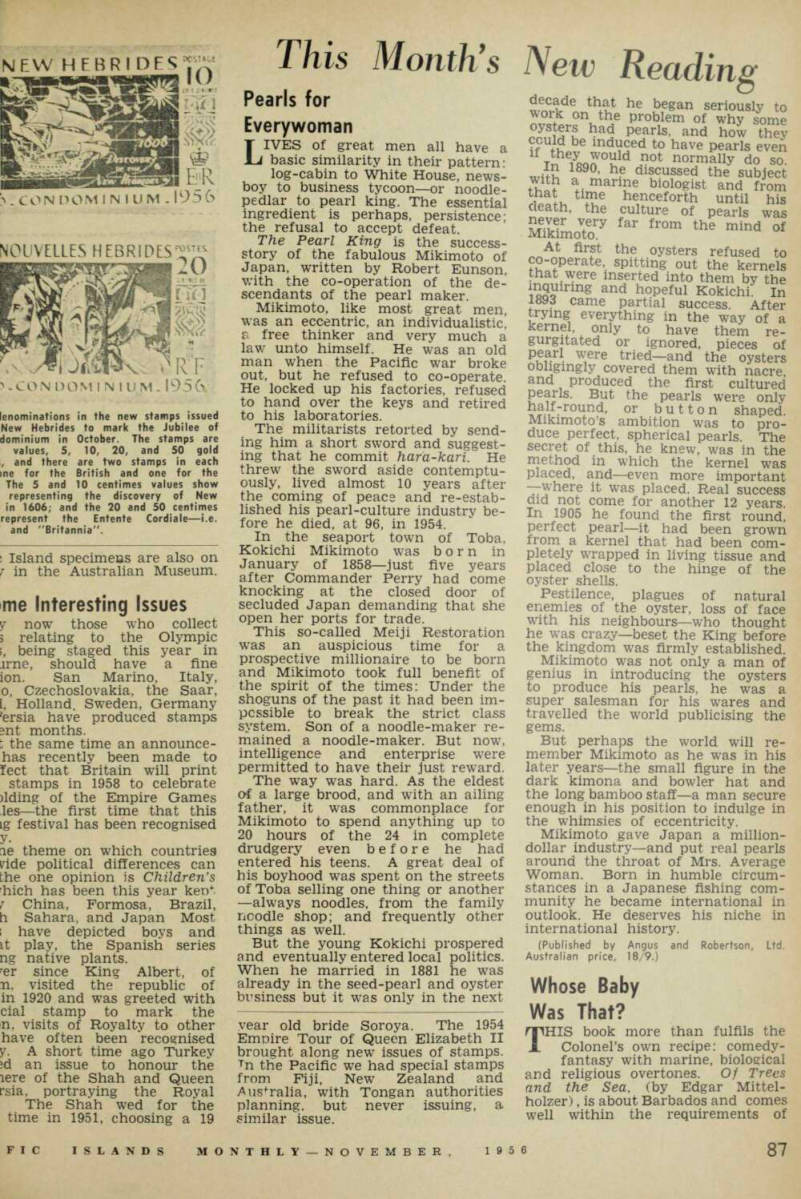
[?]lenominations in the new stamps issued New Hebrides to mark the Jubilee of dominium in October. The stamps are values, 5, 10, 20, and 50 gold [?], and there are two stamps in each [?]ne for the British and one for the The 5 and 10 centimes values show representing the discovery of New in 1606; and the 20 and 50 centimes represent the Entente Cordiale —i.e. and "Britannia".