Even The Cabin-Boy Wrote A Book
p. 85 · Read in the full issue
[?]nson in the South Seas
By H.E.M.
ETHER sick or in health, Robert Louis Stevenson not mly wrote unceasingly himself g the six years he spent in >acific; but inspired everyone d him to write as well. ; result has been a spate of by each of the members of ailima household—by his wife 7; his mother (who wrote his stepson, Lloyd Osbourne; lis stepdaughter, Isobel Strong Mrs. Field), covering one ore of his three voyages on lasco, the Equator and the Nicoll, or the four years in Samoa itself, only his immediate family t the infection —for such sly penmen as ship’s captains island traders scribbled siastically under Stevenson’s nee, though perhaps fortun not all of them persevered their tasks. Many did, r er, and some of the published 5 are astonishingly good; even Lbin boy on the Equator wrote cessful book of reminiscences. this material, and much s, has recently been gathered ter by an American historian, 1 W. Ellison, and fused into ninently readable account of period of Stevenson’s life, his departure from San isco on his first Pacific voyage iB, to his death at Vailima in iber, 1894. (“Tusitala of the Seas. The Story of Robert Stevenson’s Life in the South 3.” Published by Hastings , New York).
Ellison has succeeded in ring something of the carefree tuoyant spirit of RLS himself I this Indian summer of his Dy far his happiest as well ; most creative years, and as alt he has given the general : not only an interesting phical account, but the best uction to Stevenson’s own gs on the islands. Pew of us
nowadays can comprehend the many references to forgotten people and obscure events in say, “Vailima Letters” or “A Footnote to History,” without a commentary.
It is a pity that what must surely be the last contemporary narrative of Vailima life to come to light, Fanny Stevenson’s diary, was apparently not known to Dr.
Ellison, for it would have enabled him to add many fascinating domestic anecdotes to his account of the patriarchal household. This has now been published, inter spersed with explanatory extracts from Stevenson’s own works, and turns out to be quite a remarkable document in its own right. (“Our Samoan Adventure,” edited by Charles Neider and published by Weidenfeld and Nicholson).
The astonishing thing is that it has not been published before, but apparently it was forgotten when Mrs. Stevenson left Vailima after her husband’s death and eventually came into the possession of an Englishwoman, who in returning it to the family, remarked, “Of course, I have not read it”!
Prom it we get a vivid picture; not so much of Stevenson, but of Fanny herself: the capable, practical, dominant woman who kept him alive and provided him with the domestic milieu in which he produced his best work.
It is a chronicle of small happenings in a limited circle: the concerns of their little host of retainers, with their Stuart tartan lava-lavas, and the endless vicissitudes caused by their often unpredictable behaviour; or their relations with the local society, European and native, which in Apia, the home of beach conspiracies, was nothing if not exhilarating.
Above all, it reveals Fanny as the green-fingered gardener, with the “soul of a peasant,” as Louis once described her, happily
engaged in a daily round of clearing, weeding and planting, and ca , re of her horses, pigs and other livestock.
Portions of the MS had been blacked out at a later date and had to be deciphered with the aid °l * mfra - re d and ultra-violet photography. The ethics of this procedure were questioned in PIM (May, 1955), but the demur there was based on the erroneous supposition that it was Fanny herself who had inked them over. we can now see, however, these passages are some of the most moving in the book and, though admittedly they often deal with minor domestic tiffs between Fanny and her husband, they serve to show both as human, and consequently fallible—certainly there is nothing that either would feel ashamed at becoming known.
Other entries, disclosing dif ferences vith H. J. Moors and Joe Strong (Fanny’s son-in-law), which one would have expected to worry the unknown censor even more, have inexplicably been left intact.
This book will be enjoyed by many readers who have struggled with island gardens and untrained but enthusiastic domestic staff, even if they are not particularly interested in the Stevensons them selves.
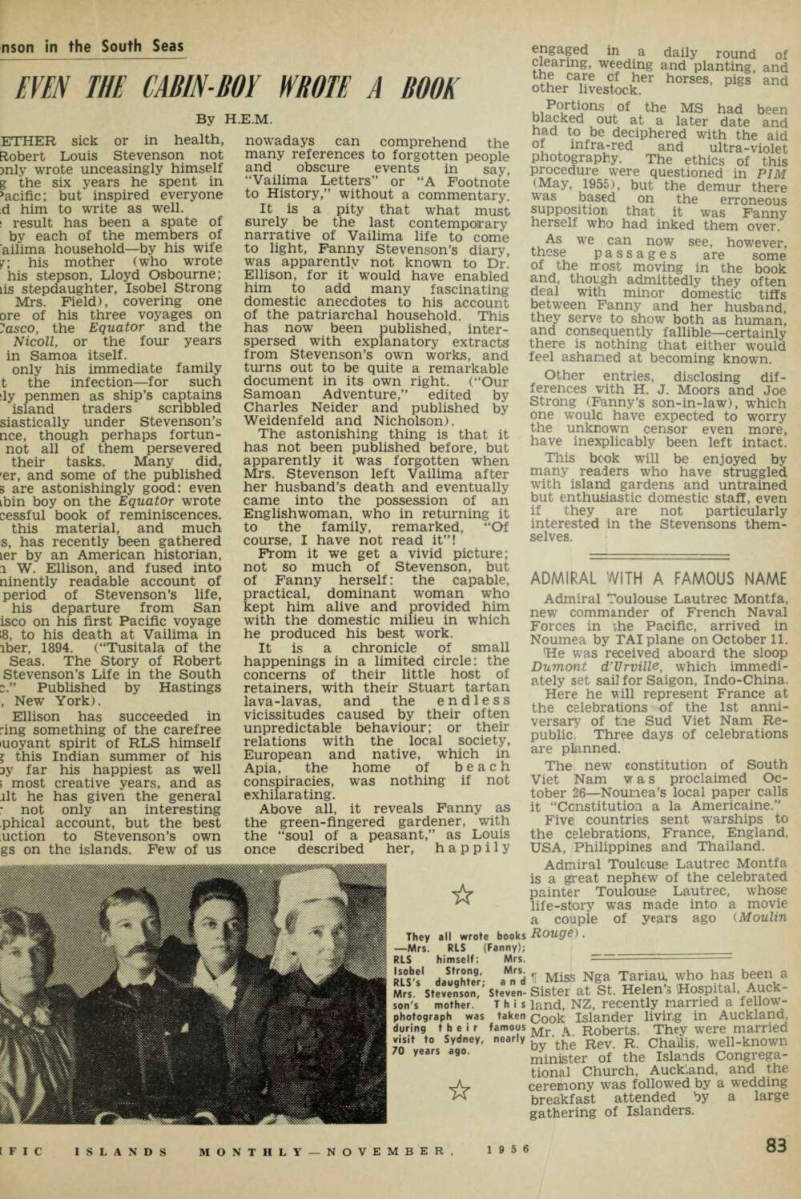
They alt wrote books —Mrs. RLS (Fanny); RLS himself; Mrs.
Isobel Strong, Mrs.
RLS's daughter; and Mrs. Stevenson, Steven son's mother. This photograph was taken during their famous visit to Sydney, nearly 70 years ago.