Pacific Shipping And Cruising Yachts
pp. 63-110 · Read in the full issue
Month's News of—
Ppened One November
he morning of November 20, le 238-ton Nantucket whaler Captain George Pollard, Jr., jr doom 1,260 miles east ast of the Marquesas when 1 by a maddened whale. The nd extraordinary story has ;told many times. It formed spiration for Herman Mel- VLohy Dick. whaler had come up to a of whales, and three boats, tided respectively by the i, Mate Owen Chase, and Mate Mather Joy, had been The Mate got fast to a vhich stove in his boat, but v managed to get back to ip by cutting the whale A few minutes later the charged the ship, stove her she quickly foundered. How lere was time for the Mate crew to launch a spare boat :e aboard some biscuits and ties, which had been picked he Galapagos. ?h the Marquesas were the land, the Captain decided would be safer to head nd east in search of some rather than face the
Marquesan cannibals. So com menced a terrible voyage.
A month later, on December 20, the three boats, which had man aged to keep together, reached Henderson Island, east of Pitcairn 1,480 miles from the starting point.
There was water there, but little else, so it was then decided to head for Easter Island, where there was a better chance of being picked up Three men could not face a further
ordeal at sea. They remained— S ware Picked up by the British days later and landed in Sydney. ot her 17 men put to sea dfpfPfn 6 vr b6 K 2 l* The Second Mate died in his boat on January 10, and on January 12 this boat was sep wSiSfer fr ° m the otllers in bad 81st da y after the Essex Isaac Cole died in the Mates boat, and at the Mate’s suggestion the body was divided and eaten as were three others up to January 29, when the two remain ing boats became separated.
Of those eaten, three died natural deaths* and the last.
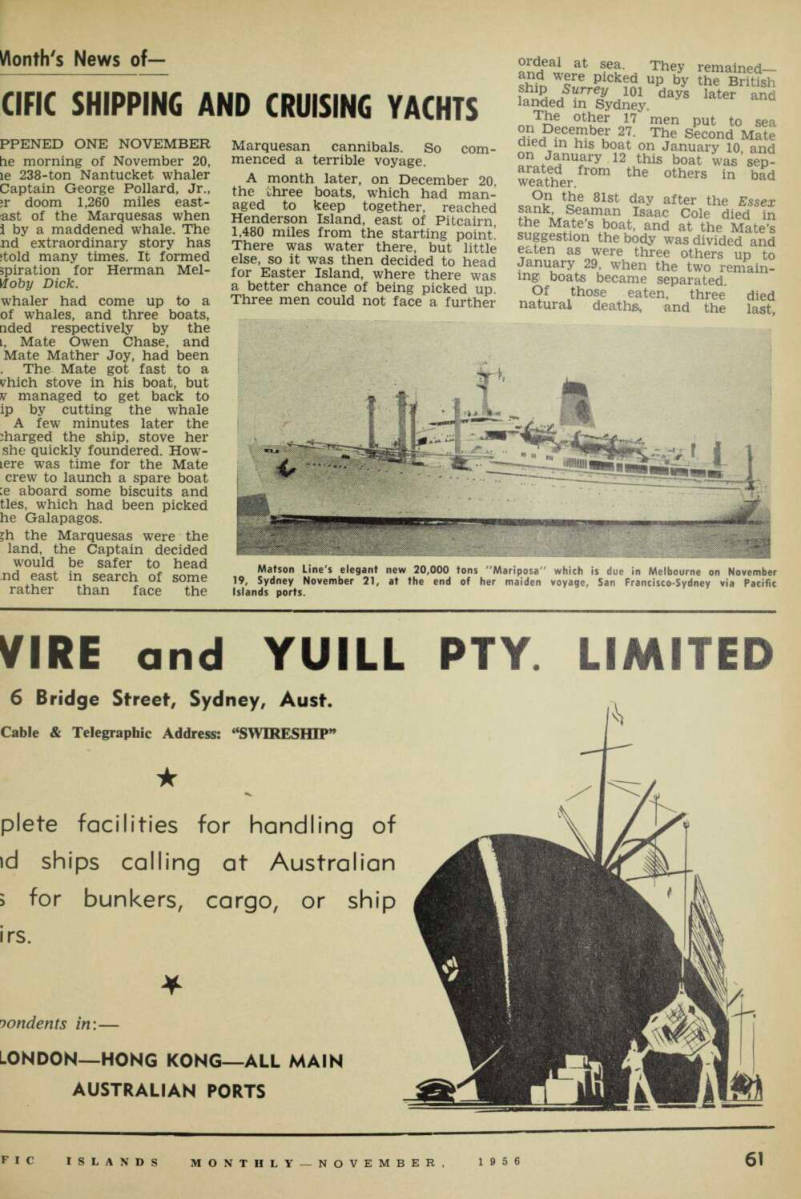
Matson Line's elegant new 20,000 tons "Mariposa" which is due in Melbourne on November 19, Sydney November 21, at the end of her maiden voyage, San Francisco-Sydney via Pacific Islands ports.
boy Owen Coffin, nephew of iptain, was shot and eaten the men had drawn lots to who was to be killed and ras to do the killing.
On February 17, the Mate and two other survivors were picked up by the London brig Indian, and on February 23, Captain Pollard and Charles Ramsdell, only sur
vivors in the Captain’s boat, were Nan^uc^et whaler Both boats were then in the vicinity of the Juan Fernandez islands. Nothing was ever heard of the Second Mate’s boat. The survivors had sailed about 4,600 miles.
On landing at Valparaiso, the Captain arranged for the English ship Surrey to call at Henderson tor the three men left there.
It has been suggested that human bones lying until recently in a cave at Henderson were those of the three men of the Essex but it can be shown conclusively that this could not be the case, though it has never been satisfactorily ex plained whose bones these are.
Melva Away
The 243-ton coaster Melva, out fitted for the Cook Island inter island trade by Mr. Hugh Williams, cleared Wellington, NZ, on October 18 for Rarotonga under command
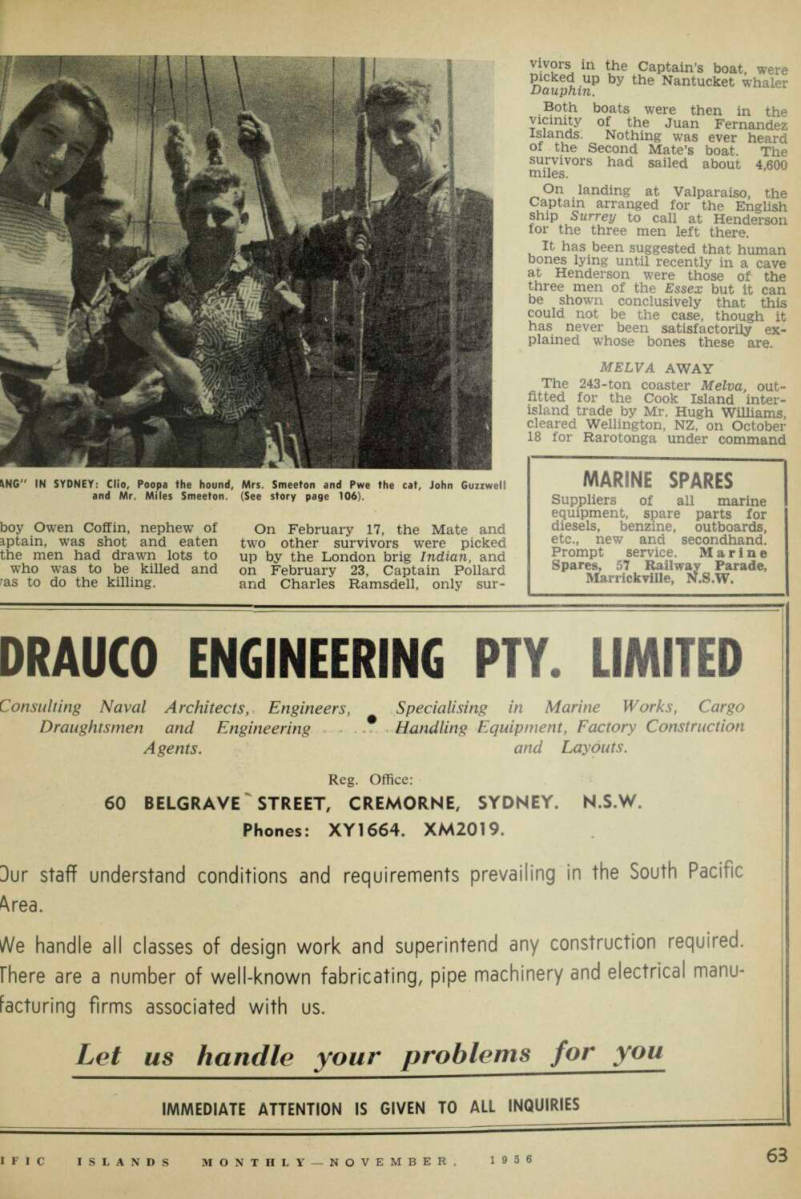
[?]ANG" IN SYDNEY: Clio, Poopa the hound, Mrs. Smeeton and Pwe the cat, John Guzzwell and Mr. Miles Smeeton. (See story page 106).
of Captain Neil, of the Holm Ship ping Co., Wellington, and with Mr.
D K. Matheson, of Auckland, as Mate and Mr. Williams as Second Mate.
Mr. Jim Price, proprietor of the Rarotonga motor garage, travelled back as Chief Engineer, with Mr.
Les Livingstone as Second.
In the Cooks, Mr. Williams will assume command and Mr. Living stone, who has been associated with Mr. Williams in his earlier ships, will take charge below.
Eliminating Competition
In Fr. Oceania
Under a Government plan to limit excessive competition on trade routes within French Oceania, it has been decreed that the 532-ton American-built wooden vessel Orohena, largest vessel in the local trade, owned by Andre Blouin & Cie, of Papeete, shall operate on the Papeete Raiatea-Huahine-Bora Bora circuit; and that the 233-ton Benecia, presently underging fire damage repairs estimated to cost two million francs, will be trans ferred to another circuit when re commissioned. This vessel is registered in the name of Miss Ah Tong Wong.
Another Pearl
The New York owners of Sea Pearl (ex Maria Ines), which took
a cargo of Cook Islands tomatoes to Wellington in September, have purchased the 679-ton, 35-year-old New Zealand coaster Holmdale and renamed her Pacific Pearl.
The transaction was completed in Wellington by Miss Doris Bettauer, attractive representative of the company, whose ships are flying
flags of convenience —Sea Pei registered owners are Victor In national Corporation of Panu and Pacific Pearl’s owners are gs as Crescent Corporation of y rovia, Liberia.
Both vessels were loading ss metal for Japan late October.
Japan, Pacific Pearl will uncfc
ons for a trade not disclosed dlington. The refrigerated arl had been held in Well in the hope of arranging a beef cargo for Honolulu but i not eventuate.
Ter-Island Fleets
annual trade reports of Fiji ench Oceania, recently pub give a picture of the ship erating within these Groups.
Fiji fleet at the end of 1955 ;d of 104 vessels of two tons d upwards, totalling in all >ns net. Of these the Fiji tnent owned 10, totalling 288 one vessel was steam i. Fifty vessels fell within 0-ton bracket, 20 were 10-20 ! were 20-30 tons, 7 were 30- , 4 were 50-80 tons, 8 were
80-150 tons, and 3 above 150 tons net. The combined net tonnage of these latter three was only 579 tons, In addition, there were 8 barges without means of propulsion totalhng 353 tons. Sail was used to some extent by 61 vessels. The total tonnage of the fleet, including barges, at 112 craft of 3,092 tons, was below that of 1954 (91 craft of 3,382 tons) and 1953 (96 craft of 3,712 tons) in tonnage, though the actual number of vessels shows a steady increase in post-war years.
French Oceania statistics show the net tonnage only in the case of vessels greater than 25 tons. In this there are 27 vessels totalling 2,355 net tons and 3,922 gross tons, In the smaller classes there are 116
vessels nf nnrw in 30 of 10-25 g T^f S Vv? nd categories are fnclSTed' 22 plelsurl craft and a further 81 registered fishing vessels, 75 of which are be low 10 tons gross. Thus the total number of registered cargo carriers at the end of 1955 was 70 but the total tonnage is not available Lare-est vpsqpi ™ n ’ register was the Orohena tons gross and 278 tons net. There were no steam-powered craft Ten of the vessels above 25 tons net employed sail with motor power
With Or Without Plan?
Because the answers would be of wide interest to Pacific mariners and residents and because they
in the news (top to bottom): The shing vessel "Pagan", to be sold at The brigantine yacht "Albatross" [?]Papeete Harbour. The yacht "Meridian" [?]e.
Photos by Oscar G. Nordman.
t clear up misunderstandings, rote in recent months to several es in Japan and the United s for information on some ts of Japanese South Pacific ,g operations. ; leading question was: Do the as fishing fleets, working to an ice plan, proceed to some de area each year to fish; or do r essels wander afield as their dual skippers wish, with no 3l by a fleet commander and ut his knowledge of where [y they are working at any :ular moment? >ugh there has been ample for replies to these letters had not been acknowledged by f the addressees.
Ifire Returned After
Joy-Ride
at seemed as though it might other exciting Pacific shipping mt, fizzled out damply on Oc -10, when the Cook Islands Inspire was returned to Raro , after having been stolen by aisguided youths. two Islanders were charged stealing the 53-ton auxiliary ig ketch from the Avarua Pass, onga, on October 9, and each ed nine months’ gaol, y were persuaded to put back third and older man who was d but was not implicated, and
the vessel returned to port 31 days later, still fully laden with cargo but somewhat less in fuel and food.
The ship-stealers were heading for New Zealand, apparently for no particular reason. The return of the vessel caused excitement on the Rarotonga waterfront and a police escort was at hand to conduct the erstwhile heroes to gaol. (See story page 109).
Pinpricking Life Of A
Whale
Whales that venture near land in the course of their north-south migrations are looking for trouble these days.
As well as the new whaling land stations at Norfolk and Auckland this season, scientists have been very busy firing 10-inch marker darts at the passing giants in Fiji and New Zealand waters.
Fifty whales were tagged in a single week in October in Foveaux Strait at the southern end of New Zealand, as they headed back to wards the Antarctic from tropical waters.
The whales move north from May to late August, and south again from mid-September to the end of October or later. The whaling season for killing sperm whales ex tends from April 1 to November 30, and for other varieties from May 1 to October 31.
Craft For Sale
With five Australians aboard, the sturdy English motor fishing vessel Pagan arrived at Papeete September 30, and was to come on to Auck land and be put up for sale in No vember.
Of 47.67 gross tons, measuring 61
ft x 18 ft x 7i ft and owned by Mr. E. R. Barker, Pagan is a standard type built for the Ad miralty during the war. This one was built at Lowestoft in 1942 and is now registered in London as a S acht.
The vessel cleared Falmouth June 23,1956, and went direct from Balboa to Papeete. A Kelvin 88-hp diesel drove her along at 7 knots cruising speed at a consumption of 21 gallons per hour.
Pagan has a cubic capacity of about 50 tons in her fore hold and about 17 tons aft. She was pur chased and extensively overhauled with the intention of selling her at the end of the voyage. The Aus tralian crew are all working their way home.
Prior to leaving England, news despatches referred to this vessel as Wambat, so evidently the name was changed, or was to be changed.
New Look For Papeete
Plans for the establishment of a bulk oil terminal at Fare Ute Point at the eastern end of Papeete Harbour call for considerable re clamation there and for the removal of some old landmarks. One of these is Walker’s shipyard which has already been vacated to make way for the project. Many vessels of the inter-island fleet have been
launched in the past from this yard, which has also carried out much repair work.
It is understood that there will be a tanker berth established in this area.
Other changes at Papeete are less visible. For several years the main
Papeete Pass has been undergo: widening and deepening, and it now considered that Masters of largest vessels trading to the p« such as the 20,000-ton South« Cross, need have no fears on enti ing and leaving. (Continued on Page 101)
I Huskies Wore Leis
. the recently purchased New [ Antarctic Expedition ship 1 Endeavour (ex John , 900 tons, cleared Papeete :kland after a short break trans-Pacific passage, even skies being carried on deck scorated with flower leis by il lassies. te the heat, and the leis, sre said to be whimpering jret at leaving.
{Ita Chapter Ends
, subject of last year’s marine disaster, has known completely separate phases xistence —as a yacht, a naval raft, and as a fishing vessel, ast acts of this third phase ice in Suva in mid-October, irticles salvaged from the yere put up for sale in a harf shed. vhile Joyita prepares for her phase, as an inter-island vessel. 0 GT, 75 ft vessel has been
stripped of her refrigerated-hold in sulation and has been undergoing a very strict and thorough survey by Fiji Marine Board authorities New owner David Simpson had in tended shifting the engines aft but it is understood that this was not approved by the surveyors. It is assumed that when the conversion is completed the vessel will be given a new name.
Checking The Fastenings
Also undergoing strict survey in Suva in October was another vessel with a very distinct place in the maritime history of the Pacific.
This is Tovata, ex Purple Sea, ex SC-671, in which Ronald Johnson drifted from near Hawaii to near Fiji and was posted missing for many months some years ago.
The construction of this ex-sub chaser is understood to be similar in some ways to that of the late lamented Vasu, which foundered at sea recently. Tovata’s present sur vey is concentrated on the ferrous fastenings employed in construc tion.
Under Private Management
There has recently been an in teresting development in relation to Fiji Government vessels. These are
n°w being managed and operated for the Government by a non-Gov ernment shipping agency—Hurley’s Agency, headed by Mr. Jim Hurley.
For Sale Again
The clipper-bowed 39-ton, 54-ft single-screw trading vessel Mel anesia,, at present operating in the Fiji inter-island trade, is likely to again come on the market The present owner, who acquired the vessel from Mr. H. M. Frewen two years ago, may leave Fiji due to ill health.
The vessel was built in Sydney by W. M. Ford, of Berry’s Bay, in 1917, and was a unit of the Seventh Day Adventist Mission fleet for some years. She changed hands about 1950 in a deal whereby the Mission took over Mr. Frewen’s Viking Ahoy and he took over Melanesia, both craft being better suited to the other purposes.
Fiji Missions To Seamen
A site has been allocated and the Fiji Government has agreed to sub sidise pound for pound to a maxi mum of £5,000, the building of a Missions to Seamen hall in Suva.
The plan has been mooted for some time and it is now expected
that construction will commence without further delay.
Tahiti Nui Completes Trials
By the time this appears, the bamboo raft Tahiti Nui, with Cap tain Eric de Bisschop and com panions aboard, should have cleared Papeete for Peru. The raft under went sea trials early October, then returned to Papeete for final pre parations. Mrs. de Bisschop, re turning to Honolulu from Papeete, reported there that the voyage should commence about November 8.
Photos Wanted
Captain Fred K. Klebingat, of 873 22nd Street, San Pedro, California, is keen to contact anyone who may have any photos of the schooner Expansion, wrecked on the east side of Suva main passage in the early 1920’s and a prominent figure there on the reef for some time.
He also seeks a photo of the American schooner Melrose entering Suva Harbour at about the same period. Captain Klebingat was master of the latter vessel from 1919-1925 when she was trading south to Fiji and Tonga. Later he was master of Zane Grey’s Fisher man, meeting and marrying a New Zealand girl as a result of a cruise in that vessel. Fisherman, origin ally the rum-runner Marshal Foch,
was later sold by Zane Grey to Father Rougier of Christmas Island.
Italian Liner Coming
Not often is the Italian merchant marine flag seen in Suva or Papeete, but it will be worn there next
January-February by a partic attractive and interesting 1 the one-class liner Castel Fell the Societa Italiana Tran Marittimi (Sitmar Line for s of Milan.
Castel Felice will spend 12
l and 25 hours in Papeete en :rom Auckland to Panama, 3, Madeira, Lisbon and mpton, 12,150-ton tourist class vessel, le attractive profile common amber of Italian liners, was :ely modernised some time 1 has appointments equal to t of the tourist class liners. iuld certainly not be picked vessel built in 1930, and story must lurk behind the formation of her be wilder ne-changes. as Kenya in 1930, she be aren in 1949, and before that is out she was again named In 1950 she became Fair and in the following year Kenya, and, believe it or i the following year we er again with Karen on vs. tie time being she has settled nth her present name—one vessels of widely varying wned by the company and ic prefix Castel, the others 3ianco, Nevoso, Verde, and ;he latter, latest addition to et, having once been the aircraft carrier Attacker. her white hull, and buff with big blue V, Castel Felice an interesting visitor. ngers are being sought and 3S from Auckland to South range from £NZIOB - clears for Suva on 7 22.
Business As Usual
Auckland yacht Glennis, ird bound from Noumea to id, passed close to a Jap- Ishing vessel about mid-way i Norfolk Island and North 7 in October. (Over)
[?]above, "Oliver Mac" arriving at see story page 107); and right, the [?]anese motor vessel "Atago Maru", cargo at Noumea.
Photos by F. E. Dunn.
ng operations were in full
rss.'wmaa
0 take photos and to see ana being landed on deck. surprise was expressed in id that the fishing vessel be so far south, but Japanese s authorities have earlier retakmg good hauls of tuna central Tasman between id and Sydney several 1 miles further south. lis made a good 8-day run oumea to Whangaroa.
Ddists Win The Leper
Ship Ballot
irst of three small shins be- .vided bv the New Zealand Trust Board for lenrosv re- •k in the south west Parifir
e launched at Auckland
the end of the year, reports per Man,” Mr. P. J. Twomey, stchurch.
Anglican Catholic and ist churches will each receive the £20,000 ships. The Brian Church asked for, and * l a Ve ves a se. C ° ttage h ° SP ‘ tal * lot was held to decide the •f delivery. The Methodist will be the first to receive The Anglicans will get the and the Catholics the third, e will be in commission next
News Of Cruising Yachts
• Albatross, which arrived at Papeete, September 29, flying the Panamanian flag, is the most in teresting vessel to report this month. Formerly a Dutch pilot schooner, built at Rottendam in 1921, she was purchased by her present owner, Mr. Ernest K. Gann, writer of the best-sellers, High and Mighty, Soldiers of Fortune, etc., and brought to San Francisco.
There she was converted to brigan tine rig. Of 96 tons gross she measures 117 ft x 21 ft x 11 ft and is powered with a M.A.N. diesel.
With 13 persons aboard, the yacht cleared San Francisco, August 8. calling at Honolulu. She will probably be seen in Suva and Rotuma before again heading north.
She was to clear Papeete for the Tuamotus on October 10. • Diana, of England, and Zonda 11, of Buenos Aires, both cleared Suva for New Zealand in mid- October. Both have been previ ously reported in this column. • Solace, of England, 31 days out of Auckland, entered at Rarotonga October 16 en route to Palmerston Island. • Little Bear, of San Francisco, was reported at Brisbane October 2. • White Hart, of Victoria, BC, arrived at Auckland October 10. • Glennis, of Auckland, arrived back there from an Island cruise
following the Auckland-Suva Yacht Race, early October. • Taihoa, of Auckland, which arrived at Papeete, via Rarotonga and Aitutaki, cleared again for Auckland via Island ports on Oc tober 6. ® Fiesta, of Honolulu, cleared Papeete September 27 homeward bound after a lengthy period in French Oceania and Cook Islands waters. The original plan to cruise round the world has been abandoned. • Nani, of Honolulu, owned by Dr. John E. Randall and family, in French Oceania waters since February 18, is now for sale at Papeete. This 37 ft ketch was built by Dr. Randall in California about 1950. The price mentioned seems attractive and interested persons could obtain details from Mr. Oscar Nordman, Papeete. • Quest, one of the Los Angeles- Papeete Race entrants, after a false start on the run home, finally cleared again September 26 follow ing engine repairs. An engine part, flown to Tahiti, was there mislaid and was the object of a general search by the Papeete populace fol lowing a local radio appeal. • Ranginui, of Auckland, arrived at Port Moresby from Noumea. The crew have obtained employment and the yacht may remain there for some time. • Tahiti, of Honolulu, 44 days out
of Auckland, arrived at Papeete October 12. • Yasme : Danny Weil, wandering yachtsman-radio ham was rescued again, for the second time within five weeks, in Papuan waters on October 25. But Yasme was lost. (See story elsewhere this issue). • Tzu Hang : To be in a yacht in mid-ocean, well off the usual ship ping lanes and to sight another yacht is unusual. When the crews of the two yachts are known to each other, and have not met for months it stretches coincidence to its limits.
This happened in the Pacific last month about 300 miles north of North Cape, NZ, when former Brigadier Miles Smeeton, on the 45ft ketch, Tzu Hang, met Tony and Bridget Reeves on the 44-ft Canadian ketch, White Hart. The Smeeton and Reeves families knew each other in Vancouver. When the yachts met, Mr. and Mrs. Reeves put out a dinghy and rowed across to have a cup of tea with Mr. Smeeton, his wife, Beryl, and 15-years-old daughter Clio.
Mr. Smeeton related this story
when he arrived in Sydney on October 23, after arrival from NZ.
When the yachts met Mr. and] Reeves were just completing leisurely cruise from Canadi NZ. Tzu Hang was making Sydney.
The Smeetons left Vancouvf October, 1955, for NZ and tralia. On their way they sto in Hawaii (four months), I ning Island (one month), I Pago and Tonga, before their ar at Russell, in the Bay of Isli!
NZ, in June. After a few v in Russell they moved on to A land and Tauranga, and then!, to Russell, which they left,, Sydney, on October 1. The Tajj trip took 23 days and was i via Norfolk and Lord Howe Islil In NZ they were joined Englishman now resident Canada, John Guzzwell, who < sailed lone-landed from Vance to NZ in his 20-ft yawl, Tw In Sydney, Tzu Hang went on to slips for repainting and cleaninr They all then left Sydney; Melbourne for the Olympic Gs at which John has an assign! for a New Zealand newspc John will leave the Smeetons? the games end and will retun NZ for Trekka, which he will back to Vancouver. But it is i question mark for the Sme© They will return to Ca* eventually, but have not yeti cided whether it will be via ' land.
Tzu Hang’s crew is sun mented by a Portuguese ten Poopa, and a Siamese cat, Both are seasoned sailors.
Mr. Smeeton bought Tzu j in England in 1951. The ketcbJ built in 1939 in Hongkong,], shipped to England just before outbreak of war. With his and Clio he sailed her from !
"Yasme”, shown here in Moresby after the September rescue, ended her existence on a Papuan reef in October —see story elsewhere.
Photo: Papuan Prints.
to Vancouver via Panama i built his yawl himself in i to a Laurent Giles design.
Hows more head space below Smeeton is a retired Indian officer, and during the war in the Western Desert and He recalls having met lant-G ene r a 1 Sir Leslie jad, commander of the 9th lian Division during the g at El Alamein. would not remember me i,” he said, “I was a very officer.” mda 111, of Argentina, and of England, arrived at nd from Suva, October 28. ormer will cruise the New d coast for two months be ontinuing to Australia and Africa, and owner N. E, of the latter yacht, has no lans. ma, 56-year-old, 40-ft cutter, d by New Zealanders Joe sa Channing-Pearce, Charles ler, and Bill Hodgson, cleared ey, Channel Islands, Pacific- October 19. Mr. Channing , 27 is a merchant navy officer by professon. The left Southend, England, four 5 ago.
Plies For Christmas
Island
Royal Fleet Auxiliary vessel ieauharnois, 7,253 gross tons, [ at Wellington, NZ, on Oc -31 direct from Christmas base for the British 1957 >bomb tests.
' dry-docking, the vessel was i a full cargo of foodstuffs ; Christmas Island garrison,
Exit Manunda
Australian coastal passenger lanunda arrived in Noumea her new name of Hakone on October 9. Before leaving )an, her new home, she loaded ore at a coastal port. me Maru will ultimately go Tokio-San Francisco service r new Japanese owners.
Exit Oliver Mac ?
W. R. Carpenter 500-tonner Mac, which has been tied-up a harbour for the last couple rs may end her career where gan it —in the Far East, has been purchased by M.
Hagen, of Noumea, former of Neo Hebridais Mark I and 11, who will use her shortly another small vessel, Loyaute, vith scrap iron, from Noumea ogkong.
Noumea correspondent says: ving the delivery of the tug • Mac ) and its tow, the l crew of 25 will be repatri-
n V iSnn” i* S that O Mac is to stay m the East also—although this is not particularly clear.
Oliver Mac has had a very patchy career. She was built by the Japs in 1940 as Hotu Maru and captured in New Guinea waters in 1944; her name was changed to Manam and she later was assigned to W. R.
Carpenter and Co. as war repara- . , . .. . . .
She had a lengthy stay in Sydney and then was sent to Fiji for use in the company’s inter-island trade in 1952. There she was given the Fijian named Ai Sokula with great Fijian ceremony. She remained in service for a couple of years and
then 11 was announced by the com pany that another vessel, Hong Ann, was arriving from Singapore and would take over the Fijian-given name Ai Sokula, while the orignal Ai Sokula would be named Oliver M «c (after Carpenter’s marine superintendent, Mr. Oliver Mac- Roberts.) Since then Oliver Mac has spent most of her time tied-up in Suva.
The trouble with Oliver Mac, so far as the Islands trade is concerned, anyway, is that she is a coal burner, Tenders were to be called in Suva at the beginning of 1954 to convert her to oil burning—but apparently the project was never proceeded with. Another trouble was that
because of her Japanese design.] had such low deck-head on her’’ decks that even men of avea height had to stoop. She is 5563 and is sufficiently powered to used as a tug.
Another “K” Class Ship ]
Stc
Bjarne Halvorsen Ltd. has its first 60-ft copra scow to St© ships Trading Company, of Moresby. Named Kuku, the should leave Sydney under the c mand of Captain George E. Lara about November 20.
The 60-ft scow is identical I the well-known 56-ft Halvoc model—except that it is 4 ft lon of course, and consequentlyi more cargo capacity.
Captain Langley is the but smallships mid-wife in the & Pacific; he left NSW with Melanesian Mission’s Baddeleyt her delivery voyage to BSIP in e September; and even more rece brought back from Norfolk Isi the whale chaser that has been i there during the brief whs season.