Onomic Strength Of Papua
pp. 51-53 · Read in the full issue
[?]in Analysis [?]orts Shows
And New Guinea
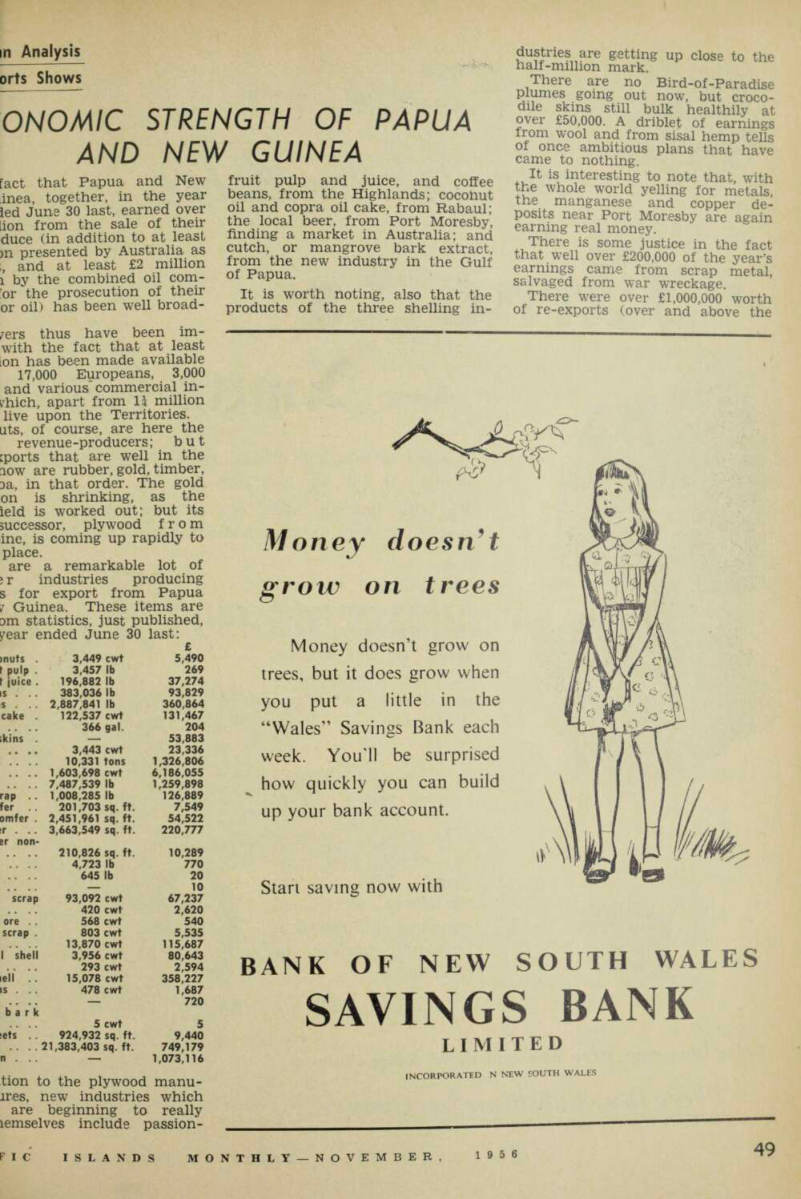
fact that Papua and New inea, together, in the year led June 30 last, earned over [ion from the sale of their duce (in addition to at least m presented by Australia as ;, and at least £2 million i by the combined oil com :or the prosecution of their or oil) has been well broad /ers thus have been im with the fact that at least ion has been made available 17,000 Europeans, 3,000 and various’ commercial in yhich, apart from U million live upon the Territories, uts, of course, are here the revenue-producers; but :ports that are well in the low are rubber, gold, timber, 3a, in that order. The gold on is shrinking, as the ield is worked out; but its successor, plywood from ine, is coming up rapidly to place. are a remarkable lot of ; r industries producing s for export from Papua 7 Guinea. These items are Dm statistics, just published, pear ended June 30 last:
tion to the plywood manu ires, new industries which are beginning to really lemselves include passion
fruit pulp and juice, and coffee beans, from the Highlands; coconut oil and copra oil cake, from Rabaul; the local beer, from Port Moresby, finding a market in Australia: and cutch, or mangrove bark extract, from the new industry in the Gulf of Papua . ’ .
It is worth noting, also that the products of the three shelling in-
dustries are getting up close to the half-million mark.
There are no Bird-of-Paradise plumes going out now, but croco dile skins still bulk healthily at over £50,000. A driblet of earnings from wool and from sisal hemp tells of once ambitious plans that have came to nothing.
It is interesting to note that, with the whole world yelling for metals, the manganese and copper de posits near Port Moresby are again earning real money.
There is some justice in the fact that well over £200,000 of the year’s earnings came from scrap metal, salvaged from war wreckage.
There were over £1,000,000 worth of re-exports (over and above the
nuts . 3,449 cwt £ 5,490 pulp . 3,457 lb 269 juice . s . .. 196,882 lb 37,274 383,036 lb 93,829 s . . . 2,887,841 lb 360,864 cake . 122,537 cwt 131,467 366 gal. 204 kins — 53,883 .. .. 3,443 cwt 23,336 .. . . 10,331 tons 1,326,806 .. .. 1,603,698 cwt 6,186,055 7,487,539 lb 1,259,898 rap . . 1,008,285 lb 126,889 Per . . 201,703 sq.ft. 7,549 Dmfer . 2,451,961 sq. ft. 54,522 r . . . 3,663,549 sq. ft. 220,777 ;r non- . . 210,826 sq. ft. 10,289 4,723 lb 770 645 lb 20 10 scrap 93,092 cwt 67,237 420 cwt 2,620 ore . . 568 cwt 540 scrap . 803 cwt 5,535 13,870 cwt 115,687
1 ’ shell
3,956 cwt 80,643 . . 293 cwt 2,594 ell . . 15,078 cwt 358,227 IS . . . 478 cwt 1,687 . • •• — 720 bark 5 cwt 5 lets 924,932 sq. ft. 9,440 .. .. 21,383,403 sq. ft. 749,179 n . .. — 1,073,116
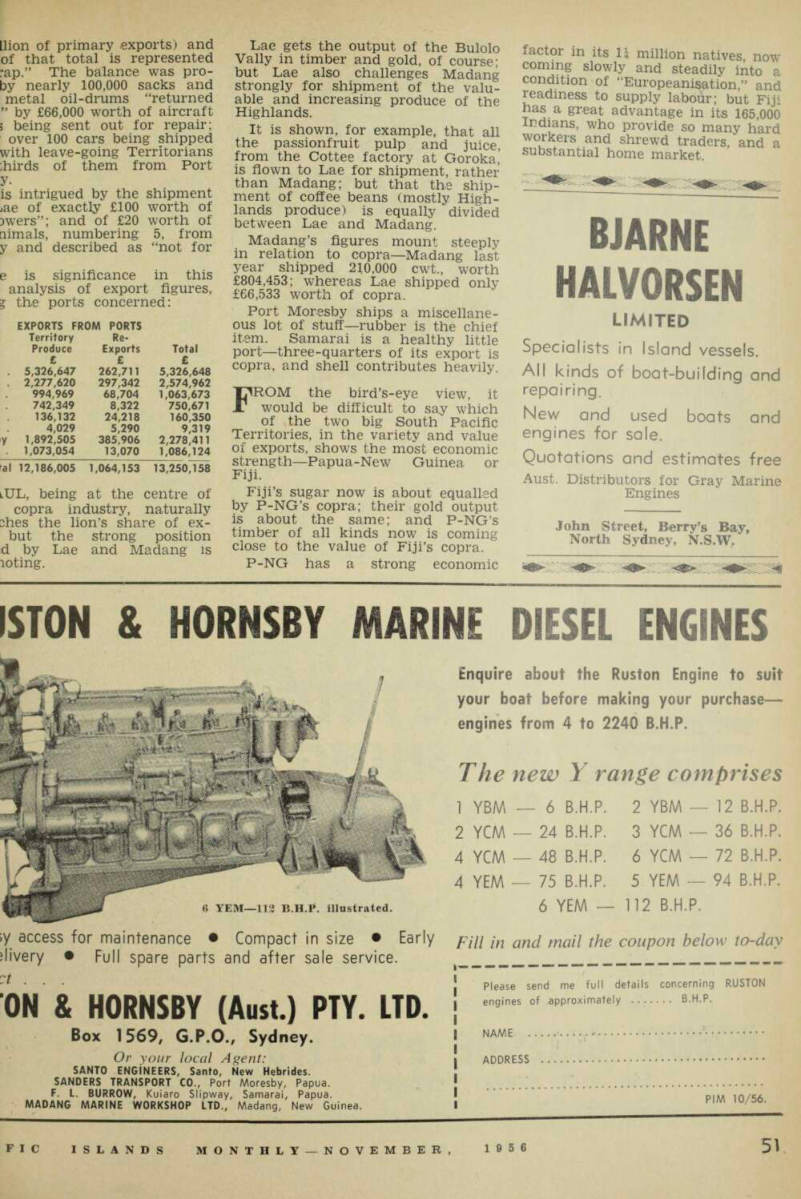
llion of primary exports) and of that total is represented :ap.” The balance was pro by nearly 100,000 sacks and metal oil-drums “returned ” by £66,000 worth of aircraft 5 being sent out for repair; over 100 cars being shipped with leave-going Territorians ;hirds of them from Port y. is intrigued by the shipment iae of exactly £lOO worth of Dwers”; and of £2O worth of aimals, numbering 5, from y and described as “not for e is significance in this analysis of export figures, ? the ports concerned:
IUL, being at the centre of copra industry, naturally 3hes the lion’s share of ex hut the strong position d by Lae and Madang is loting.
Lae gets the output of the Bulolo Vally in timber and gold, of course but Lae also challenges Madang strongly for shipment of the valu able and increasing produce of the Highlands.
It is shown, for example, that all the passionfruit pulp and juice, from the Cottee factory at Goroka, is flown to Lae for shipment, rather than Madang; but that the ship ment of coffee beans (mostly High lands produce) is equally divided between Lae and Madang.
Madang’s figures mount steeply in relation to copra—Madang last year shipped 210,000 cwt., worth £804,453; whereas Lae shipped only £66,533 worth of copra.
Port Moresby ships a miscellane ous lot of stuff—rubber is the chief item. Samarai is a healthy little port—three-quarters of its export is copra, and shell contributes heavily.
FROM the bird’s-eye view, it would be difficult to say which of the two big South “ Pacific Territories, in the variety and value of exports, shows the most economic strength—Papua-New Guinea or Fiji.
Fiji’s sugar now is about equalled by P-NG’s copra; their gold output is about the same; and P-NG’s timber of all kinds now is coming close to the value of Fiji’s copra.
P-NG has a strong economic
factor in its million natives, now coming slowly and steadily into a condition of “Europeanisation,” and readiness to supply labour; but Fiji has a great advantage in its 165,000 Indians, who provide so many hard workers and shrewd traders, and a substantial home market.
Exports From Ports
Territory Re- Produce Exports Total £ £ £ . 5,326,647 262,711 5,326,648 2,277,620 297,342 2,574,962 994,969 68,704 1,063,673 742,349 8,322 750,671 136,132 24,218 160,350 4,029 5,290 9,319 y 1,892,505 385,906 2,278,411 . 1,073,054 13,070 1,086,124 12,186,005 1,064,153 13,250,158