Caring for Senior Territorians
pp. 39-132 · Read in the full issue
L-New Guinea Diary
wing for The Visit :: Lucky Month for Those in Trouble Caring for Senior Territorians
Against a background of international alarms and tensions, Papua-New Guinea prepared, in October and early November, to welcome His Royal Highness Prince Philip, Duke of Edinburgh. This is the Territory’s first real Royal Visit although the Duke of Gloucester visited there briefly during his Governor-Generalship of Australia in the war years.
Big Spring-Clean
ildn’t have done for the r! Not that old Rouna Road, leians have suffered it for leir lorries have sustained springs; cars have been and lives lost on it. Army have toiled up its narrow, way. General Sir Thomas md Sir William Slim have its tortuous route in the years. It is Papua’s major low the Department of as excelled itself (at quite i into its budget—an esti -8,000). Corners have been tecting posts installed at s corners: bulldozers fitted adlamps have worked ut the night. The result? mooth run all the way to you, your Royal Highness.
B-4 remarked. “I must go Range the week-end the lere —the road will be good, r e my sister a visit.”
Lttle Canberra” (Port , there are great flutter le dove-cotes. Matrons are ipecting husbands’ formals, r , curtsies, and wondering sively if that special gown red from South will arrive vho work on Saturdays are ibout the holiday that has dared for November 10. tio work a five-day week have been done out of l\ but all are busy check ras and buying up supplies ike’s itinerary, which in trip to Bomana War and Sogeri, should be a it one. Bomana War will, as usual, present its i-for appearance, and the antations at Sogeri will be ief from Moresby’s present puan natives, always glad cuse for a sing-sing, will Moresby by truck, canoe, on foot, and can be de ipon to give a colourful dressed in their multi ramis, Bird-of-Paradise coloured paper and what-
h V 4 r d s d on oration th6y Can lay th6lr And they’re cleaning up Old Koki. , This floating shanty-town close to Moresby of improvised shelters built on canoes, where families of natives are born live and die. is being cleaned up. The beach, usually fc 6 kin^ s fo 2J. c L eb 1 5 is ’ is swept clean, and all rubbish has been removed.
A ‘ ?«ht, with lights twinkling
p'aTmT Ko* lo'ok
quite romantic; but by day—and at low illusions are shattered We can only hope that it is high tide when the Duke passes by The Commissioner of Police, Mr.
C ; Normoyle, has warned amateur photographers that action will be taken against them, and their
; confiscated, should they nuisance or embarrassment the Visit. are asked not to go close ideasting positions or the party.
Formoyle said that everyone given an opportunity to his pictures in a quiet and manner. He went on to ex it undue movements, sounds, hing light bulbs could be jp by the microphone, and ted broadcast result.
Governor-G ener a 1, Sir Slim, and the Minister for
Territories, Mr. Paul Hasluck are expected to arrive in Port Moresby on the afternoon of November 9 in the Governor-General’s private aircraft. They will welcome the Duke officially the following morn ing.
Arrangements have been made for about 20,000 natives to see the Duke at Port Moresby. A Govern ment trawler has already brought many dancers from as far afield as Daru. Another feature of the celebration plan is the arrival of hereditary chieftain Mitikaka from the Samarai area, with a group from
the Trobriands to look after the Chieftian and act as a food taster. panoes which have not been witnessed before in Port Moresby will be enacted at the sing -sing, and although local re si
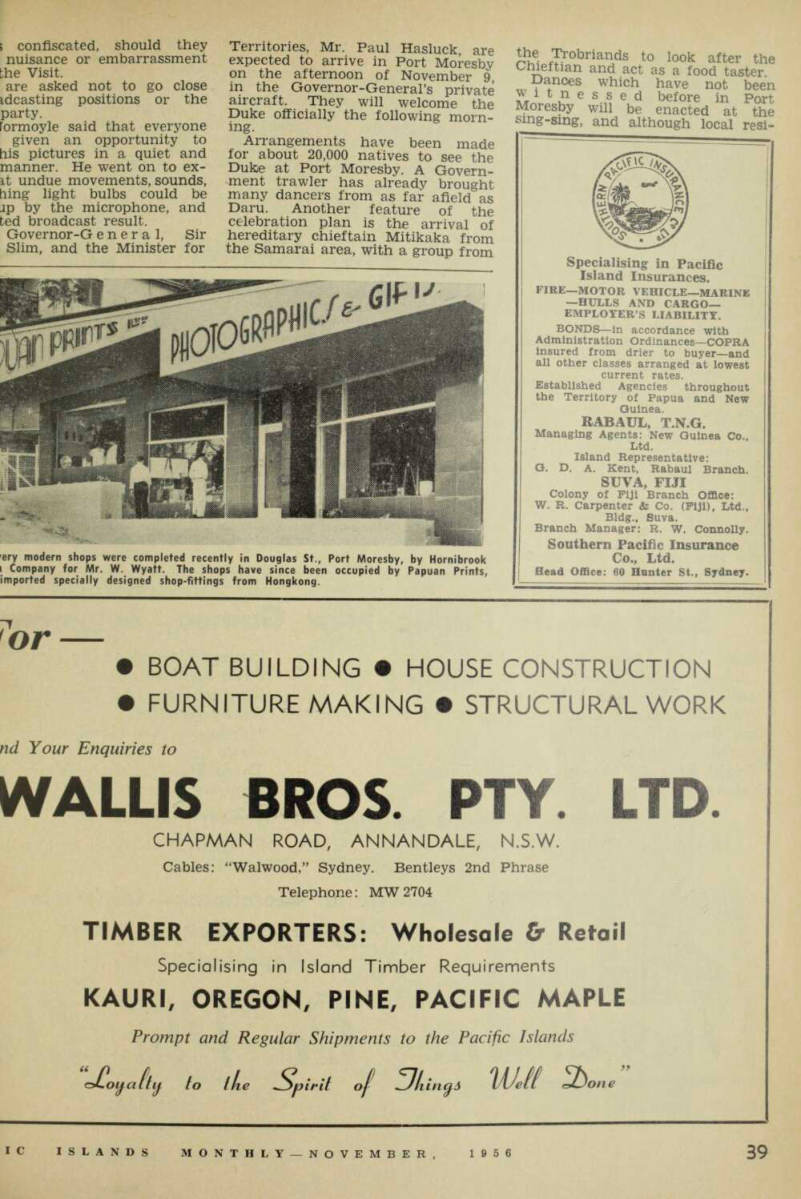
[?] r ery modern shops were completed recently in Douglas St. ( Port Moresby, by Hornibrook [?]i Company for Mr. W. Wyatt. The shops have since been occupied by Papuan Prints, [?]imported specially designed shop-fittings from Hongkong.
dents can always be depended upon to turn up in force, it seems a pity that the organisers of the Duke’s itinerary could not have arranged for him to have viewed this colourful display of native dancing—but it is not on the agenda.
The dancers will see the Duke (and be seen by him) as he motors along Ela Beach Road and around Koki corner after his visit to Ela Beach Oval in the morning, but only as bystanders.
The RSA Goldranger, supply vessel to the Royal Yacht Britannia, sailed from Port Moresby early No vember for a secret rendezvous with the Britannia.
Goldranger stayed in Port Moresby nearly a week, where she obtained supplies and fuel.
Goldranger is based at Hongkong.
Cheaper To Die
Iron is slowly entering the souls of Territorians.
In four short years the introduc tion of stamp duty, payment for ’phone calls, compulsory Third Party Insurance, and customs duty on almost every import, have become extra burdens on this so-called tax free country.
With the announcement on Oc tober 23 by Mr. W. C. Gee (Acting Director of Posts and Telegraphs) that new postal charges and ’phone rates would soon operate, they feel that that long-hovering spectre—
direct taxation—is just around the corner.
With hospital charges increased; beer and cigarette prices up, Mr.
Hasluck’s refusal of an increased subsidy for secondary school chil dren, it looks like John Citizen will sooner or later be in line for the direct attack.
There is one consolation: yc die and be buried fairly chea] here. The Administration doi latter job and charges £lO.
Some Light In Rounj
Darkness
Reminiscent of Sydney’s nerong of a few years ago, a
it announcements concern .e Kone power-house, Port y, with black-outs to follow. the black-outs —announced announced —arriving at meal Moresby housewives are at its-end trying to plan meals will not be spoiled by the irt technique. ver, a ray of light was seen r when an announcement was y the Director of Works that irogress was being made on una hydro-electric scheme.” aid that work was nearly ed on the first of two stages, .mework of the power-house e finished by November, and mber it should be boosting pply by 850 kw. anticipated that the second /ould be completed at the 1959. it has been a long time on y. When it was first an l, it was to be functioning —almost three years ago.
Of The Blue Zephyr
Id happen only in the Terri ither day a Port Moresby man dashed out of one of es to where he had parked a blue Zephyr. He jumped ’aced off to keep an appoint ;omewhere on the Range.” ten minutes later, an Ad ition official, who also owns Zephyr, proceeded more from the store to find his B. natter was reported to the md they quickly set up a >ck. vhile, at the scene of the n identical blue Zephyr was parked nearby. On exam of the glove box. a driver’s svas found and the identity wner, Mr. Bert Stubbs, was some inquiries, Mr. Bert vas contacted and found to ng the lost car. an exchange of cars was id the mystery of the blue marked down as solved by ce. understood that a similar once occurred at Rabaul.
Rsul On Horseback
house party in Boroka (a [oresby suburb), in late held to raise funds for a atholic School Hall and the guest of honour was the French Consul-General for i, M. John de Montousse. customary, the hostess had the best chair for M. de se, but he insisted on going at; joining in the games of and chatting gaily with countrywoman. In fact, the General who had just re from a tour of French i in Papua—over 100 miles
Another new building for Port Moresby's growing suburb of Boroko —the Red Cross clinic which was officially opened by the Administrator on Sep tember 29.
Photo: Papuan Prints.
dch he did on horseback — NOT sit down, ng the tour, M. de Montousse five French Missions in re )arts of Papua, going by foot, ack, truck and launch. Dur
ing one part of the journey, the horse he was riding fell into a gully, but neither horse nor rider was hurt, and after extricating the horss from the gully, the party went on its way.
The almost unbelievable work done by the missions in this in accessible country so impressed the Consul-General that he has pro mised on his return to Australia to enlist French Governmental aid, and to arrange for a light aircraft to be made available to the Missions.
The function at Boroka raised about £3O towards the new school, which is expected to be ready for occupation by the end of 1957.
The Lumi Affair
The world-headline story of the Lumi massacre, Upper Sepik, in August (which cost a woman news paper correspondent six weeks in the Port Moresby Calaboose) is drawing to an end.
Mr. A. Roberts, Director of Native Affairs, last week announced that five of the natives concerned have been arrested. The attack is pre sumed to have been made by 44 natives, 32 of them actual killers.
These are hiding in hamlets and the patrol searching for them antici pates their apprehension shortly.
Back From Bomana
Miss Pat Robertson, who occupied a “private apartment” at Bomana
October 5, Mr. M. Smith and Miss R. Tynan were married at the Roman Catholic Port Moresby. Bridesmaid, Miss M. Tynan, sister of the bride, and bestman, Mr, W also shown.
Photo: Papuan Prints.
gaol over the Lumi affair is now back in circulation in Port Moresby and has settled down happily in a new job.
She expresses appreciation for the letters, gifts and messages of good-will that, during and after her temporary withdrawal from society, almost made the experience worth while.
When Miss Robertson was suspended from duty (Sept. PIM, page 19), three months recreation leave was due within six days. The Administration is therefore richer to the extent of somewhere around £2OO. Does this sum go back into consolidated revenue? Or will it be put towards some more specific and worthier cause? Building better and bigger “private apartments” at Bomana gaol for female Territori ans, for instance?
Lucky Month
October has been a month of lucky escapes and rescues.
Two aircraft have made forced landings without harm to the crews —one at Mount Hagen and the other, on October 29, at an old war-time strip near Gaily Reach, in Papua.
Jackson’s airstrip saw its first night-landing since the war when a DC3 brought in a 4-day-old child from Rabaul.
An Englishman sailing his yacht alone was twice rescued in Papuan
waters. (See elsewhere). A Euro pean couple, adrift all night near Rabaul harbour, were rescued —none the worse for the night in the open —by a DCA crash launch early on October 29.
And on October 23, the Skymaster from Sydney blew a tyre after landing at Lae on the usual run from Moresby. What could have been a very nasty accident was averted by skilful handling.
The forced landing at Roger airstrip (Galley Reach) was a Norseman, owned by Carsairs. The pilot, B. Everingham, notified his position at 3.10 p.m. and reported that he was losing height. DCA’s Anson, another of the Company’s
aircraft, and a World Wide copter (with Dr. Gunther ab« were soon in the air. However pilot was unharmed and was p up and flown back to Moresby plane was not badly damaged.
The Gibbes Sepik Airways N man plane which crash-lande the Mount Hagen strip recentli been repaired and flown haw Goroka, Pilot John Downey, and a r medical orderly, escaped death the plane, after an engine fa ploughed into the ground on eastern end of the strip and ti completely over. The aircraft left Tari and was bound for K (Continued on Page 125) I
Mercy Flight
sound of a Catalina over [oresby at night is not un the pilots often practise night But on October 24, alert sard a different engine and inquiries were directed to eing told that the plane was about to land at Jackson’s , many motorists sped there with their headlights in case ictric flare system was not rung. However, all went well, e plane—with a seriously ill y-old baby—made a perfect in the first civil night m at Jackson’s since the war. is first intended to fly the who was suffering from an 1 blockage, to Cairns for attention. But on arrival ; Moresby, at about 9 p.m., ild was examined by the Superintendent who decided attention could be X Port Moresby hospital, chartered plane, flown by l Crampton, left Lae for where the child was picked le flight of about 11 hours pproximately £525 for the ugh all air-strips in the •y are equipped with electric tiey are used only in emerg
\N Natives Strike On
S Oint Of Honour
ice truck which, by coincid ippened to be in the line of behind a Steamships Trad mpany’s vehicle, which re natives to the compound nishing work on the Port r wharf, on October 18, the spark that led to Port r’s first native “strike.” native, apparently with a conscience, on seeing the truck following the lorry, d and threw a parcel of ) the road. suspicious act caused the o inquire further, and after the native compound con goods believed to have been rom the wharf, showing morning, the labour about 300 natives, downed id refused to work wharves, id Customs sheds. ;ed by their Councillor, the appealed to the District sioner, who, after a parley two hours, persuaded them n to work. atiyes, mostly Gosiagos, have >rking overtime and earning ley. ley are due to return to illages shortly, they have .lying goods to take back them. Unfortunately, the
majority of trade stores do not issue receipts, so ownership of the goods could not be proved.
Over The Border They’Re
Called Autochthons
In little more than a year—wars and other errors and omissions per mitting—the Dutch will be sending one of the largest and best equipped expeditions ever into their New Guinea territory. The country to be explored is the almost unknown area of the Sterrengebergte (Star Mountains), very close to where the three borders—Papua, Dutch NG, and the Trusteeship Territory—meet.
An effort will be made to find the source of the Digul River and the team of 70 men hopes to locate
minerals, and what the Dutch call valuable beechwood.”
A Mr. Schoorl, of the DNG Ad mmistration, has already done some preliminary exploration in the area; leader of the expedition, Dr. L Brongersma, and technical leader, Lieut.-Commander G. F. Venema, have also had NG experience. Light aircraft and helicopters will be used extensively to supply the party once it gets away from base which will be Tanah Merah on the Digul River.
A platoon of Royal Netherlands Marines will accompany the 6months, £lOO,OOO expedition of 10 scientists, 10 assistants, a DNG ad ministration officer, a doctor, and various other personnel—or, as the official handout on the foray states:
“50 Europeans and 20 autochthons.”
If you have never heard the term autochthons used in that way be fore —and we certainly have not— it here means “sons of the soil.”
Of all the modern circumlocutions to get over the difficulty of using that rude word, “native,” that one just about takes the prize.
Dca Official In Port
Moresby
Mr. H. A. Ellam, Controller of Supply and Transport for the De partment of Civil Aviation, arrived in Port Moresby, on October 11, on an inspection of departmental stores in the Territory.
His tour will take in Lae, Madang, Goroka, Wewak, Bulolo and Wau.
Mr. Ellam later went to Rabaul at the invitation of the Shell Com pany for the opening of the Shell bulk fuel installation there by the Administrator.
Cup Fever
“Melbourne Cup Fever,” which usually strikes Australians every where at this time of the year, showed its symptoms in Port Moresby.
Sweeps filled and Committees busily arranged Cup Day parties.
Mrs. D. M. Cleland, wife of the Administrator, attended a party at the Red Cross Hall on November 6. It was arranged by members
of the Pre-school Management Committee to provide funds for toys and equipment for the Kindergarten.
Help For Senior
Territori An S
Mr. Henry Eekhoff went to Lae to settle with his family in 1928. At
that time there was very littieje of Lae than a dot on the mr New Guinea. However, a T kunai shack soon appeared s small store was set up. Ov© next 10 years, Henry Eekhoffl his own particular hand in shr the present-day New Guinea,
f helping people to get their ,nd stores together in order ure forth seeking fortune in is. is the Eekhoff family who for and was granted the ence for a hotel at Lae, and in a temporary building, a short time they decided to id the property was pur by Mrs. Flora Stewart. It ite of the present-day Hotel years slipped by all too war came, and after it, the > were amongst the first to 0 Lae. Then Henry decided ut of business on his own but remained at Lae, and position with Buntings, their family married, Mr. 3. Eekhoff looked like living arby and Joan life quietly ie sands of time ran out. ■, the changing economy of Id wrecked that plan, and 1 Mrs. Eekhoff decided to ie and go to live in Aus -50 people gathered at the Jecil to say a final Bon to Henry in early October— khoff had preceded him to ind had purchased a small a readiness for the move, pie gathered were all pre dents of New Guinea, and id lived in Lae and had he Eekhoff family in those Ml were sorry to see them in Henry’s own words, “he ig to find security.” He said, inkly, that by going to live s he and his wife would be to an old-age pension, and ould be allowed to earn a aount in excess of this, he they would be able to live lietly without being a burden ie.
Territorians are beginning that it is high time that y in New Guinea spent a ;ime and thought on the »f the aged. There are not them—there might never —but why should a gentle and his kindly wife have the home, the friends and or which they have worked, they can no longer carry ) of work and remain in it?
Dwyer advised the Rabaul ivisory Council at a recent that a Committee had been there to aid destitute I that representations made dministration had resulted ince being given to people to help themselves, probably right enough as goes—but it would prob better all round if assist e available to these people they became actually
Lae Basketball Booms
h Tr? 6 t Lao fi ® asl s etball Association heid its first Annual Dinner at the Hotel Cecil on October 26.
About 40 representatives of the various teams attended. The premiership shield went to the Banks team. A trophy for the highest aggregate score was presented to Mr. Tony Normoyle.
Chairman for the evening was Mr.
Brian Bretag, of the Lae team, and
opnortunitv wQ c * , cheerio to several members of the Voco team who will £ orocSediM South on transfer and will not ho playing during the next 1 season It was decided unanimously l That the standard of BaskeSaU in lSb had advanced considerably and that the future of the game looked very rosy indeed; a visT to Port Moresby may be made later For her continued generosity in
g the Association the use of t Hall, both for practice and ekly competitions, a vote of to Mrs. Flora Stewart was
Now Play Australian
Rules
le over a year ago, Australian football was only a name in an Education Officer at a Technical Training Centre, ck Tong, himself a formei
Launceston Grammar School rep resentative, taught his native students the game.
Later, a committee of Europeans was formed to play in a competi tion.
Their first match was played at Boroka, where the Administrator, Brigadier D. M. Cleland, bounced the ball, and the native students from Idubada and Sogeri schools played the curtain-raiser to the match.
In September this year a Rules
team visited Cairns, where they were victori ous.
Their successful season culmin ated in a “Ball of the Year,” held November 2 at the RSL Club, Port Moresby.
Look ou t Mel bourne, here we COme! (Over)
On October 13, Mr.
W. D'Arcey of Depart ment of Works, and Sister E. Jack of the European Hospital were married at the Roman Catholic Church, Port Moresby.
Photo: Papuan Prints.
Old Warrior Dies
A great old policeman, Sgt. Major Foginau, of the Royal Papua-New Guinea Constabulary, was buried with full Police honours in Port Moresby in late October.
Sgt, Major Foginau’s record as a policeboy goes back to 1926. and he could, of course, remember the Ger man administration.
He received an American citation for the part he played in the task force landing at Manus in 1944, and was recommended five times for other decorations.
He was awarded the Police Valour Badge—a rare honour, as this is awarded only where risk of life by way of duty is incurred. It is a civil VC.
Bop Service Six Times A
Week
With the Territory’s ever-increas ing population, the demand for plane seats is so great that it is sometimes necessary to book weeks ahead on southbound planes.
Qantas has met the emergency by putting additional Skymaster on the Bird of Paradise run, Sydney- Lae service, from November 21. This means that a Skymaster will be arriving in the Territory six days a week—Sunday, Monday, Tuesday, Wednesday, Thursday and Friday.
The usual extra services to shuttle schoolchildren back to the Territory from schools in Australia will commence early in December.
Tail Piece
When Judge Gore returned to Port Moresby, end of October, he made it the first occasion for five months that all four judges were in the Territory at the same time.
t Group Captain A. S. ' officer commanding the RI base at Laucala Bay, Fiji, sp< week in New Zealand recent a conference of RNZAF st commanders.