Yachtsman Plucked From Sea
pp. 26-27 · Read in the full issue
Sea Drama in Gulf of Papua
By Catalina Flying-Boat
Real hero of the Danny Weil rescue, 150 miles from Port Moresby in the Gulf of Papua on October 25, was Captain Marshall Burgess, who put his Catalina down in the open sea to pick up Weil who was adrift in a rubber dinghy.
CONTRARY to the layman’s belief that a flying-boat is safe to land on water, anywhere, these craft land in the open sea only in an emergency.
This was an emergency, and Cap tain Burgess and his crew carried out the rescue, according to Cap tain P. L. Oakley, who is in charge of Qantas flying boats in Port Moresby, “in a manner worthy of the highest praise as it was in
telligently planned.”
Weil, who was attempting to sail around the world single-handed, was in trouble off Port Moresby in mid- September when Yasme’s engine failed in bad weather. Through the efforts of a Port Moresby radio-amateur, Mr. Frank Nolan, who picked up Weil’s distress signals, a Department of Civil Aviation launch went out and towed the yacht into port.
Weil remained in Moresby for about five weeks and on October 23 left there on the next leg of his journey, destination Darwin. Yasme hit a reef about 9 p.m. on the 24th and for the next two hours Weil gave a dramatic account of his troubles to radio hams who again played a vital part in rescue opera tions. His last message, at 11.6 p.m., was “For God’s sake, get an aircraft to drop a raft.”
A Catalina from Port Moresby, piloted by Captain Oakley, set out at first light next morning and located Yasme, then high and dry on the reef. Weil appeared safe enough at that stage. However, as the tide rose he had to climb the mast and when a Lancaster bomber from Townsville arrived and dropped a rubby dinghy, Weil abandoned ship and swam for the dinghy.
Meanwhile, the Catalina, which had been circling the Yasme for hours, had to return to Moresby to re-fuel. It returned to the reef at 3.15 p.m., this time with Captain Marsh Burgess in command.
Captain Burgess knew that hope of a surface rescue that day had been abandoned, as ships’ captains could not risk their boats in the uncharted area at night. At the time Yasme was completely sub merged and Weil was drifting down wind in the rubber dinghy at six knots.
The chances of retaining contact
with him overnight were remote, and that of relocating the dinghy at daylight on October 26 were not good.
Captain Burgess, therefore, de cided to land, using the lee of the reef as protection, and to en deavour to effect a rescue from the Catalina. Full ditching-drill was carried out and the aircraft was landed on the six-ft. south-east swell in open water.
Captain Burgess turned the air craft north in open water until he was downwind of the rubber dinghy, then turned upward to the dinghy.
After he had picked Weil up, he taxied two miles to the lee of the reef, where he took off.
When he returned to Port Moresby, Weil reported that with Yasme he had lost everything as it was impossible to insure a ship undertaking a voyage of this character, and possessed only what he stood up in—a pair of ragged shorts and a clasp-knife. Extent of his loss has been variously re ported at sums between £7,000 and £14,000.
Weil left Port Moresby for Syd ney by air on October 29. The Red Cross paid his fare.
HE told PIM on the day after he arrived in Sydney that as soon as he could get another ketch he would move on—he was deter mined to be the first Englishman to sail round the world single handed.
“I was chasing round with a yacht broker all day to-day, but I have not seen anything suitable,” he said. “I am afraid I am a little biassed and I may be hard to suit. When you have lived with a certain type of boat for a long time you become attached to it, and you never find anything to come quite up to it.”
If he was unable to get a boat in Australia he would go on to the US to see if he could get anything suitable there. Should he be suc cessful he will sail across the Pacific for a second time, but would follow a different route. On this voyage he went through Panama to Tahiti, then called at the Solomons and Port Moresby.
“Next time I will visit some of
the southern islands, such as ; and Tonga before going on to K Zealand and then Australia,’T said.
“But should I be unable to ge boat anywhere in the States it mean that I will have to go b! to England for one, and that me
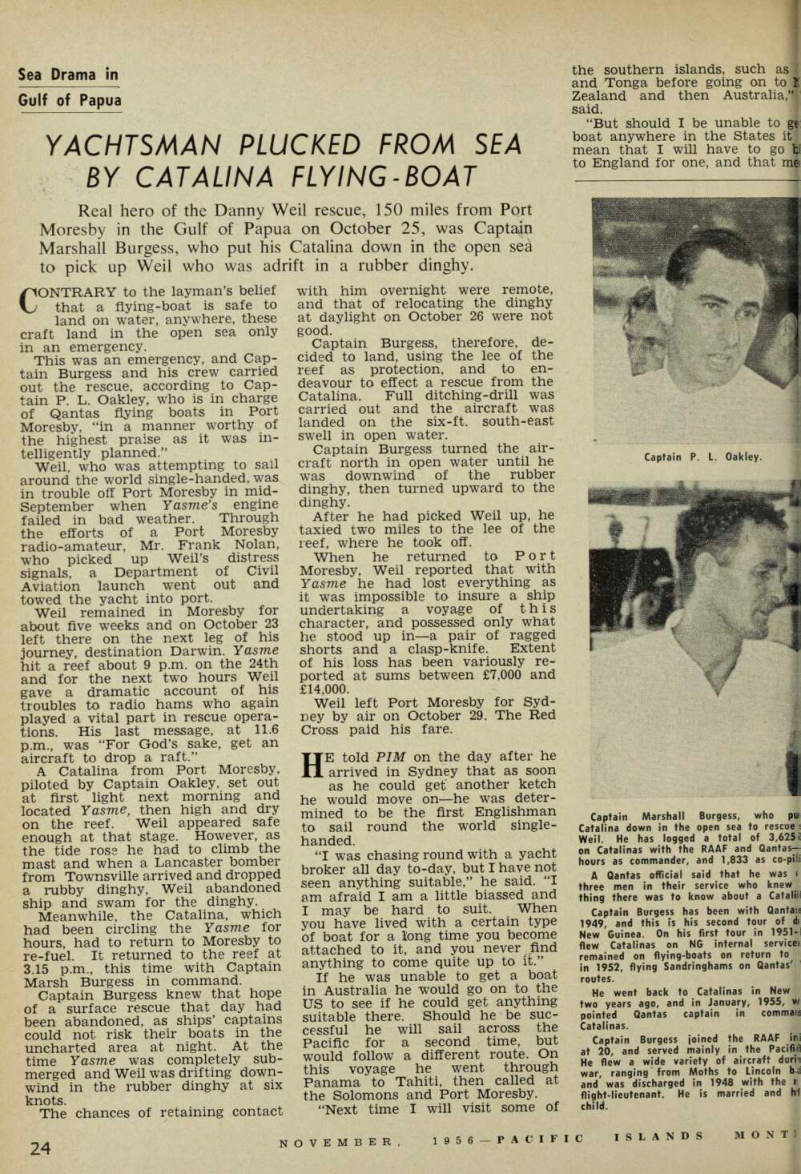
Captain Marshall Burgess, who p[?] Catalina down in the open sea to rescue ; Weil. He has logged a total of 3,625 on Catalinas with the RAAF and Qantas— hours as commander, and 1,833 as co-piii A Qantas official said that he was ( three men in their service who knew thing there was to know about a Catali Captain Burgess has been with Qantase 1949, and this is his second tour of d) New Guinea. On his first tour in 1951flew Catalinas on NG internal service) remained on flying-boats on return to in 1952, flying Sandringhams on Qantas' routes.
He went back to Catalinas in New two years ago, and in January, 1955, [?] pointed Qantas captain in comma[?] Catalinas.
Captain Burgess joined the RAAF in[?] at 20, and served mainly in the Pacifi[?] He flew a wide variety of aircraft duri[?] war, ranging from Moths to Lincoln b[?] and was discharged in 1948 with the [?] flight-lieutenant. He is married and h[?] child.
my world tour all over
aying for His Life
t Moresby, on October 30, Administration spokesman that Mr. Weil would be d pay some of the cost of le. Weil said that he would >y to do this but he had lugged 3d. piece and 4id. to e. titas spokesman in Sydney it the company had noth lo with charging Weil for le —it was a matter entirely 3 Administration, which had e only means at its disposal ling Weil when he was in -that is, it had instructed ;o send a plane out to look •esumably the Administra iill have to pay Qantas for
the time involved in the rescue and no doubt the P-NG Treasurer takes the very reasonable view that if Mr. Weil can contem plate the replacement of the £7,000 (or £14,000) Yasme, he can very well pay the cost of having his life saved.
Mr. Weil said in Sydney later that the radio hams who were sponsoring his voyage would pay for a new boat. If they are prepared to do that, they probably will not
quibble at an extra £7OO which was watery°grave. SaVing him frotn a in^p!ni! pil ' ioi !i. amongst old-timers tem 18 -f 11 ? 4 anyone Who at n to, sail lone-handed in the Gulf of Papua at this time of the year is asking for trouble. All solo v ° ya P ng . is, of course, foolhardy whether in the Gulf or elsewhere, and public opinion tolerates this and all such adventurous escapades only so long as they are successful!
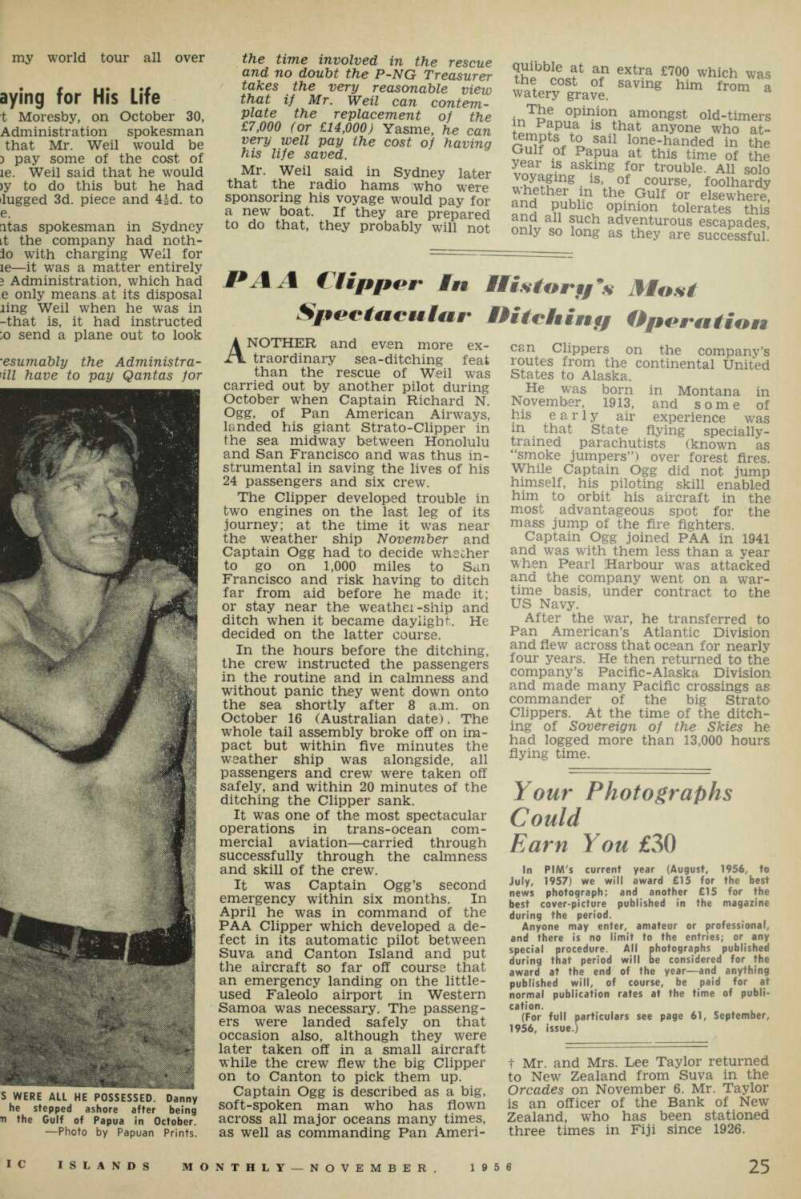
[?]S Were All He Possessed. Danny
he stepped ashore after being [?]i the Gulf of Papua in October.
Photo by Papuan Prints.