[?]itorial ...
pp. 19-20 · Read in the full issue
[?]Istory's 20 Most Significant
And Dramatic Days
OM, in modern history, have sre been 20 more critical ys than the last ten days of r and the first ten of ber. crisis is not yet over. Even j is written, the great fleets lerica are far out in the of the ocean, the great air as of Russia are shuttling the Mediterranean coasts, majority of nations are ing frantically to hold the but the danger of global very, very great, cause of the tension is the ous, cruel and powerful ation of evil that is called issian Soviet; but an under ig of why and how this has id is not provided by a study events of the last two or veeks —although they are set sequence on the next page. To understand what is dng, • and to get some idea of ;ure, it is necessary to survey ackground of international since the end of World War ,LD peace should have been isured when the Allies in 45 destroyed the power of irlin-Rome-Tokio Axis. We to do this because our e was an unholy one. We — Western nations, with an ly based on social evolution ;aken into our camp and into mfidence a powerful State economy (Communism) was tely irreconcilable with ours, war over, we disarmed, and led to restore to independ ind freedom every country we had occupied, ia did not disarm; held in tund slavery every country she had overrrun (East ay, Poland, Czecho-Slovakia, rvia, Hungary, Austria, nia, Bulgaria, Albania, La. Lithuania); and forced a mist dictatorship upon each.
Austria and Yugoslavia, she >lds them as slave States.
Russia proceeded with plans troy our system, which is upon individual freedom, so le might impose the Corn system upon us. Only the ion by the United States of Dm Bomb —which Russia did en have —gave us time to ly re-arm, and protect our- Otherwise, we should long have been enslaved by ite Communism. 3 in her immediate design,
Russia engaged in a long-range plan —namely, the gradual undermining and overthrow of the Western Powers, by attacking their economic structures, their social peace, their overseas markets, and especially their colonial organisations. Thus began the Cold War.
The Cold War has innumerable facets. The gentlemen who dig themselves into trade unions and cause strikes and go-slow; the agents who conduct whispering campaigns among illiterate people in our colonies and territories; the piebald journalists who distort the reports in newspapers, and put their own “slant” into news broadcasts in order to discredit responsible government; the tireless Planners who sneer at patriotism—all are as much a part of the Russian effort
as are the shaping of Red China and the eneoui-agement of “student” noting in Singapore. rpHE success which has attended X Russia in the Cold War has . been phenomenal. Even here m the isolated and comparatively pea-ceful South Pacific one can see / the slow rot in our economy (what we call the “inflationary spiral”) and the gradual disappear ance in the average individual of a sense of social responsibility.
And nowhere have we seen it more clearly than in the retreat of the countries whose economy was built, in the centuries, upon the control of colonies. In the case of Britain this was caused partly by the work of the Communist Pllanners, and partly by the “anti-colonialism” of America. Our future is based upon Anglo- American friendship and alliance.
That was why we deferred too often and too deeply to the anti colonial sentiment of American politicians and press.
Britain is the world’s outstanding example of a successful coloniser.
Count the countries (including USA) which began as British colonies and ended as powerful
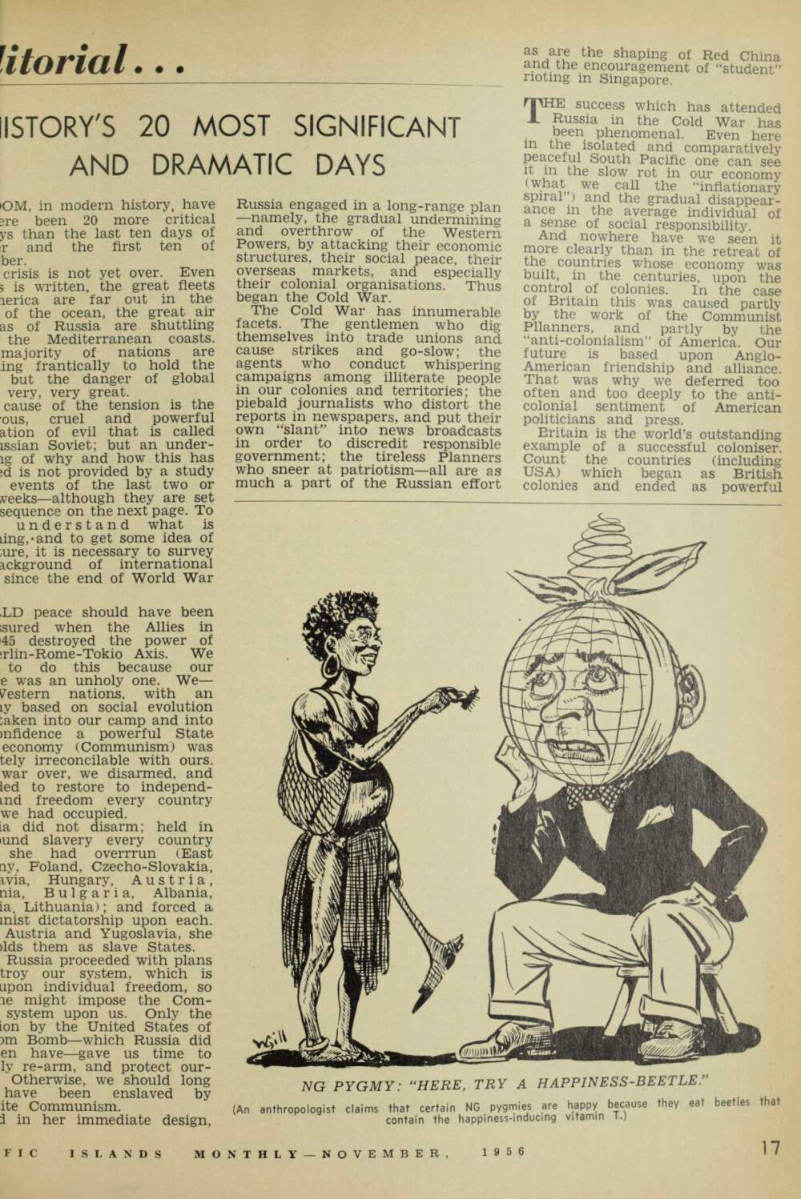
NG PYGMY: “HERE, TRY A HAPPINESS-BEETLE ” (An anthropologist claims that certain NG pygmies are happy because they eat beetles that contain the happiness-inducing vitamin T.)
independent nations. It is British policy (as seen in Africa to-day) to train the people of her colonies to govern themselves, and then to give them complete national freedom. But it is a slow process and. if it is too quick, it can be disastrous.
The combination of American sentiment and Russian intrigue has forced Britain prematurely out of many of her territories and colonies in Southern Asia and the Middle East. Nations not yet capable of governing themselves —especially in relation to other nations—have been given complete freedom much too soon; and Britain’s domestic economy, adjusted over a long time to provide for the administration and supply of those dependencies, has been severely disrupted.
When 1956 dawned, Britain’s condition was precarious. Either the headlong retreat from her colonies and her markets must be halted; or a large proportion of Britain’s industrial millions must change from export manufacturing to food production for themselves.
Meanwhile, a problem of peculiar urgency had developed in the Middle East. Western Europe—and especially England— depends increasingly for fuel and power upon the great oilfields of Persia, Iraq, Arabia; upon the pipe lines which run across the Middle East deserts into the ports of Syria and Israel; upon the lines of tankers which run from Southwest Asia through the Suez Canal.
There, Russia saw her chance, years ago. As part of her Cold War policy of destroying or dislocating Western economy, she has directed a ceaseless campaign of political and industrial disruption upon the Arab States of the Middle East. Ostensibly, her agents were encouraging Arab nationalism against Britain and Prance; actually, she was tying the Arab States ever more closely to the Muscovite set-up, and so threaten ing the security of the West’s major oil supply. Israel became a pawn in the game.
Britain and France were not blind to all this. When the arrogant Egyptian dictator Nasser, peeved by Western refusal to finance his Aswan Dam plan while he was accepting armaments from Russia, seized the Suez Canal in July, Britain knew she had reached the point of no further retreat. If she gave way again, on this, she would have lost the Middle East.
The rest is recent history.
Britain and France mobilised on Cyprus, planning to check the aggressiveness of the Arab States and to keep the Canal out of Egyptian control. Screamed at by United States (fearful of upsetting the Presidential election), by the Afro-Asian neutralists and anti colonialists, and by the Russians (as part of their Cold War), Britain
and France remained for weeks on Cyprus and argued, and it looked as if the Nasser Grab would become a fait accompli.
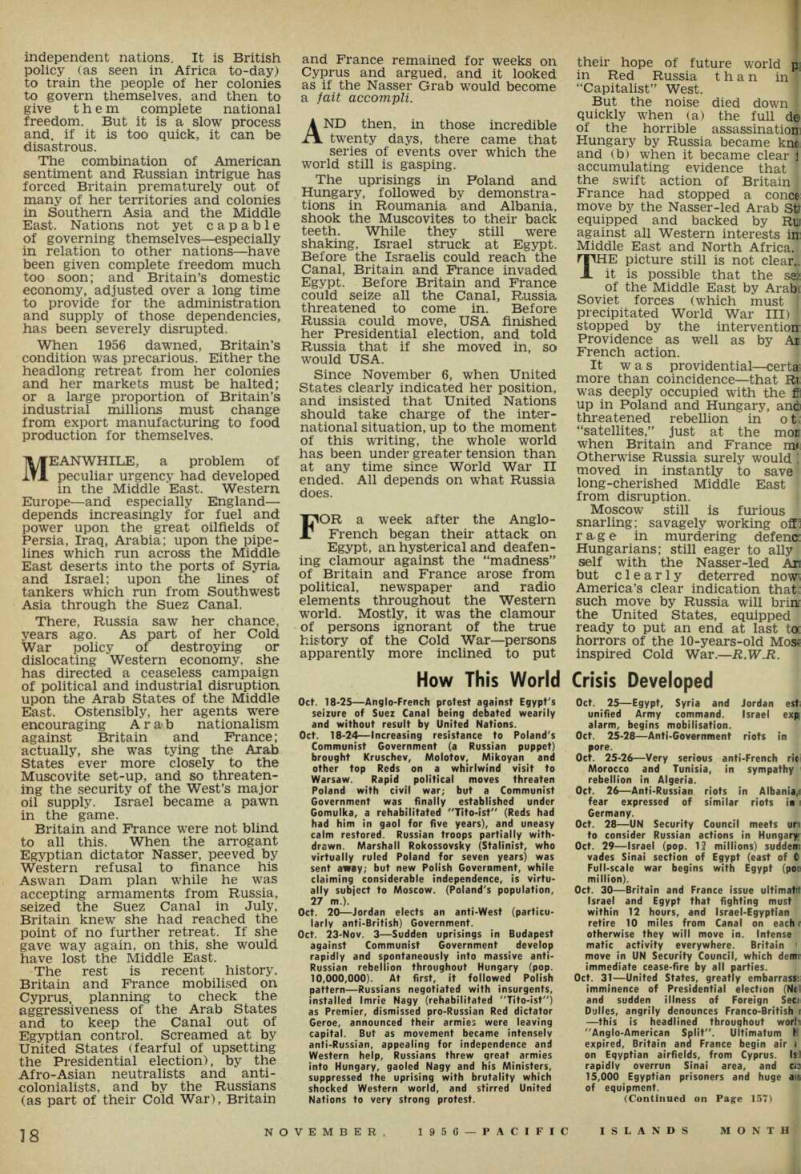
AND then, in those incredible twenty days, there came that series of events over which the world still is gasping.
The uprisings in Poland and Hungary, followed by demonstra tions in Roumania and Albania, shook the Muscovites to their back teeth. While they still were shaking, Israel struck at Egypt.
Before the Israelis could reach the Canal, Britain and France invaded Egypt. Before Britain and France could seize all the Canal, Russia threatened to come in. Before Russia could move, USA finished her Presidential election, and told Russia that if she moved in, so would USA.
Since November 6, when United States clearly indicated her position, and insisted that United Nations should take charge of the inter national situation, up to the moment of this writing, the whole world has been under greater tension than at any time since World War II ended. All depends on what Russia does.
FOR a week after the Anglo- French began their attack on Egypt, an hysterical and deafen ing clamour against the “madness” of Britain and France arose from political, newspaper and radio elements throughout the Western world. Mostly, it was the clamour of persons ignorant of the true history of the Cold War —persons apparently more inclined to put
their hope of future world p, in Red Russia than in i “Capitalist” West.
But the noise died down I quickly when (a) the full d© of the horrible assassination!
Hungary by Russia became knoj and (b) when it became clear 1 accumulating evidence that ! the swift action of Britain!
France had stopped a conce; move by the Nasser-led Arab Stt equipped and backed by Ruj against all Western interests im Middle East and North Africa.
THE picture still is not clear., it is possible that the of the Middle East by Arab' Soviet forces (which must i precipitated World War III) ’ stopped by the intervention: Providence as well as by An French action.
It was providential—certas more than coincidence—that Ri was deeply occupied with the ffl up in Poland and Hungary, and threatened rebellion in ot; “satellites,” just at the mon when Britain and France nwi Otherwise Russia surely would S moved in instantly to save long-cherished Middle East from disruption.
Moscow still is furious snarling; savagely working off] rage in murdering defenc: Hungarians; still eager to ally self with the Nasser-led An but clearly deterred now America’s clear indication that;! such move by Russia will brinr the United States, equipped ready to put an end at last toe horrors of the 10-years-old Mosc inspired Cold War.— R.W.R.