His Own Pacific Romances
pp. 89-115 · Read in the full issue

Becke, 1855-1913
[?]E Writer Who Lived
By H. E. Maude
1 publication last year in ustralia of a new edition of y Reef and Palm (the first 1916) has revived interest in works of Louis Becke. It red, appropriately enough, on entenary of his birth, and at ie when his books are rapidly ling prized collectors’ pieces, ewed hi PIM Sept., 1955). >ugh no longer a popular best throughout the English ing world, as he was in the Louis Becke still remains the rite island author of those actually live and work in the . Seas. i literary world may find Pacific through the pages of lie or Stevenson; but in an trader’s home or the cabin copra schooner, the only . book one will likely find is jviously much-read Becke. least that has been my ience. reason, I think, is that Louis really knew his Pacific from d end as no other author ever He writes, therefore, from the —of personal experiences and 5 heard by him in his irings—and his local colour characterisation bear an nticity readily apparent to living in the area. , Becke’s future biographer is to have heavy weather in ig a coherent story out of the often mutually conflicting, its of his life and adventures in his books and newspaper iews. It was not that he ?d from failing memory, for id a remarkably good one, lat he was a born romancer :ould not forbear exercising lent for picturesque invention when giving a supposedly 1 account of himself. r ever, since his death patient ch by A. T. Saunders, Basil ck and others has given us sonably clear picture of the landmarks in a life eventful h to need no embroidering.
author is well-known in the where he has lived on over nds in the course of his work British Colonial official, and y on the staff of the South : Commission. He has now the Australian National rsity as Senior Research > in Pacific History.
One thing this reconstruction shows beyond doubt is that the biographical introduction to By Reef and Palm by the Earl of Pembroke, usually quoted as our most reliable source of information about Louis Becke, is in fact as good a piece of fiction as any of the other stories in the book.
Unfortunately, it has been reprinted in the new edition as it stands; and thus perpetuates a fraud, though an unintentional one as far as the Earl is concerned —he merely reproduced information provided by Becke himself.
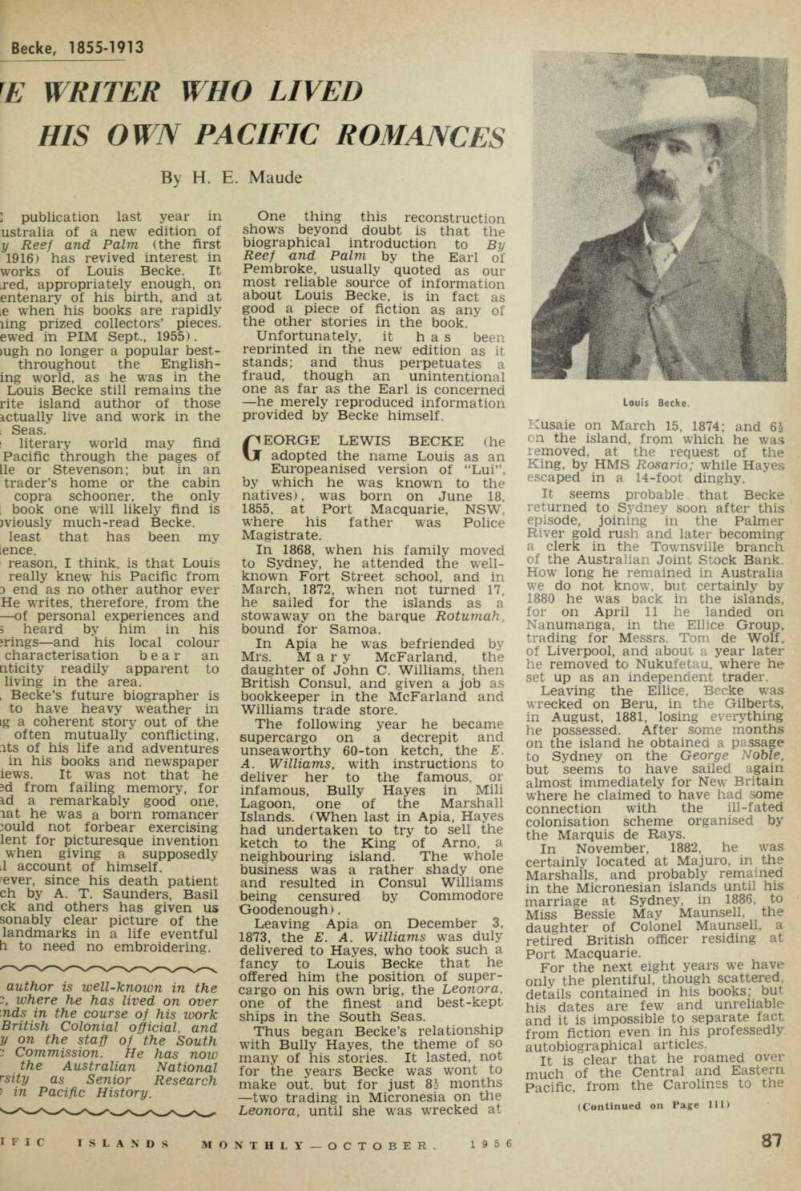
George lewis becke (he adopted the name Louis as an Europeanised version of “Lui”, by which he was known to the natives), was born on June 18, 1855, at Port Macquarie, NSW, where his father was Police Magistrate.
In 1868, when his family moved to Sydney, he attended the well known Fort Street school, and in March, 1872, when not turned 17, he sailed for the islands as a stowaway on the barque Rotumah, bound for Samoa.
In Apia he was befriended by Mrs. Mary McFarland, the daughter of John C. Williams, then British Consul, and given a job as bookkeeper in the McFarland and Williams trade store.
The following year he became supercargo on a decrepit and unseaworthy 60-ton ketch, the E.
A. Williams, with instructions to deliver her to the famous, or infamous, Bully Hayes in Mili Lagoon, one of the Marshall Islands. (When last in Apia. Hayes had undertaken to try to sell the ketch to the King of Arno, a neighbouring island. The whole business was a rather shady one and resulted in Consul Williams being censured by Commodore Goodenough).
Leaving Apia on December 3, 1873, the E. A. Williams was duly delivered to Hayes, who took such a fancy to Louis Becke that he offered him the position of super cargo on his own brig, the Leonora, one of the finest and best-kept ships in the South Seas.
Thus began Becke’s relationship with Bully Hayes, the theme of so many of his stories. It lasted, not for the years Becke was wont to make out. but for just 85 months —two trading in Micronesia on the Leonora, until she was wrecked at
Kusaie on March 15. 1874; and 6h on the island, from which he was removed, at the request of the King, by HMS Rosario; while Hayes escaped in a 14-foot dinghy.
It seems probable that Becke returned to Sydney soon after this episode, joining in the Palmer River gold rush and later becoming a clerk in the Townsville branch of the Australian Joint Stock Bank.
How long he remained in Australia we do not know, but certainly by 1880 he was back in the islands, for on April 11 he landed on Nanumanga, in the Ellice Group, trading for Messrs. Tom de Wolf, of Liverpool, and about a year later he removed to Nukufetau, where he set up as an independent trader.
Leaving the Ellice, Becke was wrecked on Beru, in the Gilberts, in August, 1881, losing everything he possessed. After some months on the island he obtained a passage to Sydney on the George Noble, but seems to have sailed again almost immediately for New Britain where he claimed to have had some connection with the ill-fated colonisation scheme organised by the Marquis de Rays.
In November, 1882, he was certainly located at Majuro, in the Marshalls, and probably remained in the Micronesian islands until his marriage at Sydney, in 1886, to Miss Bessie May Maunsell, the daughter of Colonel Maunsell, a retired British officer residing at Port Macquarie.
For the next eight years we have only the plentiful, though scattered details contained in his books; but his dates are few and unreliable and it is impossible to separate fact from fiction even in his professedly
autobiographical articles.
It is clear that he roamed over much of the Central and Eastern Pacific, from the Carolines to the
(Continued on Page 111)
Louis Becke.
.otus, and was in turn super , resident trader and labour ter; and it is probable that elped to smuggle arms and mition to the Mataafa faction moa, the details still remain i filled in, for we have no nporaneous records as exist ie period 1880-82 in his letters mother (now in the Mitchell T). 1894, Louis Becke left the ands for good, after a more ■ less continuous residence of 3ars, and settled down in y where he was introduced e author Ernest Favenc to J. 3hibald, founder and editor of ydney Bulletin. ening to his stories of Islands Archibald asked him to write of them down for publication e Bulletin, and by the next tecke, who was broke and in ilth at the time, had com- Challis the Doubter, soon ed by the other stories ned in By Reef and Palm. h the publication of this first ion in book form the same (which was also the year of ison’s death), Becke’s fame writer was made and for the -wo decades a constant stream >vels, short stories, sketches irticles appear from his pen ?h not necessarily under his , not only in the Bulletin but lere he could sell them, of his books were written in oration with Walter Jeffery editor of the Town and ry Journal, to whose expert mce may be attributed their r historical accuracy and sustained plots. 1897 Becke left for England, ig just in time to assist in ng De Rougemont’s fabrica in the Wide World Magazine; he continued to live in id, Ireland and France 3 one of his daughters was ;ed) until 1909, when he again ed to Australia, t the call of the islands was strong is shown by his ued efforts to get back: as ?er of a trading company, collector for Burroughs, ime and Company, and , as leader of a scientific tion under the sponsorship veral British and German d societies. nothing came of any of projects—except a brief visit va in 1908 and a longer one v Zealand. His last 18 months spent in Sydney, partly in a 3 hospital and partly at the Hotel where he died on ary 18, 1913, seated in his
chair with a half-completed manu script in his hand.
He had been ill for many years and looked an old and weary man, though in actual fact he was only 58.
Opinions will probably always differ as to the value of Louis Becke’s work; in the heyday of his popularity he was generally preferred by the reading public to Stevenson, at least in Australia and New Zealand, while at the same time was ignored or condemned by most literary critics.
The passage of time will almost certainly prove both sides to have been wrong. Louis Becke is not a great author; he lacks the polish of a literary craftsman and he
wrote too much, too hurriedly (34 books in 19 years, with innumerable other items) , in order to keep his head financially above water.
Admitting all this, however, one must also acknowledge that Becke is a natural story-teller who returned to civilisation after nearly a quarter of a century of adventurous island life stocked with an inexhaustable supply of reminiscences, personal and hear say, and authentic local colour.
This he proceeded to reproduce in that peculiarly condensed, simple and direct form upon which the Bulletin insisted from its contributors, a style which never left him, though in later years, when sickness and financial
:e caused his standards to be i, he tends to be more se most South Sea writers, is essentially a realist, the islands not through a cloud of sentiment but vely—as indeed we all come if we live in them long is seen at his best in his stories, and particularly the ones; crisp narratives led for the most part with e simple episode, e is little in the way of logical analysis; we see what iracters do, but gain scarcely sight into their feelings and tions. s themes Becke is concerned ;ral not so much with native i customs, but with incidents his own limited and sed experience: the relations i the white residents during )s and 80s (usually connected rading, whether ashore or and between them and Drown men and women” whom, and with whom, they Becke’s best books are held to be his first three Dns of short stories, By Reef Urn, Pacific Tales and The of the Tide, and his :ive study Wild Life in m Seas. his later work, some
unfortunately can be classed as “pot boilers’’ although still very readable, particularly by those fortunate enough to know the localities where the action takes place.
It is to be hoped that Angus and Robertson, or some other enter prising publisher, will now follow up By Reef and Palm with a definitive edition of all Becke’s major works; but with introduction less misleading than that provided by the Earl of Pembroke.