La Plume De Ma Tante
pp. 85-101 · Read in the full issue
[?] the Estimates were [?]ved They Drank to —
By Sir George Joy, Kbe, Cmg.
STNOT think why Cook named is area the New Hebrides, le only affinity with Scotland [ could see was that in my t was choc-a-bloc with Presby missionaries of the fire and one breed. these gentlemen I had the t respect for the work they plished and I invariably at l their annual Synod. 1 do I remember at a get er at the British Residency one of these gentlemen was ng his ginger beer and I a 7 and soda, my small son, who ?en making himself a nuisance id the contents of an ashtray ly drink, archtype of John Knox at remarked, “What an in it child,” —but I took a dim if his IQ. degree of harmony at the this Anglo-French Adminis i depended to a large extent political atmosphere in Lon id Paris. I must explain that ; lotus land there was two of ling, just as in Noah’s ark, forgetting, of course, two ncies, two official seals and ommissioners. le atmosphere was bright we one another “Mon cher ue.” A discord reduced it to colleague,” but if things were middling we descended to ami.” Nevertheless I recollect n one occasion when I was
particularly depressed my colleague in true Latin style threw his arms
or°both Thee^ l with^M^trp^iSf
phllpSo-Vip 0 ’’ 66KS Wlth M ° n tres chei „ .. , x , . whe £ sterl “ mg came unshackled from the The Convention provided that the British and French Residents were 0 f equal status and importance and any deviation in this respect was the subject of report to London and Paris. Now appointments in the French Colonial Service are graded a nd it so happened that on one occasion the French Resident was a “Gouverneur de troisieme classe” (the correct translation is “Governor Class III” and not, repeat not, “Third class Governor.”) This was awkward, for such a Governor was entitled to a salute of 15 guns when disembarking from a warship while under the Protocol the two Residents, being of equal status, were entitled to only 11. On disem barking from the next warship, the visits of which were fairly frequent, my colleague received his 15 guns and in accordance with Protocol I duly reported it to the Secretary of State and Paris was doubtless in formed of this breach of the Con vention.
Now, on British warships it is easy to know when to remain standing at the salute when the guns are blaz ing and when to sit down (though standing up in a launch in a rough sea requires some agility) because a
bugler announces the beginning of a and its termination. But with the French Navy things are different. They blow a whistle and it (as one hopes) one is far enough away to prevent damage to the ear diums, it is difficult to know whan the salute has finished and when to sit down; while to go on standing at the salute as if hoping for more would make one feel ridiculous.
For this good reason I used to count the number of guns before re
suming my seat. Shortly after I had reported to the Secretary of State that my colleague had been honoured with a salute of 15 guns, another French warship paid a visit.
On disembarking from this vessel at the conclusion of my official visit, I stood at the salute in my launch and counted 11 guns and then sat down but to my surprise the guns went on booming so up I got again. There were 15!
After due reflection I considered it unnecessary to worry the Sec retary of State with an account of such tact on the part of the French Naval authorities to the British Representative.
WE entertained the local com munity, and of course ourselves, a great deal, but I never attempted to surpass the mag nificent banquets of my French colleague. These highly official affairs were accompanied by many ravishing courses and the most elegant of wines of which I could never satisfy myself adequately as I had invariably to make a speech.
The piece-de-resistance was a huge turkey which was brought to the
(Continued on Page 97)
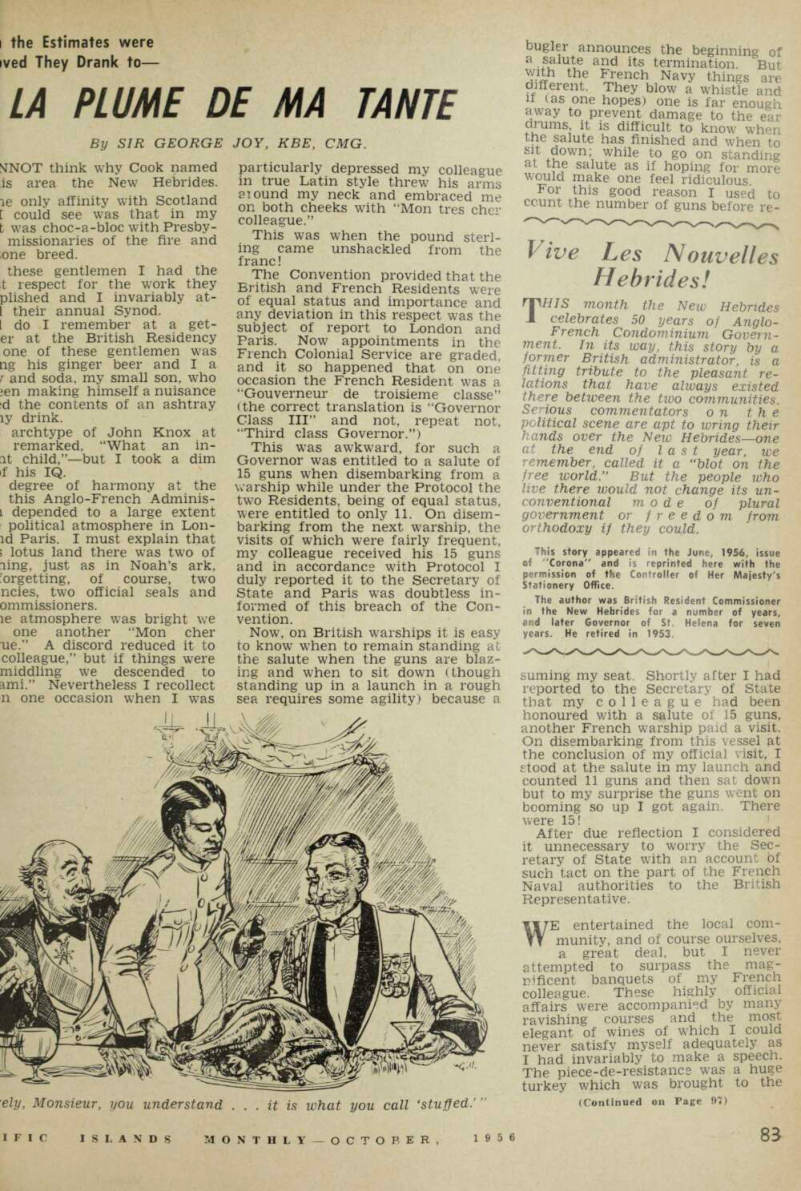
ely, Monsieur, you understand... it is what you call ‘stuffed.’
by the major-domo and placed nt of me to admire. This I suitable terms for all to hear, vas then taken out of sight, I up and served —at least so sjined. But as this ceremony place on many occasions, I to wonder where my colleague ed such beautiful birds. It 'ossed my mind that of late it sen a bit mothy, so I enquired table companion on the next Dn as to what province of 3 bred these rare birds, ooked at me in astonishment aid. “Surely, M. le Resident, nderstand that it is only ‘un mie.’ It is what you call HE was one French High mmissioner who disposed of complaints submitted by the i settlers on his rare visits to by the remark “Je m’occupe was an easy let-out and the was mollified that His Ex y would at least look into the '. But on one of the plan ; the French proprietor was and H.E. interviewed the r’s wife and enquired if she ay complaints to make. The i replied that they were well
content and as far as she knew there was nothing they wanted This unusual reply surprised His Excellency and he pressed Madame to say whether she was entirely happy with affairs. “Oui, Monsieur,” she replied, “Je suis tres heureux mais malheureusement je n’ai pas de fils.” Instantly and from habit His Excellency replied “Je nroccupe de ca.”
The majority of the members of the British and French communities could speak one another’s language in some degree but misunderstand ings were frequent. I recollect that in the French magazine Illustration there appeared a picture of Winston Churchill in the regalia of an Elder Brother of Trinity House. When a member of the French colony enquired what Chur chill represented, his British coun terpart translated it as “le frere aine de la trinite,” to which the astonished Frenchman could only reply “Mon Dieu! Mon Dieu!”
During my tenure of office I served with a score or more of French colleagues, acting and sub stantive. The French changed their administrators frequently. Many of their families were engaged in the wine industry of France and had vineyards, and I learnt much about
wine, especially the greatest wine of all.
One of my colleagues whose family were vintners in the Champagne district had a brand of that wine called “Plume” and of course he obtained his supplies from that source. I had never heard of this brand, but in France, as in Scot land, there are many excellent types of the national beverage which are not officially branded or advertised, but which are nevertheless superb.
He explained that a true cham pagne is demi-sec, that triple-sec showed a perverted taste, while the tongue-twisting “gout American” was just a horror.
“Plume” was made from specially selected grapes in small quantities and distributed principally among the family. My colleague was a bachelor, and an aunt looked after his welfare and that of the French Residency.
Art may have beguiled auntie’s age, for she was certainly a beauti ful, charming and fascinating woman and it intrigued me to hear him call her “ma cherie” or “mon petit chou,” though a term of en dearment that likens one to a cabbage seems odd to me. Certainly there have never been aunties in my family that could hold a candle to her.
We had been discussing the Con dominium Budget which required
our joint signatures before it could be implemented. The drafts which required the prior approval of our respective Governments had been despatched months ago and had al ready received the approval of the French authorities. We both awaited the approval of the British Govern
ment with considerable the financial year was running); and left little time for any spends spree.
While I was soothing my colleaf with suitable phrases (which I not believe) that approval coulcb expected at any moment, the td
! on his desk rang and he id the receiver to me. It was distant who informed me that jram had arrived from Suva to xe Budget with minor amend had been approved. This un ;ed climax threw my colleague cstacies of delight. He all but ced me, called me a prophet pening the door of his office outed to auntie to bring a “Bien frappe.” r the ceremony of opening cork should be drawn as y as possible, not a pop but 7 a ping, and that to be and if expertly done) he raised iass and said “Monsieur le nt de Sa Majeste Britannique, mes felicitations, et main , nous aliens signer notre t avec ‘La Plume de ma ext day, as was gossiped, the minium Treasurer queried the iticity of our signatures, there rery excuse for it. loubt many of you have heard 8.8. C. the weekly programme “Those were the Days.” Can hat the Eastern and Western tions at Geneva have ted to settle their differences ard liquor such as vodka and id have forgotten the ancient i of the Persian poet when he rape that can with Logic ute to-and-seventy jarring Sects ite: btle Alchemist that in a trice eaden Metal into Gold mute.