It's a School, Of Course
pp. 83-84 · Read in the full issue
The Philippines, Too, Had
A Fraudulent Falls
fTTHE Western Samoan Stamp X purporting to picture the Aleisa Falls, but displaying in actual fact the Malifa Falls, (PIM August) recalls a similar case of some years ago.
This was in 1932 when a Philippines postage-stamp featured what was supposed to be the 200foot high Pagsanjan Falls on the island of Luzon.
However, a keen-eyed Chicago collector, noticing the similarity of this waterfall with one in the Yosemite Valley, in California, USA, discovered that in reality it was a picture of the 350-foot high Vernal Falls at Yosemite.
It seems that the stamp designer was initially unable to find a suitable picture of the Philippines landmark and thought no-one would notice if he substituted the similar (in appearance) American counter part.—K.N.
That Old Fish Poisoning
Again
AN old question was raised again recentlv at Pukapuka in the Cook Islands—“ls the flesh of certain sharks poisonous?”
Among the fish caught on June 6 by the Resident Agent and a party of deep-sea fishermen was
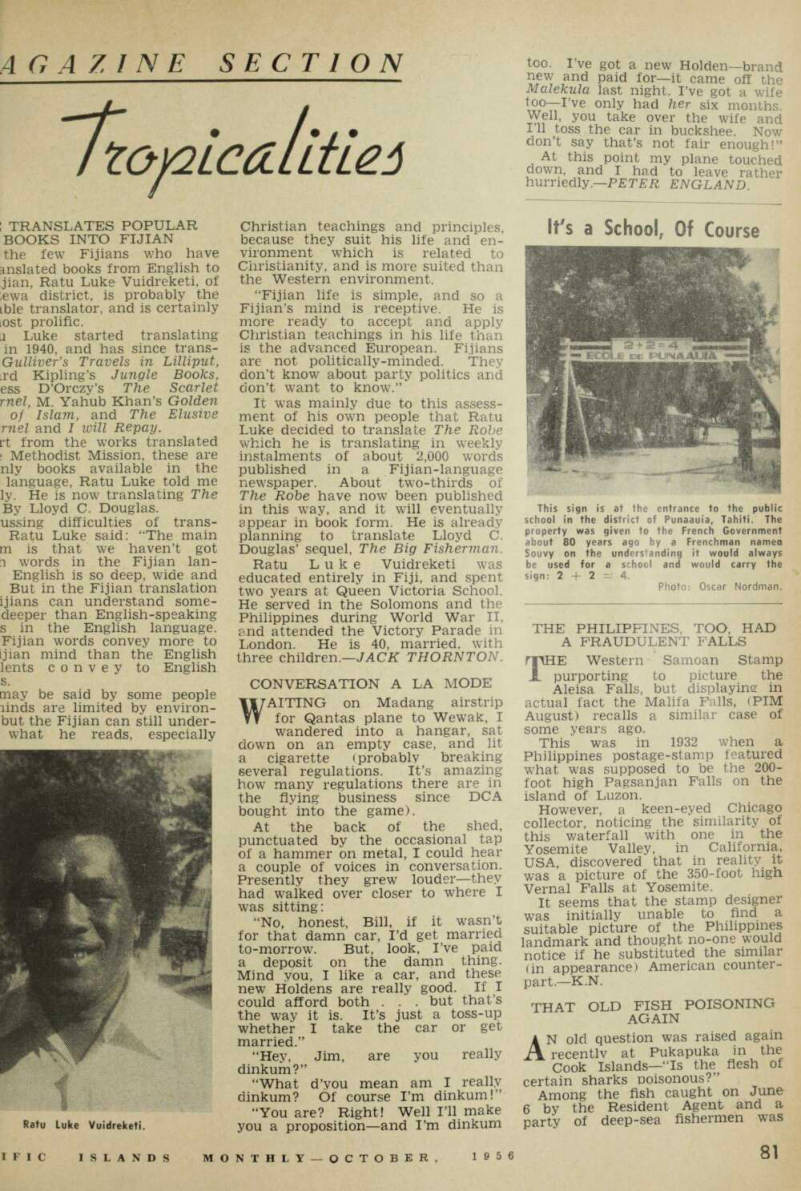
This sign is at the entrance to the public school in the district of Punaauia, Tahiti. The property was given to the French Government about 80 years ago by a Frenchman named Souvy on the understanding it would always be used for a school and would carry the sign: 2 + 2 = 4.
Photo: Oscar Nordman.
a 12 ft. black shark. The people of Pukapuka do not eat shark meat, but many of the fishing party were from the lower islands of the Cook Group where shark meat is eaten, so it was decided to bring the 300-lb. fish ashore for consump tion.
The fish was cut up and eaten and the scraps were thrown to the pigs. A few days later 16 pigs had died, but the human shark-eaters were not affected.
It is reported from Mauke Island, in the lower Cooks, that there is a species of shark there that, if eaten, will cause the consumers to feel sick for several days after wards.
Local lore has it that the way to decide whether or not the
shark flesh is poisonous is to observe whether flies settle on it.
If the flies are attracted by the meat it is wholesome, but if they avoid it the meat is unsafe to eat.
-— W. H. Percival.
The Loafers!
CORRESPONDENT Nordman, of Papeete, his memory stirred by the recent visit of some Samoans to Tahiti, recalls an occasion when he was serving in Matson Line ships on the trans pacific run.
Strolling along the beach road at Pago Pago with a group of passengers, the party passed similar groups of Samoans. Each Samoan group was heard to make a remark as they passed.
“What did they say?” said one wealthy American tourist to Nordman.
“Oh. take no notice of them”, said Nordman. They’re talking about you people. They said ‘The loafers!’ ”
“Well gahdam, whaddayaknow!” said the tourist in some disgust.
But Nordman was having his laugh. He knew of course that the polite Samoans were murmuring their greeting of “Tolofa” as they passed on their way.
Law Strikes The Cooks!
IN the Cook Islands, where rm people consider themselves m or less exempt from the fir points of such New Zealand 1:1 as do apply there, there seemed be signs of a tightening up September.
First indication was a warn from the Police Department in local press that cyclists must k to the left—an utterly unheard! thing in Rarotonga, where cyci pedestrian, and even motor merely watch to see what the n approaching plans to do, them the opposite.
A stickler for the left-hand i is considered some sort of era pot and a source of amusemenr The other legal event of i month was the fining of a nurni of persons, apparently bakers,} (1) failure to keep floors clean,-: keep trays clean, (3) keep dour tub and lid clean, (4) provide f ployees with aprons. One imagine the wave of shocked dignation that swept over Bakers’ Union on the morn that that piece of news broke!! t Two Japanese ships dischan at Noumea, a total of 6,500 t of coke for the Societe Nickel. * vessels then loaded nickel ore Japan at coastal mining centre;
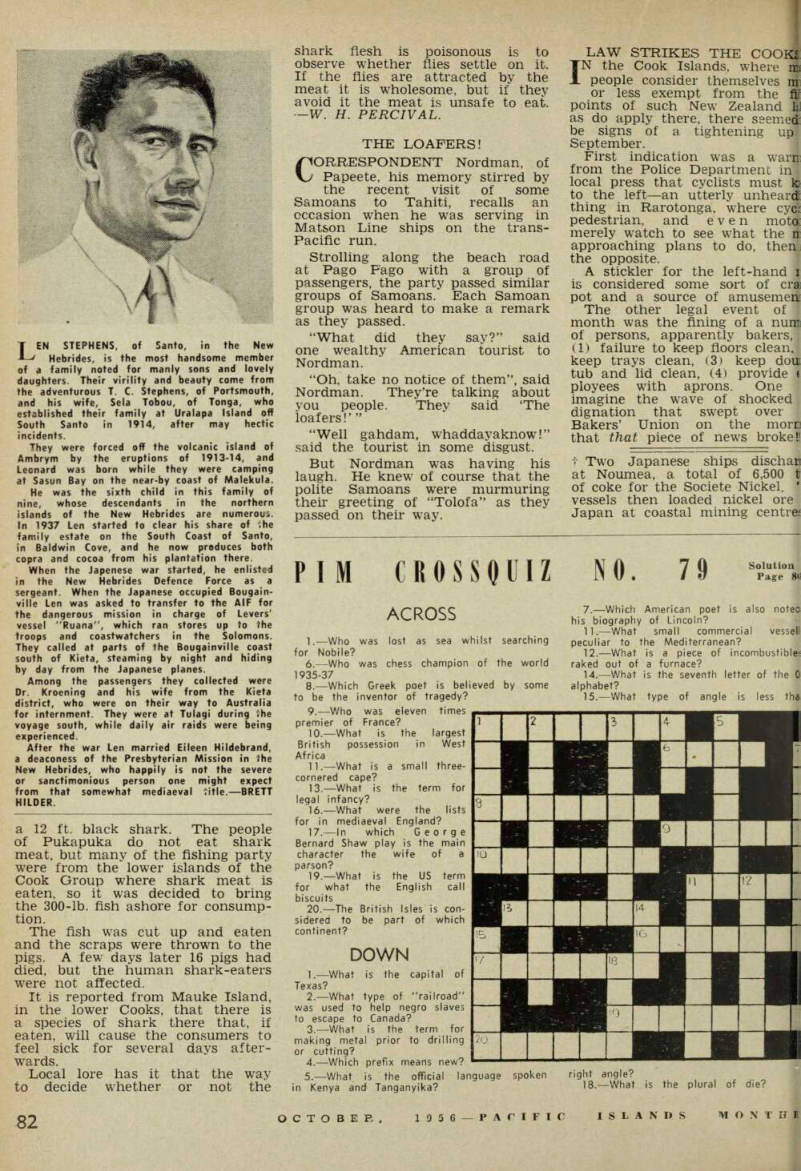
LEN STEPHENS, of Santo, in the New Hebrides, is the most handsome member of a family noted for manly sons and lovely daughters. Their virility and beauty come from the adventurous T. C. Stephens, of Portsmouth, and his wife, Sela Tobou, of Tonga, who established their family at Uralapa Island off South Santo in 1914, after may hectic incidents.
They were forced off the volcanic island of Ambrym by the eruptions of 1913-14, and Leonard was born while they were camping at Sasun Bay on the near-by coast of Malekula.
He was the sixth child in this family of nine, whose descendants in the northern islands of the New Hebrides are numerous.
In 1937 Len started to clear his share of the family estate on the South Coast of Santo, in Baldwin Cove, and he now produces both copra and cocoa from his plantation there.
When the Japenese war started, he enlisted in the New Hebrides Defence Force as a sergeant. When the Japanese occupied Bougain ville Len was asked to transfer to the AIF for the dangerous mission in charge of Levers' vessel "Ruana", which ran stores up to the troops and coastwatchers in the Solomons.
They called at parts of the Bougainville coast sooth of Kieta, steaming by night and hiding by day from the Japanese planes.
Among the passengers they collected were Dr. Kroening and his wife from the Kieta district, who were on their way to Australia for internment. They were at Tulagi during the voyage south, while daily air raids were being experienced.
After the war Len married Eileen Hildebrand, a deaconess of the Presbyterian Mission in the New Hebrides, who happily is not the severe or sanctimonious person one might expect from that somewhat mediaeval title.—BRETT