[?] Gaulle Rings Tocsin
pp. 49-53 · Read in the full issue
Caledonia Hears
[?]Ic Warnings
[?] Gaulle Rings Tocsin —But Against Whom?
Cryptic remarks made by General Charles de Gaulle in speeches ng his visit to Noumea last month were interpreted in some French r ters as a warning that “Australian imperialism” represented a threat •Jew Caledonia.
CTHER the leader of French 'esistance in World War II ctually intended to sound the against an aggressive, pre- Australia is open to doubt. 10 matter how such a con i of their country would 5h Australians, that was the ision he conveyed to many in diences, sral de Gaulle told members i elected New Caledonia As r that they must never forget ere part of France. They must conduct themselves in any vhich might discourage the country. New Caledonia was centre of a part of the world militarily and politically, soon be one of the most im t in the world. New nia, he asserted, was inevit he subject of plans, or at he thoughts, of other Powers, important were his words at marking his departure. New nia should look to the future necessary, give aid to France, d. France in return would le means of defence of New nia by establishing an air, and military base. Coming i soldier, his actual words— Caledonia should aid France y way possible”— made many • just what was implied.
PlM’s Noumea correspondent wrote: “One could not help think ing that the General had Australia in mind when he spoke of dangers
to New Caledonia. The French Press speafcmgr freely of Australian rmpermhsm and news sheets in U 'it” (L more than once have hinted Addressing ex-servicemen of two world wars, General de he had complete confidence that “France generous” would surmount her present difficul ties. Two phrases he used were; France lives and mil find a new Th& uture belongs to It was important, he said, that the returned soldiers should think of de Gaulie and that de Gaulle should think of them. He spoke of an early turning point in French affairs, then asked: And who will give the signal?’. The crowd of war veterans
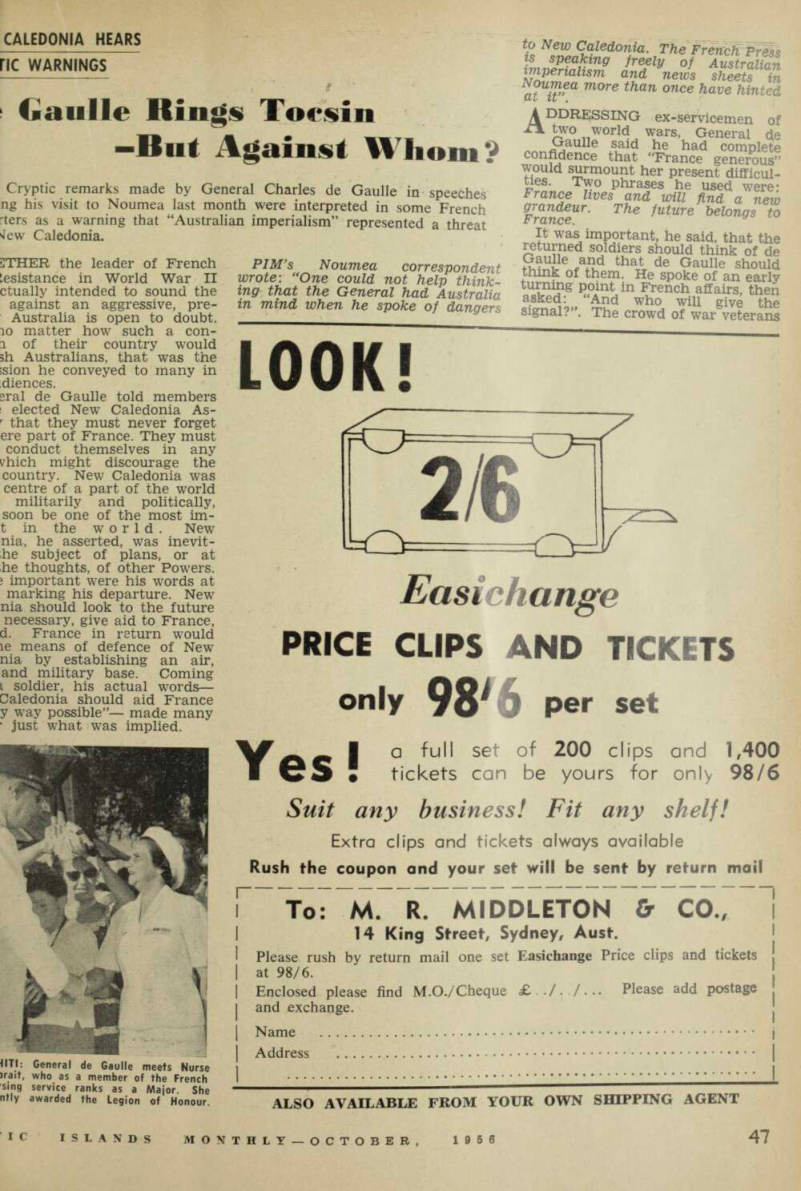
[?]TI: General de Gaulle meets Nurse prait, who as a member of the French sing service ranks as a Major. She ntly awarded the Legion of Honour.
mt in reply: “de Gaulle”, e was a discordant note at a reception to General de in Noumea Town Hall. Some lied “Get out of here” to the aledonia Deputy (M. Lenor- M. Lenormand commented in his sheet “L’Avenir nien” that obviously some id had a heavy grocery bill ad paid it by making this nterruption his, M. Lenormand implied
he incident rranged by
opposition
led by the of New d o n i a’s import export ;s.
Lenormand article also that for months lad been a per i n g ai g n in i s , and lly in the ■y of Over- France,
I that
unrest in New don i a , 'ears were of New
Caledonians coming to blows over political questions, and that the solution would be to send a few thousand soldiers.
The saddest thing about this enormous lie, said M. Lenormand was that much of it was believed He offered as proof the fact that in structions received from France for the de Gaulle visit embraced the possibility of an assassination.
An additional charge made by M.
Lenormand was that a plot was
afoot to devalue the Pacific franc He asserted that among those in the plot were commercial and mining heads of New Caledonia.
A remarkable speech greeted General de Gaulle at one native centre during his New Caledonia i x? ur - , . was made by a native Grand Chief, Vincent Bouquet. He
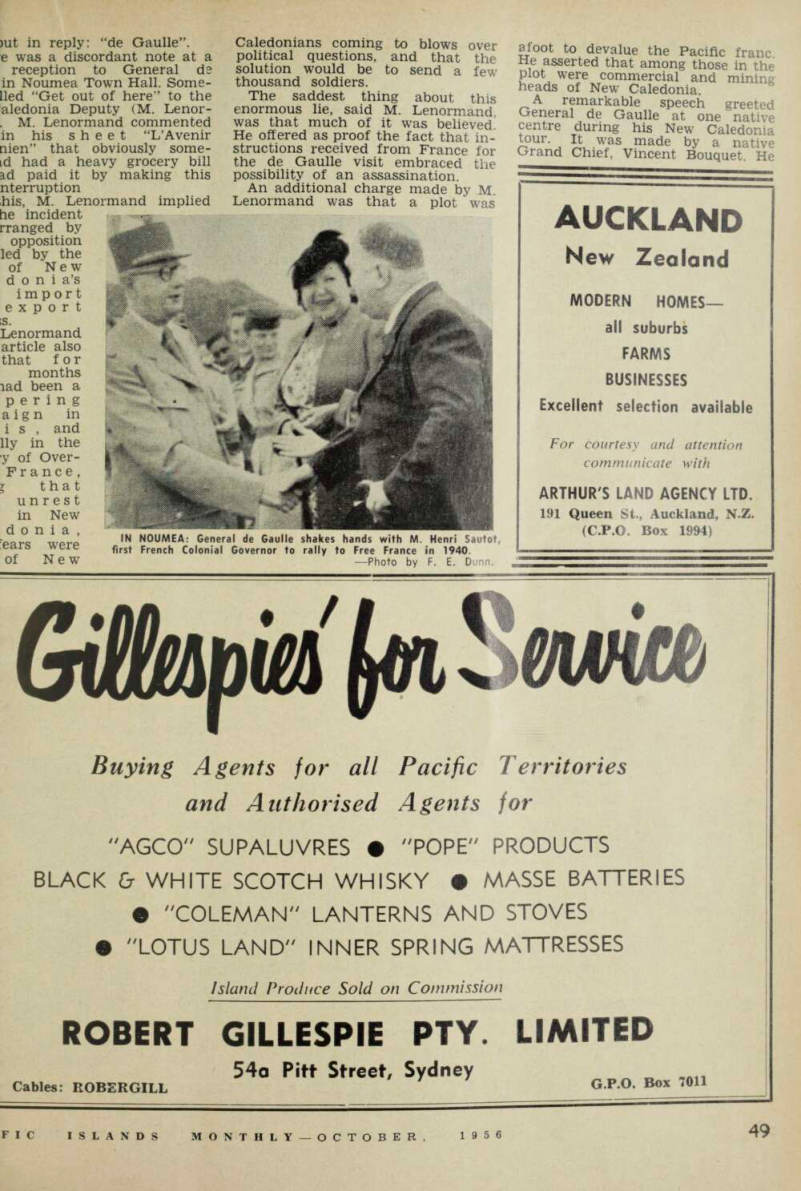
IN NOUMEA: General de Gaulle shakes hands with M. Henri Sautot first French Colonial Governor to rally to Free France in 1940 —Photo by F. E. Dunn.
said the natives of New Caledonia were grateful to France for the recent interest shown in their evolution. Rights they acquired re cently were obtained without dispute or bloodshed. Although the present concessions guaranteed the future, the natives expected more. He hoped their evolution would be rapid enough to enable their child ren to enjoy the happiness and freedom of real citizens of the French Republic.
TAHITI residents were assembled in thousands at daybreak on August 30, and ships in port were dressed in bunting, to welcome General de Gaulle and his wife when they arrived aboard the Mes sageries Maritimes liner Caledonien for a 2i-day visit.
Governor Toby and military and civilian leaders greeted the visitors at the gangway at 7 a.m. The General’s crowded itinerary included a ceremony at the Bougainville Monument commemorating French Oceania’s rallying to the call of de Gaulle and the Free France Move ment in the war years. He also found time to pay a brief visit by Catalina aircraft to the Leeward Islands.
Among the many Tahiti residents General de Gaulle met was one of the colony’s most honoured war
veterans, Nurse Maa d i Gobrait, who served with the forces of three Allied Nations during World War 11.
While in Paris recently, Nurse Gobrait. who carries the rank of major in the French Army Nursing Service, was awarded the Legion of Honour decoration.
Forty -eight hours behind schedule, the Cal e d o n i e n brought General de Gaulle into Noumea Harbour at 2.30 p.m. on September 11. Thus, 16 years after his famous call to arms to those who refused to submit to the Germans, he came to visit the first important group of French to rally to him.
Pro m i n e n t among those who
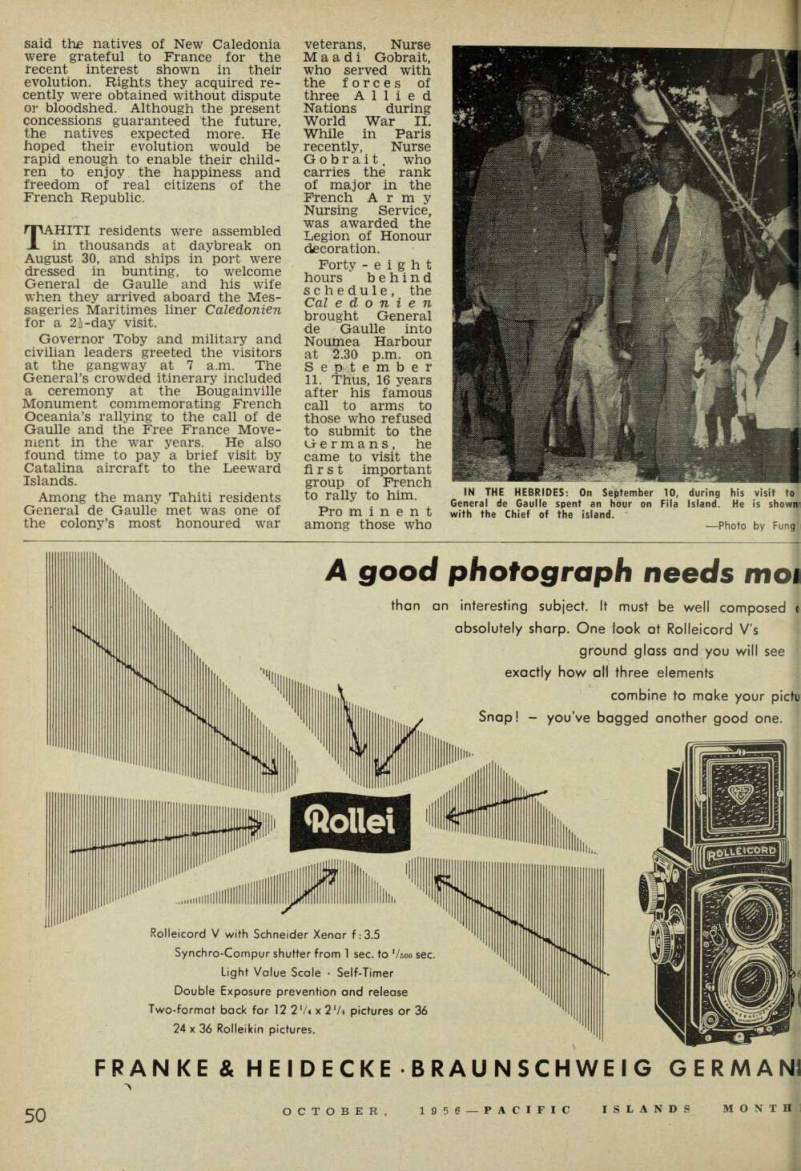
IN THE HEBRIDES: On September 10, during his visit to General de Gaulle spent an hour on Fila Island. He is shown with the Chief of the island. —Photo by Fung
ed him, in addition to the ir of Noumea and parliamen representatives, was M. Henri >t, the gallant old Lorraine as French head of the New des, led the way in the cause ee France in the dark days of iral de Gaulle’s Noumea pro tne included a review of ;on troops. Also in the march were detachments of seamen three naval units in the har and, most cheered of all, ins of Bir Hakeim and other French campaigns, in Tahiti, native dancing and ig formed part of the enter ients arranged in the General’s ir. uythical figure to most New onians, General de Gaulle i among them freely and saw ich of the colony as time—and feather—would permit, le of the year’s worst weather I cancellation of his projected sit to the Loyalty Islands but ;r rain nor cold diminished the th of the welcome wherever he visit ended when he left uta Aerodrome in a special at 5.30 p.m. on September 15, [ via Darwin and French tsions in the Indian Ocean, for e.
Efly Child Christened
infant son of Ratu Penaia au and Adi Laisa, who led from Malaya with the ion in June, was christened ugust 26, at the Methodist nary Church, Suva. He was 1 after Ratu Sir Lala la, Jossfa Lalabalavu Sukuna aliali. (These are Ratu Sir full names. When he went iool at Wanganui he reversed rder of the last two because New Zealand school-mates it easier to pronounce la than Vanaialiali). whole world remembers Ratu i’s daughter, Adi MeiKainona. > she who presented a bouquet e Queen when she stepped j in Fiji in November, 1953. [ei Kainona was then three.