The Pro's Issue Spectacles
pp. 22-148 · Read in the full issue
Moresby’s Three-Wise-Monkey Complex
Seeing The News Through
By Stuart Inder*
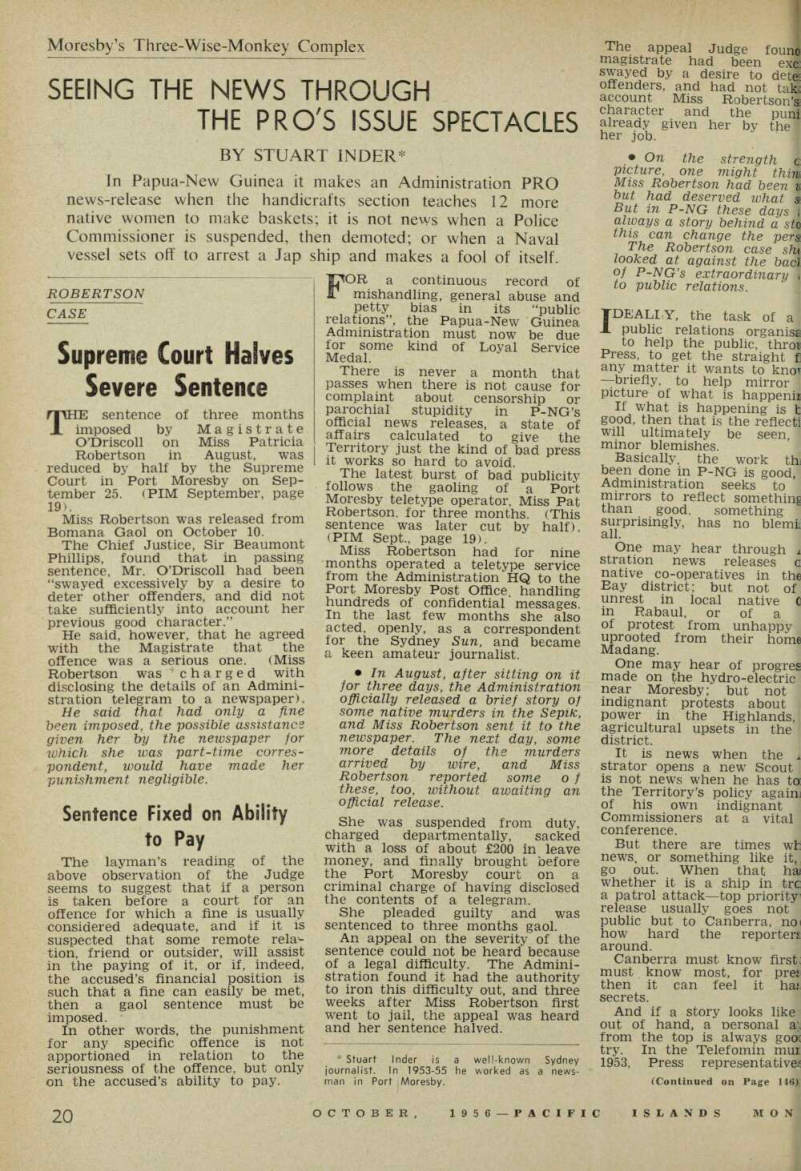
In Papua-New Guinea it makes an Administration PRO news-release when the handicrafts section teaches 12 more native women to make baskets; it is not news when a Police Commissioner is suspended, then demoted; or when a Naval vessel sets off to arrest a Jap ship and makes a fool of itself.
FOR a continuous record of mishandling, general abuse and petty bias in its “public relations”, the Papua-New Guinea Administration must now be due for some kind of Loyal Service Medal.
There is never a month that passes when there is not cause for complaint about censorship or parochial stupidity in P-NG’s official news releases, a state of affairs calculated to give the Territory just the kind of bad press it works so hard to avoid.
The latest burst of bad publicity follows the gaoling of a Port Moresby teletype operator. Miss Pat Robertson, for three months. (This sentence was later cut by half). (PIM Sept., page 19).
Miss Robertson had for nine months operated a teletype service from the Administration HQ to the Port Moresby Post Office, handling hundreds of confidential messages.
In the last few months she also acted, openly, as a correspondent for the Sydney Sun, and became a keen amateur journalist. • In August, after sitting on it for three days, the Administration officially released a brief story of some native murders in the Sepik, and Miss Robertson sent it to the newspaper. The next day, some more details of the murders arrived by wire, and Miss Robertson reported some o f these, too, without awaiting an official release.
She was suspended from duty, charged departmentally, sacked with a loss of about £2OO in leave money, and finally brought before the Port Moresby court on a criminal charge of having disclosed the contents of a telegram.
She pleaded guilty and was sentenced to three months gaol.
An appeal on the severity of the sentence could not be heard because of a legal difficulty. The Admini stration found it had the authority to iron this difficulty out, and three weeks after Miss Robertson first went to jail, the appeal was heard and her sentence halved.
The appeal Judge founo magistrate had been exc swayed by a desire to dete f offenders, and had not take account Miss Robertson’s character and the puni already given her by the her job. • On the strength c picture, one might thin Miss Robertson had been v but had deserved what & But in P-NG these days 7 always a story behind a stc this can change the per& The Robertson case sht looked at against the bad
of P-NG’s extraordinary i
to public relations.
IDEALL Y, the task of a public relations organise to help the public, throi Press, to get the straight f any matter it wants to —briefly, to help mirror picture of what is happenii If what is happening is t good, then that is the reflect] will ultimately be seen, minor blemishes.
Basically, the work thl been done in P-NG is good, Administration seeks to mirrors to reflect something than good. something surprisingly, has no blemi; all.
One may hear through j stration news releases c native co-operatives in the Bay district; but not of unrest in local native C in Rabaul, or of a of protest from unhappy uprooted from their home Madang.
One may hear of progres made on the hydro-electric near Moresby; but not indignant protests about j power in the Highlands, agricultural upsets in the district.
It is news when the J strator opens a new Scout is not news when he has to the Territory’s policy again, of his own indignant Commissioners at a vital conference.
But there are times wh news, or something like it, go out. When that ha whether it is a ship in tre a patrol attack—top priority release usually goes not public but to Canberra, no how hard the reporters around.
Canberra must know first; must know most, for pres then it can feel it has secrets.
And if a story looks like out of hand, a nersonal a;, from the top is always goot try. In the Telefomin mur 1953, Press representative;;
(Continued on Page 146>;
* Stuart Inder is a well-known Sydney journalist. In 1953-55 he worked as a news man in Port Moresby.
asked to refrain from printing of the more sordid details, l But just in case they broke; word, the sordid details were? pencilled out of the news-ref right there in front of themj A request might be made f Press not to use some ref© made at an Advisory C Meeting. But just in case minutes of that meeting ( become available, anyhow.
Just recently there wan request for the Press to i from mentioning the propose? of Dutch Army officers to It was a “Federal Goveir request”, and the catchr “security”.
LIKE all systems wit ulterior motive, the syst P-NG occasionally breaks News gets out that could onM come from a Government (so much of it comes throug channel) and a witch-hunt It is an extraordinary comm on NG Government to say tK term “witch-hunt” is in gene throughout the Administrate it has one clear meaning! where —that pressure is I exerted from the top to ge news “leak”.
This constant battle of wi nerves has an effect in the run. It affects spend too much time pitting energy and skill a gains? machine, in an effort t information that should be? available.
It affects honest Adminis officials, who are slowly conditioned to believe that thr is entitled to nothing, am there is only one correct p< view and one vital role in B the Administration’s.
And what is of vital signiii it affects the public of P-N Australia by allowing tho learn little of what is really on in P-NG in the imjj sphere of day-to-day dJ Administration. It keeps unaware of the real and dar tendency towards over-Gove; in P-NG that will one an acute embarrassment te tralia.
WHY does it all go on? * In the simplest terrm Moresby is frighten Canberra, and Canber frightened of the United ] Trusteeship Council.
Canberra may talk big in : defence whenever UN cic P-NG, but meanwhile it end? the constant effort of the A stration to suppress anything might be construed as givir UN members an opportune criticism.