[?]torial. ..
pp. 19-20 · Read in the full issue
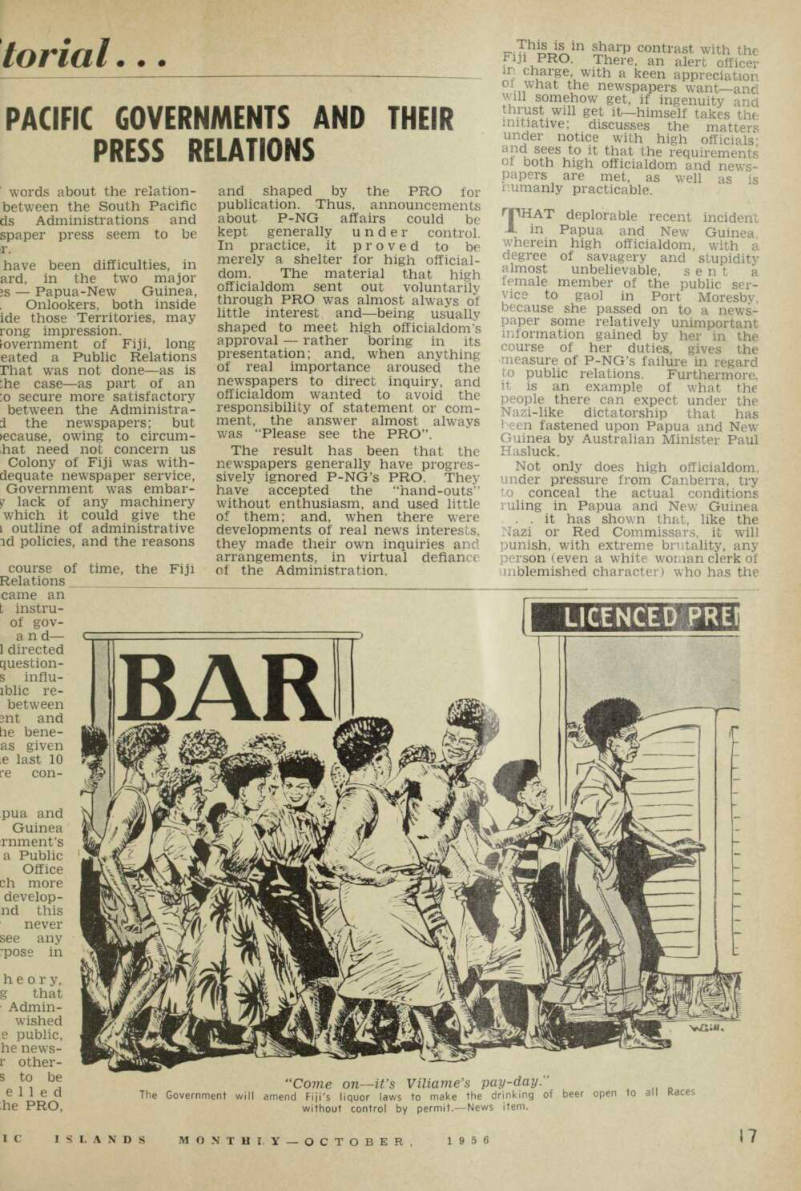
Pacific Governments And Their
Press Relations
words about the relation between the South Pacific ds Administrations and spaper press seem to be r. have been difficulties, in ard, in the two major 3S Papua-New Guinea, Onlookers, both inside ide those Territories, may rong impression, i-overnment of Fiji, long eated a Ihiblic Relations That was not done—as is ihe case—as part of an :o secure more satisfactory between the Administra -1 the newspapers; but >ecause, owing to circum ,hat need not concern us Colony of Fiji was with dequate newspaper service, Government was embar y lack of any machinery which it could give the i outline of administrative id policies, and the reasons course of time, the Fiji
Relations came an t instru ct gov and — 1 directed question s influ iblic re between mt and be bene as given e last 10 re con pua and Guinea rnment’s a Public Office ch more develop nd this never see any rpose in heory, g that Admin wished e public, he news r other s to be ell e d ;he PRO,
and shaped by the PRO for publication. Thus, announcements about P-NG affairs could be kept generally under control.
In practice, it proved to be merely a shelter for high official dom. The material that high officialdom sent out voluntarily through PRO was almost always of little interest and—being usually shaped to meet high officialdom’s approval rather boring in its presentation; and, when anything of real importance aroused the newspapers to direct inquiry, and officialdom wanted to avoid the responsibility of statement or com ment, the answer almost always was “Please see the PRO”.
The result has been that the newspapers generally have progres sively ignored P-NG’s PRO. They have accepted the “hand-outs” without enthusiasm, and used little of them; and, when there were developments of real news interests, they made their own inquiries and arrangements, in virtual defiance of the Administration.
This ln Sharp contrast with the Fiji PRO. There, an alert officer m charge with a keen appreciation oi what the newspapers want—and will somehow get, if ingenuity and thrust will get it—himself takes the initiative; discusses the matters under notice with high officials; s £ es , that the requirements of both high officialdom and news papers are met, as well as is numanly practicable. deplorable recent incident A in Papua and New Guinea wherein high officialdom, with a degree of savagery and stupidity almost unbelievable, sent a female member of the public ser vice to gaol in Port Moresby, because she passed on to a news paper some relatively unimportant information gained by her in the course of her duties, gives the ■measure of P-NG’s failure in regard to public relations. Furthermore, it is an example of what the people there can expect under the Nazi-like dictatorship that has been fastened upon Papua and New Guinea by Australian Minister Paul Hasluck.
Not only does high officialdom, under pressure from Canberra, try to conceal the actual conditions ruling in Papua and New Guinea . . it has shown that, like the Nazi or Red Commissars, it will punish, with extreme brutality, any person (even a white woman clerk of unblemished character) who has the
temerity to break its petty laws.
The Robertson incident justifies every word we have published in recent issues about Hasluck dic tatorship in P-NG.
One is tempted to comment at length. But the subject has been dealt with already in an article in this issue, by Mr. Stuart Inder.
We subscribed to every word that Mr. Inder has written.
A POINT which none has brought up, but which has a direct bearing upon this P-NG in cident, and upon the whole subject of public relations generally, is the deterioration of the newspaper press, in the past couple of decades.
It is something under which all public men, and all administrators in responsible jobs, suffer acutely.
Journalistic responsibility for ac curate and balanced presentation of the facts is almost a thing of the past. Seventy per cent, of big newspapers to-day unhesitatingly sacrifice the truth for the head line. They may not deliberately publish untruths; but, by giving only half the story, or laying the emphasis upon the wrong angle, they do so distort the truth that actually it no longer fulfils the newspaper’s primary obligation— that is, to give the public the whole truth, and only the truth.
More and more, public men and public hold the newspaper press in contempt.
The truly dreadful newspapers of today are the logical result of the wholesale adoption, in the past quarter-century, of the Hearst school of journalism. In the view of the Hearst reporter and editor, nothing matters much so long as the newspaper can produce a screeching headline, embellishd with legs of an undressed woman or the contorted features of a notorious criminal.
Pacific Islands administrators have suffered a great deal under this irresponsible journalism. For one competent and balanced writer who goes through the Islands —such a man as Osmar White, of Mel bourne Herald, for example—there are a dozen so-called journalists who seek only the exciting and sensational, and play it up without regard for truth or its implications.
In 25 years, the Pacific Islands Monthly has directed attention to scores —perhaps hundreds —of such “cock-eyed stories”, which give a completely wrong impression of Is lands conditions: but nothing there by has been achieved. The plague becomes steadily worse. These yelping, irresponsible newspaper hoodlums would not be turned loose periodically on the Islands if they were not sent along by their equally irresponsible editors and publishers.
PROBABLY, it was in order to protect themselves against this recurrent nuisance that P-NG high officialdom tried to channel
everything through a Public Re lations Office, and refused to deal with news-gathering organisations, whether good, bad or indifferent.
That was wrong, because it was regarded by the news-gatherers only as a challenge. Inevitably, it made worse the conditions which high officialdom was trying to re move altogether.
“Modern journalism”, like Mus covite Communism, however much we hate it and despise it, is here to stay, and we have got to live with it. The more we ignore it, the worse it becomes. The gaoling of the woman clerk in Port Moresby is the logical outcome of high officialdom’s short-sighted un imaginative approach to the prob lem of public relations —just as the present paralysis of Anglo-Ameri can-French diplomacy in the Middle East today is the result of the West’s total failure to cope with the deplorable and despised methods of the Communist bloc.
If the Papua and New Guinea Administration wishes to hold its own with the newspapers, high officialdom must accept today’s conditions, and meet the reporters with something of the reporters’ skill and cynicism—as high official dom does in Fiji, for example.
High officialdom will only make the P-NG picture uglier, and open the way for more “Robertson incidents”, if it hides its head away behind official barriers, and tries to persuade itself that thereby it can keep P-NG hidden away from the world. Modern journalism is not a pretty thing—but, like most evils of that kind, it must be re cognised, and accepted as inevitable —and dealt with accordingly.—