Industry
pp. 172-173 · Read in the full issue
Alarms And
Excursions, But
Rubber Still a Profit Industry
DESPITE numerous survey repeated top-level predf over the past several y© the effect that the natural : market was on its death-bed,j appears to be no sign of expiu though the market may be att a little off-colour.
PIM London quotations shox in the first half of 1955 then a steady climb from 23£d U in June. Then there was a s jump to 43d by September: followed by a jumpy decline tH to last March when the II spot quotation stood at 25!d beginning of that month.
Since then there has been a and slow rising tendency to £ August.
The controlling factor appe be the production cost and ability of synthetic rubber, has now been developed technical stage where it has. of the favourable property natural rubber.
Although world synthetic output is increasing steadilt world demand for rubber i increasing rapidly, and at e the combined natural and syi’ rubber supplies do not mee demand. That was especial case late in 1955 and earl! when United States auto manufacturers found a suddt creased demand for vehicles.
According to one recent natural rubber demand in 193 exceed available supplies by: 10,000 tons. World pro®' should be about 1,835,000 tons about 77,000 tons on 1955.< United States is now produci:i using 11 million tons of sy\ rubber, but its demand for i —4O per cent, of total consul —is still as high as in pre-was Men associated with some larger Malayan rubber estate; diet that a satisfactory retui be received for natural rub world output is stabilised at 1,800,000 tons annu a 11 y.. quantity will ensure a satisg balance with the synthetic whose cost of production likely to fall greatly in the fl able future and is at presei; above efficient natural rubbe< duction costs.
All in all, the rubber pundii seem to see no serious colla view, though some plantatioc have to improve efficiency.
The Tariff Board Inqu
WHAT has happened to 1 port that the Australian Board was to make to
allowing the inquiry into rubber held almost two £0 (it ended in Moresby in ovember, 1954).
Department of Territories, a, says that the “report has een released” —and will not e on that statement.
Fariff Board inquired into or not Australia should le Papuan rubber industry. planters asked specifically ission of the 2d per lb duty s paid on Papuan rubber Australia and in this they
were supported by the Department of Territories.
The key to the mystery is probably the fact that in the year preceding the inquiry price for Papuan rubber fell as low as 20d per pound—below cost of production for some planta tions—but since the inquiry the price has continued to rise—current price (September 8, 1956) being A32.61d.
Mr. Harrie Standen, of the Bamu River Mission (“The Mission in the Mud”), Western Papua, goes to
Britain and other European countries in April next year, on a lecturing tour—which, it is hoped, will attract some additional fund; for the organisation. Harrie and Eva Standen established this Mission over 20 years ago, in one of the least inviting spots in the Gulf of Papua. While Mr. Standen is abroad, Mrs. Standen will carry on the education work in the Bamu Delta. v More than 70 Roman Catholics cn Norfolk Island have launched an appeal for the building of a church there. As the island is in Sydney Archdiocese, the appeal is going through Sydney.
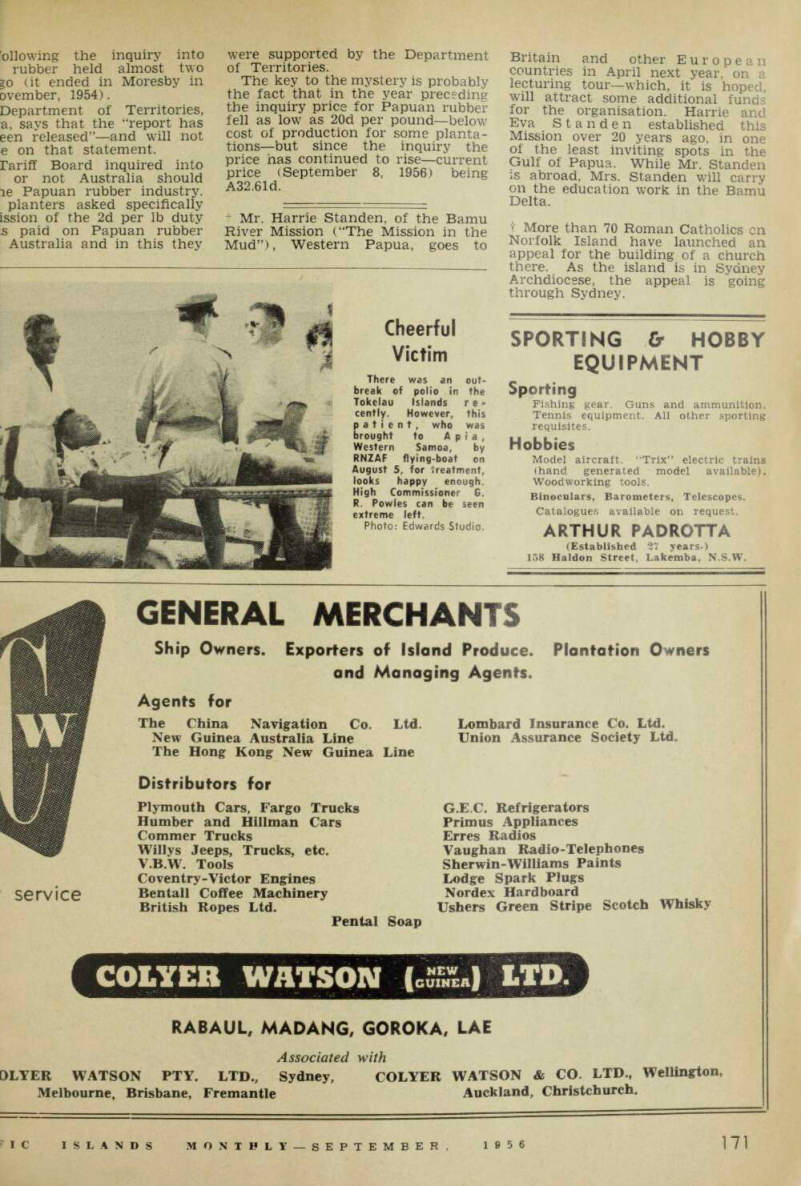
Cheerful
Victim
There was an out break of polio in the Tokelau Islands re cently. However, this patient, who was brought to Apia, Western Samoa, by RNZAF flying-boat on August 5, for treatment, looks happy enough.
High Commissioner G.
R. Powles can be seen extreme left.
Photo: Edwards Studio.