This Month's New Reading
pp. 94-103 · Read in the full issue

Elizabethan Treatment
For Victorian Plot
IT is interesting to speculate on what lay behind the decision of a novelist of A. J. Cronin’s calibre to indulge himself with the classic example of the hackneyed plot. Certainly it is a challenge; and one to which he rises with his usual brilliance.
Briefly, Crusader’s Tomb tells the story of a young man of the Eng lish “gentry,” Stephen Desmonde, destined by family tradition to enter the Church but who, several months before he is to take Orders, bolts for Paris because he wants to become an artist.
His family does not immediately cut him off without a shilling, that comes a year later when it is felt that he has had time to get his aberration out of his system.
There follow years of garrets and grinding poverty, of self-neglect, bad food or no food and finally— of course, —a hacking cough. The period is between the beginning of this century and the end of the 20’s It takes in the First World War, which the hero ignores, absorbed in his painting in
neutralist Spain.
When the war is over and he goes home, his “lack of patriotism” is therefore used as a weapon to flay him, and his family: his abhor rence of war is regarded as cowardice; his art is vilified and he is dragged into court on a charge of painting obscene pictures.
Misunderstood but unrepentant he with draws into the obscurity of London dockland, painting but refusing to exhibit or sell, finally expiring of TB in the arms of his Cockney wife, Jenny, leaving her still carrying their un born child.
Ten years after Stephen Desmonde’s death he is, of course, a famous painter.
What would any author make of it, with all this on the agenda?
When the author is a Cronin, it becomes a story of complete and absorbing interest.
Moreover, convincing.
You may not like “modern art;” belong to the cows-in-the meadow school; feel that all artists are poseurs —and end this
novel feeling that there may be Stephen Desmondes, with a seeing eye denied the rest of us.
This is a story in which the emotions go deep—the plot may be threadbare but there is nothing thin and patchy about the characters.
Essentially it is a story of aristo crats, although socially some of the people who inhabit it are far from that: the triumph of high intellect over the grosser facts of life and social custom.
Completely fascinating also are the pictures of Paris and rural France and England in the halcyon pre-World War I period of those countries’ greatness. (Published in Australia by Angus and Robert son, Ltd. Australian price, 18/9.)
Twenties
THERE is nothing aristocratic about this novel: It brims with American brashness of the Pro hibition, pre-Wall Street-collapse period.
However, as a first novel, the author, Kate Farness, does better by her publishers than do some of this company’s other “firsts.” The title, One Half So Precious, comes from that line in the Rubaiyat:
1 wonder often what the Vintne buy One half so precious as the gooo they sell.
Basically, it is the struggle b' tween Nell and Gort Crae Minnesotans of Irish descent, t the well-being of their six childre Gort puts his faith in the fact tb; he was born with a caul (a tW membrane which sometimes cove the head of a child at birth aif which is supposed to bring goa fortune); Nell in prayer. If virtf is not entirely triumphant in ti end, it probably can be said th Nell made her point. However,, we do leave Gort down it seeK distinctly unlikely that he will 1 permanently out.
This is by no means a religio book. Although the young Cra* spend an appropriate time lighti candles to this or to that, thr extra-religious activities are i traordinary, even viewed with U tolerance.
The Craigs are blessedly Rom Catholic, which permits a mu more realistic rapprochement of ; ligion and the exigencies of eve:; day life —but whether Bishop She (see below) could tie their philosoß in with his is another matter.
Community Fathers who wrr their hands over the iniquities Youth in 1956 are obviously wrin ing a good 30 years too late. Equsg
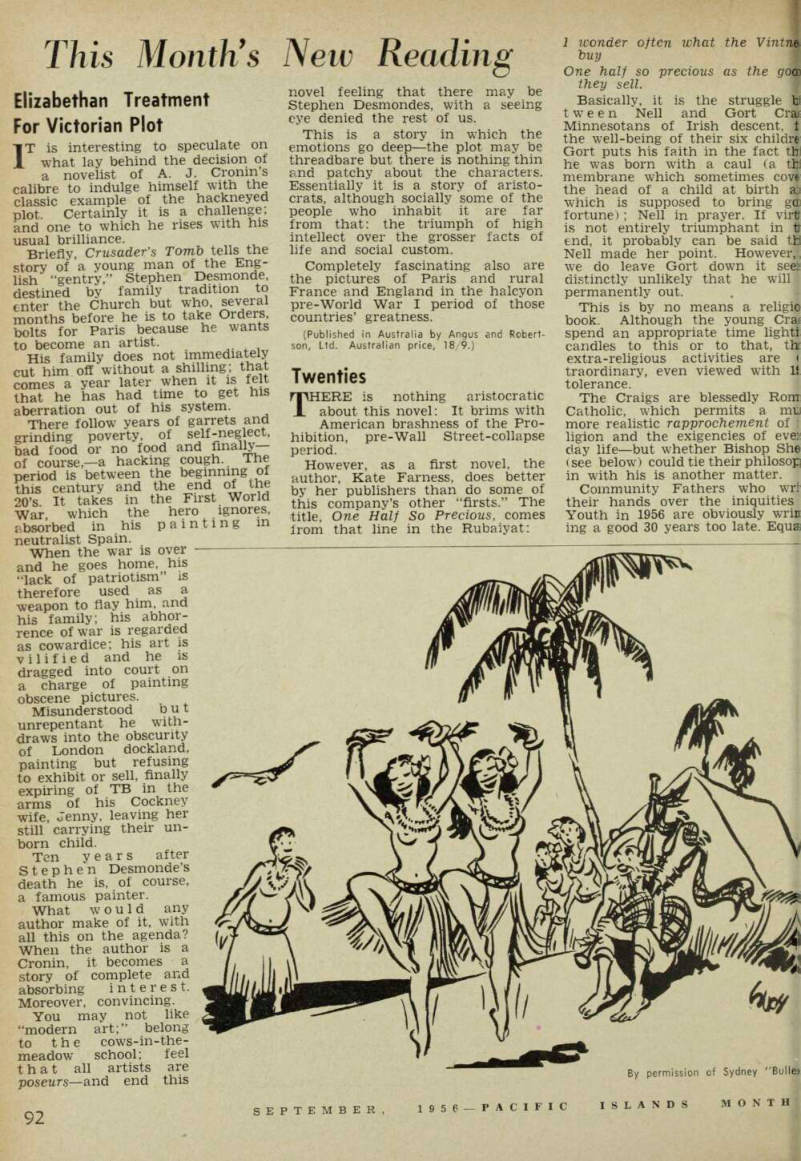
By permission of Sydney "Bulle[?]
obvious, those who had their you. after the boom burst produced much Flame as a damp-squib truly little candles between tv naughty worlds.
The Craig-type teen-agers spite their beer with pure alcohol whii their High School boy-frieru carried in hip-pocket flasks; tbi went on “petting-parties;” dano the Charleston; and really put ft cult of the automobile on fi]j foundations.
But, in comparison with the pn sent generation of young, they wr tough-fibred beings, suffering nco of the complexes, isms and reactio since sent to try us.
Gort Craig was a dentist with flourishing practice. But that w not the end of his activities, ran boot-leg liquor from across t Canadian border and elsewhere; dabbled in real estate and rode t stock-market boom —alas, too lot He had an affair with anotl woman, and killed her in a « accident. He finally went to pris for two years. In all of these entc prises the Craig kids were timately concerned.
But when the final day of recko ing came, did they retire hu emotionally twisted, socially secure? No. They came up w. chins out, fighting. Gort was s their hero.
It seems that human young less easily damaged than specialists of 1956 would have believe.
Miss Farness’ subssquent nov should be worth watching. (Published by Peter Davies, Ltd., Austro price, 17/-.)
Last Milk in the Coconut
IF there is one thing calculated send the book reviewer into attack of the screaming-meenr then it is a book about Frei Oceania, particularly when it !
Paradise somewhere in its title.
But if someone must wring last juice out of Tahiti (for wlr read Paradise) as the theme ot book, it is probably as well tJ it is veteran word-spinner Willi Price who does the job.
There is nothing, absolutely noc ing, left to say about Tahiti Tahitians; all that can be done to say it in a different way—t this Price somehow manages to The book (Adventures in Paradu covers the Cook Islands, the Sanr and Fiji, as well as French Ocea;j but about half of it is devotedt the last-named and by the tJ the author has reached Fiji, P:* and wife Mary are obviously an ous to get back home, and onl;I very superficial account is givem Readers will probably derive ? much entertainment from read) the Fiji section of the Pao: Islands Year Book and the inforrr
i therein will likely be found to more accurate, or Mr. Price’s information, Fiji not exported butter since the -thirties and currently imports ut £BO,OOO worth of butter and e from Australia and NZ to :e up the deficiencies of her own iuction. (With no ulterior motive strictly in the interest of iracy, if Mr. Price cares to ly, we should be happy to supply with a copy of the Pacific Year k, 1956 edition, gratis), he best part of Mr. Price’s book that dealing with the Cook nds, and this section we found ghtful. r ith the over-publicised sex jtices of Tahiti left behind over horizon, and the butter statistics Fiji not yet encountered, the lor gives himself over to the ex ences of Mary and self in the r Zealand-run Cooks.
Tiat he has to say will, of course, iriate some private individuals the administrators of that fair up, both in Rarotonga and lington—these people having de ped an almost French touchiness such matters in recent years. >me unfortunate episodes ctuate the visit of the Prices to Cooks but, remarkable for an jrican writer, he does not cise unduly or put it down to effete Colonial system under 3h we Britishers exist.
Nonetheless, the fact that he has had the temerity to write about events as they happened, and not present them as an excursion of un blemished bliss will probably be sufficient to bring up the hackles of many in these far away isles.
This is as good a point as any, perhaps, to exclaim at the extra ordinary attitude of Mr. Price, an American, to the Colonial system, either British or French.
Not once does he insist that we free our slaves; or give these down trodden people “independence.” He
notes the problems of the Sol di Pacific; ponders upon them— ard leaves the solution to the admbl istering authority.
This from an American writer and traveller is so extraordinary that it leaves the British reader with almost a feeling of anti-climax, if with some pleasure as well.
The Prices landed at Aitutaki from Tahiti, having travelled by TEAL. They went from Aitutaki to Rarotonga by an 80-ft “reeking, leaking little tub.”
For the sake of the then owner
tactfully leave out the name — ough everyone in the Cooks vs it, and it has recently iged hands, anyhow. But Price’s ription of the voyage and the is such a classic and we can forego the pleasure of giving 3 extracts. le Captain explained when they b on board that some Latter- Saint missionaries had already :ved the deck-house, so it would lecessary for them to go down the crew’s quarters * showed them the way. Says 3: “He opened a hatch and we 3d down into a black pit that up odours known only to the ;ls of ships. . . In the depths ould dimly make out six bunks. 1 was covered by a grimy ;ress and a pillow that had r been cleaned in all of its msly long history. . . Adjom the cabin, but with no door een, was a cubbly-hole con ng a dirty sink, a primus stove some pots and pans. Evidently as the galley. . . A small door le other end of the cabin dis d an indescribably messy hole a toilet bowl full of dark-brown r. ‘Facilities,’ said the Captain rfully. ‘Flush doesn’t work. Just ; it. The boy will take care 9 99 ie Prices went back on deck took refuge in a lifeboat full yet canvas, with two fellow
passengers, New Zealanders. The ship put to sea and once from the shelter of Aitutaki began to “toss and turn like a barrel.’’ Waves shivered into spray against the gun wale and showered into the life boat.
The conversation with the two ]^ ew Zealanders became Jess and less animated, and finally the NZers went below. The Maori deck passengers retreated to lie on the of copra in the hold, from which retching sounds soon came.
Says Price: “The Maoris deserve all the more credit for their great Pacific explorations since they are constitutionally poor sailors.”
The Mormon miss ionary, who had berthed his three daughters and one wife in the cabin, came out twice with a basin and em P tied over the side. Then he came out with a ™sh—without the basin, The en £ ineer came U P from below and also went smartly to the rail.
After the necessary interval he returned ’ sheepish. “Happens every he “ Never used “ The Prices stayed in the lifeboat, with their stomachs strangely close to their mouths - But, of course, they never got seasick-or hadn’t for 34 years-and it was only an overnight trip, anyhow.
Then a Maori seaman came along and told them to get below—the Captain said “hurricane.” (Oven
They made it—and instinctively reached into the galley for two pans which they used at once. The record of over 30 years was broken.
An English crew-member occupied one bunk; the two NZers two others. The Prices fell into two lower berths in their clothes.
The cook came and began to operate in the galley. “Bully beef stew or bully-beef curry,” he offered.
The passengers groaned.
The fumes of the Primus joined the “reek of the copra, the pung ency of crushed cockroaches, the musty fug of bedding, the sicken ing odour of lost dinners, the stench of the bilges, and the acrid stink of the John.”
Once, when Mary was more than usually occupied with the pan, a sympathetic New Zealander leaned down from the top berth and struck a match. “Want a light,” he asked.
“Thank you,” answered the lady, “I don’t need a light for what I’m doing.”
The hatch-covers stuck and huge seas washed down into the cabin — and even when the Captain finally freed it, the water continued to rise, and reached the bunks.
On deck, several crates of live crabs burst open in the storm and sought refuge below in the bunks
with the cockroaches, copra-bugs and passengers.
The ordeal went on for two nights and two days. Finally the Cap tain came below to confess he could not find Rarotonga—it was
around somewhere, but the 100 out who had been up the mast'i the previous day could find no la: in sight.
However, even this difficulty w overcome in time, and in the ea]
ning they staggered ashore in Dtonga and to Avarua’s one il. le manager was at his break- Naturally, he did not like g interrupted. No, he did not j a room. No, there was no r hotel. No, he did not have suggestions. ductantly he was bludgeoned permitting them to have kfast. After it, still unbathed bedraggled, they wandered a the street with the idea of ing a Maori family to take i in. They were side-tracked the presence of the Resident missioner who, upon hearing : tale, said, “I’m sure the hotel get you in. We’ll phone.” le Imperial We did. When the 5S returned to the hotel they i met by the beaming manager: happy to say that by shift things about a bit I’m able to you this corner room. I hope 11 be comfortable.” * ♦ * ell, gentle reader from the h Seas, have you ever had a lar experience? e’ll bet you have. alished by William Heinemann, Ltd. Aus i price, 26/-.)
irding the Western
iroaches
:TH the 10th year of Peace safely over the horizon, now is the time to produce World II books. The spate of them r s no sign of petering out, and lermore, they are almost uni illy excellent. Men write well t what they have done well. ey Shall Not Pass Unseen, by Southall, keeps this high iard in the story of a squadron lustralians (mostly) who flew lerlands in the Battle of the itic against the U-boats. a measure of the speed in h aviation history is written is fact that, at that time, these lering flying-boats were con ed a powerful weapon in the ice of Britain’s life-line. Sent vithout fighter-cover, they were dered sufficiently able to take of themselves—a strange re on to-day when anything less a supersonic-jet is regarded > vulnerable as a wooden duck, e post-war civilian version of Sunderland was, of course, the iringham, well known to every ■war traveller in the Islands they were removed as “un amic.” rt of the pleasure in this book erefore derived from the com on between one’s own dignified ging in Sandringhams and extraordinary gyrations and
manoeuvres these huge craft were capable of under the pressures of war.
This is not the history of a squadron, but the individual stories of some,.of the men and their air craft who helped to make up the squadron. The author is part of the story—although the exploits he are not his own—having begun his operational flights from Britain over Channel, Bay of Biscay and Atlantic in 1943.
He was awarded the DFC in 1944 and in 1945 was posted to the War History Section of RAAF, London— a valuable vantage point in which to collect material such as this.
The stories grip and hold the in terest even if your participation in
tbe war amounted to no more than knitting sox for soldiers. 2l/-T a " d R ° bSr,SOn - L,d - Reviewed Briefly . . .
Thinking Life Through—
The third volume from Bishop Fulton Sheen’s US television pro gramme which is known widely in America as Life Is Worth Living. . This volume, like the other two, is illustrated wth amusing black and-white drawings. The Bishop brings his philosophy to bear on a wide range of subjects from How to be Unpopular (boasting, ridicule, cynicism) to H-bombs (40 H-bombs
pped in cobalt, would be capable estroying all life on the planet). blished by Peter Davies, Ltd. Australian 15/6.)
Ersonal Security
lOUGH FAITH: —A nother irican, Lowell Russell Ditzen, enters the same field, from the estant angle. (We have uplift ny denomination this month.) Ditzen is Pastor of the Re ied Church in Bronxville, New i takes his “texts” from a vast e of places—advertisements, ipapers, personal experiences, friends—and through them ts the way to acquiring a sense ;curity in this uncertain world. old age he says: “We would ell to examine the older cultures e age is honoured and revered.
Chinese consider age the acle of life. Whereas at 50 we our hair, the Chinese is ‘per jd’ to grow a beard —as a sign honour. When great-grand *r speaks, all who are younger, natter what their station, are e respectfully silent. Such a ty has a solidity and an un nlness denied the group that itself be completely guided by youthful and inexperienced.” dished by World's Work (1913), Ltd.
Man price, £l.)
Iturn To Glory:—John
n, the author, fought along the
Kokoda Trail, in Papua, during the Pacific War. Recently he under took a 10,000-mile air trip to P apua, New Guinea and Bougain ville to see what the Territory was like 10 years after the peace. This is the story of that journey.
The book is well written and in teresting enough—if somewhat over sentimental. Mr. Baffin has appar ently not got over his Fuzzy-Wuzzy Angel complex.
The best parts of the book are those written in retrospect—par ticularly the chapter dealing with the trip he and a friend undertook “just for the ride” with an Ameri can biscuit-bomber. They paid for the ride by kicking out supplies; the entertainment provided by the Jap Zeros was for free.
A lot of old history is rehashed in this story—therefore probably of more interest to Australians than to Territorians. (Published by Angus and Robertson, Ltd.
Australian price, 16/-,)
Escape To Adventure:—A
beautifully produced book as well as an entertaining and instructive account of tropical Australia’s natural history below the sea, on the sea and on dry land, by Noel Monkman.
Monkman, a New Zealander, has spent a great deal of time in Aus tralia. According to his biography, he is a film producer (documentaries,
including sequences for some of the Disney nature films), musician microscoptist, photographer and underseas cameraman. He can also write about what interests him in an entertaining manner. (He says that although he went to school, he found public libraries much superior in the educational field.) Monkman is an aqua-lung en thusiast and a great deal of the book is devoted to his activities (including photography) under water along the Great Barrier Reef.
The book is lavishly illustrated in colour and black-and-white photo graphs by the author. (Published by Angus and Robertson, Ltd., Sydney. Australian price, 25/-,)