[?]A Believes It Has A “Switched Baby Case ”
p. 23 · Read in the full issue
Racial [?]ble Here
In anywhere but the Islands it probably would have meant ag drawn-out litigation, but in Fiji, what was apparently a by mix-up in a maternity ward a dozen years ago, has, as t, produced nothing more explosive than friendship between 5 families concerned.
944, an Indian woman, Bata m (wife of Katub Ali) and idta Tari, a Fijian, each gave to sons at Suva’s Colonial War trial Hospital, but as the en grew up the mothers id that they were unlike other en in their families.
Batalaun saw that her “son,”
Tahir Ali, had fuzzy hair and dark features. About 18 months after she left hospital, as she became more certain that she had not received her own baby, she told her brother, Ismail Khan, about it.
Some time later Batalaun and
her family heard that there was an Indian child, about the same age as Tahir, liv ing in a Fijian village in the Rewa delta.
Ismail enlisted the aid of two Fijian friends to arrange for the Fijian “parents” to bring their child, Viliame Sawamatua, to his home at Samabula, and for Tahir and Bata laun to be there at the same time.
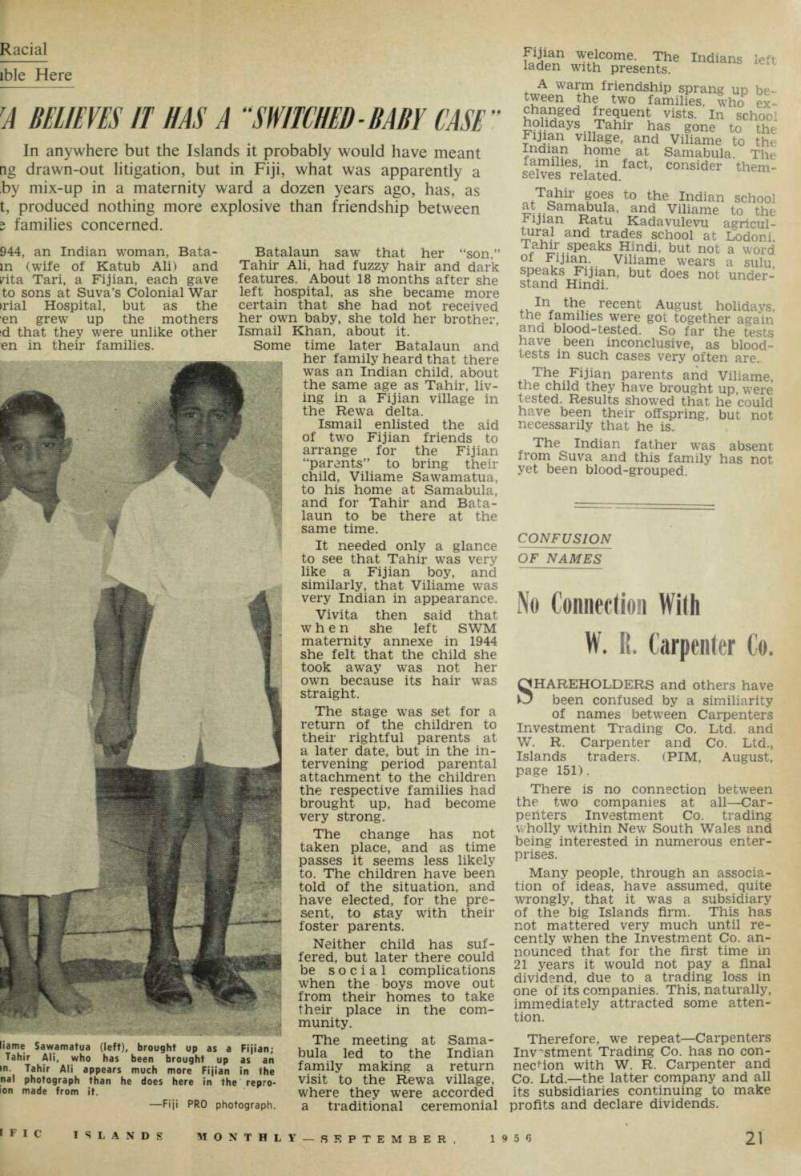
It needed only a glance to see that Tahir was very like a Fijian boy, and similarly, that Viliame was very Indian in appearance.
Vivita then said that when she left SWM maternity annexe in 1944 she felt that the child she took away was not her own because its hair was straight.
The stage was set for a return of the children to their rightful parents at a later date, but in the in tervening period parental attachment to the children the respective families had brought up, had become very strong.
The change has not taken place, and as time passes it seems less likely to. The children have been told of the situation, and have elected, for the pre sent, to stay with their foster parents.
Neither child has suf fered, but later there could be social complications when the boys move out from their homes to take their place in the com munity.
The meeting at Sama bula led to the Indian family making a return visit to the Rewa village, where they were accorded a traditional ceremonial
Fijian welcome. The Indians left laden with presents.
A warm friendship sprang up be tween the two families, who ex changed frequent vists. In schoo FiiVsm y viii^ ahlr has gone to the Fijian village, and Viliame to the Indian home at Samabula. The families, in fact, consider them selves related.
Tahir goes to the Indian school at Samabula, and Viliame to the Fijian Ratu Kadavulevu agricul tural and trades school at Lodoni.
Tah i£.. s P eaks Hindi, but not a word of Fijian. Viliame wears a sulu speaks Fijian, but does not under stand Hindi. in the recent August holidays, the families were got together again ana blood-tested. So far the tests have been inconclusive, as blood tests in such cases very often are, *u Th £-£ ijian P ar ents and Viliame, the child they have brought up, were tested. Results showed that he could have been their offspring, but not necessarily that he is.
The Indian father was absent from Suva and this family has not yet been blood-grouped.
iame Sawamatoa (left), brought up as a Fijian; Tahir Ali, who has been brought up as an [?]n. Tahir Ali appears much more Fijian in the [?]nal photograph than he does here in the repro [?]on made from it. —Fiji PRO photograph.