territori al
pp. 19-20 · Read in the full issue
Minister Hasiuck's Papua-New Guinea
L HASLUCK has been Aus alian Minister in charge of e Territory of Papua and New a for five years. He has be a controversial figure. He has so keen a personal interest administration of the Dual >ry that his ideas and outlook eem to dominate the whole mental structure. Many Terri i call him a dictator.
Hasluck himself will vigor ieny that in those five years s developed, and put into e, an administrative system on “anti-colonial” idealism, at, in substance, is the charge s most frequently levelled him. said of him that he puts too an emphasis upon native ; and refuses to accept the :nt that, if there is to be yancement of living standards natives as primitive as those
ia and New , very sub l induce mu s t be to Euro private ise to go develop the i t o r y’s nt natural SS. will have I the con that, if and New are to be along to a con yhere they support ves and hemselves, in propor what the regard as n a t i v e s’ m, e n t a 1 must be d tem to what sluck and :ers regard grant “ex
Lasluck
iself is a n of out : ability— r the most I the most Minister Territories
stralia yet
I. If any challenges statement, nvited to
read Australia’s Task In Papua and New Guinea, which is the title of the Roy Milne Memorial Lecture of about 11,000 words delivered in Perth on September 10 by Mr Hasluck.
There, in masterly fashion, Mr Hasluck outlines the principles and the plan upon which he bases his system of administration in Papua and New Guinea. Anyone who has not made a close study of New Guinea administration, and seen the plan in operation in recent years will be impressed with the breadth and clarity of the argument, and with the sincerity of the man who has devoted so much thought and effort to his Ministerial task.
Much of the argument cannot be faulted. Here, says Mr. Hasluck, is a primitive population of perhaps Is millions: divided by the country’s physical conditions, and by hundreds of different languages, into count
sohta S r?%h t fn ( ? or^ ?:l !i nities not on e blndlng them to th!f 6r fv, as a natlon > except the facts that they are all dark- irT dr?f 6 t S a ay hin hat 'K is * im P°ssible to ait a blue-print for a national fh^f Ct A Uro f h v re; and he advocates Australla should carry out her task m accordance with certain guiding principles, and leave the future society and form of govern rnent to evolutionary processes is HlS no riC s!!?h” *?£• remarks - “there is no such thing as Panuan nationalism ” The principles which he says should be observed are !Jose of justice, freedom, repre trusteeship. government, and fhis is the end result, as idealist - 11 s 6 d b ? this Ministerial Scores of different groups knowmg no relationship with each other, may gradually become a Papuan (New Guinea) people joined by a common language, liv ing at a common standard of material wellbeing, and with a common culture, strongly influenced
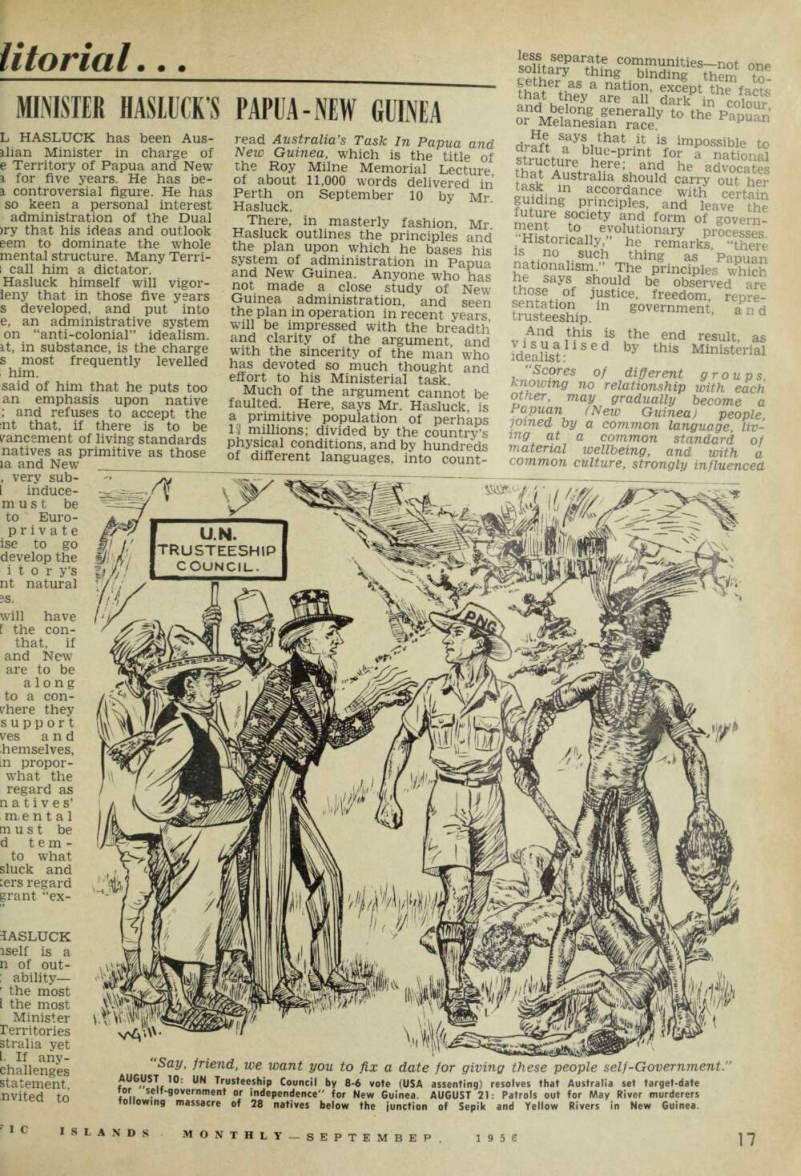
"Say, friend, we want you to fix a date for giving these people self-Government.”
AUGUST 10: UN Trusteeship Council by 8-6 vote (USA assenting) resolves that Australia set target-date tor self-government or independence" for New Guinea. AUGUST 21: Patrols out for May River murderers onowmg massacre of 28 natives below the junction of Sepik and Yellow Rivers in New Guinea.
by Christian teaching, and by Aus tralian social, economic and political practice, but preserving and enrich ing all that is best in their native cultural heritage” rIS might be possible, in a dif ferent kind of planet. But in this world, in this incalculable century, it is sheer dreaming. There is neither time, nor the money nor the administration, to carry out the task that Mr. Hasluck has out lined. .. . . , There is no time, because the kind of Islands paradise that Mr.
Hasluck visualises cannot be created within three or four generations.
Long before “a Papuan people” can be shaped, the Asians will be spill ing over into the empty South Pacific lands, their hungry masses smothering every vestige of Papuan nationalism.
There is not the money. Before the last war, Australia gave about £40.000 per annum to Papua. Since the war, the annual grants have gone like this (Mr. Hasluck s own figures);
Only a Hasluck could imagine that the Australian taxpayer will continue indefinitely to act as fairy godmother to an idealistic dream.
So far, Administration officials have not outspokenly criticised the Ministerial policy to which they have been forced to conform. But that is not to say they are happy about it. On the contrary there are hundreds of experienced and toughened officials in the Dua Territory who see a great deal of merit in the old British ‘ colonial system, at which Mr. Hasluck has sneered in his Milne Memonal lecture. . .. Q Under the “colonial” system, the Papuans (or New Guineans, or Melanesians —what you will) would be obliged to accept new living standards pretty quickly; and con tribute substantially to the develop ment of their country, and to its defence against threatening in vasion. It may be the fashion now to decry British “colonialism —but it produced some notable results There is not in the world one example of a virile new nation hav ing been created out of a hotch potch of racial groups like Papua and New Guinea, by the methods advocated by Mr. Hasluck.
MR. HASLUCK’S general plan is
well presented, and impressive;
but it has weaknesses and fallacies and they may be found in
the “Notes” prepared by the Min ister for this month’s Budget de bate. For example; “Land is purchased from native owners for settlement only by the Administration, and only if the Administration is satisfied that the owners are willing to sell and do not need it. The Administration must also be satisfied that any pro posed non-native settlement is con sistent with established policy for native advancement.” (Italics are ours.) District officers are allowed no discretion in these matters. They know the local conditions —the character of the soil, the needs of the natives, the quality of the would-be European settlers. But they are not given any authority in relation to settlement. The de cisions are not made in the Dis trict; probably not in Port Moresby; almost certainly in a well-panelled room in Canberra. That is part of the “dictatorship” that has stifled individual enterprise in Papua and New Guinea land settlement in the last few years.
The Minister himself, in his Memorial Lecture, acknowledges that the greatest problem before the Administration is that of providing a medium of instruction—some common language through which the children among these 1,750,000 natives may be made literate. \et in his “Notes” to Parliament he says that practically the whole respon sibility for elementary education is left to the Missions; and that, out of the £9,000,000 or so which Aus
tralia gives to P-NG, a beg? £120,000 per annum is given to.
Missions, to assist in this wok elementary education. There be no worthwhile progress in in education and literacy unless i large numbers of native teas are found and trained. Yet t«. there are only 563 —326 teaching 227 in training. And it also ; ported that an important co ence between Administration: the Missions, to consider ami ordinate education methods,; been postponed from this yean 1957, for reasons not explainee European land settlement; primary education are divisions of administrative p but they are the vital things if this enormously expensive* tralian effort in P-NG is not; wasted.
Experienced administrative ol< know of these conditions i problems, and talk about their discuss more effective meas all based on a system of dec© isation, in which trust is plau the men on the spot. But thr nowhere, because too much po held jealously in Canberra.
Like so many men of out! ing ability and vision, Mr. If seems to be incapable of del©
authority. Consequently,,
administration is held in a jacket. Much is being in New Guinea—but mostly wrong directions, and at a cos disproportionate to the achieved, or likely to be aclr
■ £ 1945-46 252,740 1946-47 2,018,673 1947-48 . . 1,866,942 1948-49 . . 3,196,668 1949-50 4,184,454 1950-51 . . 4,354,563 1951-52 . 5,284,309 1952-53 . , 4,657,022 1953-54 5,421,983 1954-55 .. . 7,128,289 1955-56 8,431,899 1956-57 9,250,000