8 Point Plan For
p. 86 · Read in the full issue
Scientific Research Points Way
A Happy Sex Life
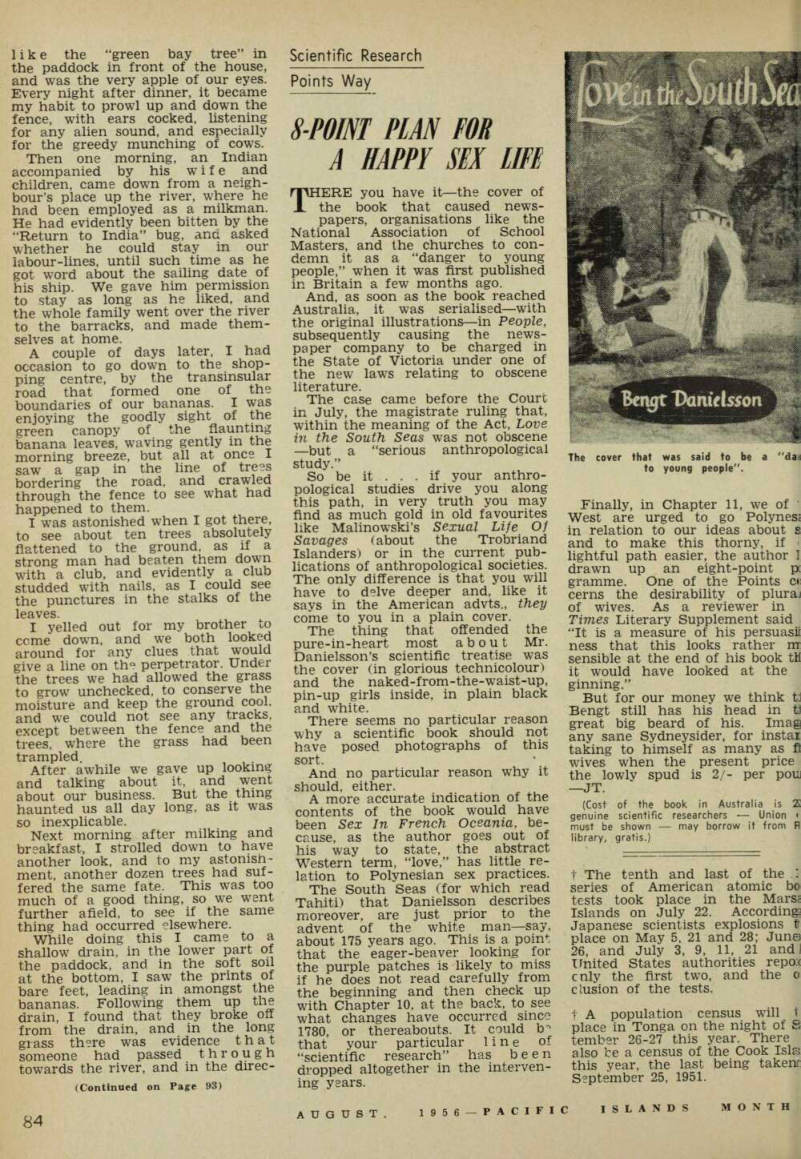
rERE you have it —the cover of the book that caused news papers, organisations like the National Association of School Masters, and the churches to con demn it as a “danger to young people,” when it was first published in Britain a few months ago.
And, as soon as the book reached Australia, it was serialised—with the original illustrations —in People, subsequently causing the news paper company to be charged in the State of Victoria under one of the new laws relating to obscene literature.
The case came before the Court in July, the magistrate ruling that, within the meaning of the Act, Love in the South Seas was not obscene —but a “serious anthropological study.”
So be it . . . if your anthro pological studies drive you along this path, in very truth you may find as much gold in old favourites like Malinowski’s Sexual Life Of Savages (about the Trobriand Islanders) or in the current pub lications of anthropological societies.
The only difference is that you will have to delve deeper and, like it says in the American advts., they come to you in a plain cover.
The thing that offended the pure-in-heart most about Mr.
Danielsson’s scientific treatise was the cover (in glorious technicolour) and the naked-from-the-waist-up, pin-up girls inside, in plain black and white.
There seems no particular reason why a scientific book should not have posed photographs of this sort.
And no particular reason why it should, either.
A more accurate indication of the contents of the book would have been Sex In French Oceania, be cause, as the author goes out of his way to state, the abstract Western term, “love,” has little re lation to Polynesian sex practices.
The South Seas (for which read Tahiti) that Danielsson describes moreover, are just prior to the advent of the white man—say, about 175 years ago. This is a point that the eager-beaver looking for the purple patches is likely to miss if he does not read carefully from the beginning and then check up with Chapter 10, at the back, to see what changes have occurred since 1780, or thereabouts. It could that your particular line of “scientific research” has been dropped altogether in the interven ing years.
Finally, in Chapter 11, we of West are urged to go Polynes? in relation to our ideas about s and to make this thorny, if lightful path easier, the author I drawn up an eight-point pc gramme. One of the Points c»; cerns the desirability of plurai of wives. As a reviewer in Times Literary Supplement said “It is a measure of his persuasii ness that this looks rather nr sensible at the end of his book tH it would have looked at the ginning.”
But for our money we think tJ Bengt still has his head in tt great big beard of his. Imag any sane Sydneysider, for instai taking to himself as many as fl wives when the present price the lowly spud is 2/- per poiu —JT. (Cost of the book in Australia is 2 genuine scientific researchers Union » must be shown may borrow it from R library, gratis.) t The tenth and last of the I series of American atomic be* tests took place in the Marss Islands on July 22. According Japanese scientists explosions tt place on May 5. 21 and 28; June 26, and July 3,9, 11, 21 andJ United States authorities repo:t cnly the first two, and the o elusion of the tests. t A population census will 1 place in Tonga on the night of S tember 26-27 this year. There also be a census of the Cook Isis this year, the last being takenr September 25, 1951.
The cover that was said to be a "dan to young people”.