Editorial. ..
pp. 19-21 · Read in the full issue
Colonel Nasser Drops The Cold War's
Riggest Rrick
OR 48 hours from Thursday, July 26, when the irresponsible [ Egyptian dictator, Nasser, seized i Suez Canal, the world teetered the edge of war. Since then, the ibabilities of international con t have slowly receded, although [ situation still is highly explosive, anwhile, a number of comforting tures have emerged. Here are le of them; ! Britain, after years of humilia i and shackled diplomacy, at \ has re-asserted herself as the tier of the Western Powers, i The British Commonwealth ions, and a large section of the stern nations, outraged beyond [urance by the Egyptian move, i supporting and applauding tain in a way not seen for many rs.
Britain has shaken off the iing-strings of Washington’s muous diplomacy, of which les has been the instrument, ring, since World War 11, been led by United States “anti fnialism” to abandon much of [ Asian Empire, and meekly to jpt the insults of various Asiatic ids which 50 years ago, honoured t obeyed the White Ensign, lain now has reached the point 10 further retreat.
Middle East events have thrown pear, revealing light not only n the politico-economic plight i which Britain and France B been driven by American anti- Wiialism, but also upon the suc which has attended Moscow’s 1 War operations in Southern i and the Middle East.
The whole of the Western Id —even the American section — realises that one further step twards by Britain means the ender of the Middle East oil- Is. as well as the Suez Canal, he Arab States; which in turn ns domination of that area by Communists, and the economic nation of Western Europe.
No single event in the Cold War greater significance for the th Pacific than this grab at the s Canal. If it should succeed, tern Europe will be hamstrung can give no further help to us i. The isolation of Western )pe means also the isolation of th America. Without Western )pe, America soon will be fight for her own survival against Reds. She would abandon the ish and French of the South fie and Southeast Asia to the .tics, just as she abandoned the ch of the East Indies to the mesians.
IT is vital to our survival here that Britain shall regain and hold the leadership of the Western Powers in international affairs, with the help of France and Western Germany and of the smaller Nordic nations. If that does not happen, we shall be doomed to World War 111 and Communism —either as the result of an explosion in the Middle East, or of an hysterical decision by America to put the issue to the test of nuclear war, before she is overwhelmed by a Moscow-dominated Asia.
A combination of Western Europe and North America, strong and alert, can hold off World War 111 indefinitely. But it must be a com bination directed by Britain. The combination which has been led by Washington diplomacy during the past ten years has brought us to the very edge of disaster.
The weaknesses of America > leadership have been exploited h cunning^ I®*’ 1 ®*’ With Me P histo Phelean Because of their idealistic viev;pomt in relation to nationalism, th Americans always have attacked th colonialism” of the Europeg n nations, and especially have they undermined British, French and Dutch influence in their various Step by step, the Western Europeans have been driven out of their colonies; and each step weakened their national economy which, over a couple of centuries, had been built upon trade with their overseas possessions.
This was exactly what the Musco vite Communists wanted: They believe that, short of a World War 111, the only way to overthrow Western civilisation and establish world Communism, is to overthrow the economic structure of the West, to destroy it from within. America forcing Britain, as the price of American help in the Cold War crisis, to withdraw from her Empire (India, Burma, Ceylon, Mesopo tamia, Palestine, Egypt, Soudan, and Jordan) caused enormous dis ruption of Britain’s economic organ isation, and brought about the
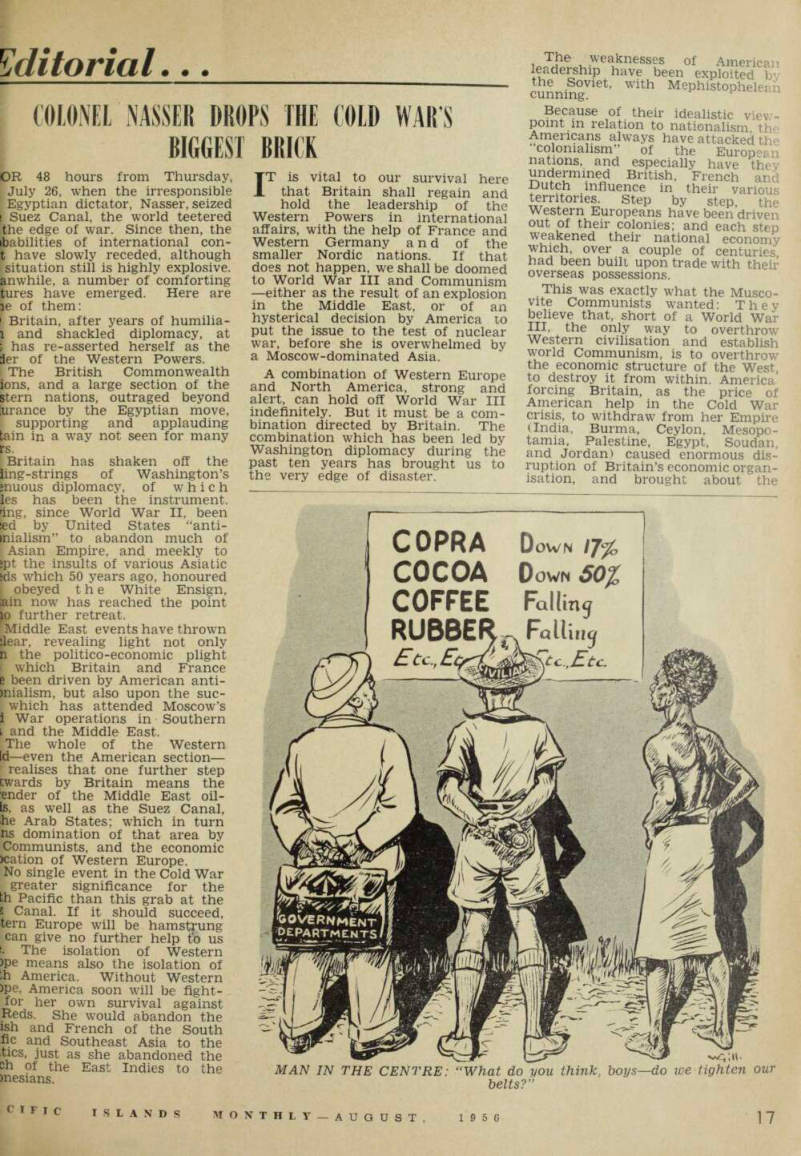
MATS! IN THE CENTRE: “What do you think, boys—do we tighten our belts?”
political and social troubles which have convulsed the Old Country in the last two years.
THE spear-point of Moscow's Cold War plan was directed at the Middle East. Russia, both Czarist and Communist, always has dreamed of a warm-water port, either in the Mediterranean or the Persian Gulf. Russia wants to dominate the Middle East, so as to deny the further use of the price less oilfields to Britain and Western Europe. She wants access to the Middle East, so as to disrupt the Suez Canal communications, and get an entry into Africa, where —
except for French North Africa — the vast colonial possessions of Britain and France are compar atively undisturbed.
Russia, while pulling ugly faces at America, cleverly allowed the Americans to do her dirty work for her—to push Britain and France out of much of Asia, and to bring them into conflict with the Arab States.
Had Britain and France been given the right kind of support from Washington, their retreat from Asia, while inevitable, would have been slow and orderly and would have added to their prestige as colonial Powers encouraging nation
hood. Instead of which it has H precipitate, calamitously expenu disorderly and of such a charae as to lower their prestige in a that does not bear thinking ab HAD it not been for Nasz blundering action in seizing?
Canal—taken in pique, bee: the Americans and British ref1 to finance his Aswan Dam —the: British collapse might have o soon. Britain’s international pre:: was very low; her domestic final condition deplorable. The o; flirting of Egypt with Moscow the last three months, the je© of B & K while Washington lenr its preoccupations to the condf of President Eisenhower’s he: was the measure of the West’sa gradation.
Suddenly, there came this ins«i challenge by one of Most, stupidest instruments. Withb few hours, all the Western Pox united in anger and indignatio a way not seen in internal affairs since the Japs strucl: Pearl Harbour, were lining u. deal with an insult that could: be ignored. True, it was on Gyppo insult, and there are: races more contemptible Gyppos; but Nasser evidf imagined he was speaking for Soviet—it was only a week on since Moscow’s mantle had officially thrown around Cairo.
Mr. Dulles did not approve—he from Washington to Londox great agitation, to insist that i ing be done to precipitate t appeasement, and more app: ment, seems to be the root cd policies.
But Mr. Dulles achieved no: —except to bring from Britain France a very clear indication: this was the end of the road! more retreat in the face of nati; i s m and anti-colonialism blundering idealism. Mr. I flew back again, to receive home truths from a gnmr Menzies, awaiting him in Was ton —and an indication that, ever Washington may think,; much of United States public op was supporting England.
There was no further sig. weakness in London. Iraq asto; ingly (in spite of the Baghdad . fell in behind Egypt. H merely ordered another ai. carrier to be got ready. T. snarled that every Egyptian give his last drop of blood, retiring from the Suez Cana.i answer came next day, whe9 French fleet was ordered 9 Toulon to join the British 1 Mediterranean.
Nasser saw the Soviet Ambaf three times in one day. H went coldly ahead with her to take the Canal out of Eg? hands, and into internationax trol—which meant, of course there was to be no further apq (Continued Column 3 Next Pas
(From Column 3 Opposite) iof the Arab States. Which it, also, that any Arab inter ice with Anglo-American oil er pipe-lines will bring prompt
j&tion.
die the British and French 5 move into position, Russia is ling noisily and gesturing ically, and giving a fine pre tion of the part of Egypt’s friend. But the West is not im ed. London and Paris know ir’s Grab was the last thing the ans wanted —they had Britain France on the run, and they nly to stand by and let bumble i Western diplomacy take its e, and the Middle East was I. * * * is The Grand Showdown. The ;nge is straight up to the t. If it does not support Britain and France will re to the dominance of the Middle If it does support Egypt, it it certainly will have to face United States and the—at nt —very silent Western Ger i Indications are that there >e very much talk, but no fire, while, Britains’ ten years’ re will have ended, and Britain’s f ul place in world affairs will gained. iser’s Grab may yet prove to been the turning-point in the War. is said that B & K are still ig and back-slapping. But it safe bet that there is nothing B & K would like better than locked un in a sound-nroof alone with a knout and Mr r.