Inisterial Sensitivity To
pp. 151-153 · Read in the full issue
[?]k Islands Before Asia
Adverse Newspaper Publicity
By J. P. Shortall, who recently spent 3 months in the Cooks.
ERSONS interested in Cook Islands affairs were treated to an extraordinary display of nisterial sensitivity and anger re itly, following the appearance of ieries of signed articles by a staff iter in the Auckland Star. rhe articles were factual, well cumented, and in fact were based •gely on the recently published ace-Belshaw report on the Cook ands. They were written in mod ite language with no tendency latever towards sensationalism. rh° writer’s sin, however, seems have been that he gave publicity some of the darker facets of K)ks Islands affairs.
To residents of the Cooks, who xee with almost all that was ritten, it is a mystery why the inister of Island Territories took ly public notice of the articles at immediately following the appear ice of the articles a long and ,stlv telegram was despatched to arotonga by the Minister. The av Cook Islands Review was on jint of publication there, and the ilegram appeared as a special sup iement occupying almost two of its a, fhe inference to be drawn from iis lengthy outburst can only be lat (a) the Minister was annoyed iat the Stace-Belshaw Report was utspoken where criticism (as well s praise) was called for; and (b) hat he was even more annoyed hat the Report (which was never Tinted, but available only in type n-itten form) was given publicity n a leading New Zealand daily lewspaper. , , .
Additional to the lengthy state aent issued by the Minister—and a übsequent lengthy statement fGl owing comment on the first by the Auckland Star, the Minister m itructed the Administration m Rarotonga to engage a local pro
'essional photographer to cover
Rarotonga.
This photographer was busy for i week and eventually delivered nany dozens of photographs which urere rushed off to Wellington by first mail. How they are to be used Is not yet clear, but a re-issue of the Department’s 1950 illustrated booklet on the Group is thought likely. The Minister took particular ex ception to a photo of a Cook Islands house which appeared with one article in the Star.
His comments on this photo of a very typical Cook Islands house — hundreds could be found in far
worse condition at Rarotonga— surely indicates that he is unaware of just how bad the housing situa tio Star articles did not imply that the present Government was responsible for all the ills of the Group, but the Minister implied that the Stace-Belshaw Report was now “being used by ill-disp° s -d per sons as a weapon to discredit the New Zealand Government m the eyes of the people of the Cook Islands.”
ONE aspect of Cl affairs that the Star writer barely mentioned was the medical situation, by far the worst blot in the Cook Islands record.
While it exists there will be many who agree with the »iar that the whole of New Zealandls £l-million annual contribution to the Colombo Plan should be diverted to her own Territory.
At the present time there is a mobile mass X-ray survey being carried out in the Cooks. Everyone associated with it is emphatic that it is an utter waste of money unless immediately followed up by the necessary drugs and equipment to treat sufferers so diagnosed.
There is no such follow-up and no funds have been made avail able.
At the present moment there are 90 cases of TB awaiting treatment on Aitutaki alone. Of these, half are dangerous, active cases, living in crowded conditions, inevitably infecting others. There is—or was in June—a waiting list of over 200 cases to enter the only sanatorium, at Rarotonga. Some have waited 2 years. Some have died.
But even if they could get into the sanatorium there would be no medical supplies available to treat
I*®”?,®‘ present. So the mass 3 n.LH! ? ,? oes on its way round t Glo^J :ellmg People they have 1 —which may worry a few of the effect ath bUt Will have oth pjj l6 medical department in t Cooks freely admits that when tl unit makes its second round in year or so, as it normally shoul few will turn up for X-rays. Wh is the use, if nothing can be doi for a cure? . also agreed that the housir situation for home treatment satisfactory in only about 2 per c Q n of all cases diagnosed.
The Minister must be aware this situation. It has been ful surveyed by eminent specialis from New Zealand—but there sharp resentment when such sut jects are brought to the notice the New Zealand public.
Facing Up To Responsibilitie
On the same subject we hav another opinion, from anothe writer on Islands affairs: UNLIKE his predecessors, the N Minister, Mr. Macdonald, doughty fighter at all times, di not take the Star’s criticism lyin down. On the contrary, he replie vigorously to his critics, and showe hew the NZ Government is facin up to its responsibilities in the Coo!
Group, although the administrator of the Territory, in any circum stances, is a most uneconomic pro position.
IN the final analysis, the Cool- Islanders can enjoy greater prosperity and a higher standarc of living only if their products— oranges, tomatoes, some bananas and similar perishable produce—can be conveyed quickly and regularly to market.
That means an expensive ship ping service—so expensive that pri vate enterprise will not provide it without a heavy subsidy. The Cook Islands trade alone is not sufficient to pay for it.
The NZ Government, for many years, has kept the old motorship Maui Pomare in this service; and now, rather than face the long de lay and crippling cost of a new ship, contemplates an expensive renovation of the Maui.
Cook Islands producers, and local critics and story-hunting journalists all howl about this, and attack the Government. The Minister, quite aptly asks what else the Government can do.
New Zealand already spends on the scattered, lightly-populated archipelago far more than the archipelago is worth, from the NZ taxpayers’ point of view.
The same problem crops up in many Pacific Islands administra tions—the British Solomons and the Gilbert and Ellice chain are out standing examples. What is there
:the mere possession of such Terri es to justify the administering intry spending a lot of its money shipping services and problem ;al development? ■he flimsy little houses, limited - and restricted life of the mders may appear as poverty in iparison with life as lived in stralia or New Zealand. But, ually, these Islanders live a very ipy, healthy and carefree life, at ninimum of cost; and they will itinue to do so while they are ; alone. If they are to change sir living standards, they must iduce something new and valu e, to meet the heavy costs of ter houses and food, better ad listration and, above all, better nsportation.
The only obvious inference that i be drawn from the divergence opinion expressed in the two ides above is that having Islands ritories is like having children— \h sweet sorrow. — Ed. PIM).
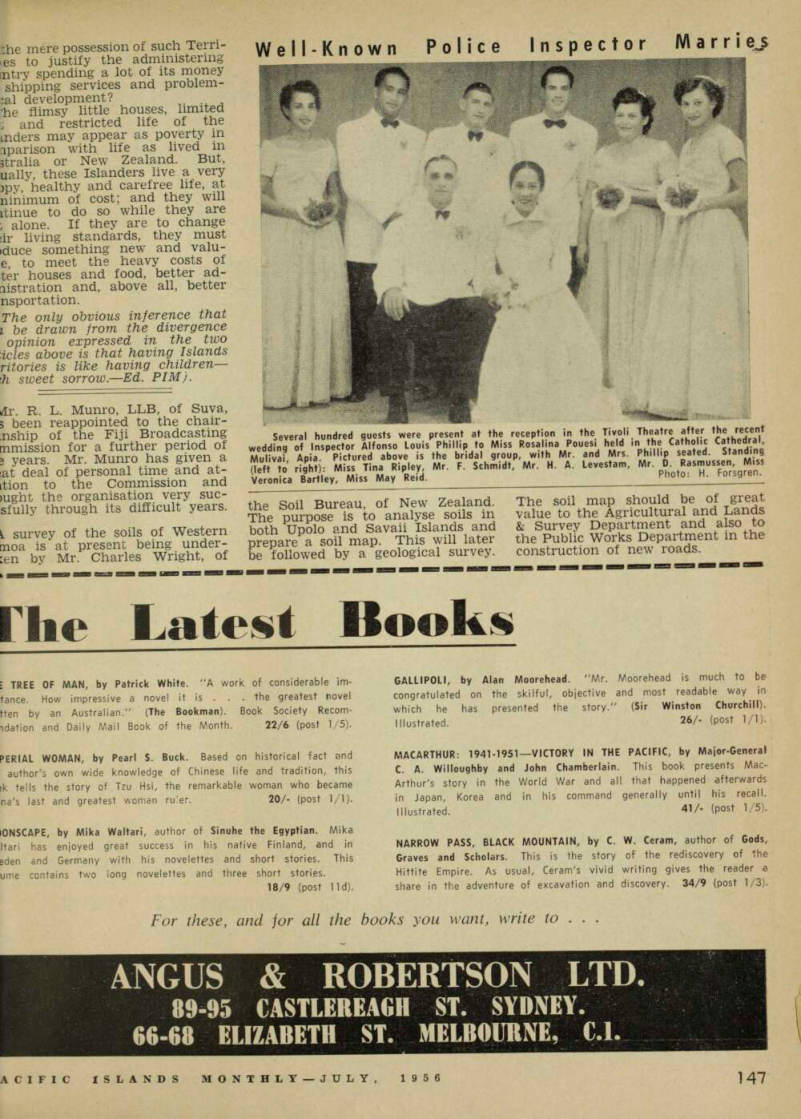
Av. R. L. Munro, LLB, of Suva, 5 been reappointed to the chair - ,nship of the Fiji Broadcasting tnmission for a further period of 5 years. Mr. Munro has given a iat deal of personal time and at ition to the Commission and »ught the organisation very suc sfully through its difficult years. i survey of the soils of Western moa is at present being under :en by Mr. Charles Wright, of
the Soil Bureau, of New Zealand.
The purpose is to analyse soils in both Upolo and Savaii Islands and prepare a soil map. This will later be followed by a geological survey.
Jhe^oi^map^ should he of Bie|t
SS Kffithe
construction of new roads.