tropicalities
pp. 87-88 · Read in the full issue
Magazine Section
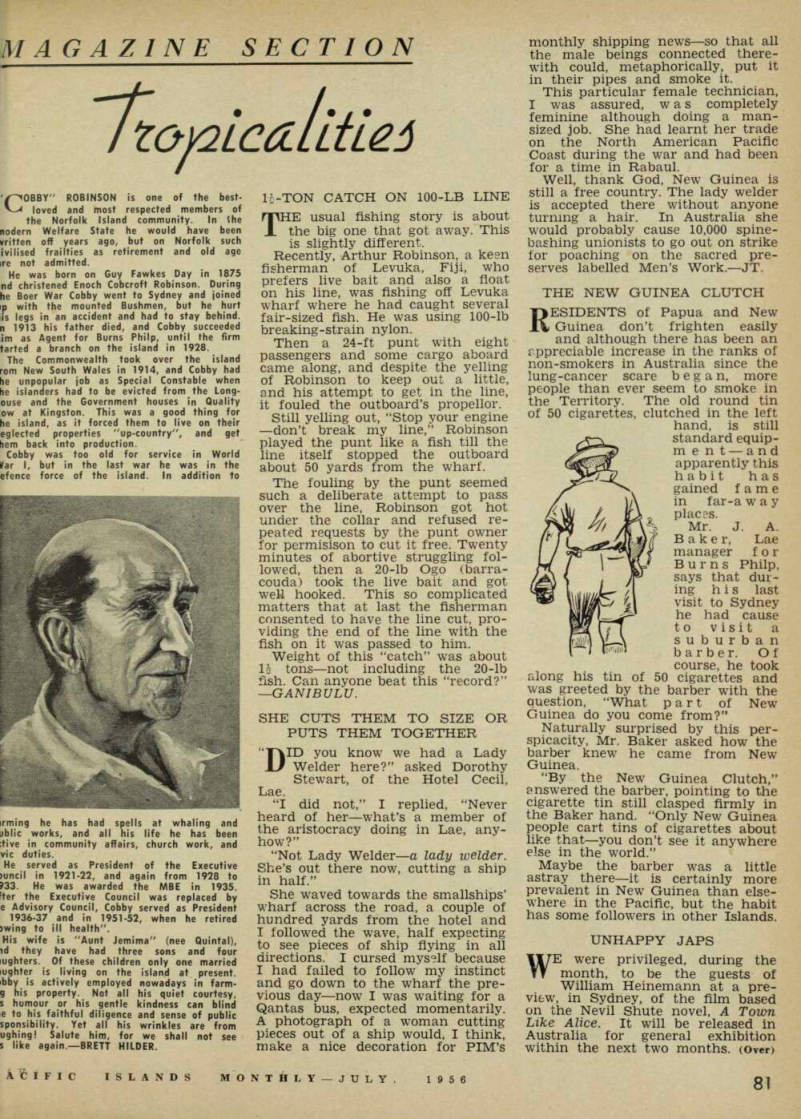
COBBY" ROBINSON is one of the best loved and most respected members of the Norfolk Island community. In (he nodern Welfare State he would have been vritten off years ago, but on Norfolk such ivilised frailties as retirement and old age ire not admitted.
He was born on Guy Fawkes Day in 1875 nd christened Enoch Cobcroft Robinson. During he Boer War Cobby went to Sydney and joined ip with the mounted Bushmen, but he hurt is legs in an accident and had to stay behind, n 1913 his father died, and Cobby succeeded im as Agent for Burns Philp, until the firm tarted a branch on the island in 1928.
The Commonwealth took over the island rom New South Wales in 1914, and Cobby had he unpopular job as Special Constable when he islanders had to be evicted from the Long ouse and the Government houses in Quality ow at Kingston. This was a good thing for he island, as it forced them to live on their eglected properties "up-country", and get hem back into production.
Cobby was too old for service in World far I, but in the last war he was in the efence force of the island. In addition to
irming he has had spells at whaling and jblic works, and all his life he has been ;tive in community affairs, church work, and vie duties.
He served as President of the Executive >uncil in 1921-22, and again from 1928 to *33. He was awarded the MBE in 1935. fter the Executive Council was replaced by e Advisory Council, Cobby served as President 1936-37 and in 1951-52, when he retired )wing to ill health".
His wife is "Aunt Jemima" (nee Quintal), id they have had three sons and four lughters. Of these children only one married lughter is living on the island at present, ibby is actively employed nowadays in farm g his property. Not all his quiet courtesy, s humour or his gentle kindness can blind e to his faithful diligence and sense of public sponsibility. Yet all his wrinkles are from ughing! Salute him, for we shall not see s like again—BßETT HILDER.
U-Ton Catch On 100-Lb Line
THE usual fishing story is about the big one that got away. This is slightly different.
Recently, Arthur Robinson, a keen fisherman of Levuka, Fiji, who prefers live bait and also a float on his line, was fishing off Levuka wharf where he had caught several fair-sized fish. He was using 100-lb breaking-strain nylon.
Then a 24-ft punt with eight passengers and some cargo aboard came along, and despite the yelling of Robinson to keep out a little, and his attempt to get in the line, it fouled the outboard’s propeller.
Still yelling out, “Stop your engine —don’t break my line,” Robinson played the punt like a fish till the line itself stopped the outboard about 50 yards from the wharf.
The fouling by the punt seemed such a deliberate attempt to pass over the line, Robinson got hot under the collar and refused re peated requests by the punt owner for permisison to cut it free. Twenty minutes of abortive struggling fol lowed, then a 20-lb Ogo (barra couda) took the live bait and got weU hooked. This so complicated matters that at last the fisherman consented to have the line cut, pro viding the end of the line with the fish on it was passed to him.
Weight of this “catch” was about Ih tons—not including the 20-lb fish. Can anyone beat this “record?”
—Ganibulu.
She Cuts Them To Size Or
Puts Them Together
“■pvlD you know we had a Lady U Welder here?” asked Dorothy Stewart, of the Hotel Cecil, Lae.
“I did not,” I replied, “Never heard of her —what’s a member of the aristocracy doing in Lae, any how?”
“Not Lady Welder —a lady welder.
She’s out there now, cutting a ship in half.”
She waved towards the smallships’ wharf across the road, a couple of hundred yards from the hotel and I followed the wave, half expecting to see pieces of ship flying in all directions. I cursed myself because I had failed to follow my instinct and go down to the wharf the pre vious day—now I was waiting for a Qantas bus, expected momentarily.
A photograph of a woman cutting pieces out of a ship would, I think, make a nice decoration for PlM’s
monthly shipping news —so that all the male beings connected there with could, metaphorically, put it in their pipes and smoke it.
This particular female technician, I was assured, was completely feminine although doing a man sized job. She had learnt her trade on the North American Pacific Coast during the war and had been for a time in Rabaul.
Well, thank God, New Guinea is still a free country. The lady welder is accepted there without anyone turning a hair. In Australia she would probably cause 10,000 spine bashing unionists to go out on strike for poaching on the sacred pre serves labelled Men’s Work.—JT.
The New Guinea Clutch
RESIDENTS of Papua and New Guinea don’t frighten easily and although there has been an appreciable increase in the ranks of non-smokers in Australia since the lung-cancer scare began, more people than ever seem to smoke in the Territory. The old round tin of 50 cigarettes, clutched in the left
hand, is still standard equip ment and apparently this habit has gained fame in far-a way places.
Mr. J. A.
Baker, Lae manager for Burns Philp, says that dur ing hi s last visit to Sydney he had cause to visit a suburban barber. Of
course, he took along his tin of 50 cigarettes and was greeted by the barber with the question, “What part of New Guinea do you come from?”
Naturally surprised by this per spicacity, Mr. Baker asked how the barber knew he came from New Guinea.
“By the New Guinea Clutch,” answered the barber, pointing to the cigarette tin still clasped firmly in the Baker hand. “Only New Guinea people cart tins of cigarettes about like that—you don’t see it anywhere else in the world.”
Maybe the barber was a little astray there —it is certainly more prevalent in New Guinea than else where in the Pacific, but the habit has some followers in other Islands.
Unhappy Japs
WE were privileged, during the month, to be the guests of William Heinemann at a pre view, in Sydney, of the film based on the Nevil Shute novel, A Town Like Alice. It will be released in Australia for general exhibition within the next two months. (Over)
This British production, without benefit of technicolour or wide screens, grips the interest throughout the two hours of its screening— proving once more that in the movie-making kingdom, the crown has now passed from the Americans to the British.
It was this film that was banned at the recent Cannes Film Festival, for fear of hurting the feelings of the Japanese. The Japanese occupation of Malaya—which forms the basis of the film—is, as a matter of strict truth, if not exactly played d 9 wn, ‘hen treated entirely without bias or emotion and if anything emerges from the picture it is that even in war there were some human, and even kindly, Japanese.
Readers who liked the book will probably be disappointed that almost the entire film is based on that part of the story which took place in Malaya and that only in the closing episodes does the scene shift to Alice Springs. So, to this extent, it can be said that the film is “not like the book” and does not live up to its title. It will be remembered that the title came from the fact that Jean, the heroine, who had been captured by the Japanese in Malaya, went to Australia after the war, there to meet the Australian POW who had befriended her and to try to create, with a legacy that had been left to her, another town “like Alice.”