The Fead Islands
p. 81 · Read in the full issue
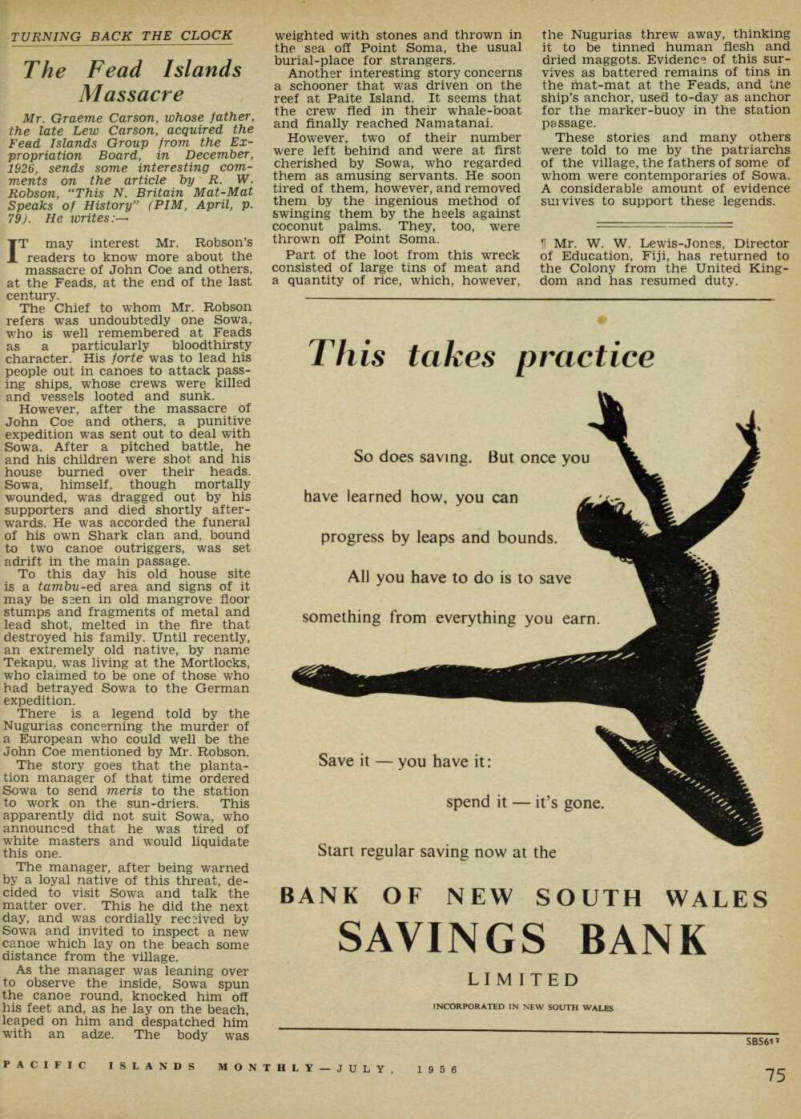
Turning Back The Clock
The Fead Islands Massacre
Mr. Graeme Carson, whose father, the late Lew Carson, acquired the Fead Islands Group from the Ex propriation Board, in December, 1926, sends some interesting com ments on the article by R. W.
Robson, “This N. Britain Mat-Mat Speaks of History” (PIM, April, p. 79). He writes:— IT may interest Mr. Robson’s readers to know more about the massacre of John Coe and others, at the Feads, at the end of the last century.
The Chief to whom Mr. Robson refers was undoubtedly one Sowa, who is well remembered at Feads as a particularly bloodthirsty character. His forte was to lead his people out in canoes to attack pass ing ships, whose crews were killed and vessels looted and sunk.
However, after the massacre of John Coe and others, a punitive expedition was sent out to deal with Sowa. After a pitched battle, he and his children were shot and his house burned over their heads.
Sowa, himself, though mortally wounded, was dragged out by his supporters and died shortly after wards. He was accorded the funeral of his own Shark clan and, bound to two canoe outriggers, was set adrift in the main passage.
To this day his old house site is a tambu-e d area and signs of it may be seen in old mangrove floor stumps and fragments of metal and lead shot, melted in the fire that destroyed his family. Until recently, an extremely old native, by name Tekapu, was living at the Mortlocks, who claimed to be one of those who had betrayed Sowa to the German expedition.
There is a legend told by the Nugurias concerning the murder of a European who could well be the John Coe mentioned by Mr. Robson.
The story goes that the planta tion manager of that time ordered Sowa to send meris to the station to work on the sun-driers. This apparently did not suit Sowa, who announced that he was tired of white masters and would liquidate this one.
The manager, after being warned by a loyal native of this threat, de cided to visit Sowa and talk the matter over. This he did the next day, and was cordially received by Sowa and invited to inspect a new canoe which lay on the beach some distance from the village.
As the manager was leaning over to observe the inside, Sowa spun the canoe round, knocked him off his feet and, as he lay on the beach, leaped on him and despatched him with an adze. The body was
weighted with stones and thrown in the sea off Point Soma, the usual burial-place for strangers.
Another interesting story concerns a schooner that was driven on the reef at Paite Island. It seems that the crew fled in their whale-boat and finally reached Namatanai.
However, two of their number were left behind and were at first cherished by Sowa, who regarded them as amusing servants. He soon tired of them, however, and removed them by the ingenious method of swinging them by the heels against coconut palms. They, too, were thrown off Point Soma.
Part of the loot from this wreck consisted of large tins of meat and a quantity of rice, which, however,
the Nugurias threw away, thinking it to be tinned human flesh and dried maggots. Evidence of this sur vives as battered remains of tins in the mat-mat at the Feads, and tne ship’s anchor, used to-day as anchor for the marker-buoy in the station passage.
These stories and many others were told to me by the patriarchs of the village, the fathers of some of whom were contemporaries of Sowa.
A considerable amount of evidence survives to support these legends.
II Mr. W. W. Lewis-Jones, Director of Education, Fiji, has returned to the Colony from the United King dom and has resumed duty.